Floor plan

Time and place18th-century Italy

18th-century Italy

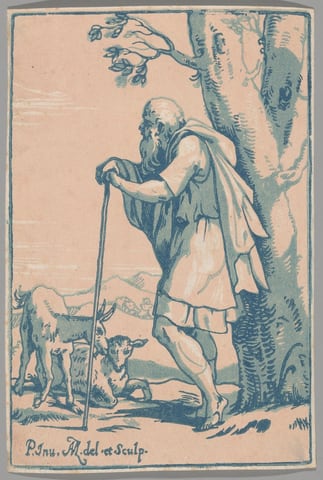
A work made of chiaroscuro woodcut, from three blocks in pink, dark blue, and light blue, on cream laid paper.
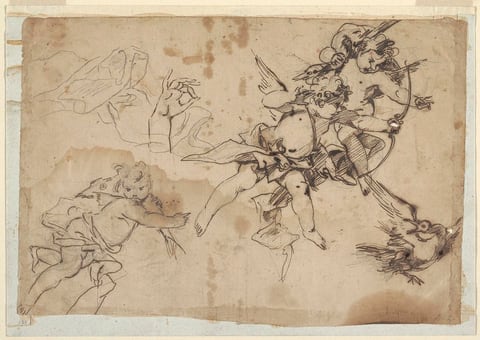
STUDY FOR A PAINTING ON THEME OF CALLISTO
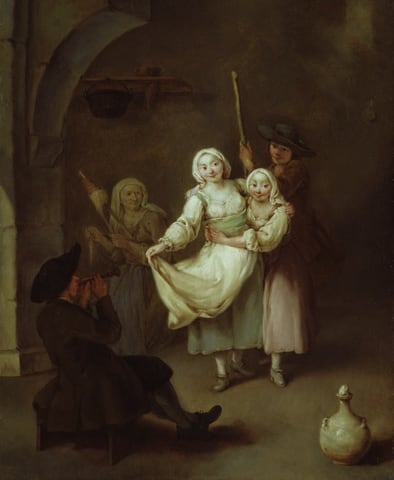
A work made of oil on canvas.
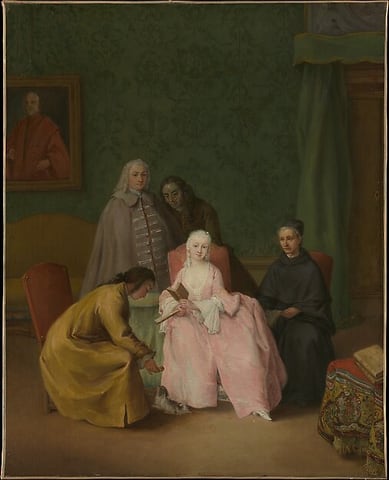
The Visit, by Pietro Longhi, 1746
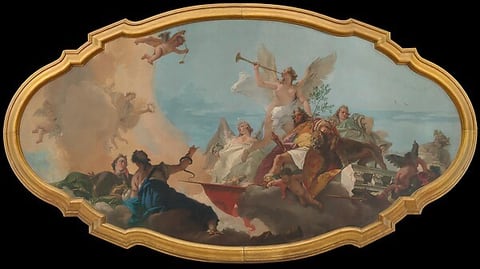
The Glorification of the Barbaro Family, by Giovanni Battista Tiepolo, ca. 1750
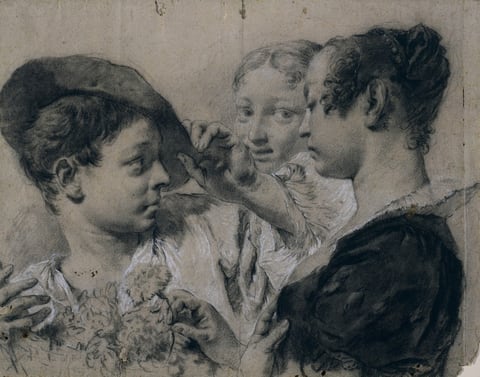
A Young Woman Buying a Pink from a Young Man, by Giovanni Battista Piazzetta, c. 1740

The works in this room are listed below.

Works in this room

Works made in Italy in the 18th century.

First room, north wall

  1. A work made of chiaroscuro woodcut, from three blocks in pink, dark blue, and light blue, on cream laid paper.
    The Old ShepherdConte Antonio Maria Zanetti, the Elder, 1722Courtesy of the Art Institute of Chicago
  2. STUDY FOR A PAINTING ON THEME OF CALLISTO
    Study for a Painting on Theme of CallistoFilippo Falciatore, ca. 1750Courtesy of Cooper Hewitt, Smithsonian Design Museum
  3. A work made of oil on canvas.
    The DancePietro Longhi, c. 1750Courtesy of the Art Institute of Chicago
  4. The Visit, by Pietro Longhi, 1746
    The VisitPietro Longhi, 1746Courtesy of The Metropolitan Museum of Art

First room, south wall

  1. The Glorification of the Barbaro Family, by Giovanni Battista Tiepolo, ca. 1750
    The Glorification of the Barbaro FamilyGiovanni Battista Tiepolo, ca. 1750Courtesy of The Metropolitan Museum of Art
  2. A Young Woman Buying a Pink from a Young Man, by Giovanni Battista Piazzetta, c. 1740
    A Young Woman Buying a Pink from a Young ManGiovanni Battista Piazzetta, c. 1740Courtesy of the Cleveland Museum of Art

Second room, south wall
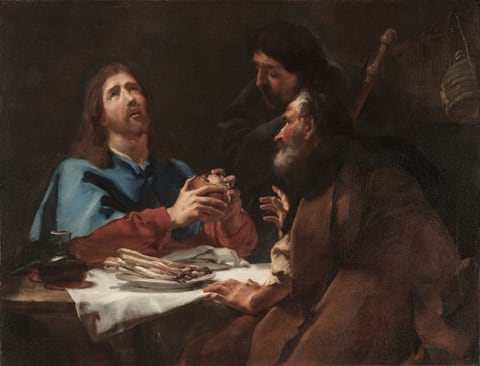
  1. The Supper at Emmaus, by Giovanni Battista Piazzetta, c. 1720
    The Supper at EmmausGiovanni Battista Piazzetta, c. 1720Courtesy of the Cleveland Museum of Art
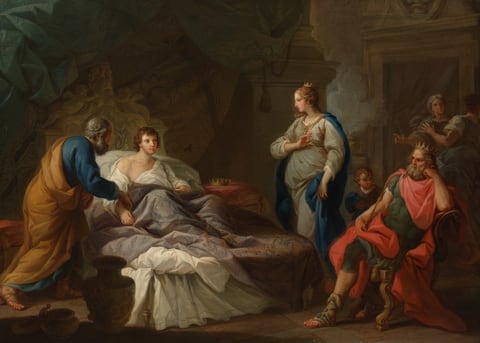
  2. A work made of oil on canvas.
    Antiochus Yearning for StratoniceStefano Pozzi, c. 1740Courtesy of the Art Institute of Chicago
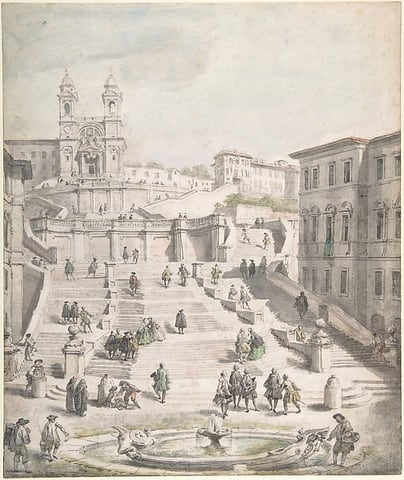
  3. Scalinata della Trinità dei Monti, by Giovanni Paolo Panini, ca. 1756–58
    Scalinata della Trinità dei MontiGiovanni Paolo Panini, ca. 1756–58Courtesy of The Metropolitan Museum of Art

Second room, north wall
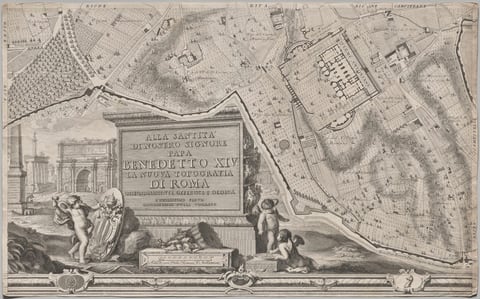
  1. Nuova pianta di Roma data in luce da Giambattista Nolli l’anno MDCCXLVII, known as La Pianta Grande di Roma, by Giovanni Battista Nolli, 1748
    Nuova pianta di Roma data in luce da Giambattista Nolli l’anno MDCCXLVII, known as La Pianta Grande di RomaGiovanni Battista Nolli, 1748Courtesy of the Cleveland Museum of Art
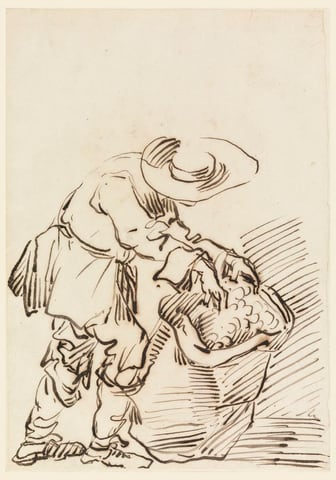
  2. WORKING PEASANT
    Working PeasantCarlo Marchionni, 1728–78Courtesy of Cooper Hewitt, Smithsonian Design Museum
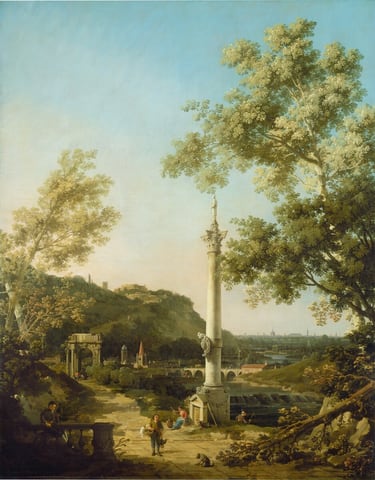
  3. We look slightly down across a sun-drenched plaza with people scattered among ruins, buildings, and around a free-standing column in this vertical landscape painting. The people we can see have light skin. Towering trees with celery, sage, and forest-green leaves frame a small plaza paved with flax-colored stones. A tree to our right almost reaches the top of the painting, and a shorter tree in front of it has toppled onto the plaza. To our left, in the lower corner, a man sits behind a shadowy balustrade, looking down. In the lower center of the painting, a man walks toward us, holding a basket over one arm and dead poultry in the other hand, and a dog sits nearby. Slightly farther back is a tall stone column with a door in its base and a statue on top. A woman wearing a red shirt and blue skirt sits on a step in front of the door. Along the left side, the plaza gives way to a tree-lined, dirt road that meanders toward a stone arch in the middle distance, and to a cluster of low buildings beyond. Two towers catch the light, one with a slate-blue dome and the other with a peach-colored steeple. Farther back from the buildings is a dark line of trees at the base of a steep green hill dotted with groves of trees, which rises high over the plaza below. Another building complex, glowing in warm tones of straw yellow, sits at its top. Small dots of red, white, and blue suggest a handful of people making their way up the hill’s wide path. A river with moss-green water pouring over a dam extends from the lower right corner into the distance along the right edge of the painting. Near the column, a man fishes at the water’s edge. The water winds back to a row of silvery-gray buildings in the far distance. Several people in red, yellow, or white, tiny in scale, dot the riverbanks and cross the bridge. A screen of thin, pale pink clouds float across the light blue sky.
    English Landscape Capriccio with a ColumnCanaletto, c. 1754Courtesy National Gallery of Art, Washington

Third room, north wall
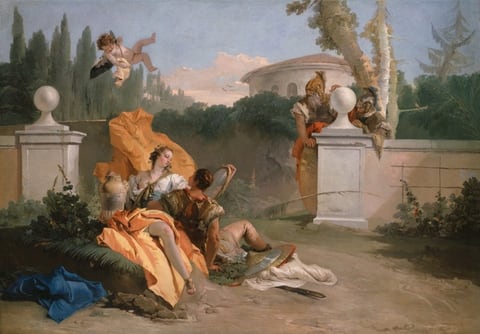
  1. A work made of oil on canvas.
    Rinaldo and Armida in Her GardenGiovanni Battista Tiepolo, c. 1742–45Courtesy of the Art Institute of Chicago
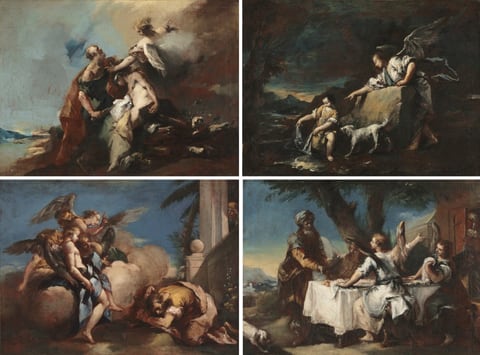
  2. The Sacrifice of Isaac, Tobias and the Angel, The Angels Appearing to Abraham, Abraham Welcoming the Three Angels (painting series), by Francesco Guardi, 1750s
    The Sacrifice of Isaac, Tobias and the Angel, The Angels Appearing to Abraham, Abraham Welcoming the Three Angels (painting series)Francesco Guardi, 1750sCourtesy of the Cleveland Museum of Art

Third room, south wall
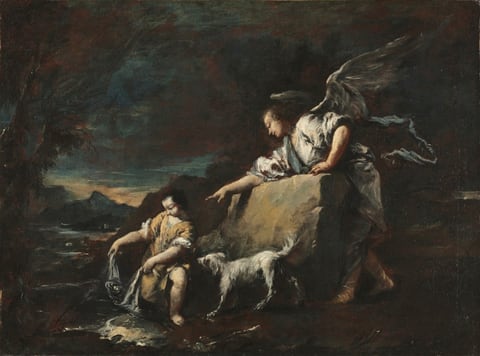
  1. Tobias and the Angel, by Francesco Guardi, 1750s
    Tobias and the AngelFrancesco Guardi, 1750sCourtesy of the Cleveland Museum of Art
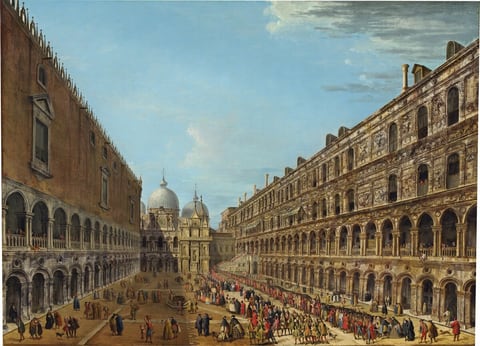
  2. This painting depicts a square seen from above, surrounded by elegant architectural structures. On the left side, there is a large building with a red-brown facade and arched white windows with columns. On the right, there is an ornate off-white structure with arches and detailed stonework. Both of these long buildings stretch from the sides of the painting towards the center, where they converge at a gray building with tall spires and large blue domes behind it. In the square there are countless people in colorful attire, wearing shades of pink, red, blue, green, yellow, black, and blue. There are men, women, and children, and those with visible faces all appear to have light skin. Some wear white masks with bird-like noses. On the right, there is a long line of people engaging in a procession or gathering. People also line the windows of the two buildings on either side of the square. The painting is incredibly detailed, capturing architectural elements and the bustling crowd. The color palette features earthy tones for the architecture and vibrant colors for the people, all set below a pale blue sky with a few white-and-gray clouds.
    Procession in the Courtyard of the Ducal Palace, VeniceAntonio Joli, 1742 or afterCourtesy National Gallery of Art, Washington