Floor plan

Time and place18th-century France

18th-century France

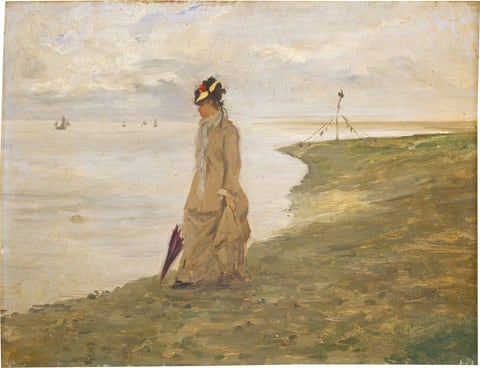
This painting shows a woman in a tan dress and a tan hat with red flowers, walking on a grassy shoreline, holding a dark purple umbrella. The woman is positioned in the center of the painting, and she faces the left, standing at the edge of the water, looking downward. She has light skin and dark hair put up under her hat. The horizon is high in the painting, where the blue-gray sky and water meet. Small ships are visible in the distance, floating on the horizon. On the right side of the painting, the yellow and green ground curves, sloping slightly downward to meet the water. The painting has loose, visible brushstrokes.
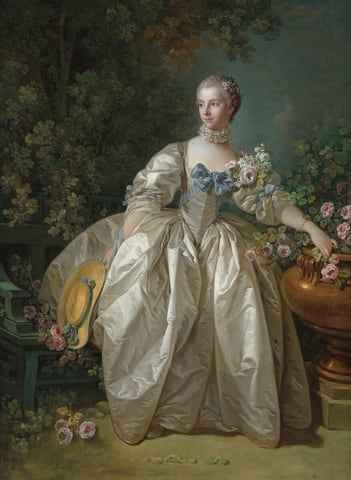
A young woman with light skin stands in a garden, wearing a voluminous, full-length, silvery, shimmering gown in this vertical portrait painting. Her body faces us, as she looks into the distance to our left. She has rosy cheeks, gray-green eyes under gently arched, light brown brows, and her coral-pink, thin, closed lips curve in a slight smile. Her ash-brown hair is pulled back and adorned with tiny shell-pink and azure-blue flowers along the left side top of head, to our right. A pleated lace ruffle encircles her smooth neck. Her gown is parchment white where the light glints off the stiff fabric and is silvery gray in the shadows, creating a silk-like sheen. The dress is cut low across the chest, fits tightly around her narrow waist, and has puffy sleeves tied at the elbows with topaz-blue bows. Another blue bow is tied at her chest, and the ends wrap around her back along her waist. A corsage at her left shoulder, to our right, is a profusion of white flowers around a pale pink rose. In her other hand, to our left, she holds a straw hat with a shallow crown and a wide brim, trimmed with sky-blue ribbon. The arm holding the hat is nearly engulfed in the deep folds of her full skirt. She holds a pink rose in her other hand, which rests on the lip of a shiny, copper-colored urn filled with pink flowers and delicate green leaves. On that wrist she wears a bracelet with four strands of white pearls holding a cameo. She stands on a pale, dirt ground. A teal-blue bench in the lower left corner of the painting is tucked into sage-green shrubbery. Sprigs of pink roses are strewn across the seat and on the ground. The woman is framed to either side with olive and celery-green trees and vegetation, which blend into the hazy distance beyond her head.
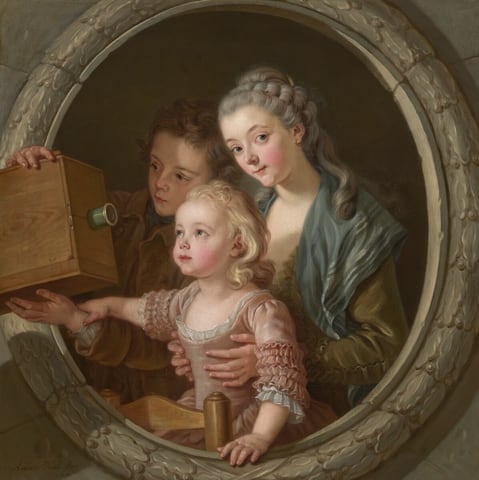
A young woman and two children are shown from the waist up through an oval, stone opening, holding and looking at a wooden box with a lens protruding from one side in this square painting. All three people have pale skin with rosy cheeks. To our right, the young woman’s body is angled to our left as she braces the torso of a young girl. The young woman looks at us from the corners of her sage-green eyes, under lifted brows. Her small, pink mouth is pursed in a slight smile, and she has a faint dimple in her rounded chin. Her heather-gray hair is partially plaited over the crown of her head, and long curls fall over her shoulders. She wears a spruce-blue shawl over the shoulders of her low-cut, olive-green dress. The child she braces has chubby cheeks, and her wavy blond hair is brushed back from her forehead and falls loosely to her shoulders. She wears a blush-pink dress with ruffles on the half-length sleeves and gossamer-white trim around the neckline and cuffs. The top and side rails of a wooden, ladderback chair up against the inside of the opening suggests she stands or kneels on a backward-facing chair. She rests her left hand on the edge of the stone opening and her other hand on the wrist of the boy standing close behind her. Mostly in the shadow behind the others, the boy has small, pointed features and short, curly, sable-brown hair. He wears a tan coat, and a muted blue scarf is tied at his throat. The two children gaze at the wooden box the boy holds, which is about the size of a toaster. A short, cylindrical, brass-lined lens pokes out of the center of the side facing the trio. The oval opening through which we see them is carved on our side with stylized leaves and berries, and the wall around it is the same elephant gray as the carvings. The girl and the box cast a shadow across the opening. The artist signed and dated the painting in the lower left corner, “Amedee Can Loo./1764.”
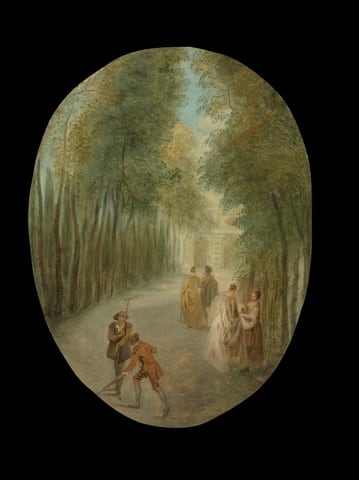
Spring, by Jean-Baptiste Pater, c. 1720–36
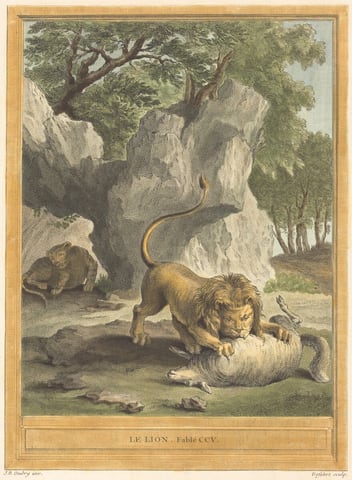
This is a drawing of a lion in a forested rocky landscape. The lion is seen standing over a defeated animal. In the background, a forest with dense trees frames the scene. One monkey is visible among the rocks watching the lion. The setting conveys a wild, rugged terrain with rocky formations and scattered vegetation. Light and shadow emphasize textures in the lion's mane and the surrounding rocks. The composition focuses on the lion and its prey.
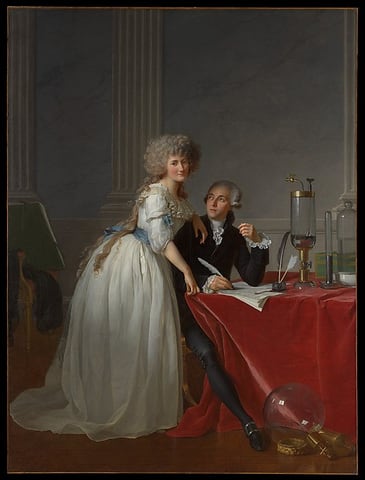
Antoine Laurent Lavoisier (1743–1794) and Marie Anne Lavoisier (Marie Anne Pierrette Paulze, 1758–1836), by Jacques-Louis David, 1788
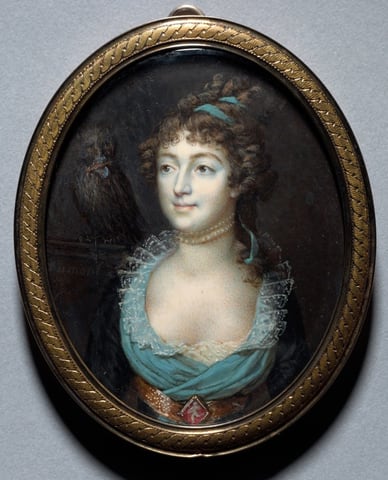
Portrait of Mademoiselle Marie-Anne Adelaide Le Normand, by François Dumont, c. 1793

The works in this room are listed below.

Works in this room

Works made in France in the 18th century.

Section 1, north wall

  1. This painting shows a woman in a tan dress and a tan hat with red flowers, walking on a grassy shoreline, holding a dark purple umbrella. The woman is positioned in the center of the painting, and she faces the left, standing at the edge of the water, looking downward. She has light skin and dark hair put up under her hat. The horizon is high in the painting, where the blue-gray sky and water meet. Small ships are visible in the distance, floating on the horizon. On the right side of the painting, the yellow and green ground curves, sloping slightly downward to meet the water. The painting has loose, visible brushstrokes.
    Woman by the SeasideUnrecorded French maker, 19th centuryCourtesy National Gallery of Art, Washington
  2. A young woman with light skin stands in a garden, wearing a voluminous, full-length, silvery, shimmering gown in this vertical portrait painting. Her body faces us, as she looks into the distance to our left. She has rosy cheeks, gray-green eyes under gently arched, light brown brows, and her coral-pink, thin, closed lips curve in a slight smile. Her ash-brown hair is pulled back and adorned with tiny shell-pink and azure-blue flowers along the left side top of head, to our right. A pleated lace ruffle encircles her smooth neck. Her gown is parchment white where the light glints off the stiff fabric and is silvery gray in the shadows, creating a silk-like sheen. The dress is cut low across the chest, fits tightly around her narrow waist, and has puffy sleeves tied at the elbows with topaz-blue bows. Another blue bow is tied at her chest, and the ends wrap around her back along her waist. A corsage at her left shoulder, to our right, is a profusion of white flowers around a pale pink rose. In her other hand, to our left, she holds a straw hat with a shallow crown and a wide brim, trimmed with sky-blue ribbon. The arm holding the hat is nearly engulfed in the deep folds of her full skirt. She holds a pink rose in her other hand, which rests on the lip of a shiny, copper-colored urn filled with pink flowers and delicate green leaves. On that wrist she wears a bracelet with four strands of white pearls holding a cameo. She stands on a pale, dirt ground. A teal-blue bench in the lower left corner of the painting is tucked into sage-green shrubbery. Sprigs of pink roses are strewn across the seat and on the ground. The woman is framed to either side with olive and celery-green trees and vegetation, which blend into the hazy distance beyond her head.
    Madame BergeretFrançois Boucher, possibly 1766Courtesy National Gallery of Art, Washington
  3. A young woman and two children are shown from the waist up through an oval, stone opening, holding and looking at a wooden box with a lens protruding from one side in this square painting. All three people have pale skin with rosy cheeks. To our right, the young woman’s body is angled to our left as she braces the torso of a young girl. The young woman looks at us from the corners of her sage-green eyes, under lifted brows. Her small, pink mouth is pursed in a slight smile, and she has a faint dimple in her rounded chin. Her heather-gray hair is partially plaited over the crown of her head, and long curls fall over her shoulders. She wears a spruce-blue shawl over the shoulders of her low-cut, olive-green dress. The child she braces has chubby cheeks, and her wavy blond hair is brushed back from her forehead and falls loosely to her shoulders. She wears a blush-pink dress with ruffles on the half-length sleeves and gossamer-white trim around the neckline and cuffs. The top and side rails of a wooden, ladderback chair up against the inside of the opening suggests she stands or kneels on a backward-facing chair. She rests her left hand on the edge of the stone opening and her other hand on the wrist of the boy standing close behind her. Mostly in the shadow behind the others, the boy has small, pointed features and short, curly, sable-brown hair. He wears a tan coat, and a muted blue scarf is tied at his throat. The two children gaze at the wooden box the boy holds, which is about the size of a toaster. A short, cylindrical, brass-lined lens pokes out of the center of the side facing the trio. The oval opening through which we see them is carved on our side with stylized leaves and berries, and the wall around it is the same elephant gray as the carvings. The girl and the box cast a shadow across the opening. The artist signed and dated the painting in the lower left corner, “Amedee Can Loo./1764.”
    The Camera ObscuraCharles Amédée Philippe Van Loo, 1764Courtesy National Gallery of Art, Washington
  4. Spring, by Jean-Baptiste Pater, c. 1720–36
    SpringJean-Baptiste Pater, c. 1720–36Courtesy of the Cleveland Museum of Art

Section 1, south wall

  1. This is a drawing of a lion in a forested rocky landscape. The lion is seen standing over a defeated animal. In the background, a forest with dense trees frames the scene. One monkey is visible among the rocks watching the lion. The setting conveys a wild, rugged terrain with rocky formations and scattered vegetation. Light and shadow emphasize textures in the lion's mane and the surrounding rocks. The composition focuses on the lion and its prey.
    Le lion (The Lion)A.-J. de Fehrt, published 1759Courtesy National Gallery of Art, Washington
  2. Antoine Laurent Lavoisier (1743–1794) and Marie Anne Lavoisier (Marie Anne Pierrette Paulze, 1758–1836), by Jacques-Louis David, 1788
    Antoine Laurent Lavoisier (1743–1794) and Marie Anne Lavoisier (Marie Anne Pierrette Paulze, 1758–1836)Jacques-Louis David, 1788Courtesy of The Metropolitan Museum of Art
  3. Portrait of Mademoiselle Marie-Anne Adelaide Le Normand, by François Dumont, c. 1793
    Portrait of Mademoiselle Marie-Anne Adelaide Le NormandFrançois Dumont, c. 1793Courtesy of the Cleveland Museum of Art

Section 2, south wall
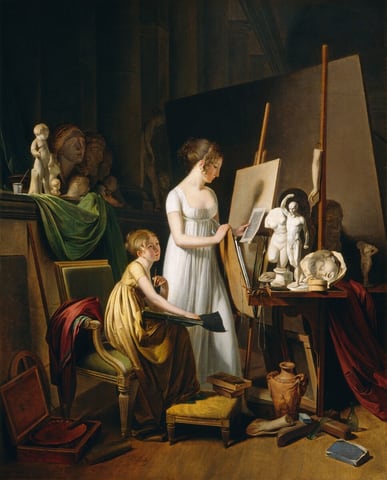
  1. In a room filled with easels, white plaster heads and statuettes, a box of paints, books, and papers, a young woman stands looking at a sketch and a young girl looks on, seated in an armchair, in this vertical painting. The scene is lit from the upper left, presumably from a window out of our view. Both women have smooth, pale skin, and their hair is swept up with curls framing their faces. They face our right in profile so their faces are in gentle shadow. They have straight noses, and their rose-pink lips are closed. They wear gowns with short sleeves, low, scooped necks, and floor-length skirts cinched under the bust. In the center of the painting, the young woman has chestnut-brown hair and wears a white gown tied with a sky-blue ribbon. She stands in front of a portfolio propped up against a tall easel. The portfolio is made of two stiff boards that tie together with pale blue ribbon to secure large sheets of paper. She rests her right hand, closer to us, on the front board of the portfolio and looks down at the sketch on a gray piece of paper she holds with her other hand. Next to her and closer to us, the younger girl sits in a gold chair upholstered with olive-green velvet. She faces our right almost in profile, and she looks up toward the drawing the other woman holds. The girl in the chair has blond hair and a gold-colored dress. Her feet are propped on a gold footstool, and she holds another portfolio on her lap. She supports the portfolio and holds a piece of paper with one hand, and a stylus or brush in the other hand, up by her chin. To the right of the easel, a wooden table holds a collection of plaster casts of faces, a hand, and small-scale bodies along with a glass vessel and a few other tools. Two translucent green bottles, boxes, a book, and a terracotta vase are collected on the footstool and the floor around the base of the easel. Garnet-red cloths are draped down the front of the table to our right and behind the girl on the chair. Next to her chair, in the lower left corner of the composition, is a wooden box with a paint palette and a handful of thin paintbrushes. A scroll of paper lies next to the box. A shelf at the standing girl’s shoulder height and behind the pair, to our left, is piled with white busts of a man, child, and woman, more figurines, and a brush in a small cup, all arranged across a moss-green cloth. The space with the girls and artist’s tools is enclosed by a large, dark brown form, presumably a canvas in shadow, that leans against the tall easels and mostly cuts off a view into the rest of the room. A glimpse of shadowy capitals is seen over the board, across the top of the painting, to suggest that a row of columns recedes into the space beyond. The artist signed the work as if he had painted his name on the floor next to the scroll, “L. Boilly.”
    A Painter's StudioLouis-Léopold Boilly, c. 1800Courtesy National Gallery of Art, Washington
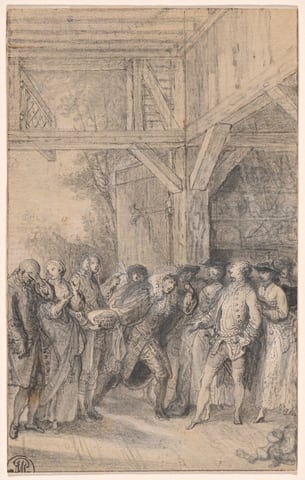
  2. A work made of graphite and pen and black ink, with touches of opaque, white watercolor on cream laid paper.
    Farmer Requesting Permission to Marry a Nobleman's DaughterGabriel de Saint-Aubin, 1761Courtesy of the Art Institute of Chicago
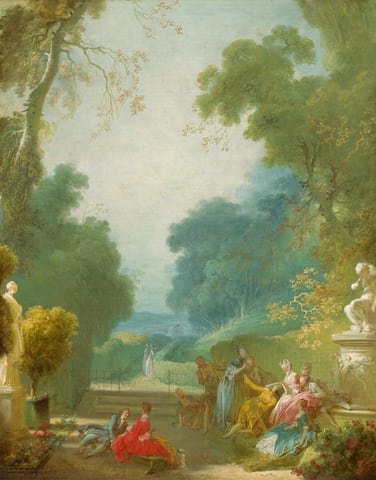
  3. Towering, pale, celery-green trees frame a view of a lush park with about a dozen elegantly dressed, light-skinned men and women in this vertical landscape painting. The color palette is dominated by moss and lemon-lime green, golden yellow, and spruce blue. The men all wear jackets with long tails over knee-breeches, and their long hair is pulled back at the napes of their necks. The women wear long dresses with full skirts and hints of lace at the sleeves and bust, and their brown or white hair is pulled up. Nine of the men and women gather to our right on a stone terrace along the bottom edge of the painting. A man in butter yellow kneels in front of a woman wearing rose pink. Around this pair, people stand, kneel, sit, or recline wearing aquamarine blue, light turquoise, or ivory white. A man and woman sit on a bench to our left, a little removed from the larger group. This woman wears ruby red and the man leaning toward her wears topaz blue. Two people in the park beyond these groups are painted with only a few strokes of pale blue and white paint, and they look over a low hedge row lining the walking path. Beds of red flowers fill the lower corners of the composition in front of a statue of a woman to our left and a person, perhaps on a fountain, to our right. The grassy walking path and trees become more blue as they fade into the hazy distance between the tall tress to either side. The sky fades from pale blue along the horizon to a silvery blue, almost white, at the top.
    A Game of Hot CocklesJean Honoré Fragonard, c. 1775/1780Courtesy National Gallery of Art, Washington

Section 2, north wall
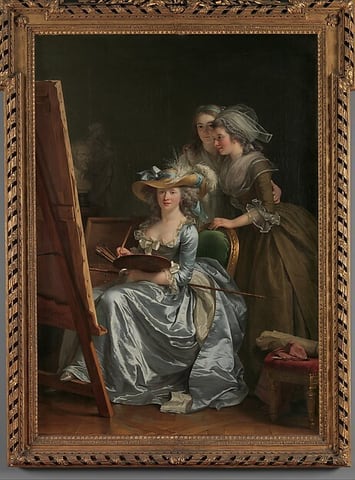
  1. Self-Portrait with Two Pupils, Marie Gabrielle Capet (1761–1818) and Marie Marguerite Carraux de Rosemond (1765–1788), by Adélaïde Labille-Guiard, 1785
    Self-Portrait with Two Pupils, Marie Gabrielle Capet (1761–1818) and Marie Marguerite Carraux de Rosemond (1765–1788)Adélaïde Labille-Guiard, 1785Courtesy of The Metropolitan Museum of Art
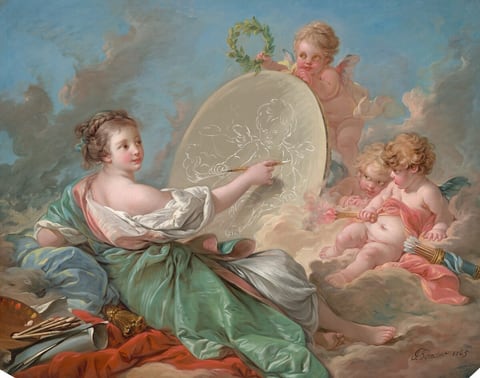
  2. A young woman draws on an oval surface with white chalk while three winged, baby-like putti gather nearby, all on a bank of pale pink clouds in this horizontal painting. The woman and putti have pale, rosy skin, flushed cheeks, and hazel-brown eyes. To our left, the woman reclines with her upper body propped up on her far elbow, which rests on a steel-blue cushion as her legs stretch out to our right. Her light brown hair is braided and wrapped across the top of her head. She wears a loose, seafoam-green robe over a billowing ivory-white garment that has slipped off the shoulder closer to us. A round paint palette with brushes sticking out of its thumb hole and a roll of blue and white paper sit in the lower left corner, behind the woman. The woman and the objects are on a red cloth. In front of the woman is a rounded surface, perhaps a canvas, on which she draws. She holds up a gold-colored stylus with her right hand, closer to us, with a pointed piece of white chalk in one end and black chalk in the other. The canvas is taller than her head, so the child-like putto she draws on it is life-sized. The three nude putti on the far side of the canvas have copper or golden-blond, curly hair, flushed, rounded cheeks, short wings in white or peacock blue, pudgy torsos, and dimpled limbs. One putto, presumably the one the woman draws, sits back on the bank of clouds with a carnation-pink sash across his chest. He pulls his chin back and looks at her from under his eyebrows. He holds a gold-colored torch with a pink flame in one hand, and the other hand rests near a cylindrical quiver of arrows. Another putto peeks around the side of the canvas, and the third stands and props the canvas up. That third putto holds up a wreath of laurel leaves up over the canvas, above the woman’s drawing hand. The bank of clouds is parchment-brown with muted pink and blue highlights against a vivid blue sky. The artist signed and dated the lower right, “F Boucher – 1765.”
    Allegory of PaintingFrançois Boucher, 1765Courtesy National Gallery of Art, Washington
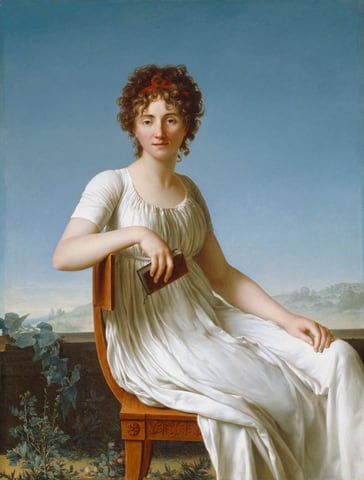
  3. A work made of oil on canvas.
    Portrait of Constance PipeletJean Baptiste François Désoria, 1797Courtesy of the Art Institute of Chicago

Section 3, north wall
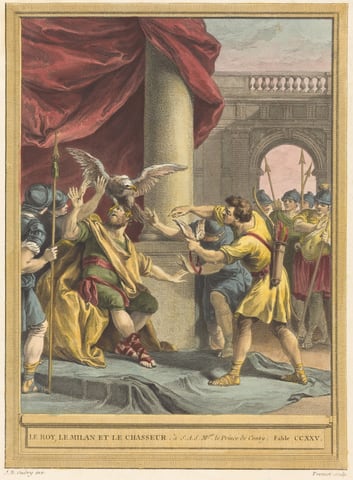
  1. This is a painting of a king, a hawk, and a hunter in a classical architectural setting with columns and arches. In the image, a figure in royal clothing is seated beneath draped red fabric, facing a man in hunting attire holding a bird. A hawk perches on the royal figure's head, wings spread, while the hunter reaches toward the hawk. Surrounding them are other figures in armor, holding spears and shields. The style is reminiscent of classic European paintings with themes of mythology or allegory.
    Le roi, le milan, et le chasseur (The King, the Kite, and the Hunter)Benoît-Louis Prévost, published 1759Courtesy National Gallery of Art, Washington
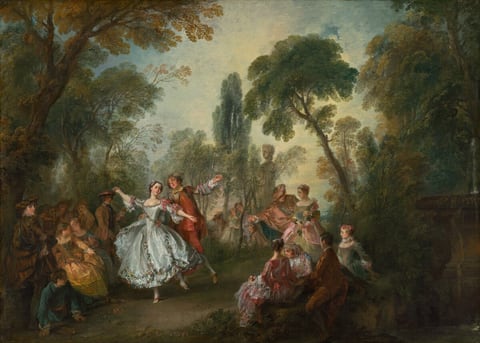
  2. Twenty-one men in long waistcoats and women in elegantly trimmed gowns gather and dance within a verdant landscape in this horizontal painting. The men wear jackets and breeches in ginger brown, pale pink, or spruce blue. The women’s gowns have full sleeves, tight-fitting bodices, and full skirts in shades of bronze, teal blue, butterscotch gold, or rich pink edged with ribbons and lace. Some of them wear floral wreaths or ribbons in their upswept hair. Groups gather around a woman and man who dance together to our left in the scene. Some in the group of onlookers to our left hold musical instruments, including a violin and a pipe. Another group is nestled among trees just beyond the dancers, at the center of the painting, and more sit and stand to our right. The dancing woman wears a gleaming, ice-blue gown with rows of flowers in muted pink, blue, and gold down the full skirt and around the bottom hem, which falls short of her thin ankles. More garlands cross her chest and shoulders, and flowers are tucked into her dark gray hair. She faces us with her head turned to our right as she looks off in that direction with dark eyes under curving brows. She has a delicate nose, rosy, round cheeks, and pink lips. She holds her arms spread wide with the thumb touching the index finger of each hand. The man with whom she dances wears a coral-red tunic and breeches with sleeves decorated with pale pink and blue ribbons. The brim of his brown hat is turned up. His body faces us but he turns his head to look at the woman, his lips parted. The man and woman each have one gracefully pointed foot raised. The dancers and groups are enclosed within a park-like setting with tall trees to either side, and a screen of trees across the back of the space. The trees have slender trunks and canopies in shades of pine, sage, and moss green. Near the back middle of the scene, a stone column topped by a human head wearing a wreath of laurel leaves rises above the central group. A fountain with a vertical jet of water is tucked into the shadows within a grove of trees along the right edge of the painting. The water falls into a pool in the lower right corner.
    La Camargo DancingNicolas Lancret, c. 1730Courtesy National Gallery of Art, Washington
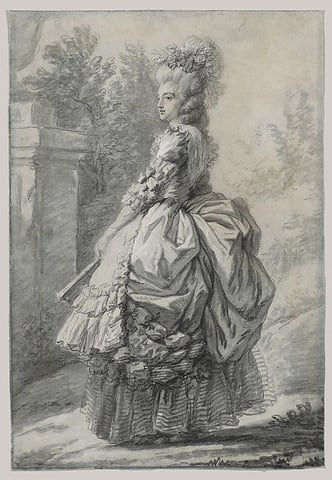
  3. Marie Antoinette in a Park, by Elisabeth Louise Vigée Le Brun, ca. 1780–81
    Marie Antoinette in a ParkElisabeth Louise Vigée Le Brun, ca. 1780–81Courtesy of The Metropolitan Museum of Art