Floor plan

Time and place18th-century Britain
18th-century Britain
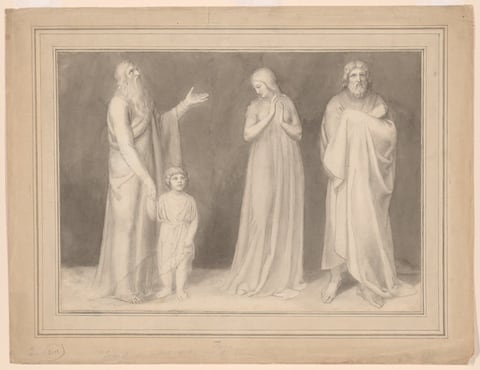
A work made of pen and black ink and brush and black ink wash, with touches of pen and brown ink, on ivory laid paper.
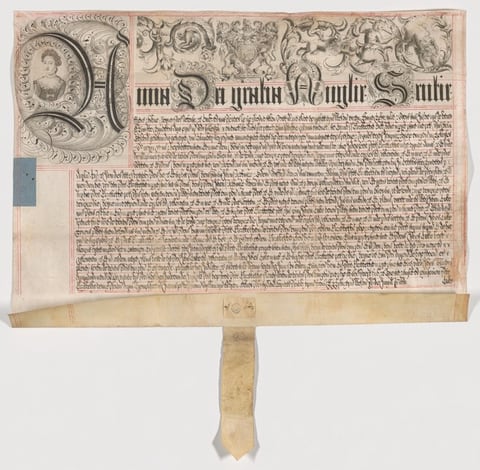
A work made of engraved letterhead, pen and ink calligraphy, and graphite ruling on parchment, folded with strap and (missing) seal.
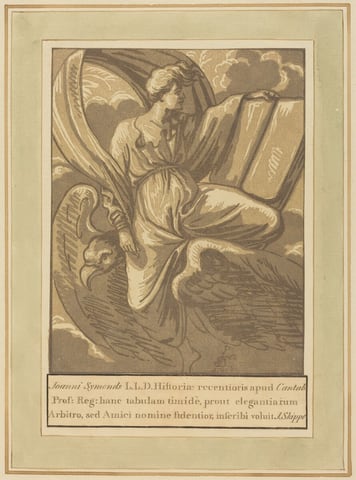
This is a drawing of a seated figure on a large bird. The image depicts a classically draped figure seated on a stylized bird. The figure holds an open book and gazes into the distance. The bird has sharp features and spread wings. The background contains swirling clouds. The scene is framed with a border, and there is text at the bottom. The lines are bold and the shades are muted.
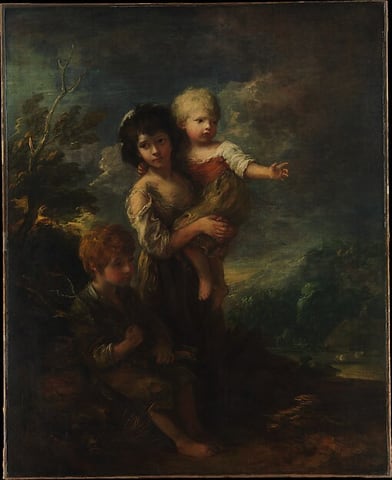
Cottage Children (The Wood Gatherers), by Thomas Gainsborough, 1787
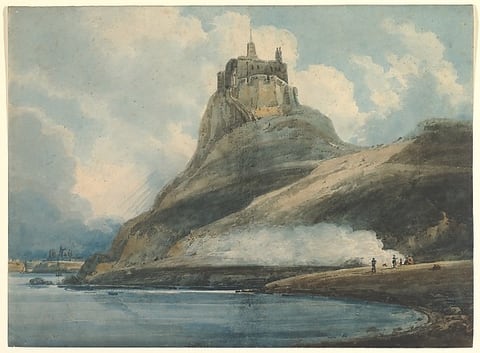
Lindisfarne Castle, Holy Island, Northumberland, by Thomas Girtin, 1796–97
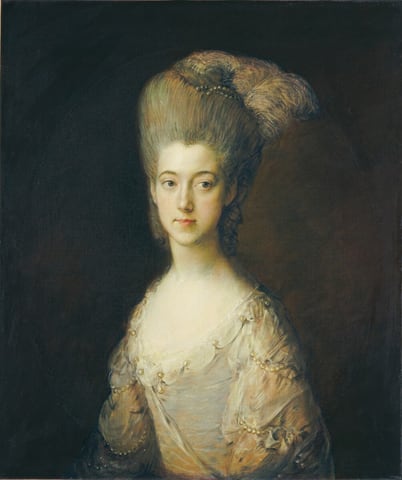
Shown from the waist up, a young, pale-skinned woman with her gray hair piled high atop her head is lit starkly against a dark background in this vertical portrait painting. The woman’s shoulders are angled to our left. Her face is square to us, but she looks off to our right from the corners of her eyes, which are gray rimmed with golden brown around the pupils. She has a thin face, smooth cheeks, a bow-shaped pink mouth, and a narrow chin. Her hair is mostly swept up high under a bank of pearl-white feathers and some sparkling ornaments. A few ringlets hang down the back of her neck. The bodice of her white dress scoops low across her chest and sits just above her sloping shoulders. The dress is adorned with pearls on the sleeves and around the neckline, and the fabric shimmers from silvery white to pale gold. The background is earth-brown around her face and deepens to almost black in the corners.
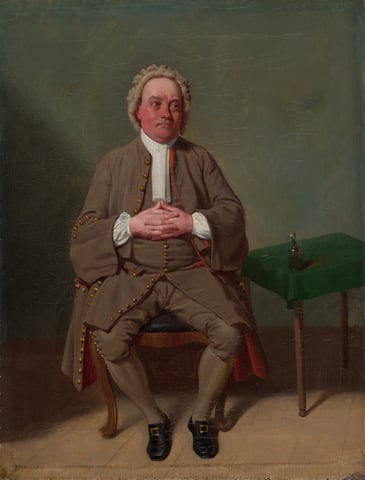
A work made of oil on canvas.
A work made of etching on ivory laid paper.

The works in this room are listed below.

Works in this room

Works made in Britain in the 18th century.

First room, north wall

  1. A work made of pen and black ink and brush and black ink wash, with touches of pen and brown ink, on ivory laid paper.
    Hannah Presenting Samuel to EliJohn Flaxman, c. 1783Courtesy of the Art Institute of Chicago
  2. A work made of engraved letterhead, pen and ink calligraphy, and graphite ruling on parchment, folded with strap and (missing) seal.
    Recovery Document (Land Title Grant)Unrecorded British maker, 1702/14 (Queen Anne period)Courtesy of the Art Institute of Chicago
  3. This is a drawing of a seated figure on a large bird. The image depicts a classically draped figure seated on a stylized bird. The figure holds an open book and gazes into the distance. The bird has sharp features and spread wings. The background contains swirling clouds. The scene is framed with a border, and there is text at the bottom. The lines are bold and the shades are muted.
    Saint John the EvangelistJohn Skippe, 1771Courtesy National Gallery of Art, Washington
  4. Cottage Children (The Wood Gatherers), by Thomas Gainsborough, 1787
    Cottage Children (The Wood Gatherers)Thomas Gainsborough, 1787Courtesy of The Metropolitan Museum of Art

First room, south wall

  1. Lindisfarne Castle, Holy Island, Northumberland, by Thomas Girtin, 1796–97
    Lindisfarne Castle, Holy Island, NorthumberlandThomas Girtin, 1796–97Courtesy of The Metropolitan Museum of Art
  2. Shown from the waist up, a young, pale-skinned woman with her gray hair piled high atop her head is lit starkly against a dark background in this vertical portrait painting. The woman’s shoulders are angled to our left. Her face is square to us, but she looks off to our right from the corners of her eyes, which are gray rimmed with golden brown around the pupils. She has a thin face, smooth cheeks, a bow-shaped pink mouth, and a narrow chin. Her hair is mostly swept up high under a bank of pearl-white feathers and some sparkling ornaments. A few ringlets hang down the back of her neck. The bodice of her white dress scoops low across her chest and sits just above her sloping shoulders. The dress is adorned with pearls on the sleeves and around the neckline, and the fabric shimmers from silvery white to pale gold. The background is earth-brown around her face and deepens to almost black in the corners.
    Mrs. Paul Cobb MethuenThomas Gainsborough, c. 1776/1777Courtesy National Gallery of Art, Washington
  3. A work made of oil on canvas.
    Mr. Quick as Vellum in Addison's DrummerSamuel De Wilde, 1792Courtesy of the Art Institute of Chicago
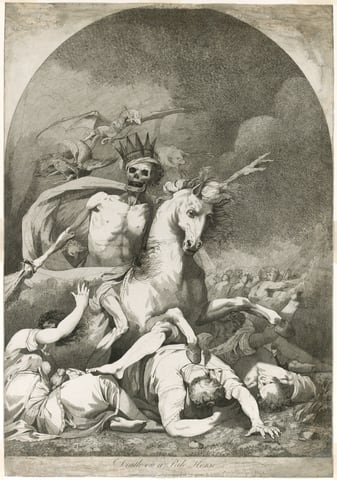
  4. A work made of etching on ivory laid paper.
    Death on a Pale HorseJoseph Haynes, 1784, after the drawing of 1775Courtesy of the Art Institute of Chicago

Second room, south wall
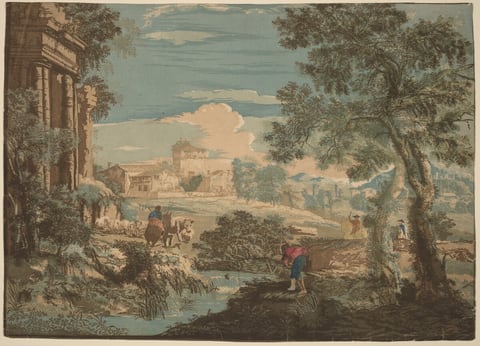
  1. The image shows a landscape scene from an elevated viewpoint. There are large columns of a classical ruin and a leafy tree on the left. On the right, there is a spreading tree with intricate leaves. In the background, there is a pastoral landscape with figures and animals. A shepherd and a cow are guiding a flock of sheep, and buildings can be seen in the distance. The horizon divides the image into sky and earth. The brushstrokes are detailed, capturing textures effectively. The color palette consists of earthy tones with touches of brighter colors on the figures' clothing.
    Heroic Landscape with Fisherman, Cows, and HorsemenJohn Baptist Jackson, 1744Courtesy National Gallery of Art, Washington
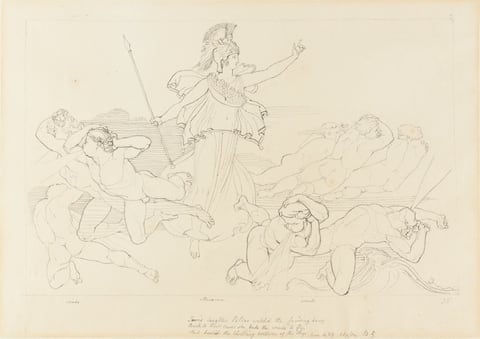
  2. A work made of pen and black ink, over traces of graphite, on tan wove paper, laid down on cream wove paper.
    Athena and the WindsJohn Flaxman, n.d.Courtesy of the Art Institute of Chicago
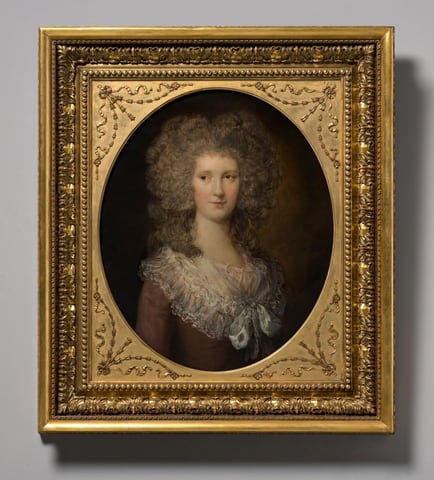
  3. Portrait of Mary Anne Jolliffe, by Gainsborough Dupont, after 1788
    Portrait of Mary Anne JolliffeGainsborough Dupont, after 1788Courtesy of the Cleveland Museum of Art

Second room, north wall
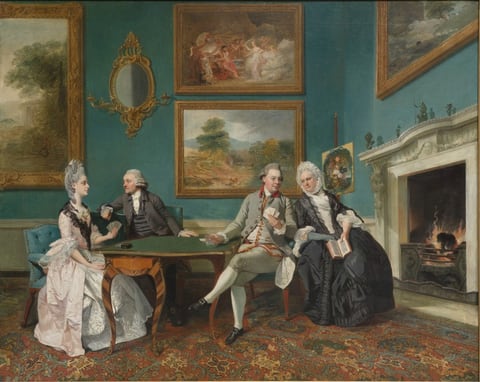
  1. The Dutton Family in the Drawing Room of Sherborne Park, Gloucestershire, by Johann Zoffany, c. 1772
    The Dutton Family in the Drawing Room of Sherborne Park, GloucestershireJohann Zoffany, c. 1772Courtesy of the Cleveland Museum of Art
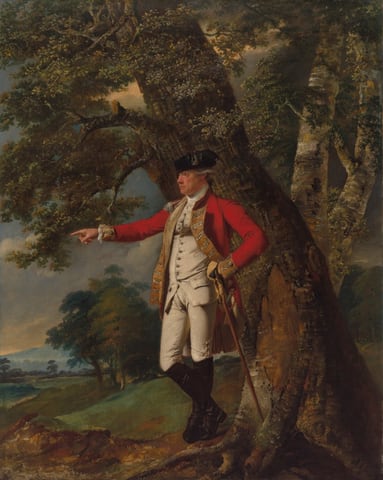
  2. Portrait of Colonel Charles Heathcote, by Joseph Wright of Derby, c. 1771–72
    Portrait of Colonel Charles HeathcoteJoseph Wright of Derby, c. 1771–72Courtesy of the Cleveland Museum of Art
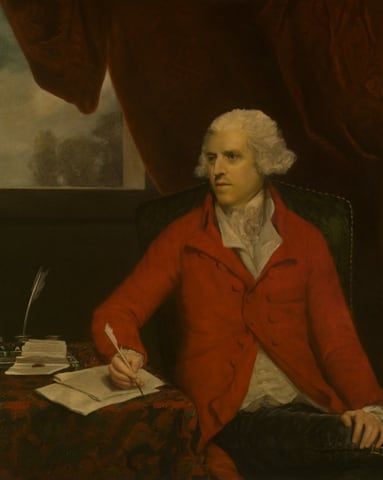
  3. A work made of oil on canvas.
    Sir Thomas Rumbold, Bt.Joshua Reynolds, 1788Courtesy of the Art Institute of Chicago

Third room, north wall
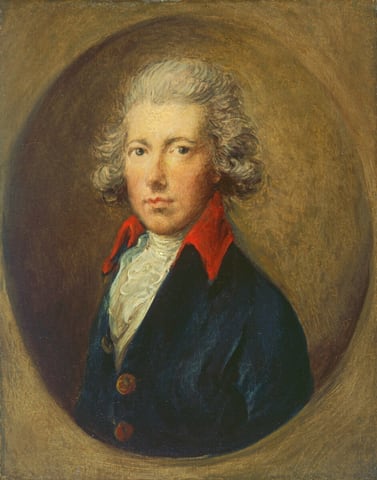
  1. The image depicts a portrait of an individual with the upper half of their body visible. The person is facing forward with their head slightly turned to the side, looking directly at the viewer. They have a fair complexion, with distinct facial features, including a rounded face and closed lips. The hair is styled in an 18th-century manner, with curls around the ears. They are wearing a dark coat with red lapels and brass buttons, over a white shirt with ruffled details. There are no visible jewelry or objects in their hands. The background is a textured, earth-toned surface.
    William PittGainsborough Dupont, 1787/1796Courtesy National Gallery of Art, Washington
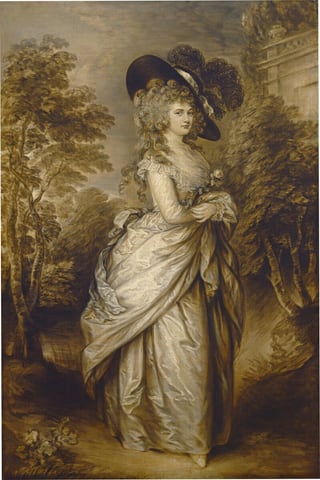
  2. This painting is a full-length portrait of a woman with her body facing the right and her head turned toward us. She has light skin, curly gray hair, arched eyebrows, and a small mouth in a neutral expression. She wears an elegant light-colored dress with a large bow on the back and a large, dark, feathered hat, and she has a flower tucked in her arms, which also gather up some of her skirts. The background shows tall trees, with the edge of a wall visible in the upper-right corner. The color scheme of the painting is mostly olive-green, and everything has a green tint.
    Georgiana, Duchess of DevonshireGainsborough Dupont, c. 1787/1796Courtesy National Gallery of Art, Washington