Floor plan

Time and placeThe 17th century

The 17th century

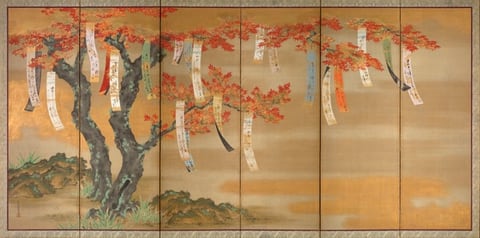
Papers with Japanese text hang from a tree bearing red and gold leaves.
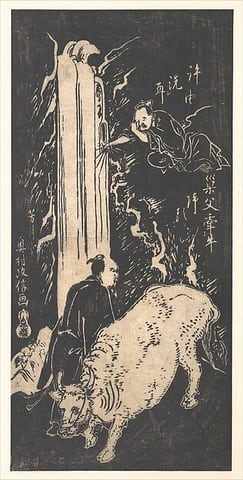
Xu You and Chao Fu, by Okumura Masanobu, 18th century
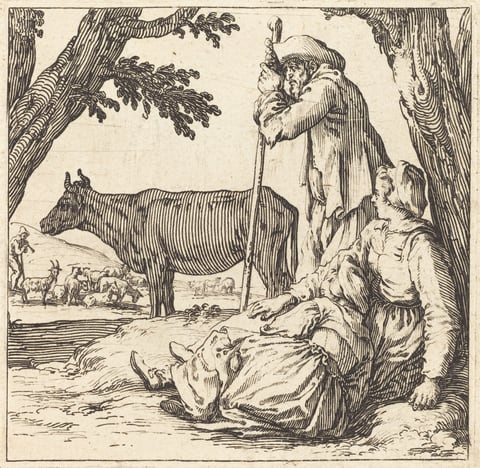
The image has an elevated perspective showing two figures with animals in the scene. One person is leaning against a tree with a stick, while the other is seated on the ground. A cow is between them and other livestock in the middle distance. A person in the distance is tending to the animals. The horizon is low in the image, hidden by rolling hills. The artwork is in monochrome with fine linework, creating texture through hatching and cross-hatching, emphasizing depth and dimensionality.
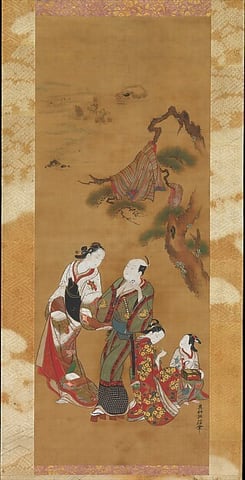
Yukihira and Two Brinemaidens at Suma, by Okumura Masanobu, 18th century
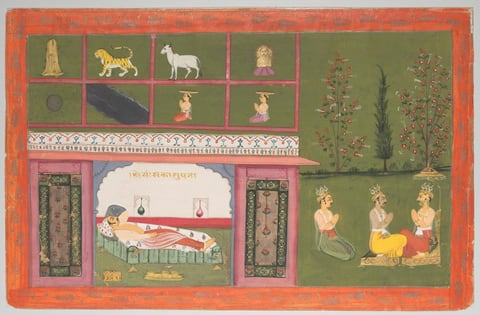
Prince Shreyamsa dreams of the coming of Rishabha, from a Panchakalyanaka (Five Auspicious Events), 1670–80
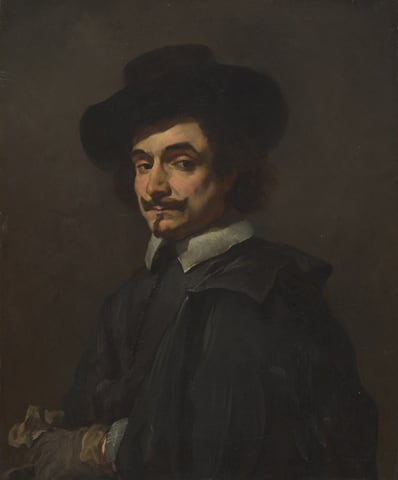
A work made of oil on copper.
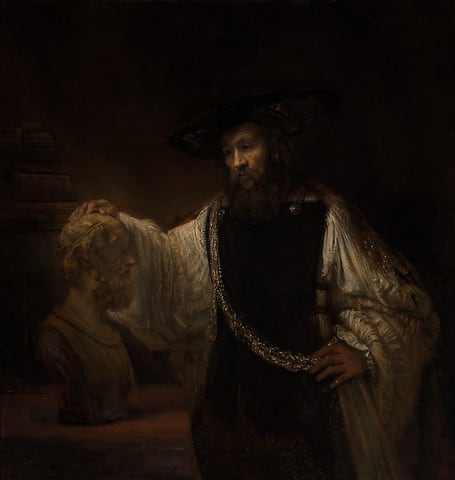
Aristotle with a Bust of Homer, by Rembrandt van Rijn, 1653

The works in this room are listed below.

Works in this room

Works made in the 17th century, anywhere in the world.

Section 1, north wall

  1. Papers with Japanese text hang from a tree bearing red and gold leaves.
    Autumn Maples with Poem SlipsTosa Mitsuoki, c. 1675Courtesy of the Art Institute of Chicago
  2. Xu You and Chao Fu, by Okumura Masanobu, 18th century
    Xu You and Chao FuOkumura Masanobu, 18th centuryCourtesy of The Metropolitan Museum of Art
  3. The image has an elevated perspective showing two figures with animals in the scene. One person is leaning against a tree with a stick, while the other is seated on the ground. A cow is between them and other livestock in the middle distance. A person in the distance is tending to the animals. The horizon is low in the image, hidden by rolling hills. The artwork is in monochrome with fine linework, creating texture through hatching and cross-hatching, emphasizing depth and dimensionality.
    Peasant Couple with CowJacques Callot, c. 1621Courtesy National Gallery of Art, Washington

Section 1, south wall

  1. Yukihira and Two Brinemaidens at Suma, by Okumura Masanobu, 18th century
    Yukihira and Two Brinemaidens at SumaOkumura Masanobu, 18th centuryCourtesy of The Metropolitan Museum of Art
  2. Prince Shreyamsa dreams of the coming of Rishabha, from a Panchakalyanaka (Five Auspicious Events), 1670–80
    Prince Shreyamsa dreams of the coming of Rishabha, from a Panchakalyanaka (Five Auspicious Events)Unrecorded Indian maker, 1670–80Courtesy of the Cleveland Museum of Art
  3. A work made of oil on copper.
    Portrait of a ManJan Baptist Weenix, c. 1650Courtesy of the Art Institute of Chicago
  4. Aristotle with a Bust of Homer, by Rembrandt van Rijn, 1653
    Aristotle with a Bust of HomerRembrandt van Rijn, 1653Courtesy of The Metropolitan Museum of Art

Section 2, south wall
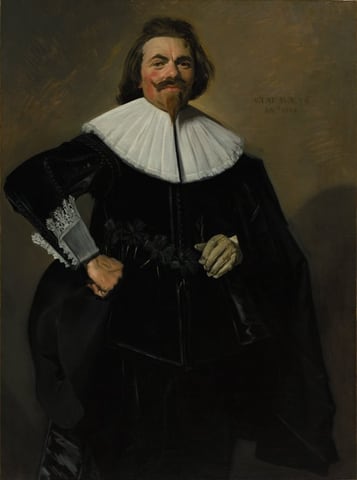
  1. Portrait of Tieleman Roosterman, by Frans Hals, 1634
    Portrait of Tieleman RoostermanFrans Hals, 1634Courtesy of the Cleveland Museum of Art
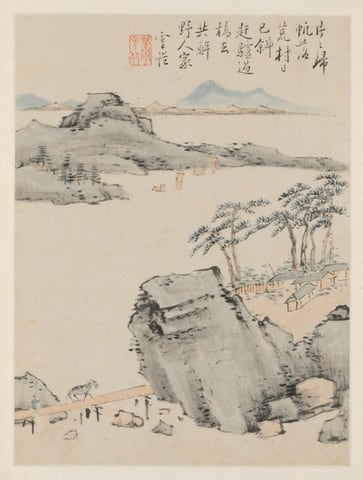
  2. Album of Seasonal Landscapes, Leaf C (previous leaf 6), by Xiao Yuncong, 1668
    Album of Seasonal Landscapes, Leaf C (previous leaf 6)Xiao Yuncong, 1668Courtesy of the Cleveland Museum of Art
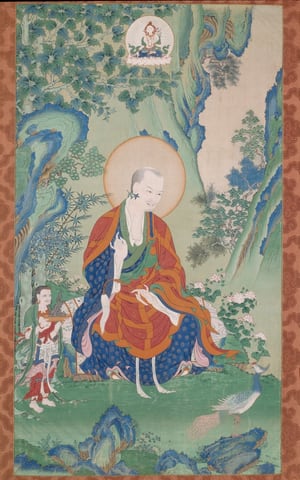
  3. A scene in green, orange, and blue depicts a large robed figure seated prominently in the foreground, a small standing figure beside him, and a tiny, seated, floating figure above him, mountains in the background.
    Arhat Vanavasin, One of the Sixteen Great Arhats, from a Set of Twenty-ThreeTibeto-Chinese, late 17th/early 18th centuryCourtesy of the Art Institute of Chicago

Section 2, north wall
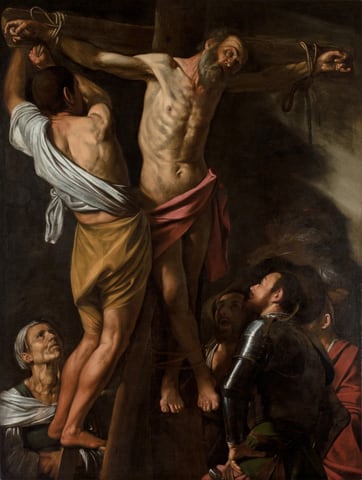
  1. The Crucifixion of Saint Andrew, by Caravaggio, 1606–7
    The Crucifixion of Saint AndrewCaravaggio, 1606–7Courtesy of the Cleveland Museum of Art
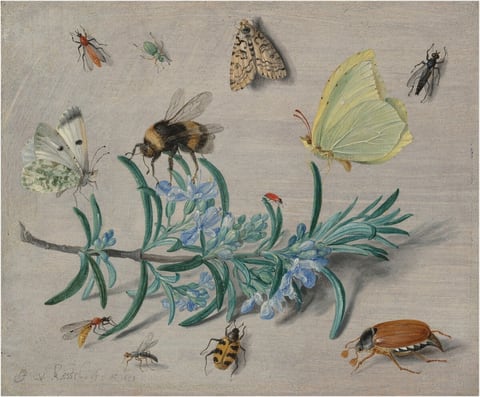
  2. A sprig of flowering rosemary lying against an ivory-white background and the twelve insects that surround it fills this horizontal painting. Stretching nearly the length of the composition with the cut end to our left, the rosemary has blunted, needle-like, gently curling teal-green leaves and small periwinkle-blue flowers along the ash-brown stem. Several insects perch on the sprig while others are seen as if looking from overhead, resting on the white background. The three largest insects perch along the top of the sprig, with an ivory-white butterfly with moss-green and black markings to the left, a black and golden, fuzzy bumblebee near the center, and a lemon-yellow butterfly with red antennae to our right. A tiny red insect, perhaps a ladybug without spots, sits on a leaf between the bee and yellow butterfly, and a small wasp-like insect rests on a leaf in at the lower left. Another mosquito-like insect alights on the surface nearby, next to a beetle with a honey-orange body with black, almost tiger-like stripes. A large cockroach sitting near the lower right corner has six spindly legs, a mahogany-colored abdomen, a black thorax, and tiny, black head. Spaced somewhat evenly across the top of the panel are a brick-red, winged insect to the left, a mint-green, beetle-like bug near a moth patterned with bone white and black, and a black, fly-like insect to our right. Lit from the upper left, the rosemary and insects cast shadows on the surface. The artist signed and dated the work with gray in the lower left corner: “J v. kessel . . f. Ao 1653.”
    Insects and a Sprig of RosemaryJan van Kessel the Elder, 1653Courtesy National Gallery of Art, Washington
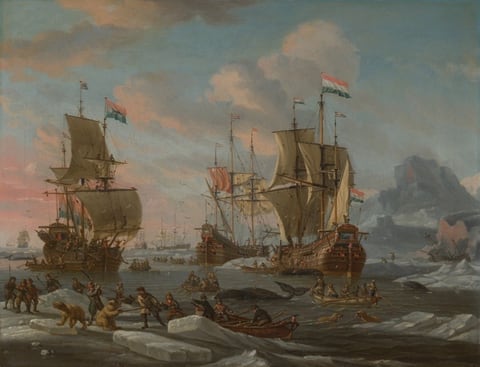
  3. A work made of oil on canvas.
    The Dutch Whaling FleetAbraham Storck, c. 1695Courtesy of the Art Institute of Chicago
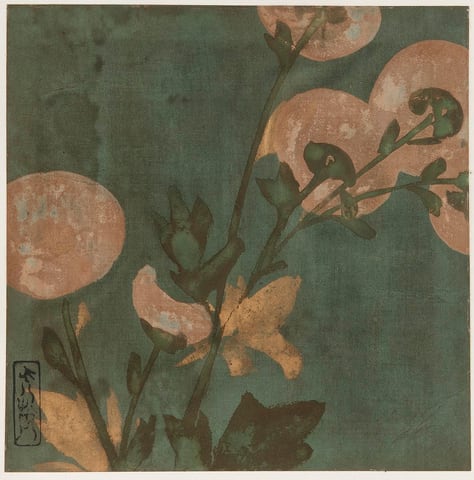
  4. Poetry sheet (shikishi)
    ChrysanthemumsHon'ami Kōetsu, 1615-1868Courtesy of the National Museum of Asian Art, Smithsonian Institution

Section 3, north wall

  1. A work made of oil on canvas.
    Jacopo ButeraFrancesco Solimena, c. 1695Courtesy of the Art Institute of Chicago
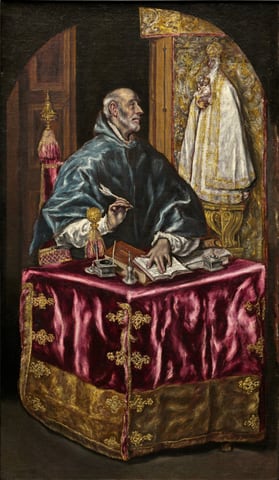
  2. A light-skinned man wearing a voluminous, ocean-blue, hooded robe sits at a cloth-draped writing table and looks up, fingers splayed over an open book and a pen held in his other hand, in this vertical painting. The man and desk take up most of the composition, which has an arched top. The man’s shoulders and body are angled to our right, and he looks off in that direction in profile. His balding head is rimmed with white hair curving over the large ear we can see, and he has a trimmed white and gray beard and mustache. His prominent nose is pointed, and his lips are closed. Light glints off the robe he wears so it shimmers in shades of topaz, aquamarine, and midnight blue. Voluminous white sleeves emerge under the mantle and are edged with narrow lace cuffs. His left hand, to our right, rests on an open book, which is propped against one or two other tomes. Near the edge of the table, two quills stand in the corners of a lidded inkwell, and a round, silver blotter, shaped like an upside-down chalice, and a lidded silver box sit nearby. The man’s chair has a tall post next to his shoulder to our left with a teardrop-shaped, gold finial. A second post, near his wrist, is lower and topped with a gold orb. The chair is draped in the same deep, raspberry-pink of the square table at which he sits. The tablecloth is edged with a wide band of gold along the bottom, and filigree-like gold decorations line the seams or folds at the corners. Brushstrokes are visible in many areas, especially in the colorfully charged blue and pink fabric. Beyond the man, to our right, a statuette of a person wearing a long, white robe over a white dress holds a baby. The clothing is edged with gold, and she wears a sphere-like gold crown. The baby also wears white and holds up one hand. The statuette stands on a platform supported by S-shaped corbels, and could have a projecting, squared awning over the top. This area is more loosely painted so some details are difficult to make out. In the background to our left, a wooden door stands open next to a dark space just behind the man’s head, so his profile is picked out against the shadow. The floor beneath is earth brown.
    Saint IldefonsoEl Greco, c. 1603/1614Courtesy National Gallery of Art, Washington