Floor plan

Time and place17th-century Netherlands
17th-century Netherlands
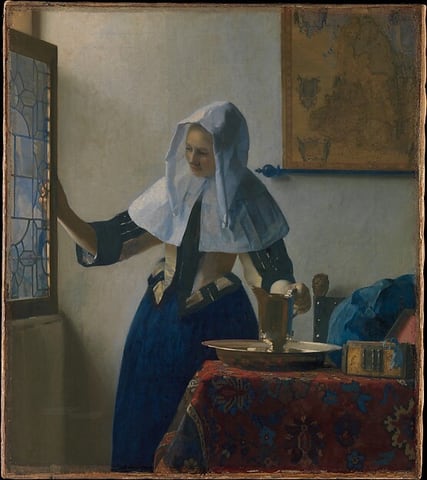
Young Woman with a Water Pitcher, by Johannes Vermeer, ca. 1662
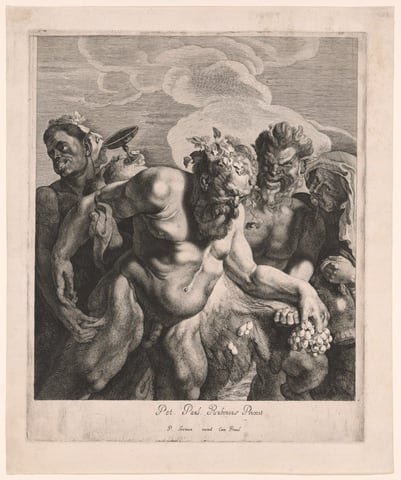
A work made of engraving in black on cream laid paper.
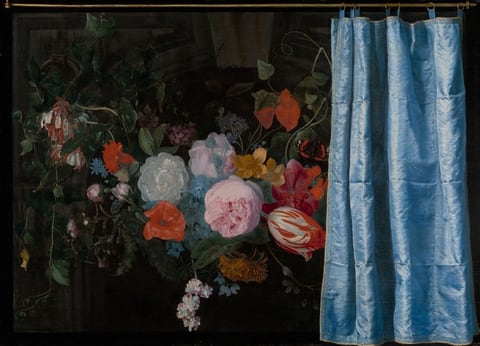
A work made of oil on panel.
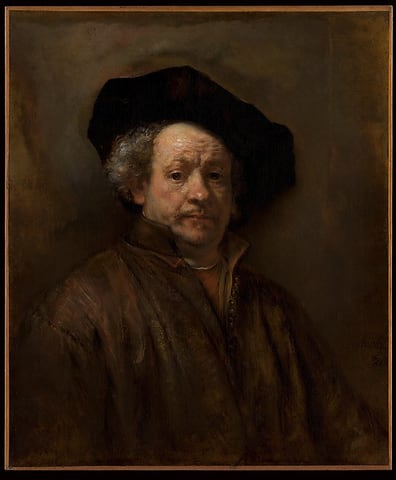
Self-Portrait, by Rembrandt van Rijn, 1660
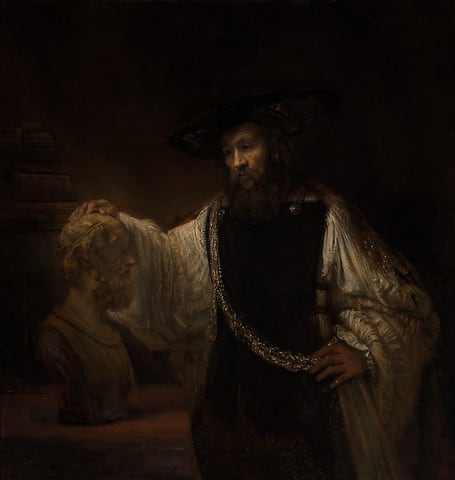
Aristotle with a Bust of Homer, by Rembrandt van Rijn, 1653
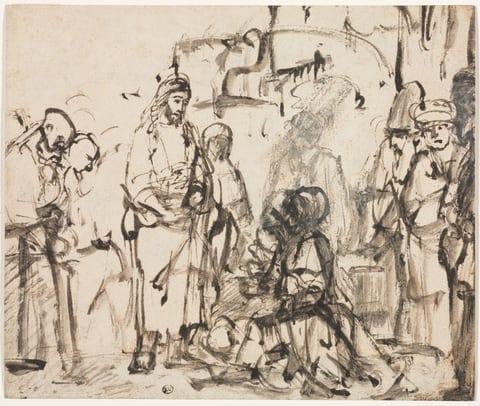
The Meeting of Christ with Martha and Mary after the Death of Lazarus, by Rembrandt van Rijn, c. 1662–65
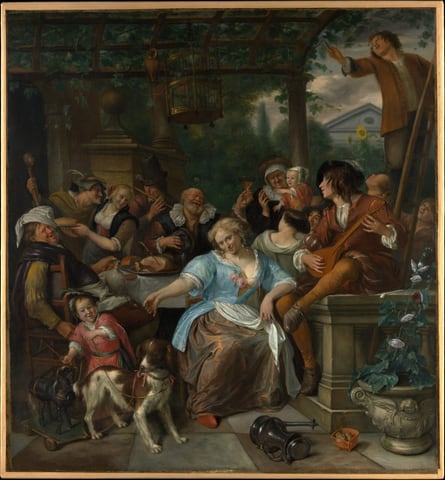
Merry Company on a Terrace, by Jan Steen, ca. 1670

The works in this room are listed below.

Works in this room

Works made in the Netherlands in the 17th century.

First room, north wall

  1. Young Woman with a Water Pitcher, by Johannes Vermeer, ca. 1662
    Young Woman with a Water PitcherJohannes Vermeer, ca. 1662Courtesy of The Metropolitan Museum of Art
  2. A work made of engraving in black on cream laid paper.
    Drunken SilenusJonas Suyderhoef, 1642Courtesy of the Art Institute of Chicago
  3. A work made of oil on panel.
    Trompe-l'Oeil Still Life with a Flower Garland and a CurtainAdriaen van der Spelt, 1658Courtesy of the Art Institute of Chicago
  4. Self-Portrait, by Rembrandt van Rijn, 1660
    Self-PortraitRembrandt van Rijn, 1660Courtesy of The Metropolitan Museum of Art

First room, south wall

  1. Aristotle with a Bust of Homer, by Rembrandt van Rijn, 1653
    Aristotle with a Bust of HomerRembrandt van Rijn, 1653Courtesy of The Metropolitan Museum of Art
  2. The Meeting of Christ with Martha and Mary after the Death of Lazarus, by Rembrandt van Rijn, c. 1662–65
    The Meeting of Christ with Martha and Mary after the Death of LazarusRembrandt van Rijn, c. 1662–65Courtesy of the Cleveland Museum of Art
  3. Merry Company on a Terrace, by Jan Steen, ca. 1670
    Merry Company on a TerraceJan Steen, ca. 1670Courtesy of The Metropolitan Museum of Art

Second room, south wall
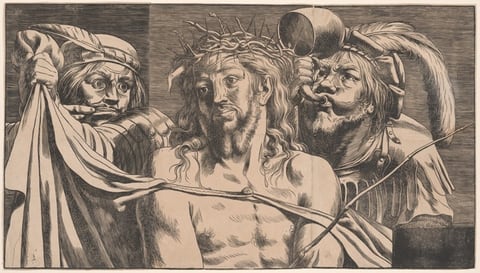
  1. A work made of woodcut on three joined sheets of ivory laid paper.
    The Mocking of ChristWerner van den Valckert, c. 1620Courtesy of the Art Institute of Chicago
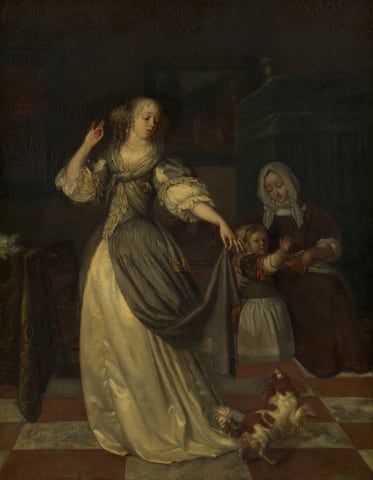
  2. A work made of oil on canvas.
    Lady Playing with a DogEglon van der Neer, c. 1670Courtesy of the Art Institute of Chicago
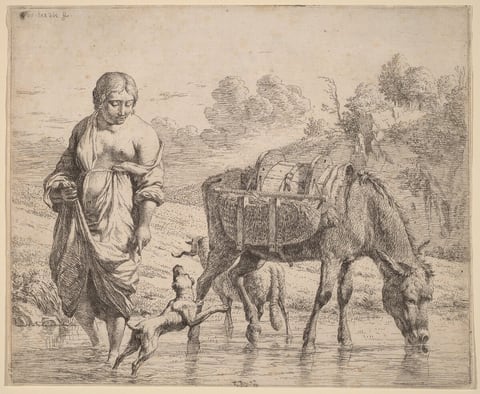
  3. The image shows a woman standing close to us, slightly turned to the side, looking down, with a hand supporting her draped attire and the other grasping a stick. Next to her, a donkey drinks from a shallow stream, carrying a large wicker basket with barrels inside. A dog is splashing in the water beside them. The horizon is low, meeting a rise of land with trees and shrubs, leading the eye to a distant pathway where a couple of small figures can be seen. The sky above has sketchily rendered clouds. The style involves fine, detailed linework, characteristic of etching, emphasizing textures such as the fur of the donkey and the folds of the fabric. The color palette is monochromatic, relying on various intensities of ink and line density to render shadows and highlights.
    Woman Crossing a StreamKarel Dujardin, 1662Courtesy National Gallery of Art, Washington

Second room, north wall
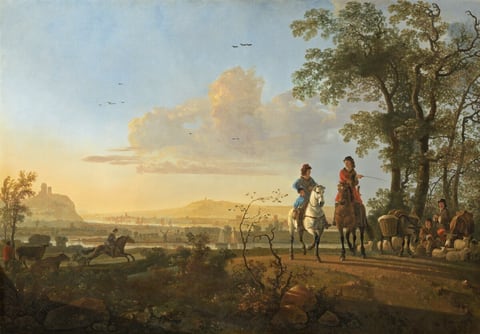
  1. Golden sunlight pours across a landscape with three people on horseback and two more people near a flock of sheep, a cow, and a mule in this horizontal painting. The people all have pale, peachy skin. The horizon is about a third of the way up the composition and is lined with towers on distant, hazy, pale yellow hills. Two of the horses are to the right of center, both facing us. The horse on the left is white, and the rider wears an azure-blue tunic and red brimless cap. The other horse is brown with a white blaze, and its rider wears a red tunic and black cap. That second rider points with a whip to the sitting and standing people near the sheep, to the right. Those two people wear brown jackets, and the standing man has a mustache. The seated person rests a long staff over one shoulder. About half of the nine sheep there lie on the ground, and the others stand. The cow dips her head down to the sheep, and the splay-footed donkey has baskets hung to each side. This grouping is in front of a copse of tall trees that nearly reach the top edge of the composition. The third rider is to our left and a short distance away. That dark brown horse gallops to our right. A short distance away, another herdsman along the left edge of the composition wears a red tunic and brown pants, and he rests a long staff on one shoulder. One cow stands and one lies down next to that herdsman. Sunlight rakes across twigs, leafy plants, scrubby growth, and rocks in the foreground, closest to us. Sailboats float on the waterways that stretch horizontally across the painting in the distance, and the land separating those bodies of water is dotted with spires, windmills, towers, and other structures. A dozen dark birds fly high in the sky, which takes up the top two-thirds of the picture. A bank of iridescent yellow and pearly white clouds trundle across the pale blue sky. The artist signed the painting in the lower right corner, “A.cuijp.”
    Horsemen and Herdsmen with CattleAelbert Cuyp, 1655/1660Courtesy National Gallery of Art, Washington
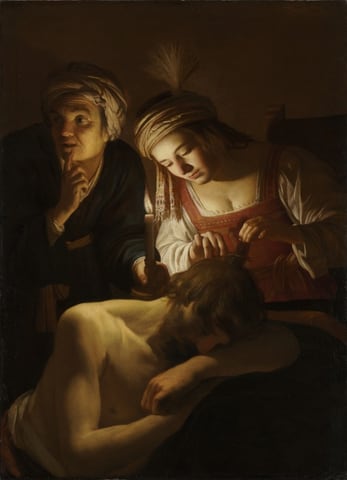
  2. Samson and Delilah, by Gerrit van Honthorst, c. 1616
    Samson and DelilahGerrit van Honthorst, c. 1616Courtesy of the Cleveland Museum of Art
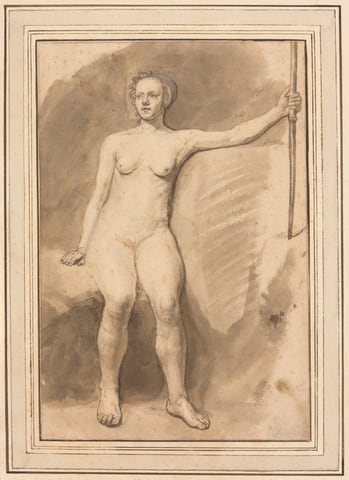
  3. A work made of pen and brown ink and brush and brown wash, with traces of black chalk and opaque white watercolor, on cream laid paper, laid down on cream laid paper.
    Seated Female NudeSamuel van Hoogstraten, 1647/78Courtesy of the Art Institute of Chicago

Third room, north wall
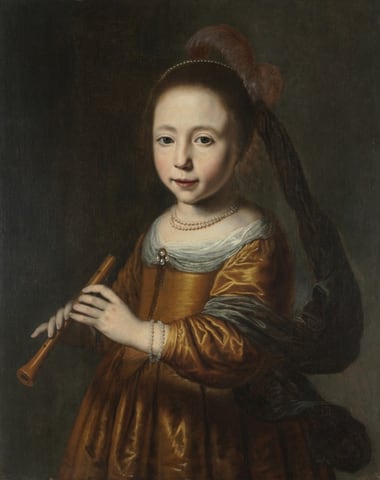
  1. Portrait of Elizabeth Spiegel, by Dirck Dircksz. Santvoort, 1639
    Portrait of Elizabeth SpiegelDirck Dircksz. Santvoort, 1639Courtesy of the Cleveland Museum of Art
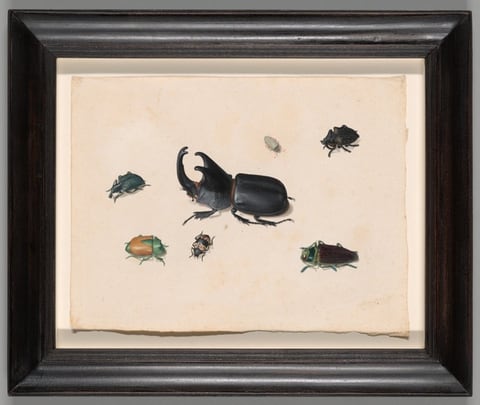
  2. A work made of watercolor and opaque watercolor on cream laid paper.
    Megasoma Elephas or Megaceras Jason and Six Other InsectsPieter Holsteyn, the younger, 1640/80Courtesy of the Art Institute of Chicago
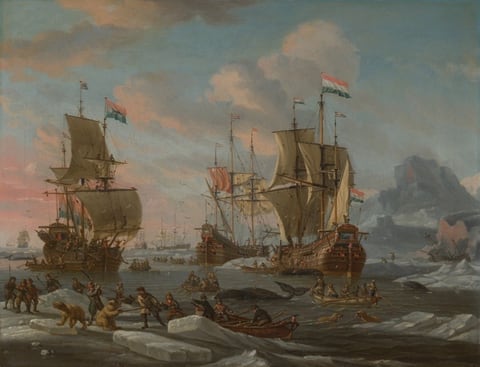
  3. A work made of oil on canvas.
    The Dutch Whaling FleetAbraham Storck, c. 1695Courtesy of the Art Institute of Chicago