Floor plan

Time and place17th-century Netherlands
17th-century Netherlands
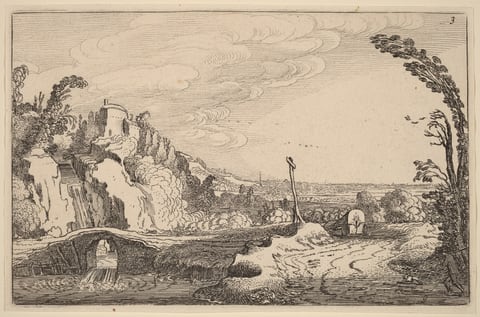
The image shows a pastoral scene in black and white with fine line work. A small bridge with a circular archway crosses a stream. A dirt path winds through the landscape flanked by grass and bushes. A rocky cliff ascends on the left with a tower-like structure partially obscured by vegetation. The horizon features a cloudy sky, with swirling lines indicating motion. In the distance, a tall, thin structure, possibly a spire or chimney, stands amid faint hills and trees. The scene conveys a serene atmosphere through hatching and cross-hatching techniques.
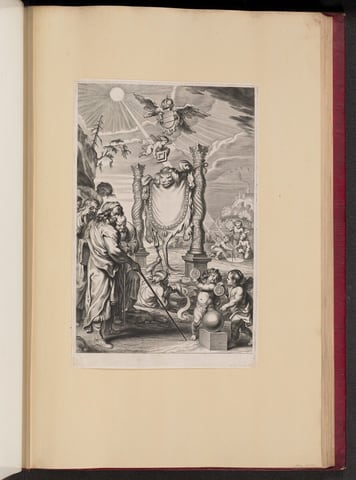
This is a drawing of a mythological or allegorical scene. The scene features various figures of different ages engaged in activities around a central structure resembling an ornate draped curtain held up by columns. There is a celestial element shining down from the top, and an emblem or coat of arms held by winged figures at the very top. The figures are dressed in flowing robes and interact with each other and objects such as a globe and a staff. The composition is rich with symbolism, typical of artwork focused on narrative depth and storytelling.
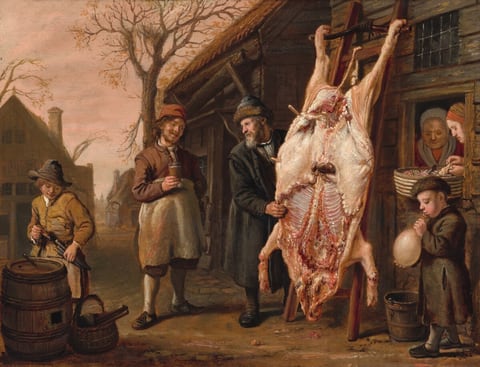
In the center of this painting, a large animal carcass is hanging upside down from a wooden frame, with several people attending to it. The carcass is light pink and has been cut open to reveal white ribs, red muscles, and purple organs. On the far left, a young boy stands next to a barrel and a basket, holding several small knives. To the right, a man in a red cap and white apron observes the carcass while holding a drink. An older man in a furred cap and dark clothing looks towards him and holds one edge of the carcass. On the other side of the animal, a young boy blows up a round object. Two women peer out from the doorway of a wooden building in the background, one holding a basket full of what looks like meat. Behind this group of people are several brown structures and a bare tree against a light pink sky.
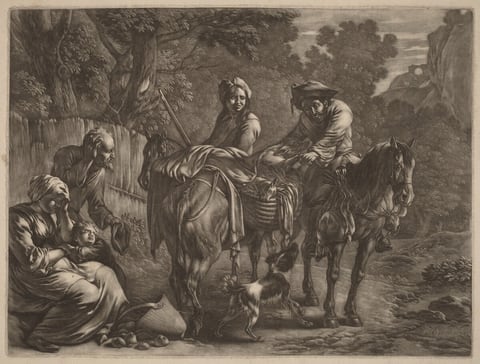
This is a drawing of a rural scene with horses and figures. The image shows an interaction between several figures and two horses within a pastoral setting. In the foreground, two individuals are seated on the ground, accompanied by a small child. Nearby, a figure atop a horse reaches towards another figure who leads a laden horse. A dog is present, standing alert at the horse's hooves. The backdrop showcases lush trees and distant hills, suggesting a serene countryside environment. The attention to detail and shading creates a realistic depiction of this rustic scene.
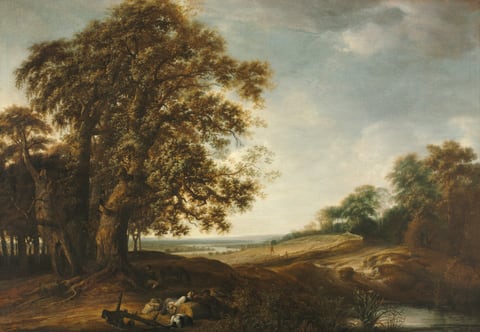
Sleeping Peasants near Fields (Parable of the Weeds), by Simon de Vlieger, 1650–53
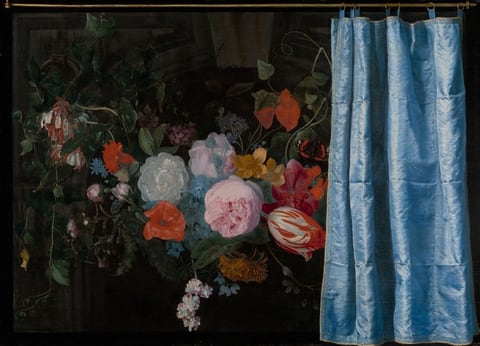
A work made of oil on panel.
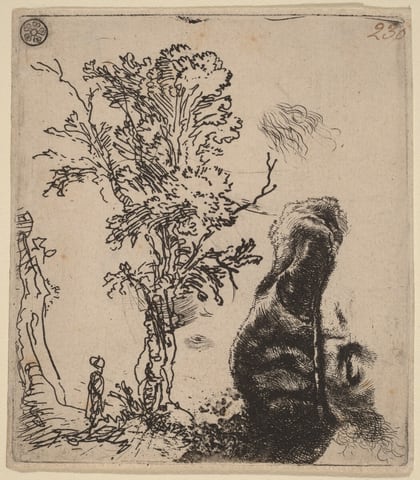
The image displays intricate, swirling lines and textured shading to create an abstract scene. On the left side are fine lines resembling branches and leaves, with a small figure nearby. On the right side is a large, densely shaded form reminiscent of mountains or a rock formation. The elements come together to suggest landscapes and nature through imaginative shapes and line work.

The works in this room are listed below.

Works in this room

Works made in the Netherlands in the 17th century.

First room, north wall

  1. The image shows a pastoral scene in black and white with fine line work. A small bridge with a circular archway crosses a stream. A dirt path winds through the landscape flanked by grass and bushes. A rocky cliff ascends on the left with a tower-like structure partially obscured by vegetation. The horizon features a cloudy sky, with swirling lines indicating motion. In the distance, a tall, thin structure, possibly a spire or chimney, stands amid faint hills and trees. The scene conveys a serene atmosphere through hatching and cross-hatching techniques.
    Cascade under a Stone BridgeJan van de Velde II, c. 1616Courtesy National Gallery of Art, Washington
  2. This is a drawing of a mythological or allegorical scene. The scene features various figures of different ages engaged in activities around a central structure resembling an ornate draped curtain held up by columns. There is a celestial element shining down from the top, and an emblem or coat of arms held by winged figures at the very top. The figures are dressed in flowing robes and interact with each other and objects such as a globe and a staff. The composition is rich with symbolism, typical of artwork focused on narrative depth and storytelling.
    Title Page for G. de St. Vincent, Opus Geometricum Quadraturae CirculiCornelis Galle II, 1647Courtesy National Gallery of Art, Washington
  3. In the center of this painting, a large animal carcass is hanging upside down from a wooden frame, with several people attending to it. The carcass is light pink and has been cut open to reveal white ribs, red muscles, and purple organs. On the far left, a young boy stands next to a barrel and a basket, holding several small knives. To the right, a man in a red cap and white apron observes the carcass while holding a drink. An older man in a furred cap and dark clothing looks towards him and holds one edge of the carcass. On the other side of the animal, a young boy blows up a round object. Two women peer out from the doorway of a wooden building in the background, one holding a basket full of what looks like meat. Behind this group of people are several brown structures and a bare tree against a light pink sky.
    The Slaughtered HogJan Victors, 1653Courtesy National Gallery of Art, Washington
  4. This is a drawing of a rural scene with horses and figures. The image shows an interaction between several figures and two horses within a pastoral setting. In the foreground, two individuals are seated on the ground, accompanied by a small child. Nearby, a figure atop a horse reaches towards another figure who leads a laden horse. A dog is present, standing alert at the horse's hooves. The backdrop showcases lush trees and distant hills, suggesting a serene countryside environment. The attention to detail and shading creates a realistic depiction of this rustic scene.
    Robbers on HorsebackJan van Huchtenburgh, late 17th/early 18th centuryCourtesy National Gallery of Art, Washington

First room, south wall

  1. Sleeping Peasants near Fields (Parable of the Weeds), by Simon de Vlieger, 1650–53
    Sleeping Peasants near Fields (Parable of the Weeds)Simon de Vlieger, 1650–53Courtesy of the Cleveland Museum of Art
  2. A work made of oil on panel.
    Trompe-l'Oeil Still Life with a Flower Garland and a CurtainAdriaen van der Spelt, 1658Courtesy of the Art Institute of Chicago
  3. The image displays intricate, swirling lines and textured shading to create an abstract scene. On the left side are fine lines resembling branches and leaves, with a small figure nearby. On the right side is a large, densely shaded form reminiscent of mountains or a rock formation. The elements come together to suggest landscapes and nature through imaginative shapes and line work.
    Sheet with Two Studies: a Tree, and the Upper Part of a Head of the Artist Wearing a Velvet CapRembrandt van Rijn, c. 1642Courtesy National Gallery of Art, Washington

Second room, south wall
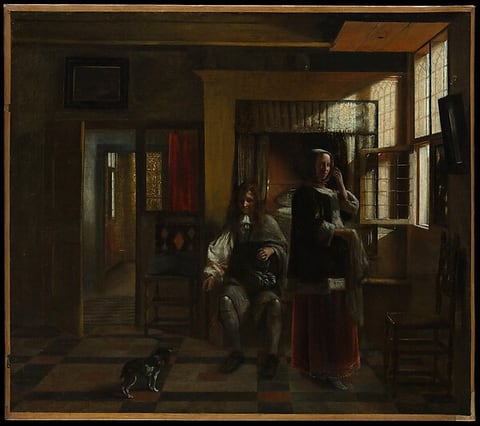
  1. Interior with a Young Couple, by Pieter de Hooch, probably ca. 1662–65
    Interior with a Young CouplePieter de Hooch, probably ca. 1662–65Courtesy of The Metropolitan Museum of Art
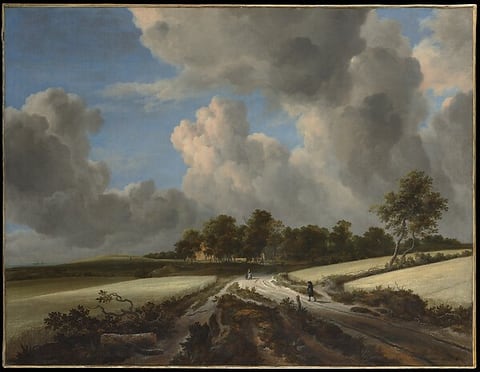
  2. Wheat Fields, by Jacob van Ruisdael, ca. 1670
    Wheat FieldsJacob van Ruisdael, ca. 1670Courtesy of The Metropolitan Museum of Art
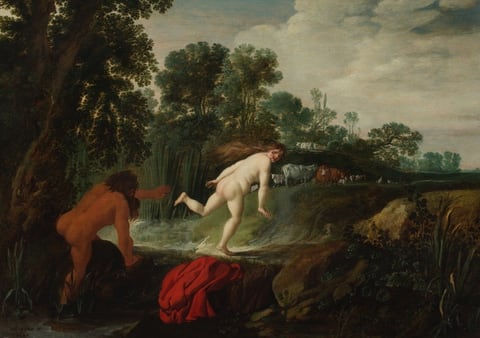
  3. A work made of oil on panel.
    Alpheus and ArethusaMoses van Uyttenbroeck, 1626Courtesy of the Art Institute of Chicago

Second room, north wall
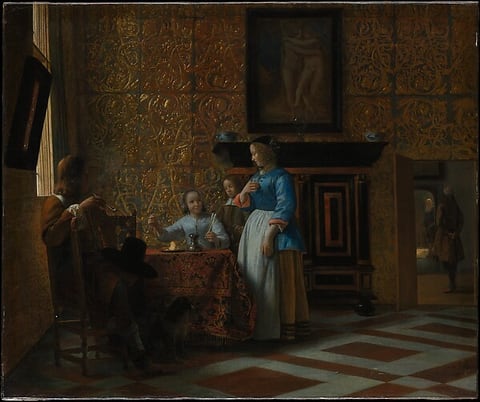
  1. Leisure Time in an Elegant Setting, by Pieter de Hooch, ca. 1663–65
    Leisure Time in an Elegant SettingPieter de Hooch, ca. 1663–65Courtesy of The Metropolitan Museum of Art
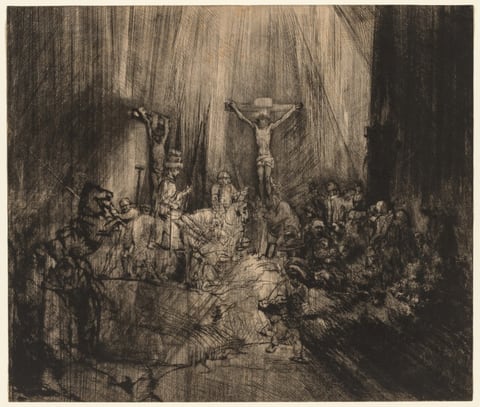
  2. Christ Crucified Between the Two Thieves: 'The Three Crosses', by Rembrandt van Rijn, 1653-c.1660
    Christ Crucified Between the Two Thieves: 'The Three Crosses'Rembrandt van Rijn, 1653-c.1660Courtesy of the Cleveland Museum of Art
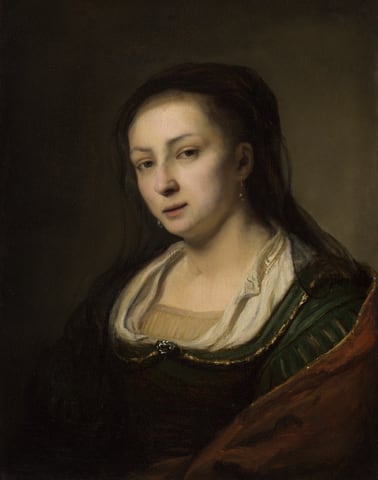
  3. A work made of oil on canvas.
    Portrait of a womanFerdinand Bol, c. 1655Courtesy of the Art Institute of Chicago
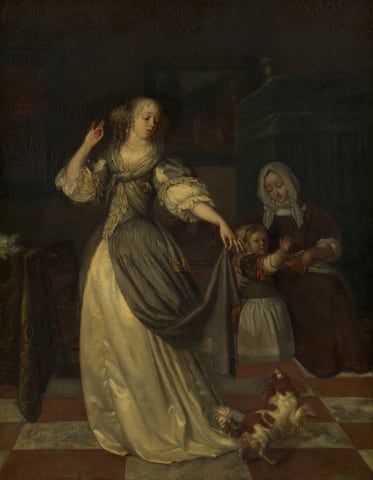
  4. A work made of oil on canvas.
    Lady Playing with a DogEglon van der Neer, c. 1670Courtesy of the Art Institute of Chicago

Third room, north wall
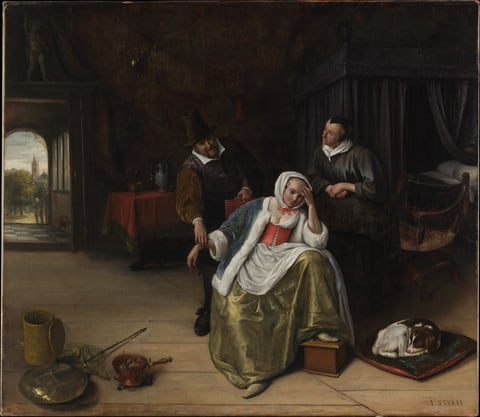
  1. The Lovesick Maiden, by Jan Steen, ca. 1660
    The Lovesick MaidenJan Steen, ca. 1660Courtesy of The Metropolitan Museum of Art
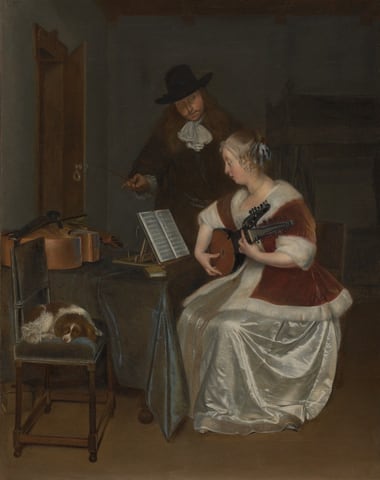
  2. A work made of oil on canvas.
    The Music LessonGerard ter Borch the Younger, c. 1670Courtesy of the Art Institute of Chicago