Floor plan

Time and place17th-century France

17th-century France

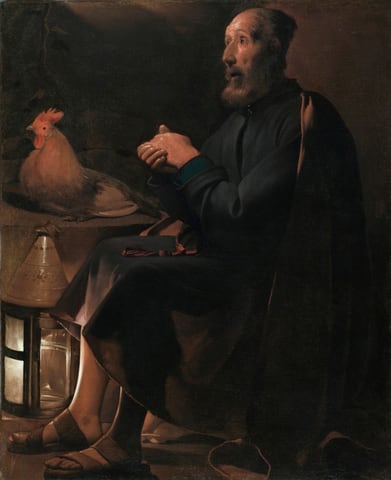
Saint Peter Repentant, by Georges de La Tour, 1645
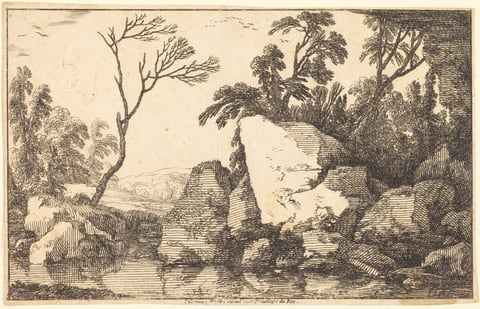
The image is a landscape view with a natural scene depicted in fine etching. The horizon is situated towards the middle of the composition, where the land gently rises, and a subtle outline of distant hills is visible. Large rocks and foliage are depicted close to us, with a lone, barren tree extending upwards on the left side. The etching features intricate and well-defined brushstrokes, including thin lines and cross-hatching to create texture and depth. The color palette is monochromatic, with dark tones against a lighter background. In the distance, additional clusters of trees can be seen, rendered with similar linework to convey movement and detail.
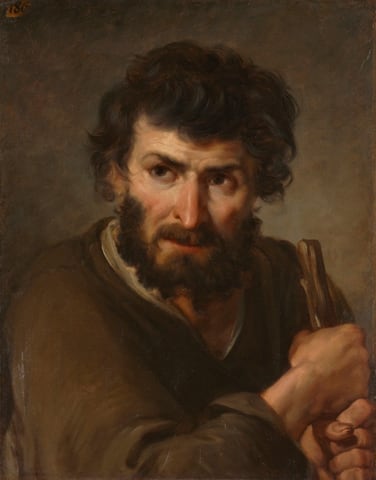
Study of a Shepherd, 1700s
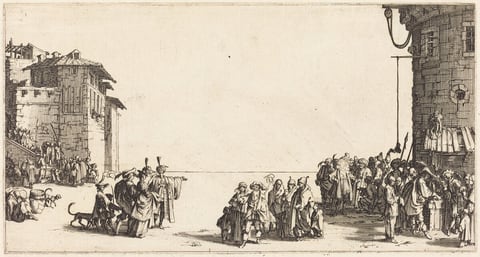
This is a drawing of a busy street scene with architectural structures and various figures. It depicts a large open area bordered by a grand building to the left and a rounded tower or structure to the right. The left side of the scene is lined with stairs leading up to an elevated walkway or platform, where people are gathered. In the middle and to the right, a crowd has formed, encompassing the space in front of the tower. Various individuals, some wearing distinctive headgear, are seen mingling and gesturing. The architectural details in the background, such as the windows and brickwork of the tower, frame the scene below. A hand-operated apparatus extends from the tower, possibly for lifting goods or supplies. The drawing captures a dynamic urban moment.
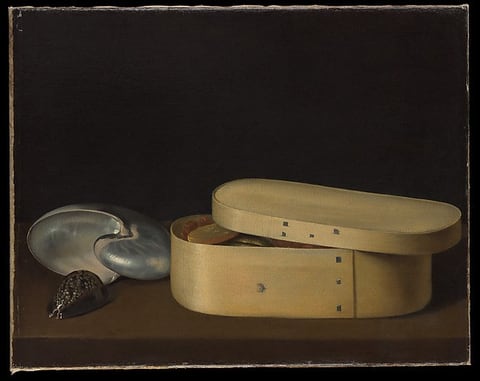
Still Life with Shells and a Chip-Wood Box, by Sebastian Stoskopff, late 1620s
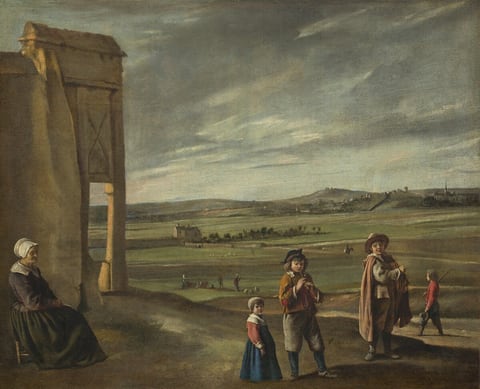
An elderly woman sits on a small stool and four children stand along the foreground of a landscape with rolling, olive-green fields leading back to low, slate-gray mountains in this nearly square painting. The horizon comes about halfway up the painting, and the sky above is filled with a sheet of steel-gray clouds that break to reveal patches of ice-blue sky. Closest to us and along the left edge of the painting, the woman sits near a structure with a fragment of wall and a column that could be made from tan-colored stone. The woman faces our right in profile and looks at or toward three children gathered on a low hill to our right. Her lined face is partially cast in shadow by her white bonnet, but her skin is yellowed where the light falls across the side closer to us. A wide, white collar lies over the shoulders of her muted, plum-purple jacket, which is tied with a narrow red belt. Her hands rest in the lap of her full, moss-green skirt that falls to her feet and covers most of the stool. To our right, two boys and a little girl stand on a low hill. They all stand with their bodies angled to our right, and all have pale skin and brown hair. To our left in the trio, the young girl wears a royal-blue dress with brick-red, long sleeves and a wide, white collar, cuffs, and cap. Next to her, a slightly older boy wearing gray knee-britches, a honey-orange jacket with a white collar, and a blue tricorn hat looks down and plays a thin pipe. His jacket is torn at the elbows, revealing a red shirt beneath. To our right, the oldest boy wears a brown cloak over a gray jacket, tan trousers, and a tan brimmed hat. He holds his right arm, closer to us, across his chest as he touches an instrument nestled in the crook of his other elbow. Another bareheaded boy wearing a red shirt and blue trousers walks beyond this trio, holding a short pole over one shoulder and a brimmed hat in his other hand. He walks to our left and looks to the horizon. More people with sheep, cows, and a person on horseback dot the rolling fields that stretch back to low hills. One house sits next to a line of trees to the left of center, in the middle distance, and more buildings, including a church spire, cluster on the horizon to our right.
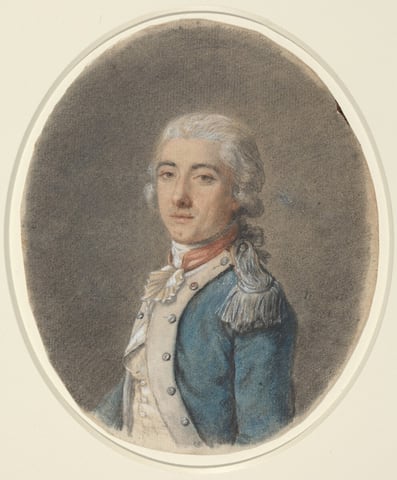
The image displays an oval portrait of a man's upper torso. He is turned slightly to the right, looking directly at the viewer with a composed expression. The man has pale skin, defined facial features, softly arched eyebrows, a subtle mustache, and styled hair in an 18th-century fashion. He wears a blue coat with white lapels, silver buttons, and a silver-fringed epaulet on the shoulder, along with a cravat and waistcoat. The background is a smooth, neutral gray.
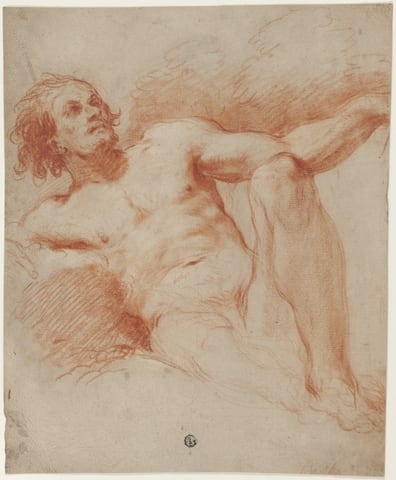
A work made of red chalk, with stumping, on tan laid paper.

The works in this room are listed below.

Works in this room

Works made in France in the 17th century.

Section 1, north wall

  1. Saint Peter Repentant, by Georges de La Tour, 1645
    Saint Peter RepentantGeorges de La Tour, 1645Courtesy of the Cleveland Museum of Art
  2. The image is a landscape view with a natural scene depicted in fine etching. The horizon is situated towards the middle of the composition, where the land gently rises, and a subtle outline of distant hills is visible. Large rocks and foliage are depicted close to us, with a lone, barren tree extending upwards on the left side. The etching features intricate and well-defined brushstrokes, including thin lines and cross-hatching to create texture and depth. The color palette is monochromatic, with dark tones against a lighter background. In the distance, additional clusters of trees can be seen, rendered with similar linework to convey movement and detail.
    A Rocky PondLaurent de La Hyre, 1640Courtesy National Gallery of Art, Washington
  3. Study of a Shepherd, 1700s
    Study of a ShepherdUnrecorded French maker, 1700sCourtesy of the Cleveland Museum of Art
  4. This is a drawing of a busy street scene with architectural structures and various figures. It depicts a large open area bordered by a grand building to the left and a rounded tower or structure to the right. The left side of the scene is lined with stairs leading up to an elevated walkway or platform, where people are gathered. In the middle and to the right, a crowd has formed, encompassing the space in front of the tower. Various individuals, some wearing distinctive headgear, are seen mingling and gesturing. The architectural details in the background, such as the windows and brickwork of the tower, frame the scene below. A hand-operated apparatus extends from the tower, possibly for lifting goods or supplies. The drawing captures a dynamic urban moment.
    The Slave MarketJacques Callot, 1620Courtesy National Gallery of Art, Washington

Section 1, south wall

  1. Still Life with Shells and a Chip-Wood Box, by Sebastian Stoskopff, late 1620s
    Still Life with Shells and a Chip-Wood BoxSebastian Stoskopff, late 1620sCourtesy of The Metropolitan Museum of Art
  2. An elderly woman sits on a small stool and four children stand along the foreground of a landscape with rolling, olive-green fields leading back to low, slate-gray mountains in this nearly square painting. The horizon comes about halfway up the painting, and the sky above is filled with a sheet of steel-gray clouds that break to reveal patches of ice-blue sky. Closest to us and along the left edge of the painting, the woman sits near a structure with a fragment of wall and a column that could be made from tan-colored stone. The woman faces our right in profile and looks at or toward three children gathered on a low hill to our right. Her lined face is partially cast in shadow by her white bonnet, but her skin is yellowed where the light falls across the side closer to us. A wide, white collar lies over the shoulders of her muted, plum-purple jacket, which is tied with a narrow red belt. Her hands rest in the lap of her full, moss-green skirt that falls to her feet and covers most of the stool. To our right, two boys and a little girl stand on a low hill. They all stand with their bodies angled to our right, and all have pale skin and brown hair. To our left in the trio, the young girl wears a royal-blue dress with brick-red, long sleeves and a wide, white collar, cuffs, and cap. Next to her, a slightly older boy wearing gray knee-britches, a honey-orange jacket with a white collar, and a blue tricorn hat looks down and plays a thin pipe. His jacket is torn at the elbows, revealing a red shirt beneath. To our right, the oldest boy wears a brown cloak over a gray jacket, tan trousers, and a tan brimmed hat. He holds his right arm, closer to us, across his chest as he touches an instrument nestled in the crook of his other elbow. Another bareheaded boy wearing a red shirt and blue trousers walks beyond this trio, holding a short pole over one shoulder and a brimmed hat in his other hand. He walks to our left and looks to the horizon. More people with sheep, cows, and a person on horseback dot the rolling fields that stretch back to low hills. One house sits next to a line of trees to the left of center, in the middle distance, and more buildings, including a church spire, cluster on the horizon to our right.
    Landscape with PeasantsLouis Le Nain, c. 1640Courtesy National Gallery of Art, Washington
  3. The image displays an oval portrait of a man's upper torso. He is turned slightly to the right, looking directly at the viewer with a composed expression. The man has pale skin, defined facial features, softly arched eyebrows, a subtle mustache, and styled hair in an 18th-century fashion. He wears a blue coat with white lapels, silver buttons, and a silver-fringed epaulet on the shoulder, along with a cravat and waistcoat. The background is a smooth, neutral gray.
    Portrait of a Man in a Military UniformUnrecorded French maker, 18th centuryCourtesy National Gallery of Art, Washington
  4. A work made of red chalk, with stumping, on tan laid paper.
    Seated Male NudeFrançois Le Moyne, n.d.Courtesy of the Art Institute of Chicago

Section 2, south wall
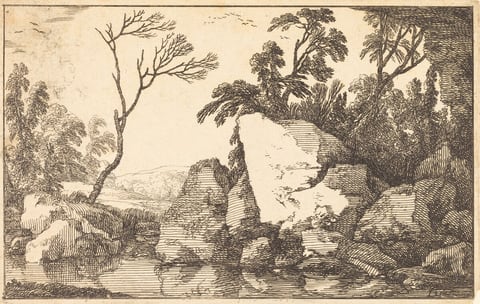
  1. The image shows a landscape with trees, rocks, and water. The perspective is slightly elevated. Rocks are prominent in the central area, with various shapes and textures. Trees and foliage are depicted with detailed brushstrokes. The color scheme is sepia, creating a warm and vintage atmosphere. The scene includes water reflecting rocks, distant hills, and faint cloud formations.
    A Rocky PondLaurent de La Hyre, 1640Courtesy National Gallery of Art, Washington
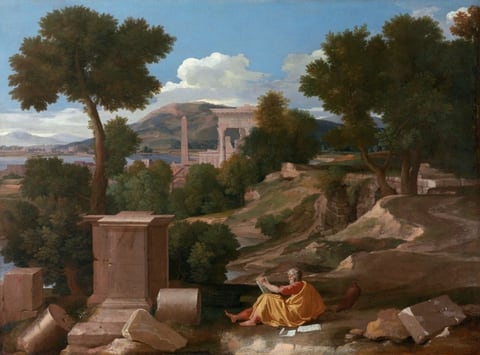
  2. Painting of Greek landscape, classical architecture, yellow, red robed man reading.
    Landscape with Saint John on PatmosNicolas Poussin, 1640Courtesy of the Art Institute of Chicago
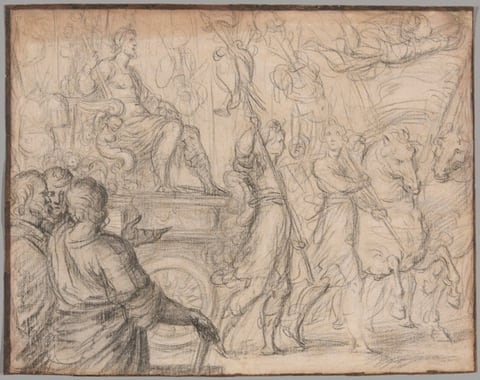
  3. A work made of black chalk, with touches of white chalk, on cream laid paper.
    A ProcessionAmbroise Dubois, c. 1610Courtesy of the Art Institute of Chicago

Section 2, north wall
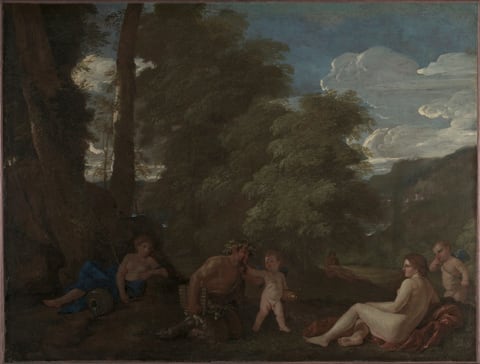
  1. Nymphs and a Satyr (Amor Vincit Omnia), by Nicolas Poussin, c. 1625–27
    Nymphs and a Satyr (Amor Vincit Omnia)Nicolas Poussin, c. 1625–27Courtesy of the Cleveland Museum of Art
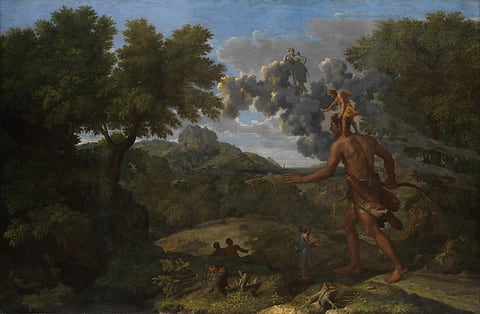
  2. Blind Orion Searching for the Rising Sun, by Nicolas Poussin, 1658
    Blind Orion Searching for the Rising SunNicolas Poussin, 1658Courtesy of The Metropolitan Museum of Art
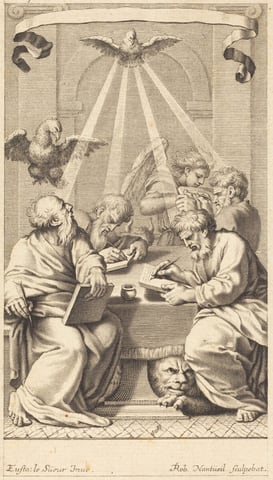
  3. The image shows four elderly men around a table. They have long hair and beards, and appear focused as they write or take notes on tablets. They wear classical robes and sit in different postures, engaged in writing or possibly calculating. Two hold writing implements and tablets, while a third holds a scroll. Above them, a seated figure with wings is present. Light rays emanate from a dove at the top, highlighting a celestial influence. An eagle is perched nearby. Architectural elements like columns and arches are in the background. A lion's head is under the table.
    The Four EvangelistsRobert NanteuilCourtesy National Gallery of Art, Washington

Section 3, north wall
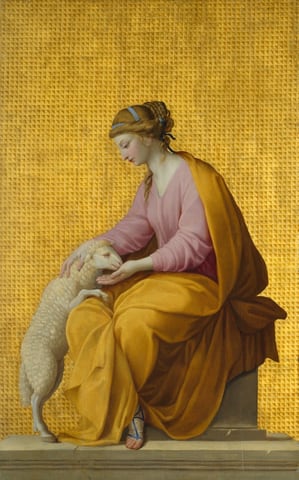
  1. A work made of oil on panel.
    MeeknessEustache Le Sueur, 1650Courtesy of the Art Institute of Chicago
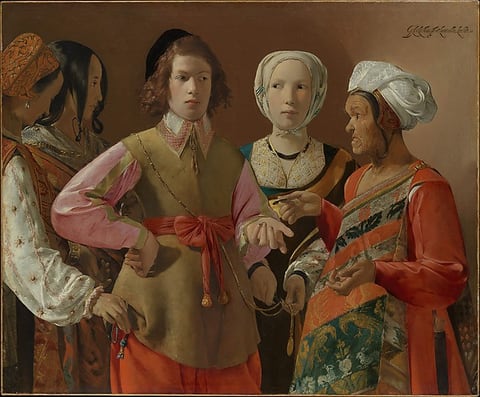
  2. The Fortune-Teller, by Georges de La Tour, probably 1630s
    The Fortune-TellerGeorges de La Tour, probably 1630sCourtesy of The Metropolitan Museum of Art