Floor plan

Time and placeThe 16th century

The 16th century

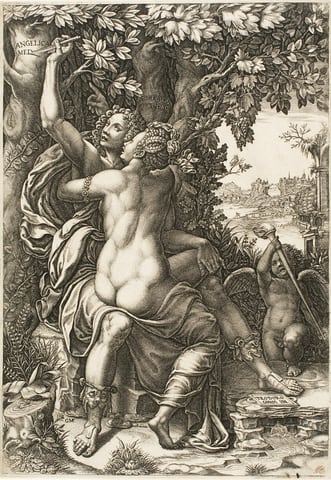
A work made of engraving in black on ivory laid paper.
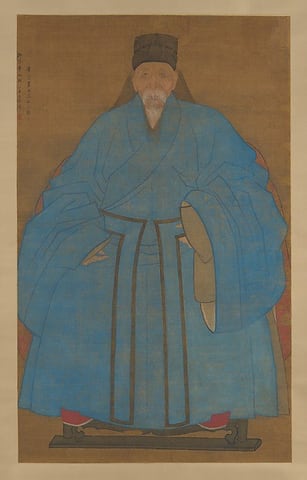
Portrait of the artist’s great-granduncle Yizhai at the age of eighty-five, by Ruan Zude, dated 1561 or 1621
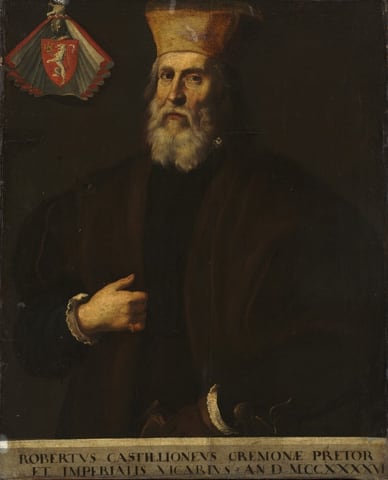
Portrait of Roberto Castiglione, early 1600s
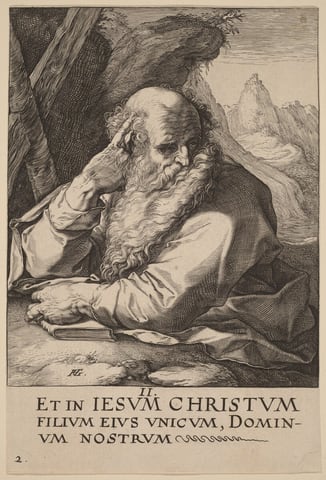
The image shows an elderly man seated from the waist up. He is angled slightly away from the viewer, resting his head on one hand and leaning on the other arm. The man has a deeply lined face, a large beard, curly hair, and appears focused on something outside the frame. He wears flowing garments and a book is under his arm. In the background, there are rugged, mountainous rock formations. Ornate text frames the image at the bottom.
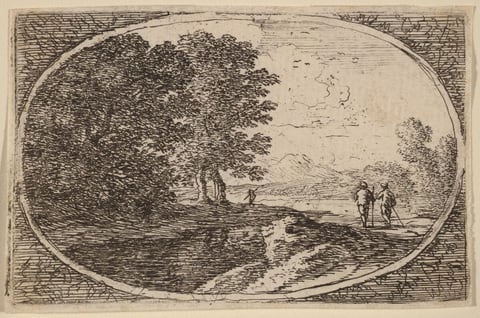
The image shows a landscape scene viewed from an elevated perspective. The horizon is low, with mountains visible in the distance. The scene features detailed brushstroke technique and a monochromatic palette. Trees dominate the left side, with two figures walking along a path towards the horizon. The color palette is black and white, accentuating details, light, and shadow.
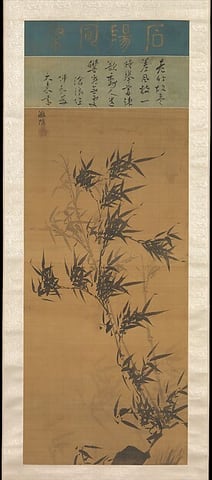
Bamboo in the Wind, by Yi Jeong (artist name: Taneun), early 17th century
Hanging scroll

The works in this room are listed below.

Works in this room

Works made in the 16th century, anywhere in the world.

First room, north wall

  1. A work made of engraving in black on ivory laid paper.
    Angelica and MedoroGiorgio Ghisi, c. 1570Courtesy of the Art Institute of Chicago
  2. Portrait of the artist’s great-granduncle Yizhai at the age of eighty-five, by Ruan Zude, dated 1561 or 1621
    Portrait of the artist’s great-granduncle Yizhai at the age of eighty-fiveRuan Zude, dated 1561 or 1621Courtesy of The Metropolitan Museum of Art
  3. Portrait of Roberto Castiglione, early 1600s
    Portrait of Roberto CastiglioneUnrecorded Italian maker, early 1600sCourtesy of the Cleveland Museum of Art

First room, south wall

  1. The image shows an elderly man seated from the waist up. He is angled slightly away from the viewer, resting his head on one hand and leaning on the other arm. The man has a deeply lined face, a large beard, curly hair, and appears focused on something outside the frame. He wears flowing garments and a book is under his arm. In the background, there are rugged, mountainous rock formations. Ornate text frames the image at the bottom.
    Saint AndrewHendrick Goltzius, probably 1589Courtesy National Gallery of Art, Washington
  2. The image shows a landscape scene viewed from an elevated perspective. The horizon is low, with mountains visible in the distance. The scene features detailed brushstroke technique and a monochromatic palette. Trees dominate the left side, with two figures walking along a path towards the horizon. The color palette is black and white, accentuating details, light, and shadow.
    Three Men Carrying StaffsHerman van SwaneveltCourtesy National Gallery of Art, Washington
  3. Bamboo in the Wind, by Yi Jeong (artist name: Taneun), early 17th century
    Bamboo in the WindYi Jeong (artist name: Taneun), early 17th centuryCourtesy of The Metropolitan Museum of Art
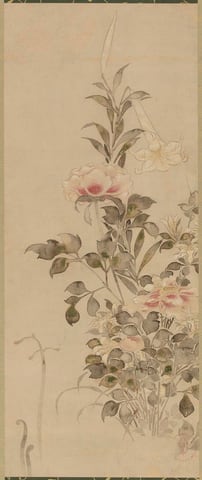
  4. Hanging scroll
    Peonies and lilies 芍薬と百合図Tawaraya Sotatsu, 1568-1615Courtesy of the National Museum of Asian Art, Smithsonian Institution

Second room, south wall
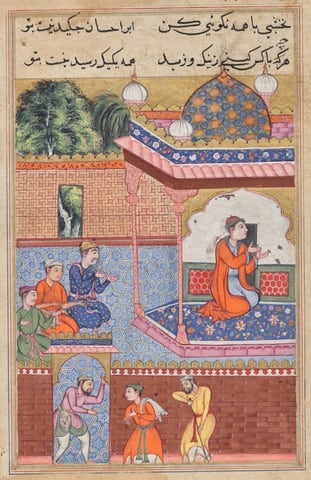
  1. Kaiwan, Latif, and Sharif arrive at a house of worship, where they seek help from Khurshid who has become a mystical healer, from a Tuti-Nama (Tales of a Parrot): Thirty-second Night, c. 1560
    Kaiwan, Latif, and Sharif arrive at a house of worship, where they seek help from Khurshid who has become a mystical healer, from a Tuti-Nama (Tales of a Parrot): Thirty-second NightUnrecorded Indian maker, c. 1560Courtesy of the Cleveland Museum of Art
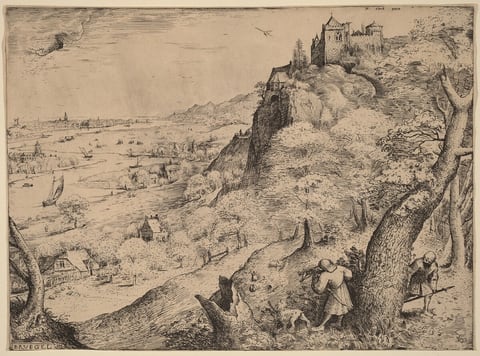
  2. The image shows a landscape with a city in the distance, a castle on a cliff, fields, forests, and two figures with a dog hunting. There are sailboats on water and houses on farmland. The style is detailed with etching lines in sepia tones.
    The Rabbit HuntersPieter Bruegel, 1560Courtesy National Gallery of Art, Washington
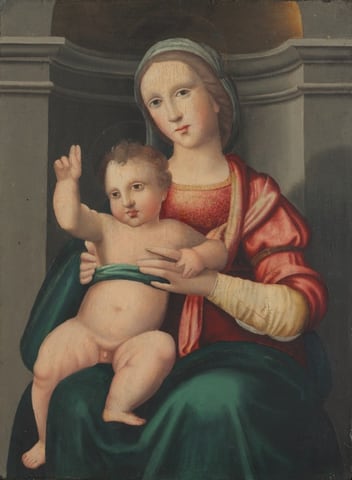
  3. Madonna and Child in a Niche, by Antonio del Ceraiolo, c. 1520s
    Madonna and Child in a NicheAntonio del Ceraiolo, c. 1520sCourtesy of the Cleveland Museum of Art
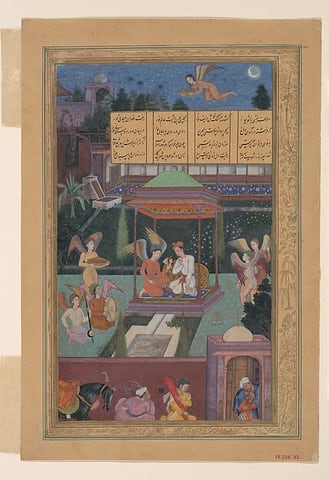
  4. "The Story of the Princess of the Blue Pavillion: The Youth of Rum Is Entertained in a Garden by a Fairy and her Maidens", Folio from a Khamsa (Quintet) of Amir Khusrau Dihlavi, by Amir Khusrau Dihlavi, 1597–98
    "The Story of the Princess of the Blue Pavillion: The Youth of Rum Is Entertained in a Garden by a Fairy and her Maidens", Folio from a Khamsa (Quintet) of Amir Khusrau DihlaviAmir Khusrau Dihlavi, 1597–98Courtesy of The Metropolitan Museum of Art

Second room, north wall
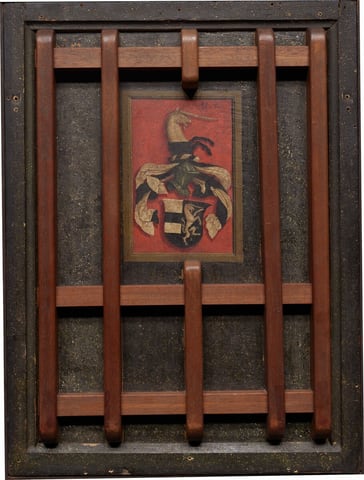
  1. This is a painting depicting a heraldic coat of arms. The image features a detailed coat of arms with a central shield, adorned with black and gold sections, and additional decorative elements above it. There is a figure resembling a unicorn emerging from the crest. The background is a deep red hue. The artwork is displayed within a wooden frame with crossbars. This style is associated with displaying family crests and lineage.
    Hans Roth [reverse]Bernhard Strigel, 1527Courtesy National Gallery of Art, Washington
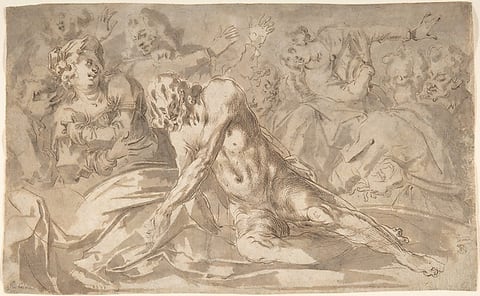
  2. The Raising of Lazarus, by Jacques Bellange, ca. 1606–8
    The Raising of LazarusJacques Bellange, ca. 1606–8Courtesy of The Metropolitan Museum of Art
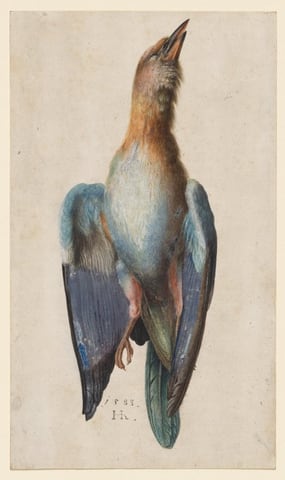
  3. Dead Blue Roller, by Hans Hoffmann, 1583
    Dead Blue RollerHans Hoffmann, 1583Courtesy of the Cleveland Museum of Art

Third room, north wall
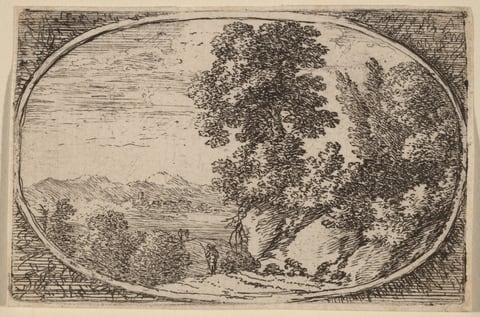
  1. The image shows a landscape viewed from above. The scene is oval, framed by tree branches on each side. Distant mountains form a boundary near the top. Delicate, finely executed lines create detailed foliage and landscape features. A winding path with a small figure adds scale. Lush trees climb upwards, with a muted color palette of the paper and dark brown and black lines providing contrast.
    The Boulder Crowned with TreesHerman van SwaneveltCourtesy National Gallery of Art, Washington
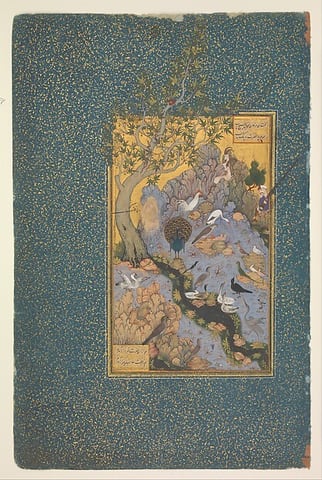
  2. "The Concourse of the Birds", Folio 11r from a Mantiq al-Tayr (Language of the Birds), by Habiballah of Sava, ca. 1600
    "The Concourse of the Birds", Folio 11r from a Mantiq al-Tayr (Language of the Birds)Habiballah of Sava, ca. 1600Courtesy of The Metropolitan Museum of Art