Floor plan

Time and placeThe 16th century

The 16th century

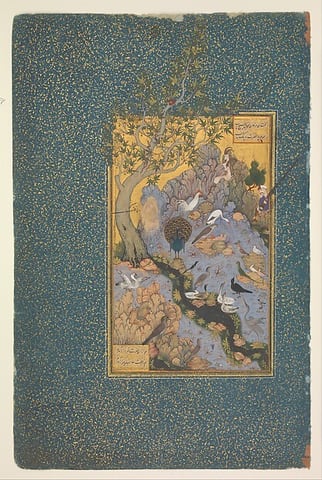
"The Concourse of the Birds", Folio 11r from a Mantiq al-Tayr (Language of the Birds), by Habiballah of Sava, ca. 1600
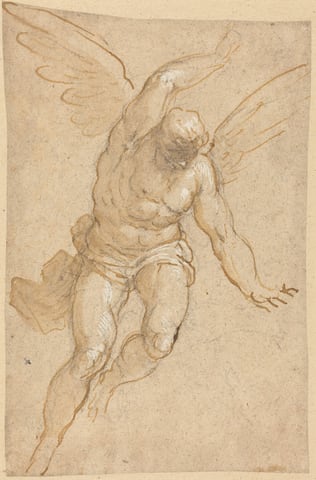
The image shows a human figure with wings positioned as though in flight. The figure is captured from a slightly frontal perspective, with the head turned downwards and the right arm outstretched. The facial features are undefined, focusing more on the body's muscular structure. The figure wears a cloth or drapery around the waist and has well-defined muscles on the chest, arms, and legs. Large wings extend out behind the figure, adding to the sense of flight. The background is plain with a light texture.
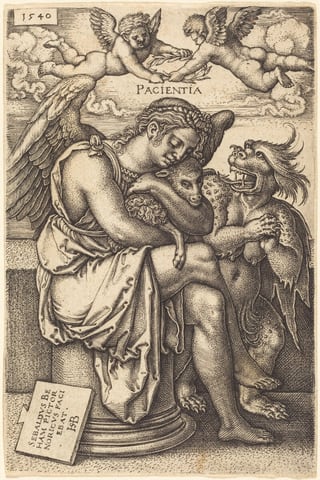
This is a drawing of a winged figure with a sheep, accompanied by a mythical creature and cherubs. The central figure is holding the sheep tenderly. On the left, two cherubs are flying with a laurel branch, under the word "PACIENTIA." On the right is a mythical creature with dragon-like features. Below the scene, a plaque with an inscription is placed against the pedestal. The artwork is detailed with lines, cross-hatching, and shading, accentuating textures and forms.
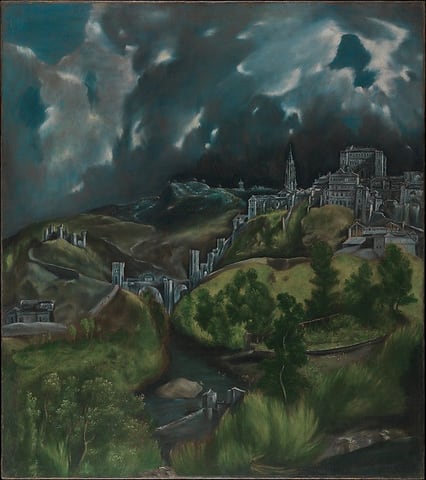
View of Toledo, by El Greco, ca. 1599–1600
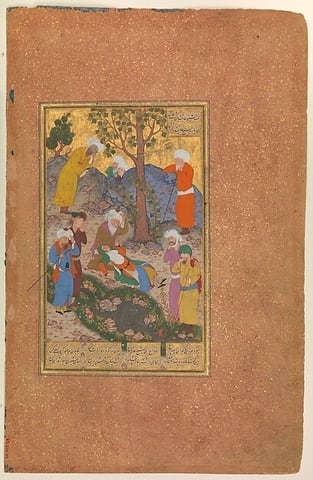
"Shaikh San'an and the Christian Maiden", Folio 22v from a Mantiq al-Tayr (Language of the Birds), by Farid al-Din `Attar, ca. 1600
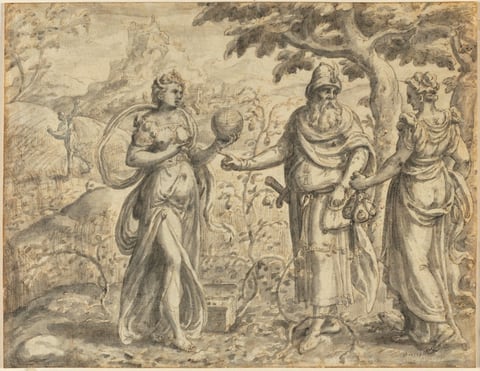
The Seed Received among the Thorns, from the Parable of the Sower, by Gerard P. van Groningen, c. 1573
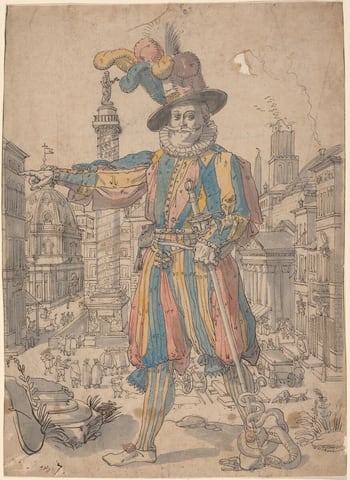
The artwork features a person standing prominently in front of an architectural scene. The individual has one arm extended out to the side, pointing with a gloved hand. The other hand holds a staff with a snake wrapped around it. The person has a stern facial expression, a beard and mustache, and wears a large hat with colorful feathers. They are dressed in a colorful suit with vertical stripes in red, blue, and yellow, paired with a ruffled collar and cuffs. The person also has an oversized sword at their hip. In the background, there is a Renaissance-style cityscape with architectural elements, people, and horse-drawn carriages.
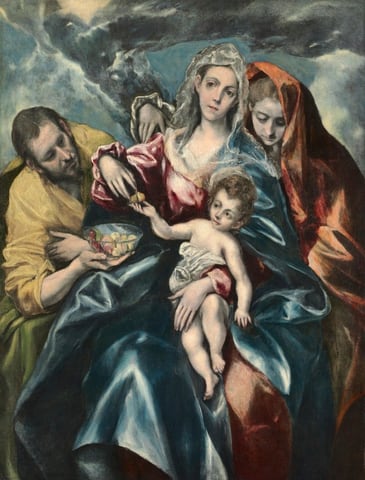
The Holy Family with Mary Magdalen, by El Greco, c. 1590–95

The works in this room are listed below.

Works in this room

Works made in the 16th century, anywhere in the world.

First room, north wall

  1. "The Concourse of the Birds", Folio 11r from a Mantiq al-Tayr (Language of the Birds), by Habiballah of Sava, ca. 1600
    "The Concourse of the Birds", Folio 11r from a Mantiq al-Tayr (Language of the Birds)Habiballah of Sava, ca. 1600Courtesy of The Metropolitan Museum of Art
  2. The image shows a human figure with wings positioned as though in flight. The figure is captured from a slightly frontal perspective, with the head turned downwards and the right arm outstretched. The facial features are undefined, focusing more on the body's muscular structure. The figure wears a cloth or drapery around the waist and has well-defined muscles on the chest, arms, and legs. Large wings extend out behind the figure, adding to the sense of flight. The background is plain with a light texture.
    A Flying AngelJacopo Palma il Giovane, 1580/1590Courtesy National Gallery of Art, Washington
  3. This is a drawing of a winged figure with a sheep, accompanied by a mythical creature and cherubs. The central figure is holding the sheep tenderly. On the left, two cherubs are flying with a laurel branch, under the word "PACIENTIA." On the right is a mythical creature with dragon-like features. Below the scene, a plaque with an inscription is placed against the pedestal. The artwork is detailed with lines, cross-hatching, and shading, accentuating textures and forms.
    Pacientia (Patience)Sebald Beham, 1540Courtesy National Gallery of Art, Washington
  4. View of Toledo, by El Greco, ca. 1599–1600
    View of ToledoEl Greco, ca. 1599–1600Courtesy of The Metropolitan Museum of Art

First room, south wall

  1. "Shaikh San'an and the Christian Maiden", Folio 22v from a Mantiq al-Tayr (Language of the Birds), by Farid al-Din `Attar, ca. 1600
    "Shaikh San'an and the Christian Maiden", Folio 22v from a Mantiq al-Tayr (Language of the Birds)Farid al-Din `Attar, ca. 1600Courtesy of The Metropolitan Museum of Art
  2. The Seed Received among the Thorns, from the Parable of the Sower, by Gerard P. van Groningen, c. 1573
    The Seed Received among the Thorns, from the Parable of the SowerGerard P. van Groningen, c. 1573Courtesy of the Cleveland Museum of Art
  3. The artwork features a person standing prominently in front of an architectural scene. The individual has one arm extended out to the side, pointing with a gloved hand. The other hand holds a staff with a snake wrapped around it. The person has a stern facial expression, a beard and mustache, and wears a large hat with colorful feathers. They are dressed in a colorful suit with vertical stripes in red, blue, and yellow, paired with a ruffled collar and cuffs. The person also has an oversized sword at their hip. In the background, there is a Renaissance-style cityscape with architectural elements, people, and horse-drawn carriages.
    Giovanni Grosso of the Swiss Guards Standing before a View of RomeUnrecorded Swiss makerCourtesy National Gallery of Art, Washington
  4. The Holy Family with Mary Magdalen, by El Greco, c. 1590–95
    The Holy Family with Mary MagdalenEl Greco, c. 1590–95Courtesy of the Cleveland Museum of Art

Second room, south wall
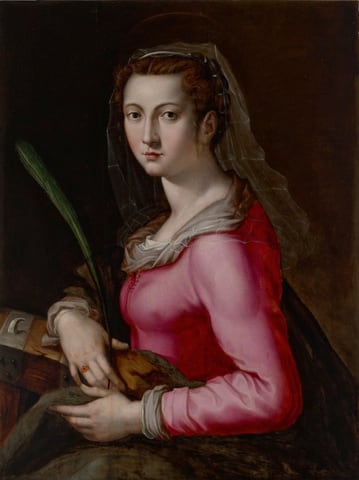
  1. Portrait of a Woman as Saint Catherine, by Pier Francesco Foschi, c. 1560
    Portrait of a Woman as Saint CatherinePier Francesco Foschi, c. 1560Courtesy of the Cleveland Museum of Art
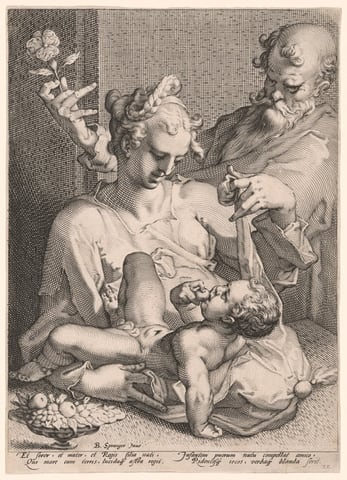
  2. A work made of engraving on laid paper.
    The Holy FamilyPieter de Jode, I, c. 1585-1595Courtesy of the Art Institute of Chicago
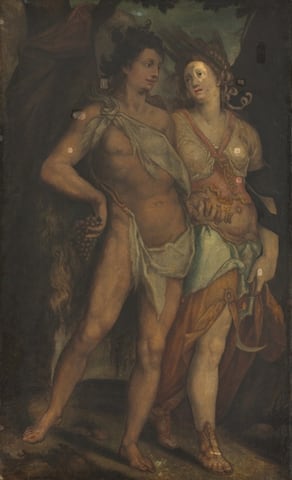
  3. Ceres and Bacchus, by Bartholomaeus Spranger, 1600s
    Ceres and BacchusBartholomaeus Spranger, 1600sCourtesy of the Cleveland Museum of Art
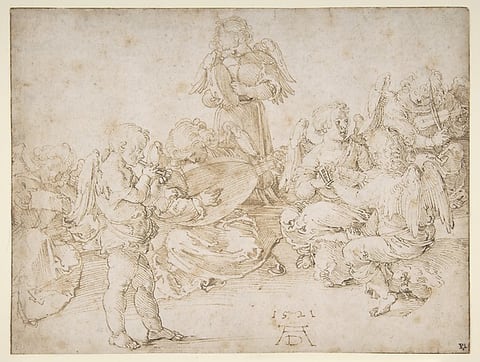
  4. Music-Making Angels, by Albrecht Dürer, 1521
    Music-Making AngelsAlbrecht Dürer, 1521Courtesy of The Metropolitan Museum of Art

Second room, north wall
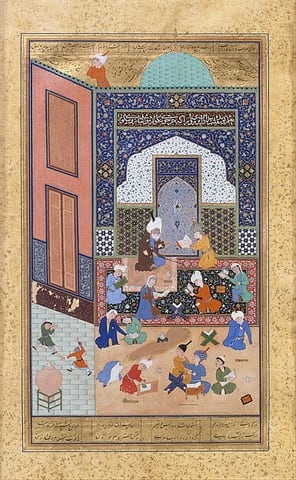
  1. "Laila and Majnun in School", Folio 129 from a Khamsa (Quintet) of Nizami of Ganja, by Nizami, dated 931 AH/1524–25 CE
    "Laila and Majnun in School", Folio 129 from a Khamsa (Quintet) of Nizami of GanjaNizami, dated 931 AH/1524–25 CECourtesy of The Metropolitan Museum of Art
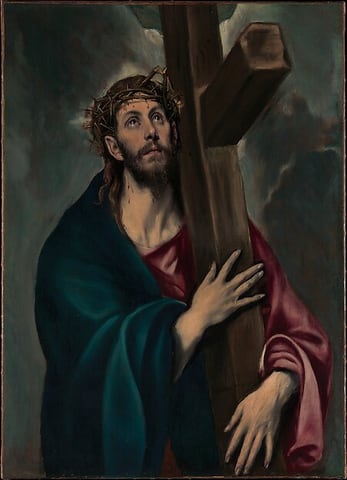
  2. Christ Carrying the Cross, by El Greco, ca. 1577–87
    Christ Carrying the CrossEl Greco, ca. 1577–87Courtesy of The Metropolitan Museum of Art
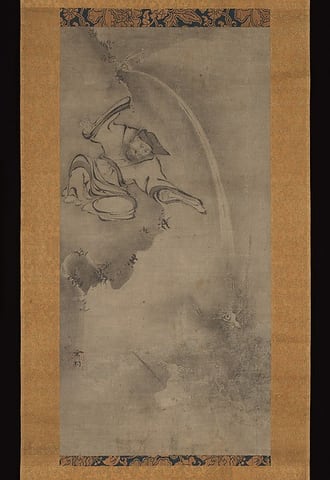
  3. Daoist Master Fei Zhangfang, by Sesson Shūkei, ca. 1555–61
    Daoist Master Fei ZhangfangSesson Shūkei, ca. 1555–61Courtesy of The Metropolitan Museum of Art
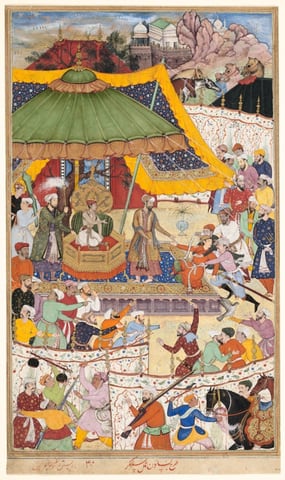
  4. A work made of opaque watercolor and gold on paper.
    The Young Emperor Akbar Arrests the Insolent Shah Abu’l-Maali, Page from a Manuscript of the AkbarnamaBasawan, Mughal dynasty (1526-1857), c. 1590-1595Courtesy of the Art Institute of Chicago