Floor plan

Time and place16th-century India

16th-century India

A work made of opaque watercolor and gold on paper.
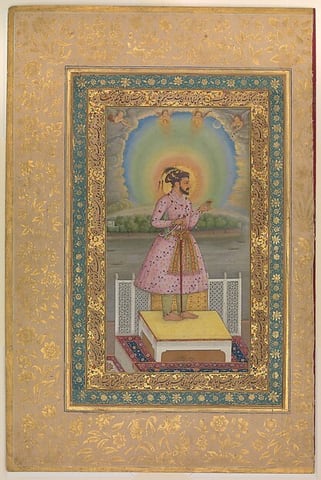
"Shah Jahan on a Terrace, Holding a Pendant Set With His Portrait", Folio from the Shah Jahan Album, by Chitarman, recto: dated 1627–28; verso: ca. 1530–50
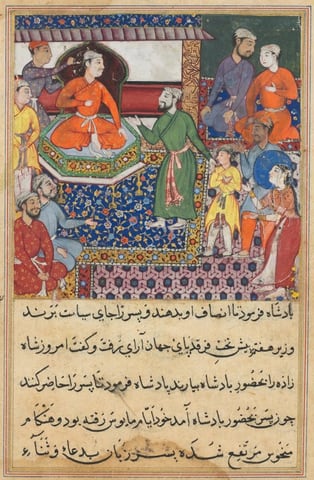
The handmaiden again pleads for the death of the prince, from a Tuti-nama (Tales of a Parrot): Eighth Night, by Lalu, c. 1560
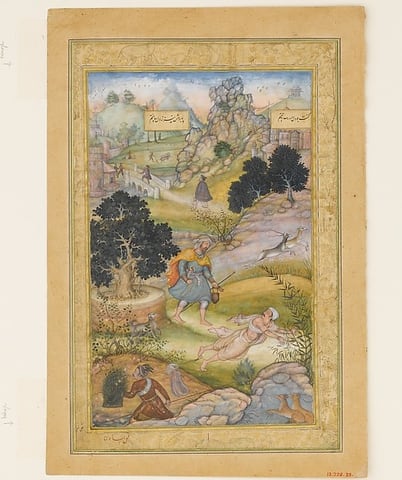
"A Muslim Pilgrim Learns a Lesson in Piety from a Brahman", Folio from a Khamsa (Quintet) of Amir Khusrau Dihlavi, by Amir Khusrau Dihlavi, 1597–98
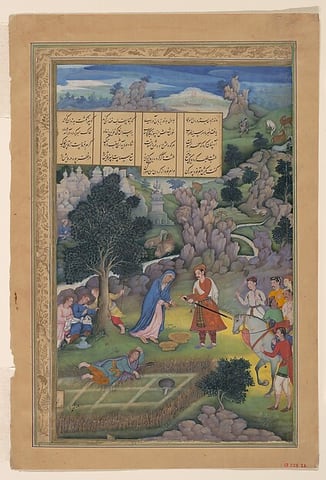
"A King Offers to Make Amends to a Bereaved Mother", Folio from a Khamsa (Quintet) of Amir Khusrau Dihlavi, by Amir Khusrau Dihlavi, 1597–98
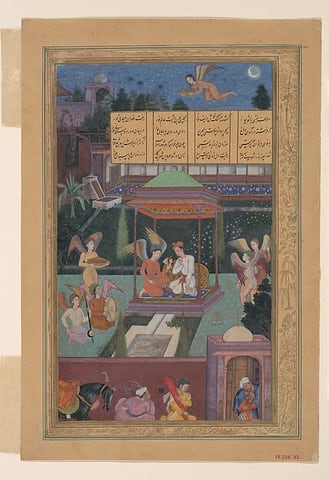
"The Story of the Princess of the Blue Pavillion: The Youth of Rum Is Entertained in a Garden by a Fairy and her Maidens", Folio from a Khamsa (Quintet) of Amir Khusrau Dihlavi, by Amir Khusrau Dihlavi, 1597–98
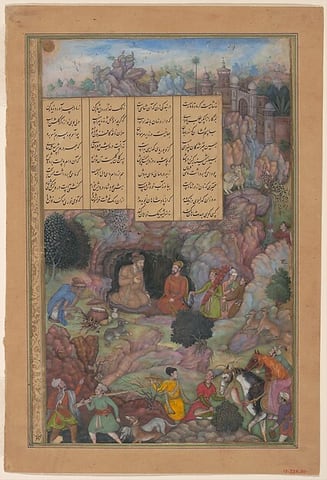
"Alexander Visits the Sage Plato in his Mountain Cave", Folio from a Khamsa (Quintet) of Amir Khusrau Dihlavi, by Amir Khusrau Dihlavi, 1597–98
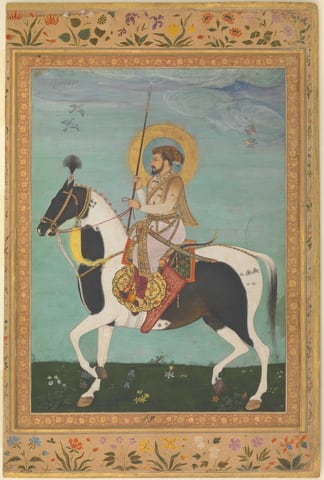
"Shah Jahan on Horseback", Folio from the Shah Jahan Album, by Payag, verso: ca. 1630; recto: ca. 1530–50

The works in this room are listed below.

Works in this room

Works made in India in the 16th century.

First room, north wall

  1. A work made of opaque watercolor and gold on paper.
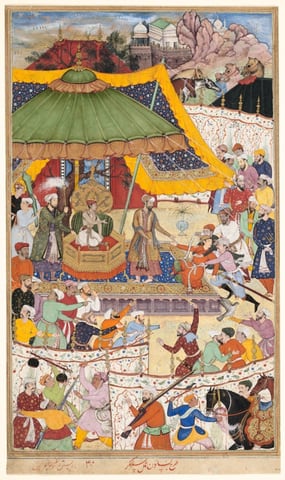
    The Young Emperor Akbar Arrests the Insolent Shah Abu’l-Maali, Page from a Manuscript of the AkbarnamaBasawan, Mughal dynasty (1526-1857), c. 1590-1595Courtesy of the Art Institute of Chicago
  2. "Shah Jahan on a Terrace, Holding a Pendant Set With His Portrait", Folio from the Shah Jahan Album, by Chitarman, recto: dated 1627–28; verso: ca. 1530–50
    "Shah Jahan on a Terrace, Holding a Pendant Set With His Portrait", Folio from the Shah Jahan AlbumChitarman, recto: dated 1627–28; verso: ca. 1530–50Courtesy of The Metropolitan Museum of Art
  3. The handmaiden again pleads for the death of the prince, from a Tuti-nama (Tales of a Parrot): Eighth Night, by Lalu, c. 1560
    The handmaiden again pleads for the death of the prince, from a Tuti-nama (Tales of a Parrot): Eighth NightLalu, c. 1560Courtesy of the Cleveland Museum of Art
  4. "A Muslim Pilgrim Learns a Lesson in Piety from a Brahman", Folio from a Khamsa (Quintet) of Amir Khusrau Dihlavi, by Amir Khusrau Dihlavi, 1597–98
    "A Muslim Pilgrim Learns a Lesson in Piety from a Brahman", Folio from a Khamsa (Quintet) of Amir Khusrau DihlaviAmir Khusrau Dihlavi, 1597–98Courtesy of The Metropolitan Museum of Art

First room, south wall

  1. "A King Offers to Make Amends to a Bereaved Mother", Folio from a Khamsa (Quintet) of Amir Khusrau Dihlavi, by Amir Khusrau Dihlavi, 1597–98
    "A King Offers to Make Amends to a Bereaved Mother", Folio from a Khamsa (Quintet) of Amir Khusrau DihlaviAmir Khusrau Dihlavi, 1597–98Courtesy of The Metropolitan Museum of Art
  2. "The Story of the Princess of the Blue Pavillion: The Youth of Rum Is Entertained in a Garden by a Fairy and her Maidens", Folio from a Khamsa (Quintet) of Amir Khusrau Dihlavi, by Amir Khusrau Dihlavi, 1597–98
    "The Story of the Princess of the Blue Pavillion: The Youth of Rum Is Entertained in a Garden by a Fairy and her Maidens", Folio from a Khamsa (Quintet) of Amir Khusrau DihlaviAmir Khusrau Dihlavi, 1597–98Courtesy of The Metropolitan Museum of Art
  3. "Alexander Visits the Sage Plato in his Mountain Cave", Folio from a Khamsa (Quintet) of Amir Khusrau Dihlavi, by Amir Khusrau Dihlavi, 1597–98
    "Alexander Visits the Sage Plato in his Mountain Cave", Folio from a Khamsa (Quintet) of Amir Khusrau DihlaviAmir Khusrau Dihlavi, 1597–98Courtesy of The Metropolitan Museum of Art
  4. "Shah Jahan on Horseback", Folio from the Shah Jahan Album, by Payag, verso: ca. 1630; recto: ca. 1530–50
    "Shah Jahan on Horseback", Folio from the Shah Jahan AlbumPayag, verso: ca. 1630; recto: ca. 1530–50Courtesy of The Metropolitan Museum of Art

Second room, south wall
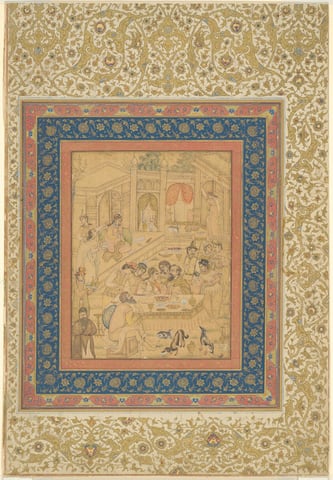
  1. A work made of opaque watercolor and gold on paper.
    European Banquet Scene (or The Marriage Feast at Cana?)Mughal, Mughal period, c. 1600Courtesy of the Art Institute of Chicago
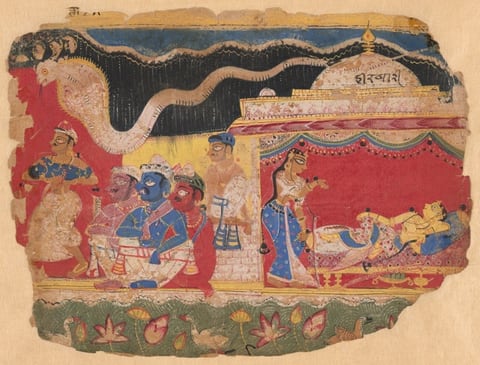
  2. A work made of opaque watercolor on paper.
    The Infant Krishna Spirited Away by Vasudev, from a copy of the Dispersed Bhagavat PuranaUnrecorded Indian maker, c. 1520–1530Courtesy of the Art Institute of Chicago
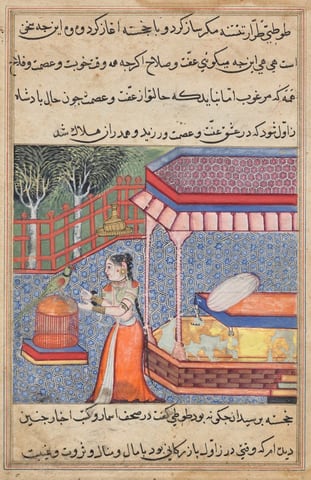
  3. The parrot addresses Khujasta at the beginning of the thirty-sixth night, from a Tuti-nama (Tales of a Parrot), c. 1560
    The parrot addresses Khujasta at the beginning of the thirty-sixth night, from a Tuti-nama (Tales of a Parrot)Unrecorded Indian maker, c. 1560Courtesy of the Cleveland Museum of Art
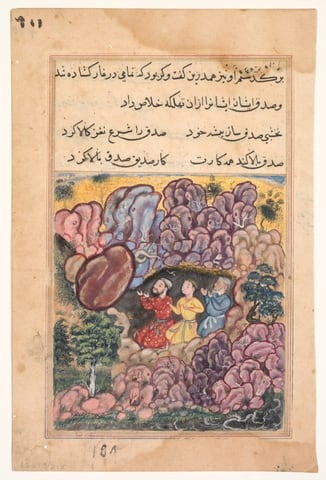
  4. The tale of the three men trapped in a cave by a rolling boulder, from a Tuti-nama (Tales of a Parrot): Thirty-second Night, by Bihzad, c. 1560
    The tale of the three men trapped in a cave by a rolling boulder, from a Tuti-nama (Tales of a Parrot): Thirty-second NightBihzad, c. 1560Courtesy of the Cleveland Museum of Art

Second room, north wall
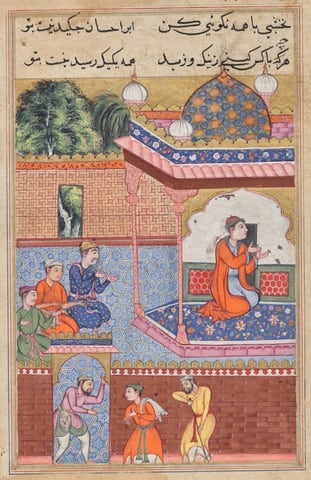
  1. Kaiwan, Latif, and Sharif arrive at a house of worship, where they seek help from Khurshid who has become a mystical healer, from a Tuti-Nama (Tales of a Parrot): Thirty-second Night, c. 1560
    Kaiwan, Latif, and Sharif arrive at a house of worship, where they seek help from Khurshid who has become a mystical healer, from a Tuti-Nama (Tales of a Parrot): Thirty-second NightUnrecorded Indian maker, c. 1560Courtesy of the Cleveland Museum of Art
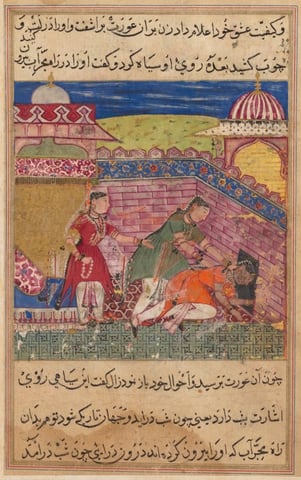
  2. The deceitful wife ejects the procuress after blackening her face, from a Tuti-nama (Tales of a Parrot): Eighth Night, by Shravana, c. 1560
    The deceitful wife ejects the procuress after blackening her face, from a Tuti-nama (Tales of a Parrot): Eighth NightShravana, c. 1560Courtesy of the Cleveland Museum of Art
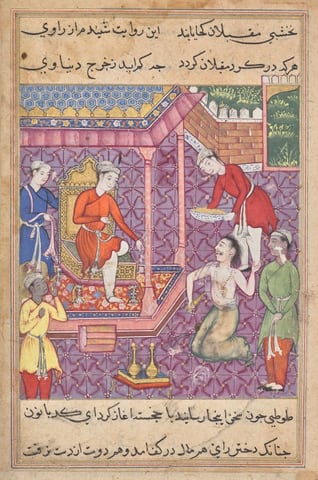
  3. The magician disguised as a Brahman returns to claim his “daughter-in-law,” from a Tuti-nama (Tales of a Parrot): Thirty-fifth Night, c. 1560
    The magician disguised as a Brahman returns to claim his “daughter-in-law,” from a Tuti-nama (Tales of a Parrot): Thirty-fifth NightUnrecorded Indian maker, c. 1560Courtesy of the Cleveland Museum of Art
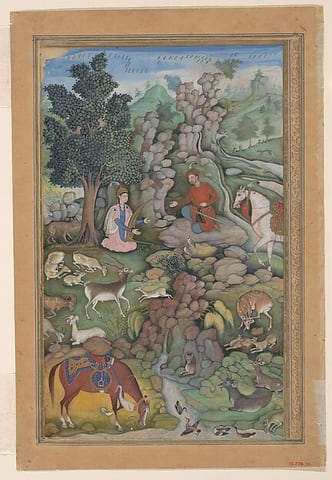
  4. "Bahram Gur Sees a Herd of Deer Mesmerized by Dilaram' s Music", Folio from a Khamsa (Quintet) of Amir Khusrau Dihlavi, by Amir Khusrau Dihlavi, 1597–98
    "Bahram Gur Sees a Herd of Deer Mesmerized by Dilaram' s Music", Folio from a Khamsa (Quintet) of Amir Khusrau DihlaviAmir Khusrau Dihlavi, 1597–98Courtesy of The Metropolitan Museum of Art