Floor plan

Time and place15th-century Italy

15th-century Italy

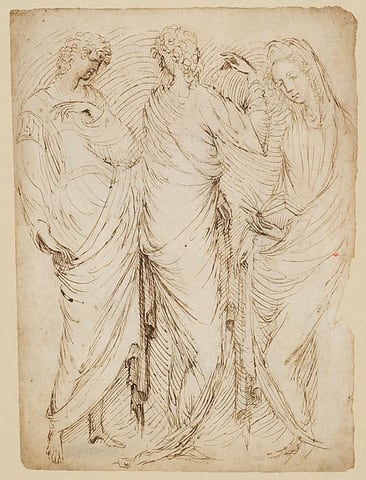
Three Standing Figures (recto); Seated Woman and a Male Hermit in Half-length (verso), by Stefano da Verona (Stefano di Giovanni d'Arbosio di Francia), 1435–38
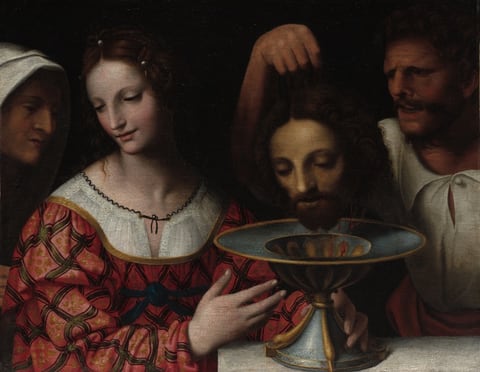
Salome with the Head of Saint John the Baptist, by Bernardino Luini, 1500s or later
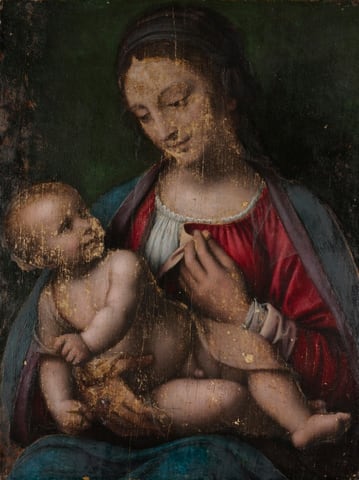
Virgin and Child, by Bernardino Luini, 1500s
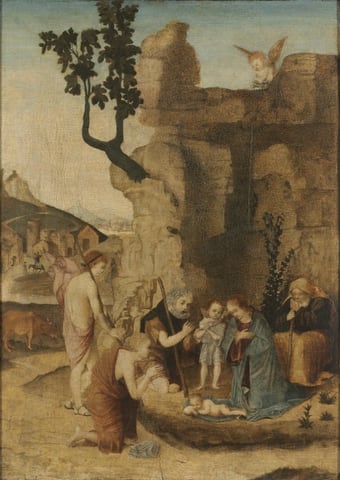
Adoration of the Shepherds, c. 1500
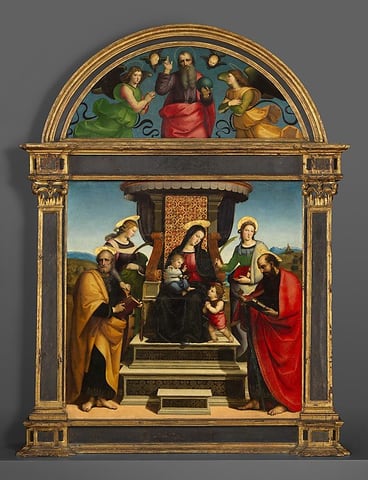
Madonna and Child Enthroned with Saints, by Raphael, ca. 1504
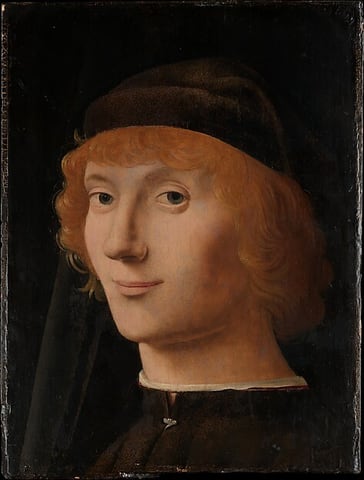
Portrait of a Young Man, by Antonello da Messina (Antonello di Giovanni d'Antonio), ca. 1470
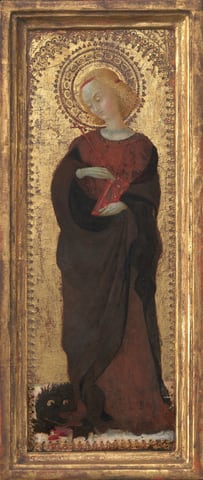
This painting shows a person standing, their body turned to us, with their head looking downward to the left. The person has pale skin, round, rosy cheeks, and wavy yellow hair surrounded by a golden halo with intricate patterns. They are wearing a dark robe over a dark red dress or tunic and holding a long, thin red cross in one hand, while the other hand holds a closed red book. At their feet lies a black dog-like animal with wide yellow eyes. The scene is set against a golden textured background within a gilded border.
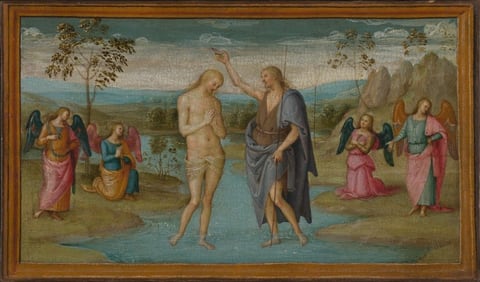
A work made of tempera on panel, transferred to canvas.

The works in this room are listed below.

Works in this room

Works made in Italy in the 15th century.

Section 1, north wall

  1. Three Standing Figures (recto); Seated Woman and a Male Hermit in Half-length (verso), by Stefano da Verona (Stefano di Giovanni d'Arbosio di Francia), 1435–38
    Three Standing Figures (recto); Seated Woman and a Male Hermit in Half-length (verso)Stefano da Verona (Stefano di Giovanni d'Arbosio di Francia), 1435–38Courtesy of The Metropolitan Museum of Art
  2. Salome with the Head of Saint John the Baptist, by Bernardino Luini, 1500s or later
    Salome with the Head of Saint John the BaptistBernardino Luini, 1500s or laterCourtesy of the Cleveland Museum of Art
  3. Virgin and Child, by Bernardino Luini, 1500s
    Virgin and ChildBernardino Luini, 1500sCourtesy of the Cleveland Museum of Art
  4. Adoration of the Shepherds, c. 1500
    Adoration of the ShepherdsUnrecorded Italian maker, c. 1500Courtesy of the Cleveland Museum of Art

Section 1, south wall

  1. Madonna and Child Enthroned with Saints, by Raphael, ca. 1504
    Madonna and Child Enthroned with SaintsRaphael, ca. 1504Courtesy of The Metropolitan Museum of Art
  2. Portrait of a Young Man, by Antonello da Messina (Antonello di Giovanni d'Antonio), ca. 1470
    Portrait of a Young ManAntonello da Messina (Antonello di Giovanni d'Antonio), ca. 1470Courtesy of The Metropolitan Museum of Art
  3. This painting shows a person standing, their body turned to us, with their head looking downward to the left. The person has pale skin, round, rosy cheeks, and wavy yellow hair surrounded by a golden halo with intricate patterns. They are wearing a dark robe over a dark red dress or tunic and holding a long, thin red cross in one hand, while the other hand holds a closed red book. At their feet lies a black dog-like animal with wide yellow eyes. The scene is set against a golden textured background within a gilded border.
    Saint MargaretSassetta, c. 1435Courtesy National Gallery of Art, Washington
  4. A work made of tempera on panel, transferred to canvas.
    The Baptism of ChristPerugino, 1500–05Courtesy of the Art Institute of Chicago

Section 2, south wall
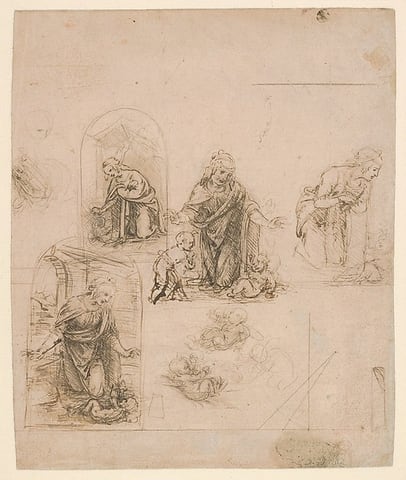
  1. Compositional Sketches for the Virgin Adoring the Christ Child, with and without the Infant St. John the Baptist; Diagram of a Perspectival Projection (recto); Slight Doodles (verso), by Leonardo da Vinci, 1480–85
    Compositional Sketches for the Virgin Adoring the Christ Child, with and without the Infant St. John the Baptist; Diagram of a Perspectival Projection (recto); Slight Doodles (verso)Leonardo da Vinci, 1480–85Courtesy of The Metropolitan Museum of Art
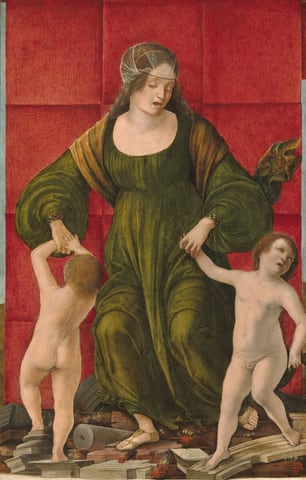
  2. A woman holds the hands of two nude children in front of a crimson-red cloth in this vertical painting. All three have pale skin and brown hair. The woman wears a forest-green dress with voluminous sleeves and a gauzy white headdress that wraps around her hair and is fastened with a band across her forehead. She stands crouching with one foot extended slightly forward in a sandal, surrounded by broken chunks of masonry and bits of burning logs. Her body faces us but she turns her head to the right. Her mouth is wide open, and her eyes cut back to our left. The woman clutches the children’s hands in both of her own. The child to our left turns away from us and reaches one hand up to touch the back of the woman’s hand. The child on the right twists away from the woman, eyes squinted up and to the right and mouth open. Behind them, fold lines create a grid across the red cloth. Slivers of grass and blue sky line each side of the composition.
    The Wife of Hasdrubal and Her ChildrenErcole de' Roberti, c. 1490/1493Courtesy National Gallery of Art, Washington
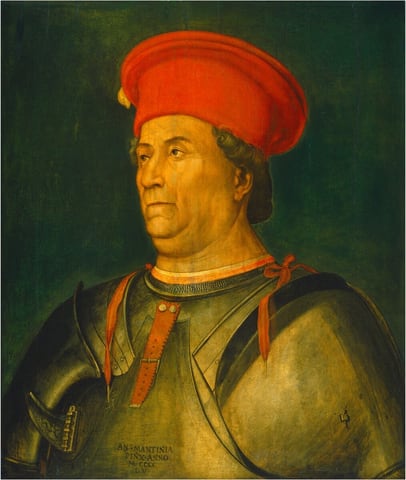
  3. This painting shows an upper-body portrait of a man in a three-quarter view, turned to the left. He has a prominent double chin, a slightly furrowed brow, thin lips, and a serious expression. He has pale yellow skin and short, dark hair, and he wears a large, red hat. He is clad in silver armor with red straps on his shoulder and chest. The background is a simple, dark green color.
    Francesco SforzaUnrecorded Italian maker, probably c. 1480/1500Courtesy National Gallery of Art, Washington
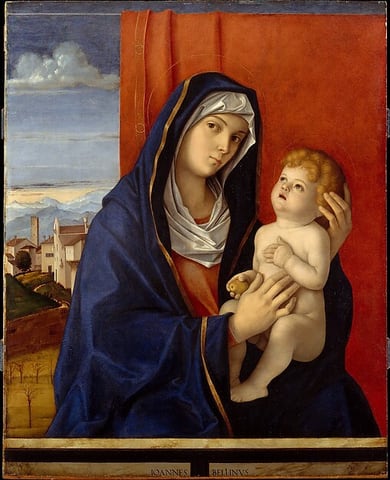
  4. Madonna and Child, by Giovanni Bellini, late 1480s
    Madonna and ChildGiovanni Bellini, late 1480sCourtesy of The Metropolitan Museum of Art

Section 2, north wall
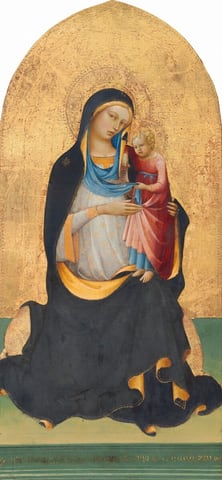
  1. A woman sits and supports a baby standing on her lap, both against a gold background in this arched, vertical painting. The woman and baby’s light skin is shaded with faint green, and they have pale pink cheeks. The woman’s body faces us. She tips her head toward the baby who stands on her knee, to our right. The woman looks at us with light brown eyes under curving brows. She has a long, straight nose, and her small pink lips are closed. Her blond hair is mostly covered by a midnight-blue robe that drapes over her shoulders, across her lap, and pools on the floor. The robe is lined with goldenrod yellow, edged with bright gold, and has gold starburst-like designs on the shoulder we can see and top of the head. The dress she wears underneath has more gold stars creating a pattern across the pearl-white fabric. A sky-blue scarf wraps over her head and loops across her shoulders. The baby holds one end of the scarf, and his other elbow rests on the woman’s shoulder. She props him up with both hands. He has a cap of blond curls and chubby cheeks with delicate features. His geranium-red garment falls over a pale blue skirt that reaches his bare feet. In the hand near the woman’s shoulder, he holds a scroll with the letters “EGO S.” The floor beneath them is mint green and has gold writing across the front, reading, “AVE.G ANN O.D M.CCCC.XIII.” The woman and baby’s disc-like gold halos blend into the gold background, which is visibly cracked in some areas. The panel comes to a pointed arch at the top.
    Madonna and ChildLorenzo Monaco, 1413Courtesy National Gallery of Art, Washington
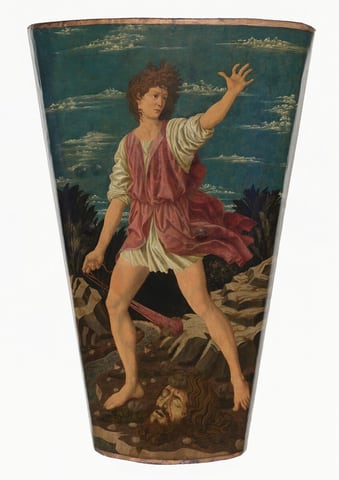
  2. This shield-shaped painting shows a young man with pale, peachy skin and curling brown hair standing astride the severed head of a man with dark hair and tanned skin. The painting is wider at the top and tapers like a pint glass to a narrower base. The young man, David, holds the end of long red slingshot with his right hand. The slingshot is weighted by a rock and swings behind his body. His sleeveless rust-red garment is cinched at his waist over a long white shirt. Both garments skim David’s thighs and his legs and feet are bare. Long, curling brown hair frames the ashen and bloodied upturned face of the head at David’s feet. A palm-sized stone is embedded in that forehead. The landscape background is made up of gray boulders, a meandering river, and low palm-like trees. Frothy white clouds sweep across an azure-blue sky.
    David with the Head of GoliathAndrea del Castagno, c. 1450/1455Courtesy National Gallery of Art, Washington
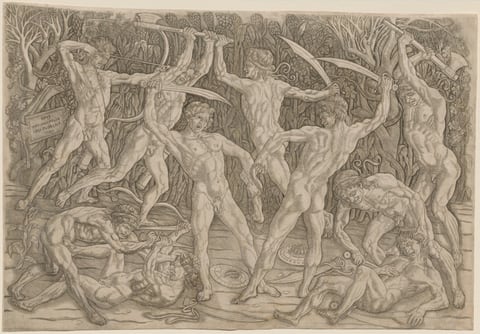
  3. Battle of the Nudes, by Antonio Pollaiuolo, 1470s–80s
    Battle of the NudesAntonio Pollaiuolo, 1470s–80sCourtesy of the Cleveland Museum of Art
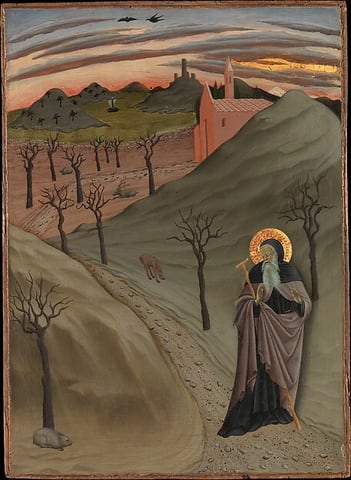
  4. Saint Anthony the Abbot in the Wilderness, by Sano di Pietro (Ansano di Pietro di Mencio), ca. 1440
    Saint Anthony the Abbot in the WildernessSano di Pietro (Ansano di Pietro di Mencio), ca. 1440Courtesy of The Metropolitan Museum of Art