Floor plan

Artist galleriesUnrecorded makers

Unrecorded makers

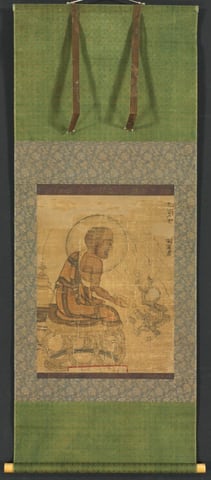
Arhat, 1235
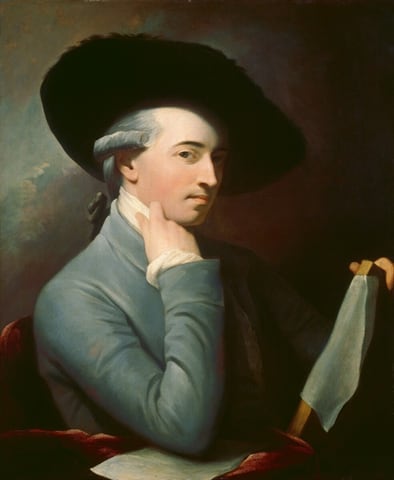
Shown from about the ribcage up, a cleanshaven man with pale skin sits with his elbow resting on the arm of his chair so the back of those fingers brush his chin in this vertical portrait painting. His body and face are angled to our right almost in profile so he looks at us from the corners of his brown eyes under dark, arched eyebrows. He has a straight nose, and his pale coral-pink lips are closed. His nickel-gray hair is curled along his ears and pulled back with an olive-green bow at the nape of his neck. His large hat is pushed back over his forehead, away from us, so its wide brim creates a dark circle around his face. The lapels of his steel-blue, tight-fitting jacket are folded back over a high, white collar. The edge of the white shirt also shows at the cuff of his right hand. The elbow closer to us rests on what might be a piece of light gray paper or piece of fabric, over a cranberry-red cloth or the arm of the upholstered chair. His left hand, farther from us, is propped on a wood frame or board, to which a small, white, square cloth appears to be affixed or draped. The light falls strongly from our upper left so his profile is brightly lit against the dark shadows on the far side of his face. The background darkens from light, slate blue to our left to coffee brown to our right.
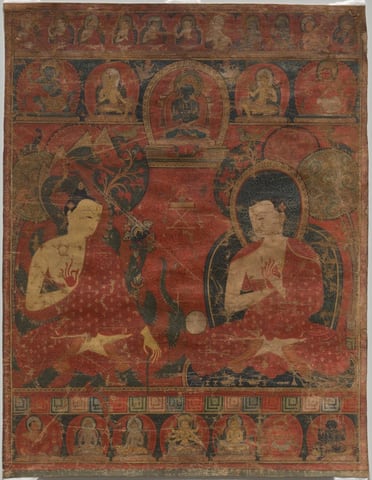
Nagarjuna (c. 150–250 CE) with a Buddhist Master, c. 1300s
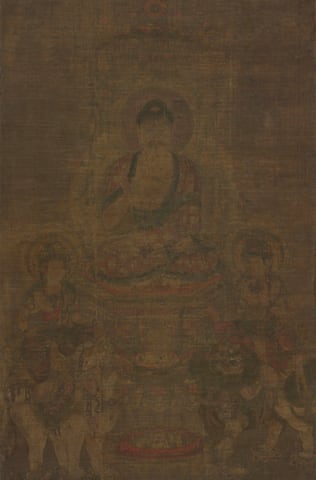
Shakyamuni Triad: Buddha Attended by Manjushri and Samantabhadra, c. 900
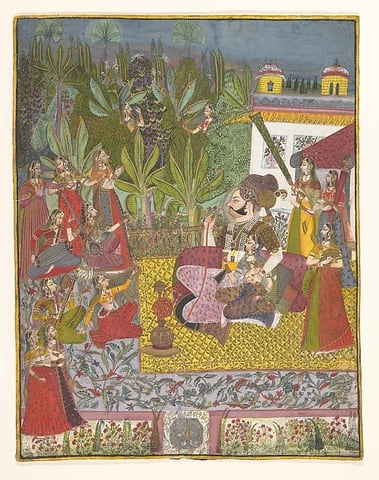
Maharaja Bijay Singh in His Harem, ca. 1770
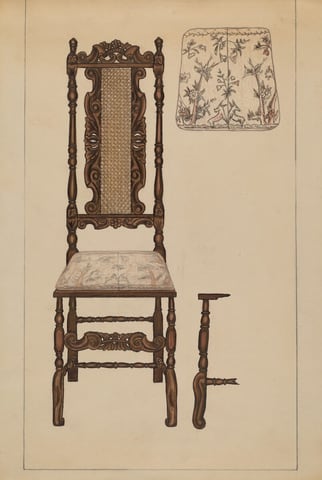
This is a drawing of a wooden chair with detailed upholstery. The chair has an ornate, high backrest with elaborate scrollwork and a woven central panel. The seat is cushioned and covered with a floral patterned fabric. There is also a separate drawing of the fabric pattern used on the seat and a sketch of one of the chair's legs to show the craftsmanship and decorative elements.
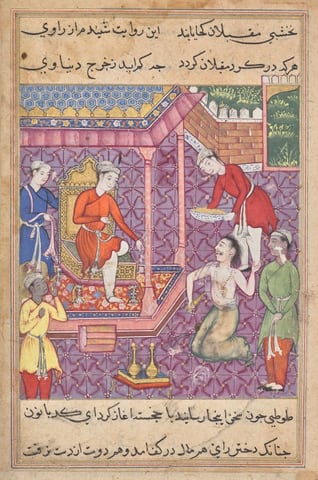
The magician disguised as a Brahman returns to claim his “daughter-in-law,” from a Tuti-nama (Tales of a Parrot): Thirty-fifth Night, c. 1560

The works in this room are listed below.

Works in this room

Works whose makers the museums don't name.

First room, north wall

  1. Arhat, 1235
    ArhatUnrecorded Korean maker, 1235Courtesy of the Cleveland Museum of Art
  2. Shown from about the ribcage up, a cleanshaven man with pale skin sits with his elbow resting on the arm of his chair so the back of those fingers brush his chin in this vertical portrait painting. His body and face are angled to our right almost in profile so he looks at us from the corners of his brown eyes under dark, arched eyebrows. He has a straight nose, and his pale coral-pink lips are closed. His nickel-gray hair is curled along his ears and pulled back with an olive-green bow at the nape of his neck. His large hat is pushed back over his forehead, away from us, so its wide brim creates a dark circle around his face. The lapels of his steel-blue, tight-fitting jacket are folded back over a high, white collar. The edge of the white shirt also shows at the cuff of his right hand. The elbow closer to us rests on what might be a piece of light gray paper or piece of fabric, over a cranberry-red cloth or the arm of the upholstered chair. His left hand, farther from us, is propped on a wood frame or board, to which a small, white, square cloth appears to be affixed or draped. The light falls strongly from our upper left so his profile is brightly lit against the dark shadows on the far side of his face. The background darkens from light, slate blue to our left to coffee brown to our right.
    Benjamin WestUnrecorded maker, c. 1776Courtesy National Gallery of Art, Washington
  3. Nagarjuna (c. 150–250 CE) with a Buddhist Master, c. 1300s
    Nagarjuna (c. 150–250 CE) with a Buddhist MasterUnrecorded Himalayan maker, c. 1300sCourtesy of the Cleveland Museum of Art

First room, south wall

  1. Shakyamuni Triad: Buddha Attended by Manjushri and Samantabhadra, c. 900
    Shakyamuni Triad: Buddha Attended by Manjushri and SamantabhadraUnrecorded Chinese maker, c. 900Courtesy of the Cleveland Museum of Art
  2. Maharaja Bijay Singh in His Harem, ca. 1770
    Maharaja Bijay Singh in His HaremUnrecorded Indian maker, ca. 1770Courtesy of The Metropolitan Museum of Art
  3. This is a drawing of a wooden chair with detailed upholstery. The chair has an ornate, high backrest with elaborate scrollwork and a woven central panel. The seat is cushioned and covered with a floral patterned fabric. There is also a separate drawing of the fabric pattern used on the seat and a sketch of one of the chair's legs to show the craftsmanship and decorative elements.
    Side ChairUnrecorded American maker, 1935/1942Courtesy National Gallery of Art, Washington
  4. The magician disguised as a Brahman returns to claim his “daughter-in-law,” from a Tuti-nama (Tales of a Parrot): Thirty-fifth Night, c. 1560
    The magician disguised as a Brahman returns to claim his “daughter-in-law,” from a Tuti-nama (Tales of a Parrot): Thirty-fifth NightUnrecorded Indian maker, c. 1560Courtesy of the Cleveland Museum of Art

Second room, south wall
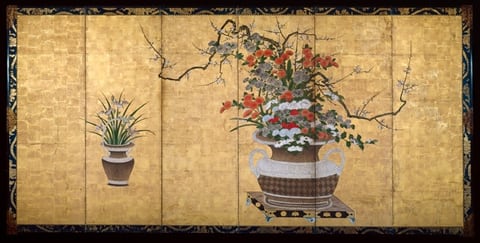
  1. A work made of six-panel screen; ink, colors, and gold on paper.
    Baskets with Flowers of the Four SeasonsUnrecorded Japanese maker, 19th centuryCourtesy of the Art Institute of Chicago
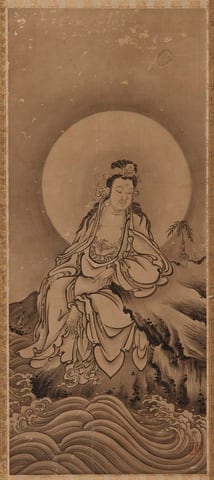
  2. Hanging scrolls (pair)
    KwannonUnrecorded Japanese maker, 1615-1868Courtesy of the National Museum of Asian Art, Smithsonian Institution
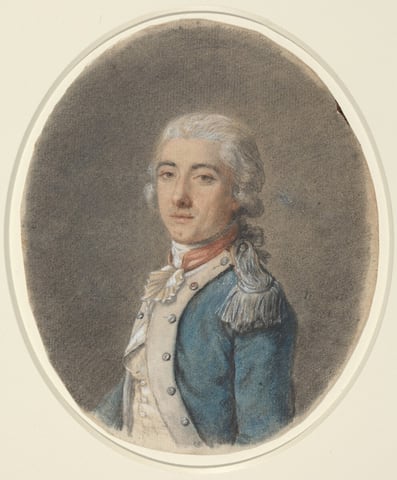
  3. The image displays an oval portrait of a man's upper torso. He is turned slightly to the right, looking directly at the viewer with a composed expression. The man has pale skin, defined facial features, softly arched eyebrows, a subtle mustache, and styled hair in an 18th-century fashion. He wears a blue coat with white lapels, silver buttons, and a silver-fringed epaulet on the shoulder, along with a cravat and waistcoat. The background is a smooth, neutral gray.
    Portrait of a Man in a Military UniformUnrecorded French maker, 18th centuryCourtesy National Gallery of Art, Washington

Second room, north wall
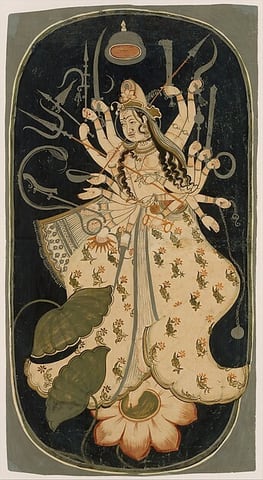
  1. Mahadevi, the Great Goddess, ca. 1725
    Mahadevi, the Great GoddessUnrecorded Indian maker, ca. 1725Courtesy of The Metropolitan Museum of Art
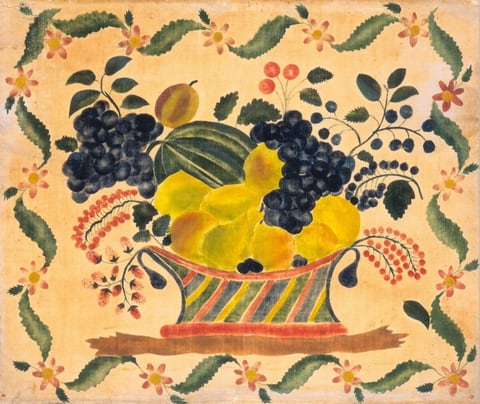
  2. Basket of Fruit, c. 1830
    Basket of FruitUnrecorded American maker, c. 1830Courtesy National Gallery of Art, Washington
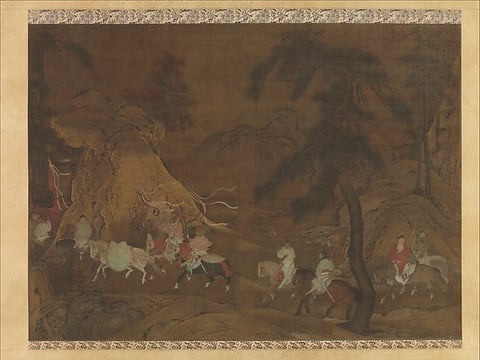
  3. Emperor Xuanzong's flight to Shu, mid-12th century
    Emperor Xuanzong's flight to ShuUnrecorded Chinese maker, mid-12th centuryCourtesy of The Metropolitan Museum of Art
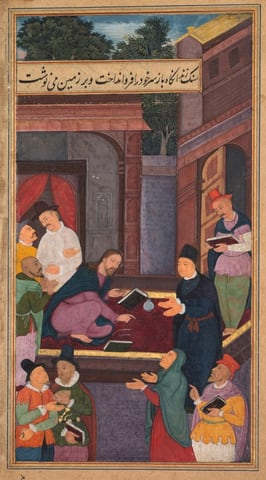
  4. Jesus writes on the ground (folio 130 verso), from a Mirror of Holiness (Mir’at al-quds) of Father Jerome Xavier, 1602–4
    Jesus writes on the ground (folio 130 verso), from a Mirror of Holiness (Mir’at al-quds) of Father Jerome XavierUnrecorded Indian maker, 1602–4Courtesy of the Cleveland Museum of Art

Third room, north wall
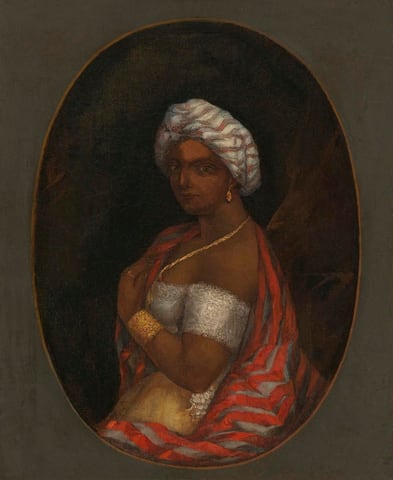
  1. Artist: Unidentified Artist, Sitter: Unidentified Woman, Current owner: National Portrait Gallery, Smithsonian Institution
    Unidentified Black Woman with TurbanUnrecorded makerCourtesy of the National Portrait Gallery, Smithsonian Institution
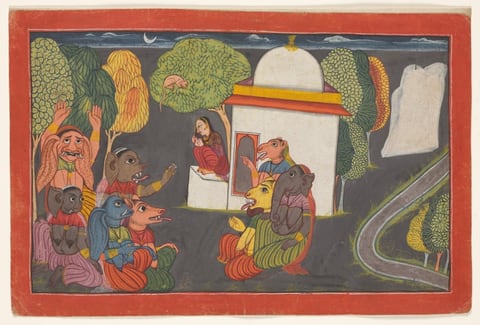
  2. Hanuman spies Sita in the Ashoka Grove, from the “Shangri” Ramayana, c. 1700–25
    Hanuman spies Sita in the Ashoka Grove, from the “Shangri” RamayanaUnrecorded Indian maker, c. 1700–25Courtesy of the Cleveland Museum of Art