Floor plan

Artist galleriesHendrick Goltzius

Hendrick Goltzius

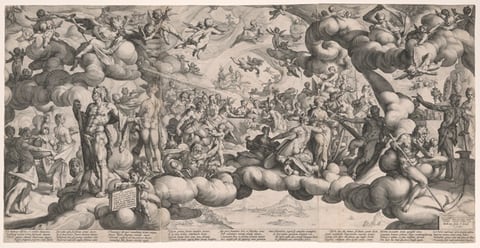
A work made of engraving on three joined sheets of ivory laid paper.
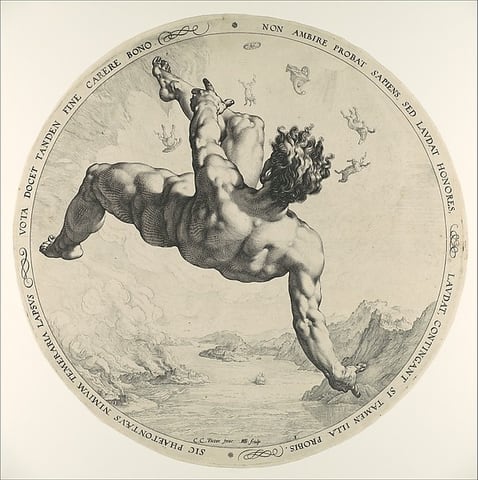
Phaeton, from "The Four Disgracers", by Hendrick Goltzius, 1588
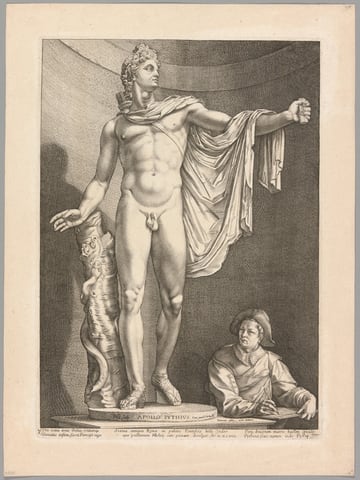
A work made of engraving in black on cream laid paper.
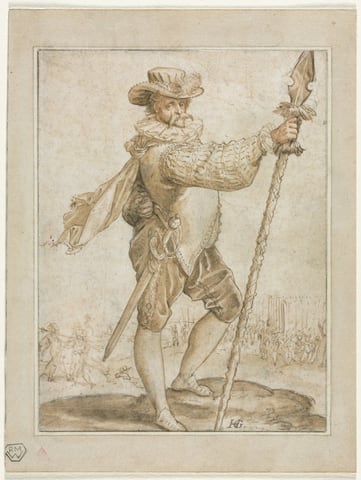
Standing Officer Holding a Boar's Spear, by Hendrick Goltzius, 1586
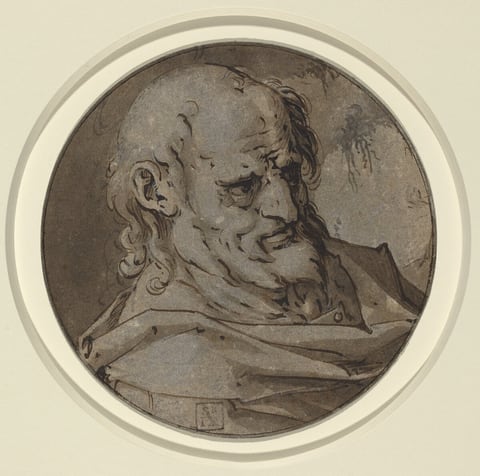
The image features the upper body and head of a man in a circular frame. The man is facing slightly to the side and downward, with his body oriented to the left and his head turned towards the viewer. He has a prominent forehead, a defined nose, a furrowed brow, and a scrunched face. His hair is thinning on top, with longer strands curling around the back and sides of his head. The man has a beard with similar curled texture as his hair. He is wearing a garment that drapes over his shoulders, with visible folds and a texture that suggests a substantial fabric. No jewelry or objects are in his hands, as they are not visible in this image. The background is plain with a light, sketchy look, focusing attention on the man as the central figure in the circular composition.
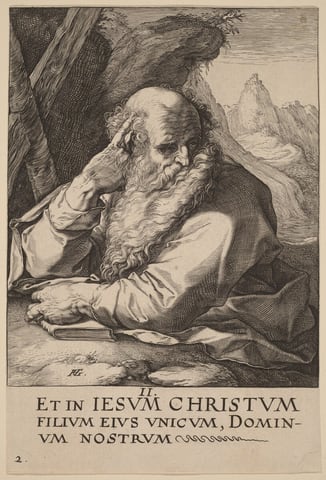
The image shows an elderly man seated from the waist up. He is angled slightly away from the viewer, resting his head on one hand and leaning on the other arm. The man has a deeply lined face, a large beard, curly hair, and appears focused on something outside the frame. He wears flowing garments and a book is under his arm. In the background, there are rugged, mountainous rock formations. Ornate text frames the image at the bottom.
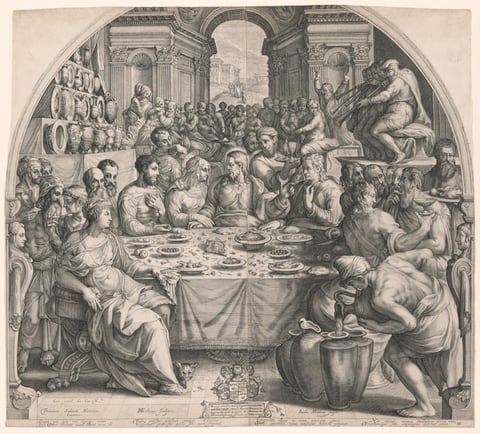
A work made of engraving on two joined sheets of ivory laid paper.

The works in this room are listed below.

Works in this room

Hendrick Goltzius (Dutch, 1558–1617). Every work of theirs in the collection, in today's hang.

Section 1, north wall

  1. A work made of engraving on three joined sheets of ivory laid paper.
    The Wedding of Cupid and PsycheHendrick Goltzius, 1587Courtesy of the Art Institute of Chicago
  2. Phaeton, from "The Four Disgracers", by Hendrick Goltzius, 1588
    Phaeton, from "The Four Disgracers"Hendrick Goltzius, 1588Courtesy of The Metropolitan Museum of Art
  3. A work made of engraving in black on cream laid paper.
    The Apollo Belvedere, plate 3 from Three Famous Antique SculpturesHendrick Goltzius, c. 1592, printed c. 1617Courtesy of the Art Institute of Chicago
  4. Standing Officer Holding a Boar's Spear, by Hendrick Goltzius, 1586
    Standing Officer Holding a Boar's SpearHendrick Goltzius, 1586Courtesy of the Cleveland Museum of Art

Section 1, south wall

  1. The image features the upper body and head of a man in a circular frame. The man is facing slightly to the side and downward, with his body oriented to the left and his head turned towards the viewer. He has a prominent forehead, a defined nose, a furrowed brow, and a scrunched face. His hair is thinning on top, with longer strands curling around the back and sides of his head. The man has a beard with similar curled texture as his hair. He is wearing a garment that drapes over his shoulders, with visible folds and a texture that suggests a substantial fabric. No jewelry or objects are in his hands, as they are not visible in this image. The background is plain with a light, sketchy look, focusing attention on the man as the central figure in the circular composition.
    Head of an ApostleHendrick GoltziusCourtesy National Gallery of Art, Washington
  2. The image shows an elderly man seated from the waist up. He is angled slightly away from the viewer, resting his head on one hand and leaning on the other arm. The man has a deeply lined face, a large beard, curly hair, and appears focused on something outside the frame. He wears flowing garments and a book is under his arm. In the background, there are rugged, mountainous rock formations. Ornate text frames the image at the bottom.
    Saint AndrewHendrick Goltzius, probably 1589Courtesy National Gallery of Art, Washington
  3. A work made of engraving on two joined sheets of ivory laid paper.
    The Wedding at CanaHendrick Goltzius, c. 1590-1610Courtesy of the Art Institute of Chicago