Floor plan

Artist galleriesSir William Beechey's contemporaries
Sir William Beechey's contemporaries
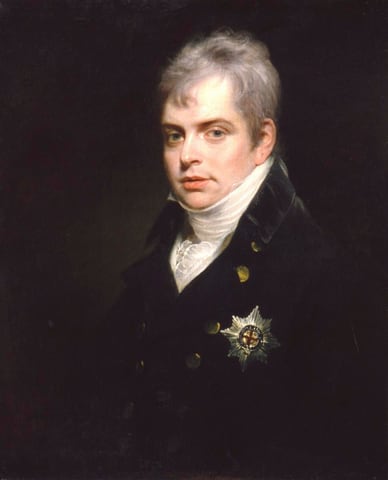
Duke of Sussex, by Sir William Beechey, n.d.
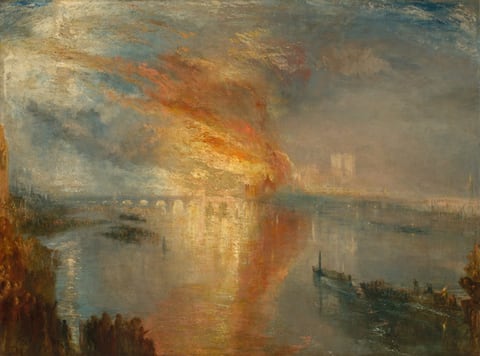
The Burning of the Houses of Lords and Commons, 16 October 1834, by Joseph Mallord William Turner, 1835
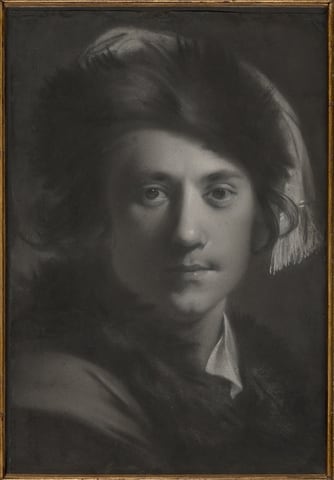
Black, gray pastel portrait of man in a fur hat.
A work made of pen and black ink, over traces of graphite, on tan wove paper, laid down on cream wove paper.
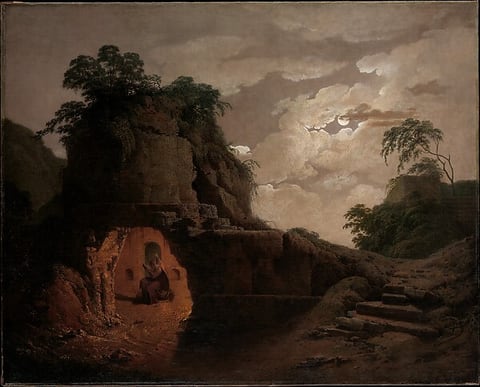
Virgil's Tomb by Moonlight, with Silius Italicus Declaiming, by Joseph Wright of Derby, 1779
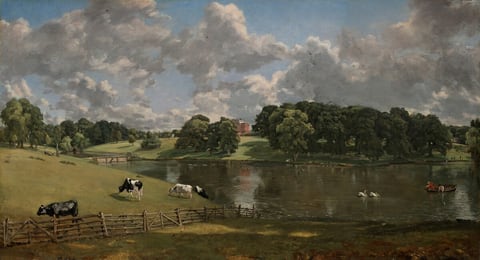
We look out onto a landscape with low, grassy hills to the left, a lake to the right, and a brick building in the center distance below a sky filled with towering white clouds in this horizontal painting. A wooden fence closer to us crosses the landscape from the lower left corner and disappears where the land slopes down to meet the water at the center of the painting. Several black and white cows graze in the field beyond the fence to our left. Two men in a wooden boat pull in nets on the lake to our right near a pair of swans. The lake crosses the composition in the near distance, disappearing into a culvert farther back. A donkey pulls a small carriage with two people near a bridge that crosses the lake in the distance to our left. The brick manor house is visible through a break in the full, deep green trees that line the horizon, which comes halfway up the composition. The clouds cast noticeable shadows in the brightly sunlit scene.

The works in this room are listed below.

Works in this room

A few works by Sir William Beechey, then their contemporaries: makers of the same nationality born within 25 years of them, then works from the same century and place.

With their contemporaries

  1. Duke of Sussex, by Sir William Beechey, n.d.
    Duke of SussexSir William Beechey, n.d.Courtesy of the Smithsonian American Art Museum
  2. The Burning of the Houses of Lords and Commons, 16 October 1834, by Joseph Mallord William Turner, 1835
    The Burning of the Houses of Lords and Commons, 16 October 1834Joseph Mallord William Turner, 1835Courtesy of the Cleveland Museum of Art
  3. Black, gray pastel portrait of man in a fur hat.
    Self-Portrait in a Fur CapJoseph Wright of Derby, 1765/68Courtesy of the Art Institute of Chicago

Their contemporaries

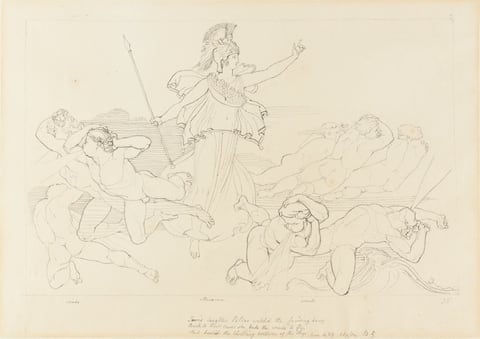
  1. A work made of pen and black ink, over traces of graphite, on tan wove paper, laid down on cream wove paper.
    Athena and the WindsJohn Flaxman, n.d.Courtesy of the Art Institute of Chicago
  2. Virgil's Tomb by Moonlight, with Silius Italicus Declaiming, by Joseph Wright of Derby, 1779
    Virgil's Tomb by Moonlight, with Silius Italicus DeclaimingJoseph Wright of Derby, 1779Courtesy of The Metropolitan Museum of Art
  3. We look out onto a landscape with low, grassy hills to the left, a lake to the right, and a brick building in the center distance below a sky filled with towering white clouds in this horizontal painting. A wooden fence closer to us crosses the landscape from the lower left corner and disappears where the land slopes down to meet the water at the center of the painting. Several black and white cows graze in the field beyond the fence to our left. Two men in a wooden boat pull in nets on the lake to our right near a pair of swans. The lake crosses the composition in the near distance, disappearing into a culvert farther back. A donkey pulls a small carriage with two people near a bridge that crosses the lake in the distance to our left. The brick manor house is visible through a break in the full, deep green trees that line the horizon, which comes halfway up the composition. The clouds cast noticeable shadows in the brightly sunlit scene.
    Wivenhoe Park, EssexJohn Constable, 1816Courtesy National Gallery of Art, Washington

Their contemporaries, second
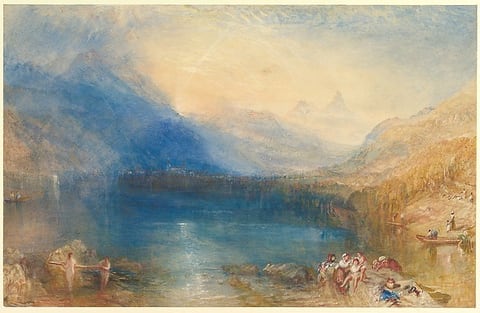
  1. The Lake of Zug, by Joseph Mallord William Turner, 1843
    The Lake of ZugJoseph Mallord William Turner, 1843Courtesy of The Metropolitan Museum of Art
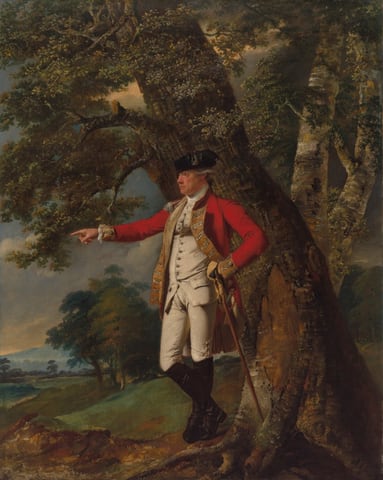
  2. Portrait of Colonel Charles Heathcote, by Joseph Wright of Derby, c. 1771–72
    Portrait of Colonel Charles HeathcoteJoseph Wright of Derby, c. 1771–72Courtesy of the Cleveland Museum of Art