Floor plan

Artist galleriesHans Holbein the Younger's contemporaries
Hans Holbein the Younger's contemporaries
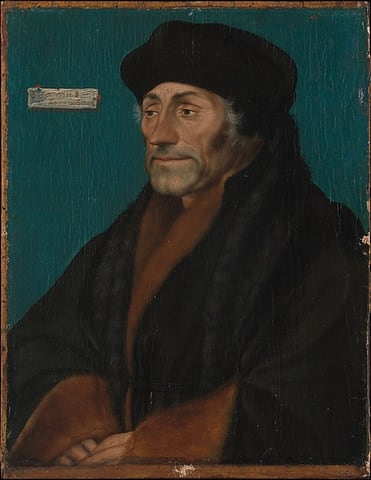
Erasmus of Rotterdam, by Hans Holbein the Younger, ca. 1532
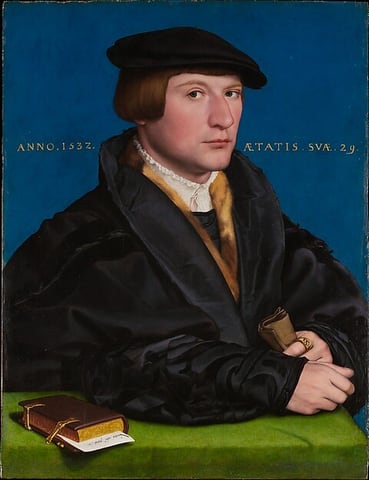
Hermann von Wedigh III (died 1560), by Hans Holbein the Younger, 1532
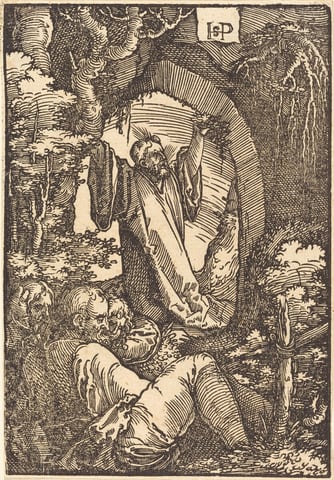
The image shows a central person standing with both arms raised. They have a long beard, aged appearance, long hair, and wear a robe. Three other individuals are around them, reclining or lying on the ground. The setting is an outdoor scene with detailed trees and vegetation. There are initials "I.SP" in the top right corner.
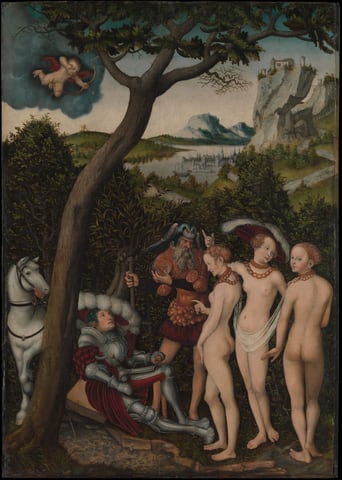
The Judgment of Paris, by Lucas Cranach the Elder, ca. 1528
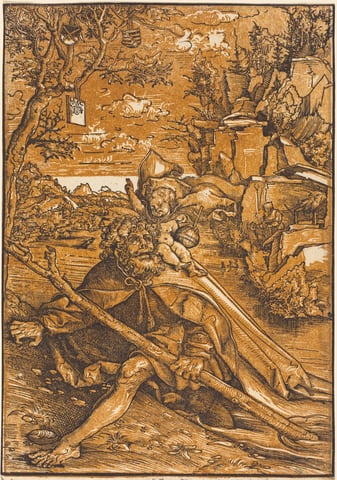
This is a drawing of a wilderness setting by a river. The scene features rocky cliffs, lush vegetation, a large bearded figure holding a staff, and a small cherubic figure beside them. In the background, there is a village against a mountainous backdrop. The drawing has rich texture and intricate details, with a contrast of dark lines and lighter hues.
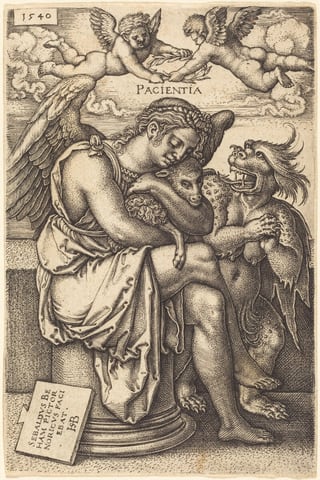
This is a drawing of a winged figure with a sheep, accompanied by a mythical creature and cherubs. The central figure is holding the sheep tenderly. On the left, two cherubs are flying with a laurel branch, under the word "PACIENTIA." On the right is a mythical creature with dragon-like features. Below the scene, a plaque with an inscription is placed against the pedestal. The artwork is detailed with lines, cross-hatching, and shading, accentuating textures and forms.

The works in this room are listed below.

Works in this room

A few works by Hans Holbein the Younger, then their contemporaries: makers of the same nationality born within 25 years of them, then works from the same century and place.

Section 1, north wall

  1. Erasmus of Rotterdam, by Hans Holbein the Younger, ca. 1532
    Erasmus of RotterdamHans Holbein the Younger, ca. 1532Courtesy of The Metropolitan Museum of Art
  2. Hermann von Wedigh III (died 1560), by Hans Holbein the Younger, 1532
    Hermann von Wedigh III (died 1560)Hans Holbein the Younger, 1532Courtesy of The Metropolitan Museum of Art

Their contemporaries

  1. The image shows a central person standing with both arms raised. They have a long beard, aged appearance, long hair, and wear a robe. Three other individuals are around them, reclining or lying on the ground. The setting is an outdoor scene with detailed trees and vegetation. There are initials "I.SP" in the top right corner.
    The Agony in the GardenSebald Beham, 1522Courtesy National Gallery of Art, Washington
  2. The Judgment of Paris, by Lucas Cranach the Elder, ca. 1528
    The Judgment of ParisLucas Cranach the Elder, ca. 1528Courtesy of The Metropolitan Museum of Art
  3. This is a drawing of a wilderness setting by a river. The scene features rocky cliffs, lush vegetation, a large bearded figure holding a staff, and a small cherubic figure beside them. In the background, there is a village against a mountainous backdrop. The drawing has rich texture and intricate details, with a contrast of dark lines and lighter hues.
    Saint ChristopherLucas Cranach the Elder, 1506Courtesy National Gallery of Art, Washington
  4. This is a drawing of a winged figure with a sheep, accompanied by a mythical creature and cherubs. The central figure is holding the sheep tenderly. On the left, two cherubs are flying with a laurel branch, under the word "PACIENTIA." On the right is a mythical creature with dragon-like features. Below the scene, a plaque with an inscription is placed against the pedestal. The artwork is detailed with lines, cross-hatching, and shading, accentuating textures and forms.
    Pacientia (Patience)Sebald Beham, 1540Courtesy National Gallery of Art, Washington

Their contemporaries, second
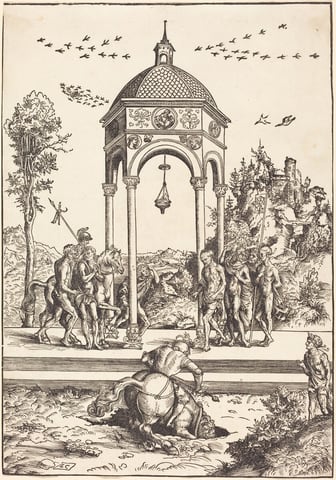
  1. This print features a detailed scene. In the center is a classical-style pavilion with arched openings and a domed roof adorned with intricate designs. A group of mostly-nude people is gathered around the pavilion, with one on horseback, holding a spear, and another holding a flag. In front of the pavilion, a knight on horseback appears to be falling into a dark hole in the ground. Vegetation, including trees and shrubs, is scattered throughout the landscape, and birds are seen flying in the sky above the pavilion. The horizon shows hills leading to a distant castle on a rocky formation on the right.
    Marcus Curtius Plunging into the ChasmLucas Cranach the ElderCourtesy National Gallery of Art, Washington
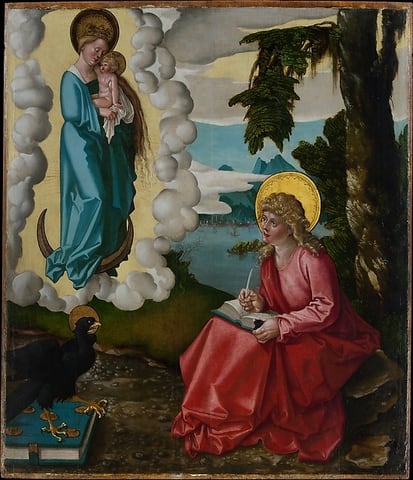
  2. Saint John on Patmos, by Hans Baldung (called Hans Baldung Grien), ca. 1511
    Saint John on PatmosHans Baldung (called Hans Baldung Grien), ca. 1511Courtesy of The Metropolitan Museum of Art