Floor plan

Artist galleriesGiovanni Battista Piazzetta's contemporaries
Giovanni Battista Piazzetta's contemporaries
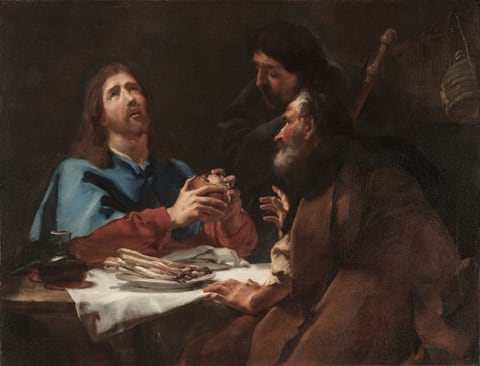
The Supper at Emmaus, by Giovanni Battista Piazzetta, c. 1720
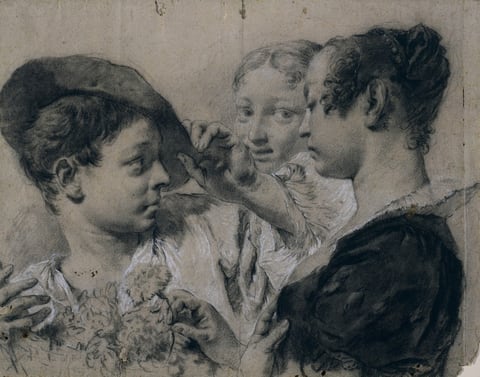
A Young Woman Buying a Pink from a Young Man, by Giovanni Battista Piazzetta, c. 1740
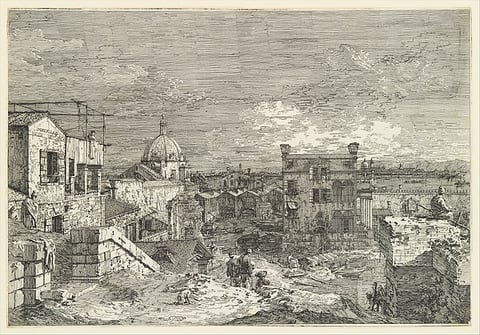
Imaginary View of Venice, houses at left with figures on terraces, a domed church at center in the background, boats and boat-sheds below, and a seated man observing from a wall at right in the foreground, from "Views" (Vedute altre prese da i luoghi altre ideate da Antonio Canal), by Canaletto, 1741
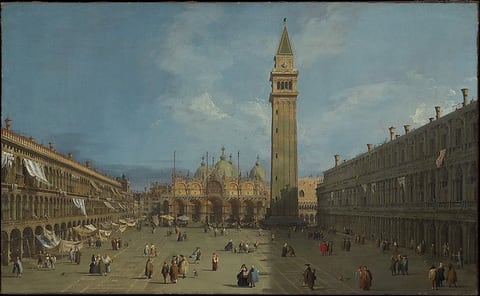
Piazza San Marco, by Canaletto, late 1720s
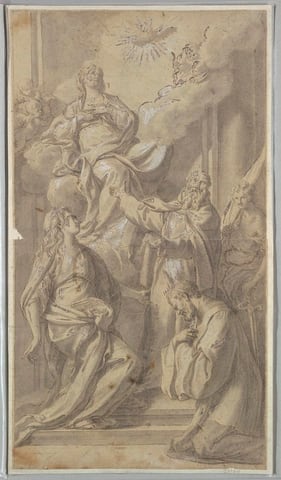
MADONNA AND SAINTS

The works in this room are listed below.

Works in this room

A few works by Giovanni Battista Piazzetta, then their contemporaries: makers of the same nationality born within 25 years of them, then works from the same century and place.

Section 1, north wall

  1. The Supper at Emmaus, by Giovanni Battista Piazzetta, c. 1720
    The Supper at EmmausGiovanni Battista Piazzetta, c. 1720Courtesy of the Cleveland Museum of Art
  2. A Young Woman Buying a Pink from a Young Man, by Giovanni Battista Piazzetta, c. 1740
    A Young Woman Buying a Pink from a Young ManGiovanni Battista Piazzetta, c. 1740Courtesy of the Cleveland Museum of Art

Their contemporaries

  1. Imaginary View of Venice, houses at left with figures on terraces, a domed church at center in the background, boats and boat-sheds below, and a seated man observing from a wall at right in the foreground, from "Views" (Vedute altre prese da i luoghi altre ideate da Antonio Canal), by Canaletto, 1741
    Imaginary View of Venice, houses at left with figures on terraces, a domed church at center in the background, boats and boat-sheds below, and a seated man observing from a wall at right in the foreground, from "Views" (Vedute altre prese da i luoghi altre ideate da Antonio Canal)Canaletto, 1741Courtesy of The Metropolitan Museum of Art
  2. Piazza San Marco, by Canaletto, late 1720s
    Piazza San MarcoCanaletto, late 1720sCourtesy of The Metropolitan Museum of Art
  3. MADONNA AND SAINTS
    Madonna and SaintsSebastiano Conca, ca. 1730Courtesy of Cooper Hewitt, Smithsonian Design Museum

Their contemporaries, second
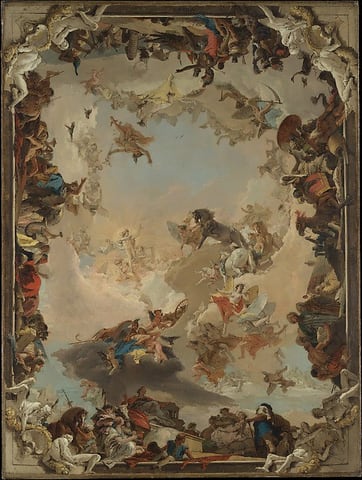
  1. Allegory of the Planets and Continents, by Giovanni Battista Tiepolo, 1752
    Allegory of the Planets and ContinentsGiovanni Battista Tiepolo, 1752Courtesy of The Metropolitan Museum of Art
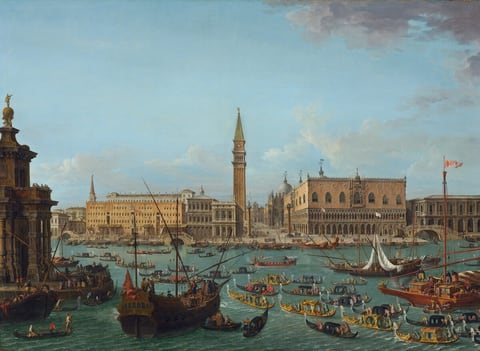
  2. The painting depicts many large and small ships on blue-green water. Gondolas in shades of gold, black, red, and blue drift across the water, small people on them pushing long poles through the water. There are also large sailboats and long boats with several rowers. They create a colorful mix. On the left, a large brown building with columns is visible. Some of the boats pull up to it, and many people in colorful clothing are visible on the shore. Behind the water are more large buildings in shades of brown, cream, and tan, with even more people visible on the streets below them. There is a large tower in the center of the painting, and several blue domes are visible in the distance. The sky is light blue, with white and gray clouds drifting across it.
    Procession of Gondolas in the Bacino di San Marco, VeniceAntonio Joli, 1742 or afterCourtesy National Gallery of Art, Washington
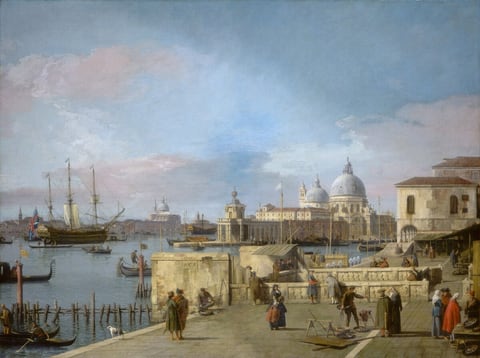
  3. We look slightly down onto a port-side town along a canal, with a church across the water from us in this horizontal landscape painting. A bright blue sky with billowing white, pink, and gray clouds fills the top two-thirds of the painting. Below, a three-masted ship with all but one sail furled is surrounded by a couple dozen black long, low boats, gondolas, and one or two other sailboats. People stand and walk mostly in pairs and trios along the stone walkway under us, which extends into the distance to our right. The women all wear long dresses and most of the men wear suits with knee-length jackets with tails or capes, and hats. The clothing is painted in shades of brick and terracotta red, pine green, royal blue, and gray. The walkway is interrupted by two low walls that partition off an area near us. The angled roofs of stalls line the walkway in the farther distance before it is again interrupted, this time by a two-story, cream-colored building. The walkway continues as a narrower path under an arched arcade on the lower level of that building, alongside the water. On the far side of the canal, to our left and in the distance, a cluster of ivory-white buildings includes a structure with two stone-blue domes. More buildings extend into the deep distance to our left.
    Entrance to the Grand Canal from the Molo, VeniceCanaletto, 1742/1744Courtesy National Gallery of Art, Washington