Floor plan

Artist galleriesFrederick Kemmelmeyer's contemporaries
Frederick Kemmelmeyer's contemporaries
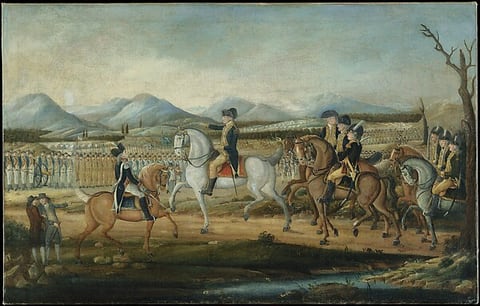
Washington Reviewing the Western Army at Fort Cumberland, Maryland, by Frederick Kemmelmeyer, after 1795
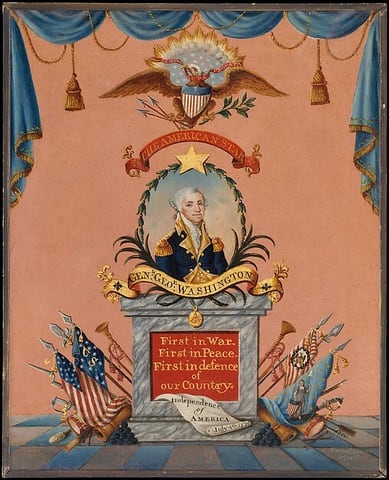
The American Star (George Washington), by Frederick Kemmelmeyer, ca. 1803
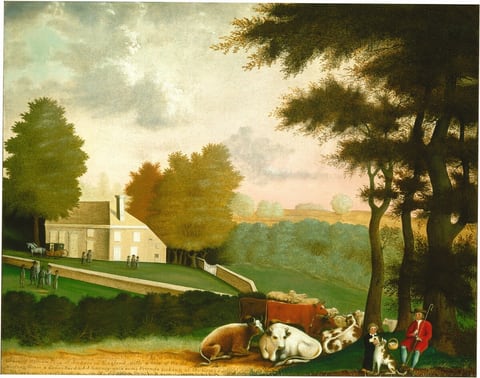
This painting shows a pastoral setting with a large white-and-gray house on a hill to the left. Distant people stand in front of the house, along with a horse-drawn wagon. In the bottom right corner, two people sit in the grass under a tree, one dressed in red holding a tall crook and the other wearing a black garment and a yellow hat and petting a large brown-and-white dog. There is a basket on the ground between them, and next to them is a large herd of cows and sheep, all resting on the grass. The landscape includes trees with green leaves and yellow hills in the distance. The sky above is in pastel shades of pink and blue, with fluffy clouds. In the bottom left, a patch of yellow ground has several lines of text written over it.
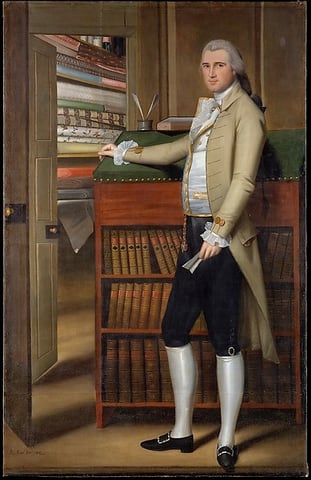
Elijah Boardman, by Ralph Earl, 1789
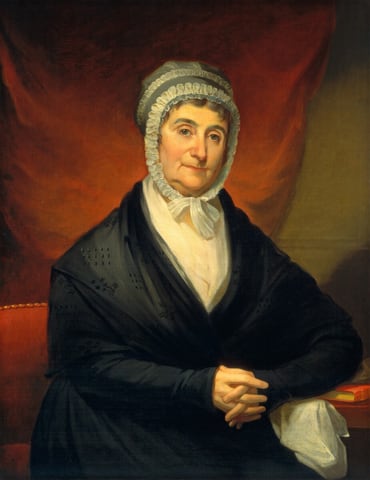
The image shows the upper half of a seated woman facing forward. She has her hands clasped together in front of her. The woman appears calm with visible signs of age, including a few wrinkles on her face. She wears a white bonnet with a frilled edge tied under her chin, a dark shawl over a white high-collared blouse, and sits on a red chair with a gold trim. A red book and a handkerchief are on the surface next to her. The background transitions from deep red to brown tones.

The works in this room are listed below.

Works in this room

A few works by Frederick Kemmelmeyer, then their contemporaries: makers of the same nationality born within 25 years of them, then works from the same century and place.

Section 1, north wall

  1. Washington Reviewing the Western Army at Fort Cumberland, Maryland, by Frederick Kemmelmeyer, after 1795
    Washington Reviewing the Western Army at Fort Cumberland, MarylandFrederick Kemmelmeyer, after 1795Courtesy of The Metropolitan Museum of Art
  2. The American Star (George Washington), by Frederick Kemmelmeyer, ca. 1803
    The American Star (George Washington)Frederick Kemmelmeyer, ca. 1803Courtesy of The Metropolitan Museum of Art

Their contemporaries

  1. This painting shows a pastoral setting with a large white-and-gray house on a hill to the left. Distant people stand in front of the house, along with a horse-drawn wagon. In the bottom right corner, two people sit in the grass under a tree, one dressed in red holding a tall crook and the other wearing a black garment and a yellow hat and petting a large brown-and-white dog. There is a basket on the ground between them, and next to them is a large herd of cows and sheep, all resting on the grass. The landscape includes trees with green leaves and yellow hills in the distance. The sky above is in pastel shades of pink and blue, with fluffy clouds. In the bottom left, a patch of yellow ground has several lines of text written over it.
    The Grave of William PennEdward Hicks, c. 1847/1848Courtesy National Gallery of Art, Washington
  2. Elijah Boardman, by Ralph Earl, 1789
    Elijah BoardmanRalph Earl, 1789Courtesy of The Metropolitan Museum of Art
  3. The image shows the upper half of a seated woman facing forward. She has her hands clasped together in front of her. The woman appears calm with visible signs of age, including a few wrinkles on her face. She wears a white bonnet with a frilled edge tied under her chin, a dark shawl over a white high-collared blouse, and sits on a red chair with a gold trim. A red book and a handkerchief are on the surface next to her. The background transitions from deep red to brown tones.
    Ann Old Coleman (Mrs. Robert Coleman)Jacob Eichholtz, c. 1820Courtesy National Gallery of Art, Washington

Their contemporaries, second
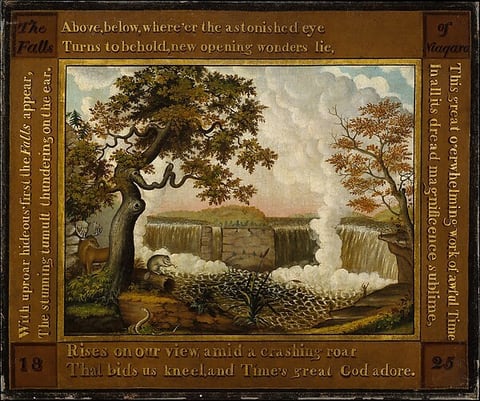
  1. The Falls of Niagara, by Edward Hicks, ca. 1825
    The Falls of NiagaraEdward Hicks, ca. 1825Courtesy of The Metropolitan Museum of Art
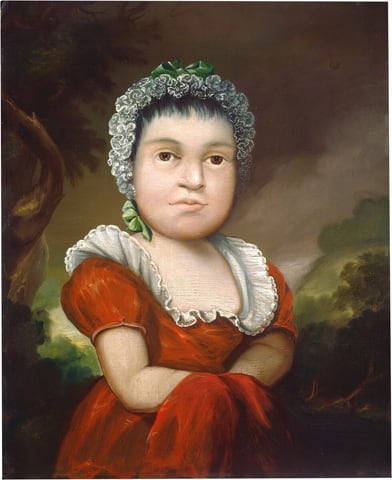
  2. A pale-skinned child wearing a short-sleeved red dress and a white bonnet stands before a shadowy green forest under dark clouds in this vertical portrait painting. The child’s over-large head is out of scale with the rest of her body. She looks toward us with brown eyes in her wide, round-jawed face. She has a broad nose, and her pale lips are set in a line. Her lace bonnet lines her black hair like frothy seafoam and is tied with spring-green bows at the top and under her right ear, to our left. The low neckline of her crimson dress is lined with a wide white ruffle. Red fabric covers her hands, which are gathered in front of her waist. Gray clouds sweep over the hazy green forest in the background. A gnarled tree grows up the left side of the painting, framing the girl.
    Portrait of a ChildEdward Hicks, c. 1840Courtesy National Gallery of Art, Washington
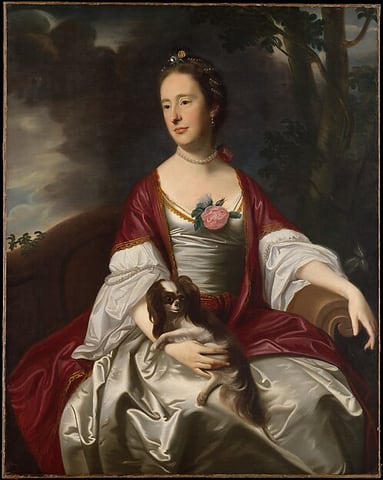
  3. Mrs. Jerathmael Bowers, by John Singleton Copley, ca. 1763
    Mrs. Jerathmael BowersJohn Singleton Copley, ca. 1763Courtesy of The Metropolitan Museum of Art