Floor plan

Artist galleriesCharles Germain de Saint-Aubin's contemporaries
Charles Germain de Saint-Aubin's contemporaries
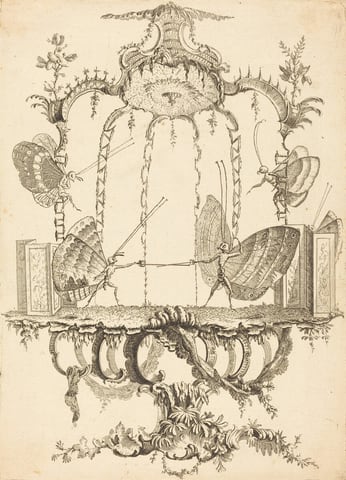
This is a drawing of anthropomorphic butterflies engaged in a duel with fencing swords. The butterflies have human-like bodies with wings resembling cloaks or capes. They stand on an ornate structure featuring decorative architectural elements like columns with floral and leaf motifs. Above them are arches, canopies, and hanging vines, creating a theatrical setting. The drawing combines fantasy and nature elements, showcasing elegance and imagination.
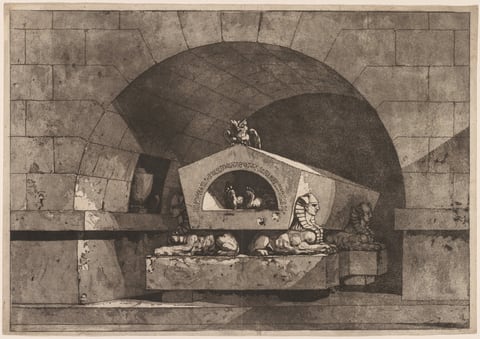
Tomb with Sphinxes and an Owl, by Louis Jean Desprez, c. 1779–84
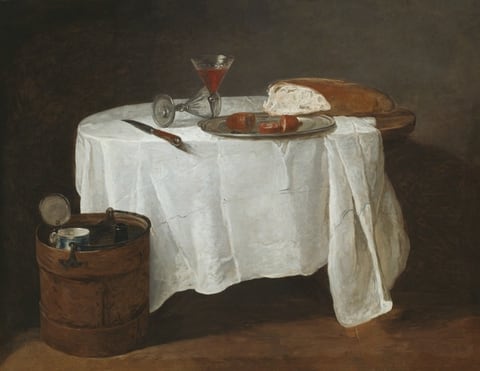
A work made of oil on canvas.
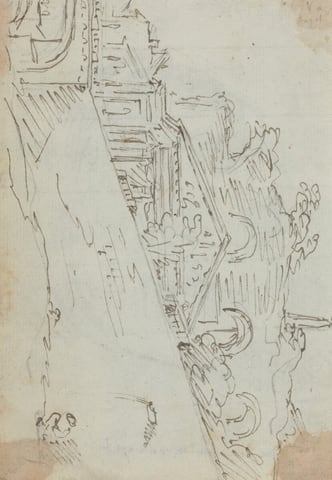
The image shows a sketch of an architectural scene with structures lining a road or pathway. The horizon is not clearly defined, and the sketch focuses on architectural details. The drawing features loose, freehand lines outlining buildings and trees, with classical elements like columns and entablatures. The color palette is monochromatic, with light parchment and dark ink strokes creating contrast. Close-up details are lightly shaded for depth, while distant details are less defined. The composition is open and airy, emphasizing architectural features over precision.
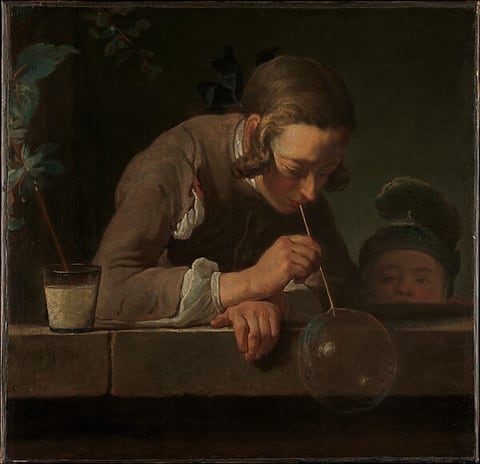
Soap Bubbles, by Jean Siméon Chardin, ca. 1733–34
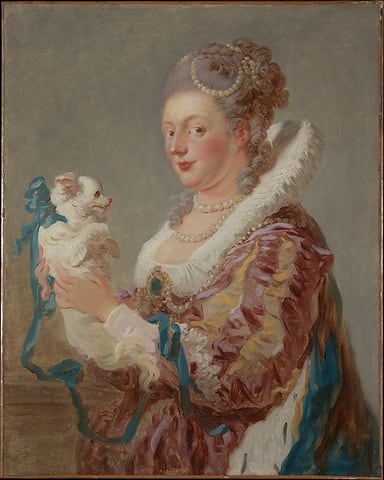
Marie Emilie Coignet de Courson (1716–1806) with a Dog, by Jean Honoré Fragonard, ca. 1769

The works in this room are listed below.

Works in this room

A few works by Charles Germain de Saint-Aubin, then their contemporaries: makers of the same nationality born within 25 years of them, then works from the same century and place.

With their contemporaries

  1. This is a drawing of anthropomorphic butterflies engaged in a duel with fencing swords. The butterflies have human-like bodies with wings resembling cloaks or capes. They stand on an ornate structure featuring decorative architectural elements like columns with floral and leaf motifs. Above them are arches, canopies, and hanging vines, creating a theatrical setting. The drawing combines fantasy and nature elements, showcasing elegance and imagination.
    Le Duel (The Duel)Charles Germain de Saint-Aubin, in or after 1756Courtesy National Gallery of Art, Washington
  2. Tomb with Sphinxes and an Owl, by Louis Jean Desprez, c. 1779–84
    Tomb with Sphinxes and an OwlLouis Jean Desprez, c. 1779–84Courtesy of the Cleveland Museum of Art
  3. A work made of oil on canvas.
    The White TableclothJean Siméon Chardin, c. 1731–32Courtesy of the Art Institute of Chicago
  4. The image shows a sketch of an architectural scene with structures lining a road or pathway. The horizon is not clearly defined, and the sketch focuses on architectural details. The drawing features loose, freehand lines outlining buildings and trees, with classical elements like columns and entablatures. The color palette is monochromatic, with light parchment and dark ink strokes creating contrast. Close-up details are lightly shaded for depth, while distant details are less defined. The composition is open and airy, emphasizing architectural features over precision.
    Ancient Ruins on the Bank of the TiberAugustin Pajou, 1752/1756Courtesy National Gallery of Art, Washington

Their contemporaries

  1. Soap Bubbles, by Jean Siméon Chardin, ca. 1733–34
    Soap BubblesJean Siméon Chardin, ca. 1733–34Courtesy of The Metropolitan Museum of Art
  2. Marie Emilie Coignet de Courson (1716–1806) with a Dog, by Jean Honoré Fragonard, ca. 1769
    Marie Emilie Coignet de Courson (1716–1806) with a DogJean Honoré Fragonard, ca. 1769Courtesy of The Metropolitan Museum of Art

Their contemporaries, second
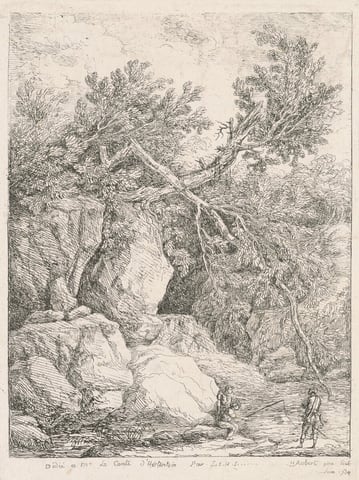
  1. The image shows an illustration of a rocky terrain with towering stone formations and dense foliage. The sky is textured and the scene is created using an etching technique with intricate linework. There are two figures in the scene, one appearing to climb or position near a rock, while the other observes. The color palette is monochromatic, using black on a white background to depict depth and dimension in the artwork.
    Landscape with a Fallen Tree (Paysage à l'arbre cassé)Hubert Robert, 1764Courtesy National Gallery of Art, Washington
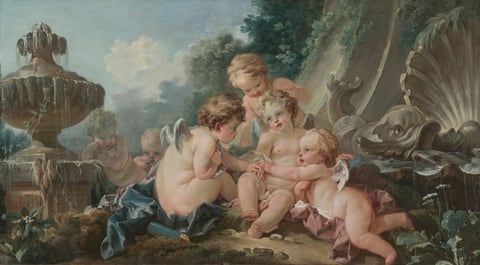
  2. Cupids in Conspiracy, by François Boucher, 1740s
    Cupids in ConspiracyFrançois Boucher, 1740sCourtesy of the Cleveland Museum of Art