Floor plan

Artist galleriesAlessandro Vittoria's contemporaries
Alessandro Vittoria's contemporaries
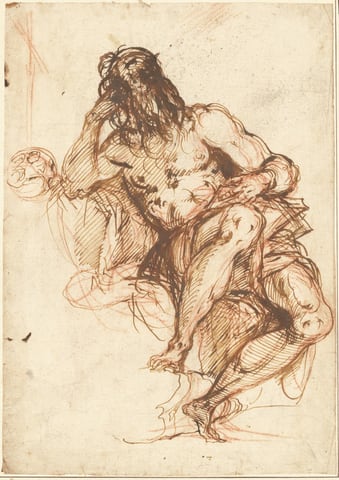
The image shows a sketch of a seated bearded figure holding an orb. The figure appears muscular, with a beard merging into long hair. The face is not detailed, and draped fabric covers part of the body. There is no jewelry, and the background is plain.
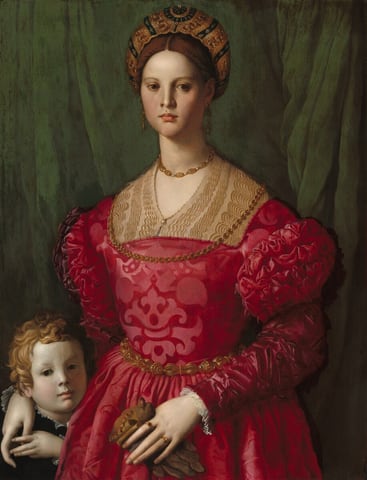
A woman wearing a crimson-red brocade dress and gold jewelry fills most of this vertical portrait, but her right hand, on our left, rests on the shoulder of a young boy tucked into the lower left corner of the panel. The woman and boy both have pale, white skin, and both face and look out at us against an emerald-green curtain that falls behind them. The woman has brown eyes, a straight nose, full pink lips, smooth cheeks, and a long neck. Her brown hair is pulled back under a turban densely embroidered with gold. The woman’s dress has puffed shoulders and decorative slashes on the sleeves. One gold chain rests on her throat and the other falls over her chest. She wears long gold earrings, a gold belt, and two gold rings. She holds a brown leather glove in her left hand. The boy’s face is even with the woman’s waist, and he raises his left hand to hold hers, which is draped over his shoulder. He has curly blond hair and dark eyes, and he wears black with a ruffled white shirt just visible at his collar.
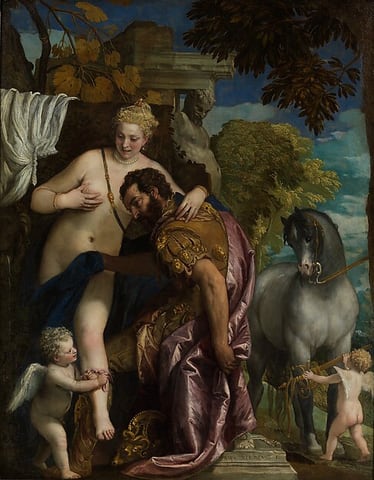
Mars and Venus United by Love, by Paolo Veronese (Paolo Caliari), 1570s
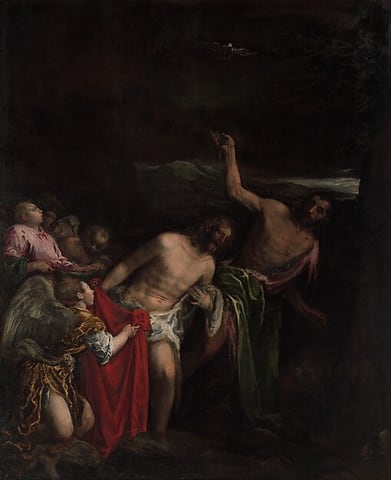
The Baptism of Christ, by Jacopo Bassano, ca. 1590
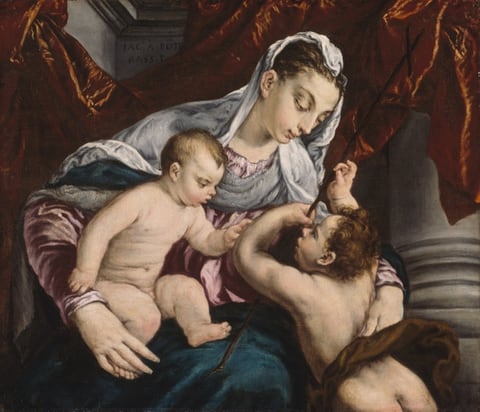
A work made of oil on canvas.
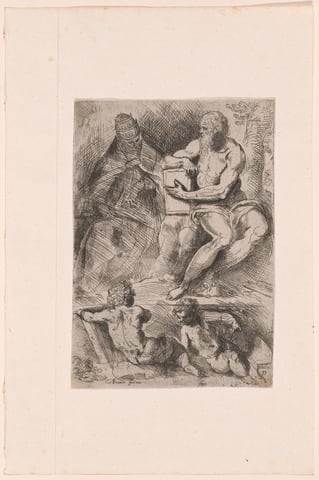
A work made of etching in black on cream laid paper.

The works in this room are listed below.

Works in this room

A few works by Alessandro Vittoria, then their contemporaries: makers of the same nationality born within 25 years of them, then works from the same century and place.

With their contemporaries

  1. The image shows a sketch of a seated bearded figure holding an orb. The figure appears muscular, with a beard merging into long hair. The face is not detailed, and draped fabric covers part of the body. There is no jewelry, and the background is plain.
    Saint JeromeAlessandro Vittoria, 1565/1570Courtesy National Gallery of Art, Washington
  2. A woman wearing a crimson-red brocade dress and gold jewelry fills most of this vertical portrait, but her right hand, on our left, rests on the shoulder of a young boy tucked into the lower left corner of the panel. The woman and boy both have pale, white skin, and both face and look out at us against an emerald-green curtain that falls behind them. The woman has brown eyes, a straight nose, full pink lips, smooth cheeks, and a long neck. Her brown hair is pulled back under a turban densely embroidered with gold. The woman’s dress has puffed shoulders and decorative slashes on the sleeves. One gold chain rests on her throat and the other falls over her chest. She wears long gold earrings, a gold belt, and two gold rings. She holds a brown leather glove in her left hand. The boy’s face is even with the woman’s waist, and he raises his left hand to hold hers, which is draped over his shoulder. He has curly blond hair and dark eyes, and he wears black with a ruffled white shirt just visible at his collar.
    A Young Woman and Her Little BoyAgnolo Bronzino, c. 1540Courtesy National Gallery of Art, Washington
  3. Mars and Venus United by Love, by Paolo Veronese (Paolo Caliari), 1570s
    Mars and Venus United by LovePaolo Veronese (Paolo Caliari), 1570sCourtesy of The Metropolitan Museum of Art

Their contemporaries

  1. The Baptism of Christ, by Jacopo Bassano, ca. 1590
    The Baptism of ChristJacopo Bassano, ca. 1590Courtesy of The Metropolitan Museum of Art
  2. A work made of oil on canvas.
    Virgin and Child with the Young Saint John the BaptistJacopo Bassano, 1560–65Courtesy of the Art Institute of Chicago
  3. A work made of etching in black on cream laid paper.
    Saint Jerome and a Pope with Two Putti (Saint Jerome and Pope Damasus)Jacopo Palma il Giovane, c. 1611Courtesy of the Art Institute of Chicago

Their contemporaries, second
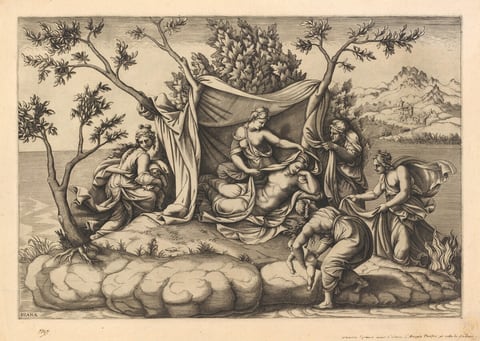
  1. Latona Giving Birth to Apollo and Diana on the Island of Delos, by Diana Scultori, 1561-1565
    Latona Giving Birth to Apollo and Diana on the Island of DelosDiana Scultori, 1561-1565Courtesy National Gallery of Art, Washington
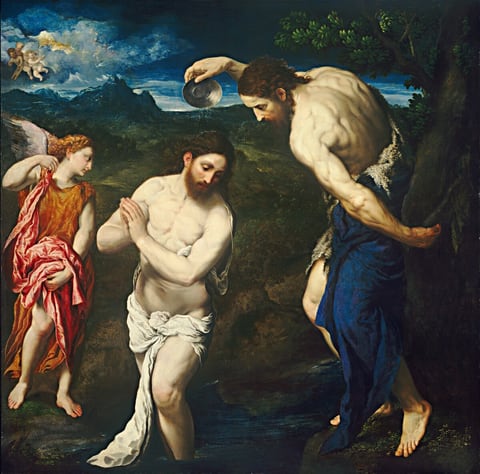
  2. Bright light from the upper left illuminates two muscular men and a winged angel against a dim landscape in this square painting. They all have pale skin, and the two men have dark brown hair and beards. One man, Jesus, stands ankle-deep in a rippling dark blue stream in the center of the composition facing us with downcast eyes. He is nude except for a white cloth that drapes over one shoulder and is tied around his hips. The other end of the cloth drops into the water. Jesus’s hands are pressed together in prayer at chest-height closer to his right shoulder, to our left. He leans his torso in the other direction and looks down at the water. The second man stands on the riverbank to our right. His body faces our left but his left shoulder, closer to us, dips down so his broad back is angled toward us. His lower body is wrapped in a cobalt-blue garment bordered with what looks like sheepskin. His near hand swings back to clutch the trunk of a tree growing immediately behind him. In his other hand, he holds up a pewter-grey dish that dribbles water onto Jesus’s head. On the left riverbank, the copper-haired angel looks on, facing our right in profile but the body faces us. The angel wears a sleeveless, pumpkin-orange robe with a shimmering salmon-pink mantle draped over the right shoulder, to our left. Petal-pink and dark grey wings extend from the shoulders, and the lower legs and feet are bare. The shadowy landscape has a dark green field stretching back to jagged, sapphire-blue mountains along the horizon, which comes four-fifths of the way up this composition. Pale blue clouds skim across the vivid blue sky, where three chubby, winged babies float. One holds a triangle and a rod with which to strike it, and another might hold a rectangular musical instrument. Blue clouds split nearby to show a sliver of golden yellow light, and possibly more angels.
    The Baptism of ChristParis Bordone, c. 1535/1540Courtesy National Gallery of Art, Washington