Floor plan

Style galleriesParis Salon painting
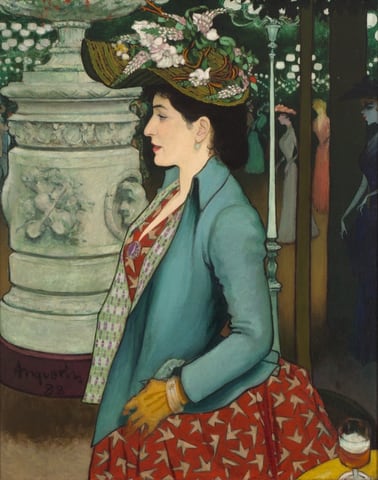
Paris Salon painting
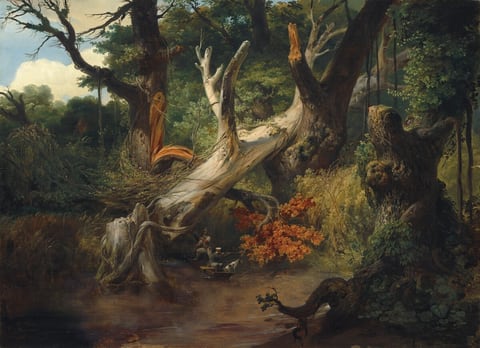
A leafless, ash-white tree trunk has fallen from a broken stump into the wide V of a neighboring tree at the edge of a body of water near a verdant forest in this horizontal landscape painting. The fallen trunk creates a diagonal from near the lower left corner to the upper right. As it fell, it sheared off a substantial branch from a neighboring tree with a dark trunk. The bark where the damaged branch has pulled away is honey-orange, the same color as the leaves at the canopy, which has been pinned under the fallen trunk. Trees, vines, and other vegetation fill the space around and beyond this pair. In the lower right corner of the painting, vines grow over a broken stump, which deep in shadow. Between the stump and fallen tree, the peanut-brown surface of the water is smooth. Tiny in scale beneath the fallen tree and easily overlooked, there are two men and a dog in a boat. One man stands at the back of the boat and pushes it along with a long pole. He wears a tall, brown, cloth hat, a white shirt rolled up to the elbows under a blue vest, and loose-fitting pants. A second man wears a flat-topped, white hat with a black brim, a long, forest-green jacket, and tight-fitting slate-blue pants. He braces a rifle against one shoulder and shoots into the forest. The dog is white with brown spots, and it stands with its front paws on the edge of the boat, presumably ready to spring after the target. A patch of blue sky with puffy white clouds is seen above the trees in the upper left corner. The artist signed and dated the work in the lower right corner: “H. Vernet Rome 1833.”
A work made of oil on canvas.
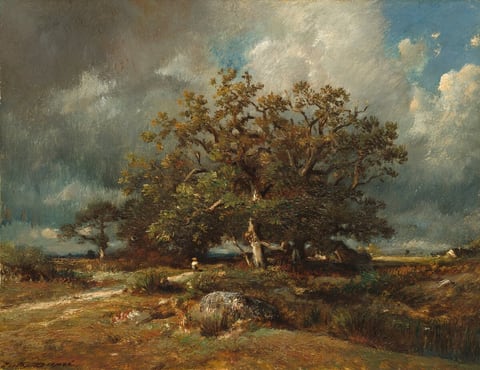
The painting depicts a landscape with a field, trees, and a dramatic cloudy sky. Grass, rocks, and a group of large trees are visible in the center of the composition. Below the trees, there is a small shape that could be a person looking up. Farther back, there are some small triangular structures that might be houses. The brushstrokes are expressive and not much detail is visible in the smaller shapes. The grass and foliage are painted in earthy tones of brown, orange, and green, while the sky is blue with areas of thick gray and white clouds.
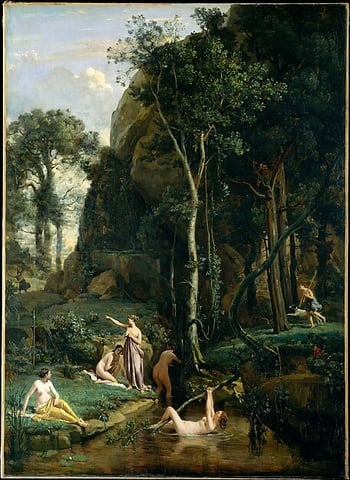
Diana and Actaeon (Diana Surprised in Her Bath), by Jean Baptiste Camille Corot, 1836
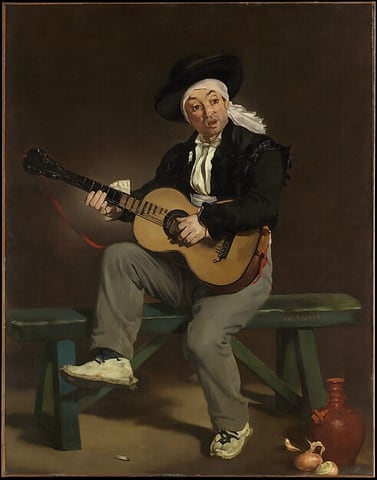
The Spanish Singer, by Édouard Manet, 1860
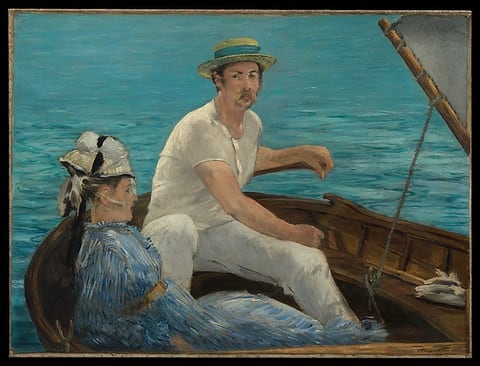
Boating, by Édouard Manet, 1874

The works in this room are listed below.

Works in this room

Painting made for the great annual exhibition in Paris, and the realists who argued with it.

Section 1, north wall

  1. A leafless, ash-white tree trunk has fallen from a broken stump into the wide V of a neighboring tree at the edge of a body of water near a verdant forest in this horizontal landscape painting. The fallen trunk creates a diagonal from near the lower left corner to the upper right. As it fell, it sheared off a substantial branch from a neighboring tree with a dark trunk. The bark where the damaged branch has pulled away is honey-orange, the same color as the leaves at the canopy, which has been pinned under the fallen trunk. Trees, vines, and other vegetation fill the space around and beyond this pair. In the lower right corner of the painting, vines grow over a broken stump, which deep in shadow. Between the stump and fallen tree, the peanut-brown surface of the water is smooth. Tiny in scale beneath the fallen tree and easily overlooked, there are two men and a dog in a boat. One man stands at the back of the boat and pushes it along with a long pole. He wears a tall, brown, cloth hat, a white shirt rolled up to the elbows under a blue vest, and loose-fitting pants. A second man wears a flat-topped, white hat with a black brim, a long, forest-green jacket, and tight-fitting slate-blue pants. He braces a rifle against one shoulder and shoots into the forest. The dog is white with brown spots, and it stands with its front paws on the edge of the boat, presumably ready to spring after the target. A patch of blue sky with puffy white clouds is seen above the trees in the upper left corner. The artist signed and dated the work in the lower right corner: “H. Vernet Rome 1833.”
    Hunting in the Pontine MarshesHorace Vernet, 1833Courtesy National Gallery of Art, Washington
  2. A work made of oil on canvas.
    A Woman at the Élysée Montmartre (Femme à l’Élysée Montmartre)Louis Anquetin, 1888Courtesy of the Art Institute of Chicago
  3. The painting depicts a landscape with a field, trees, and a dramatic cloudy sky. Grass, rocks, and a group of large trees are visible in the center of the composition. Below the trees, there is a small shape that could be a person looking up. Farther back, there are some small triangular structures that might be houses. The brushstrokes are expressive and not much detail is visible in the smaller shapes. The grass and foliage are painted in earthy tones of brown, orange, and green, while the sky is blue with areas of thick gray and white clouds.
    The Old OakJules Dupré, c. 1870Courtesy National Gallery of Art, Washington

Section 1, south wall

  1. Diana and Actaeon (Diana Surprised in Her Bath), by Jean Baptiste Camille Corot, 1836
    Diana and Actaeon (Diana Surprised in Her Bath)Jean Baptiste Camille Corot, 1836Courtesy of The Metropolitan Museum of Art
  2. The Spanish Singer, by Édouard Manet, 1860
    The Spanish SingerÉdouard Manet, 1860Courtesy of The Metropolitan Museum of Art
  3. Boating, by Édouard Manet, 1874
    BoatingÉdouard Manet, 1874Courtesy of The Metropolitan Museum of Art

Section 2, south wall
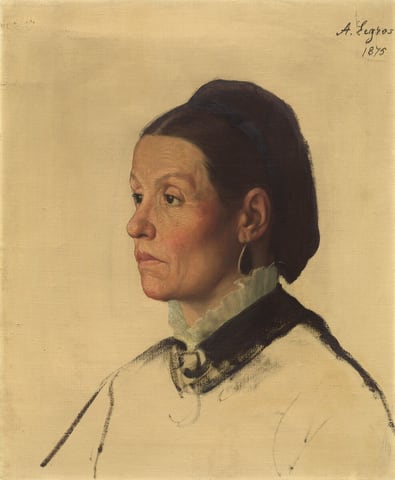
  1. The image portrays a woman in a profile view, with her head turned towards the left. She has medium-length dark hair styled back, wearing a high-collared garment with ruffled edges. She has a sharp nose, defined cheekbones, and a firm chin. The background is a plain, light-colored canvas, and the artist's signature "A. Legros" and the year "1875" are seen in the upper right corner.
    Portrait of a WomanAlphonse Legros, 1875Courtesy National Gallery of Art, Washington
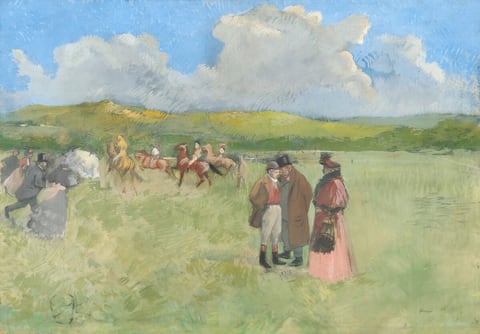
  2. This painting depicts a wide, grassy green field with distant green hills under a blue sky with fluffy white clouds. To the right of center, two men and one woman seem to be engaged in conversation. One man wears a dark suit with a long jacket over it and a top hat, and the other man wears a red shirt with tan breeches, tall black boots, a shorter brown coat, and a round hat. The woman wears a long pink dress with a ruffled black neckline and a large pink hat. Behind them, on the left, are four people riding horses, all headed towards the back left. On the far left, more men and women in dresses and suits seem to watch as the horses and riders race by, one woman holding a large white parasol. All of the people appear to have light skin, and their facial features are indistinct. The brushstrokes in the painting are loose and visible, and the landscape and sky are painted with short, overlapping lines going in different directions, giving the scene a hazy impression.
    The Race TrackJean Louis Forain, c. 1891Courtesy National Gallery of Art, Washington
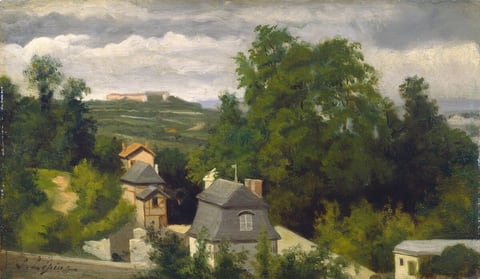
  3. The painting shows an elevated perspective overlooking a landscape with green hills and leafy trees. Closest to us, there are cream-colored buildings among dense foliage. These buildings have roofs in shades of pale blue-gray and reddish-brown, and the one in the center has wispy white smoke coming out of a chimney. In the distance on the left, a large, low structure sits atop a hill, with faint paths winding towards it through the green landscape. Beyond the trees, the distant landscape on the right is painted in shades of pale blue and green. The sky above is filled with puffy clouds in shades of gray.
    View on the Outskirts of CaenStanislas Lépine, 1872/1875Courtesy National Gallery of Art, Washington
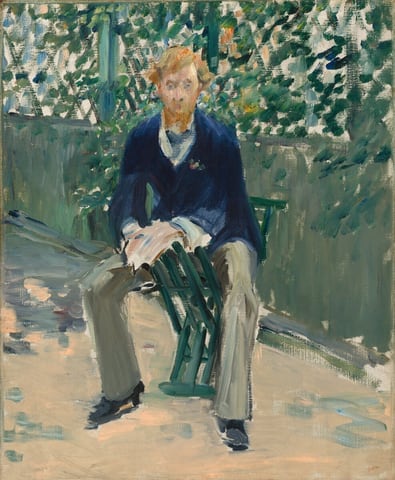
  4. A pale-skinned young man with a carrot-red beard and hair faces us, straddling a green chair in a sunny outdoor setting in this vertical painting. The scene is loosely painted so his features are indistinct. His eyes are painted as pale blue dots, and he looks out at us. His chair unfolds into an X shape, with interlacing slats to make the seat. He leans forward to rest his hands on one side of the chair, and his legs are spread wide. He wears a marine-blue jacket over a white shirt, sage-green trousers streaked with gray, and black shoes. A soft blue V-shape at the neck suggests a neckerchief. Behind him, a half wall is topped by a trellis. The wall is painted in muted tones of pale laurel green while the trellis is painted with crisscrossed strokes of pine green. Daubs of emerald, pine, and forest green suggest vines and leaves, and flicks of orange, gold, and blue could be flowers. The ground beneath the man is pale peach scattered with thin scribbles and patches of fog blue. The painting is inscribed with “E 72.” in the lower right.
    George Moore in the Artist's GardenÉdouard Manet, c. 1879Courtesy National Gallery of Art, Washington

Section 2, north wall
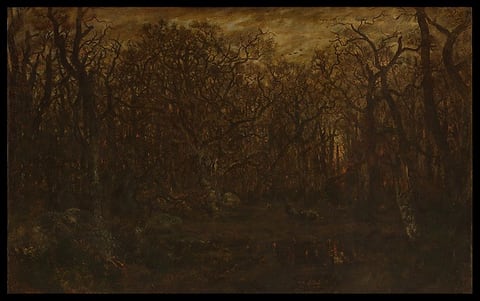
  1. The Forest in Winter at Sunset, by Théodore Rousseau, ca. 1846–67
    The Forest in Winter at SunsetThéodore Rousseau, ca. 1846–67Courtesy of The Metropolitan Museum of Art
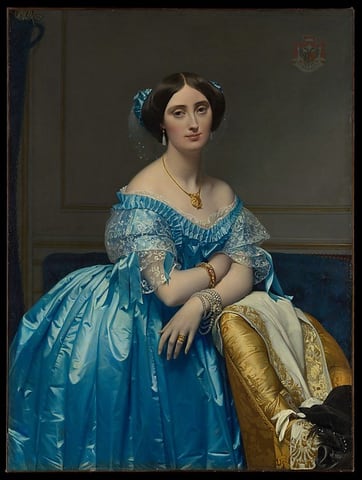
  2. Joséphine-Éléonore-Marie-Pauline de Galard de Brassac de Béarn (1825–1860), Princesse de Broglie, by Jean Auguste Dominique Ingres, 1851–53
    Joséphine-Éléonore-Marie-Pauline de Galard de Brassac de Béarn (1825–1860), Princesse de BroglieJean Auguste Dominique Ingres, 1851–53Courtesy of The Metropolitan Museum of Art

Section 3, north wall
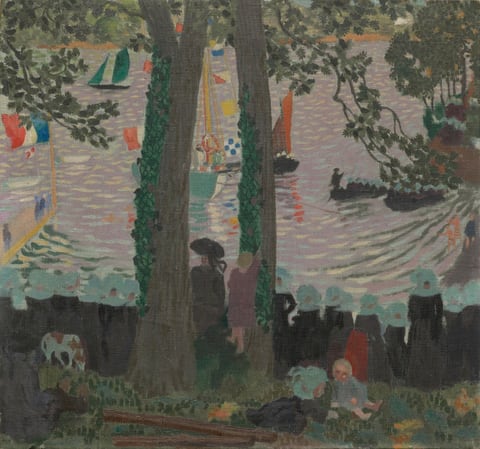
  1. Blessing of a Yacht on the Belon River, by Maurice Denis, 1899
    Blessing of a Yacht on the Belon RiverMaurice Denis, 1899Courtesy of the Cleveland Museum of Art
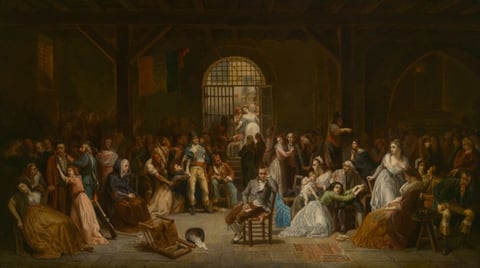
  2. A work made of oil on canvas.
    The Roll Call of the Last Victims of the TerrorCharles Louis-Lucien Muller, c. 1850Courtesy of the Art Institute of Chicago

Section 3, south wall
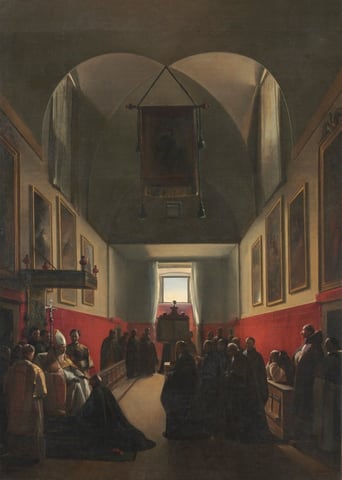
  1. Homage to a Bishop, by François Marius Granet, 1839
    Homage to a BishopFrançois Marius Granet, 1839Courtesy of the Cleveland Museum of Art
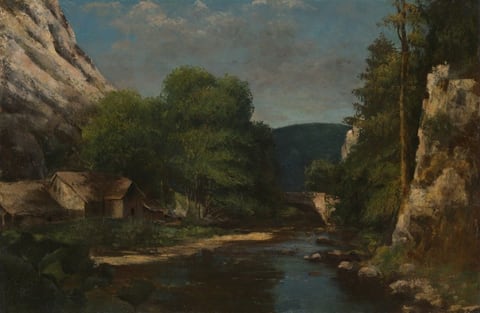
  2. A work made of oil on canvas.
    LandscapeMarcel Ordinaire, 1867Courtesy of the Art Institute of Chicago