Floor plan

Style galleriesPaintings of the 19th century
Paintings of the 19th century
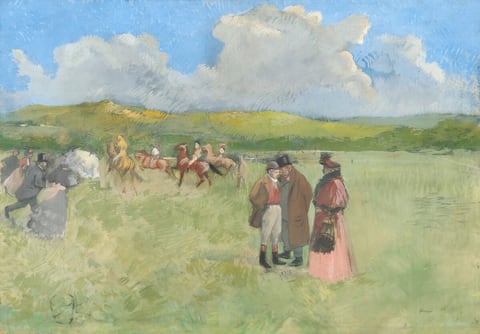
This painting depicts a wide, grassy green field with distant green hills under a blue sky with fluffy white clouds. To the right of center, two men and one woman seem to be engaged in conversation. One man wears a dark suit with a long jacket over it and a top hat, and the other man wears a red shirt with tan breeches, tall black boots, a shorter brown coat, and a round hat. The woman wears a long pink dress with a ruffled black neckline and a large pink hat. Behind them, on the left, are four people riding horses, all headed towards the back left. On the far left, more men and women in dresses and suits seem to watch as the horses and riders race by, one woman holding a large white parasol. All of the people appear to have light skin, and their facial features are indistinct. The brushstrokes in the painting are loose and visible, and the landscape and sky are painted with short, overlapping lines going in different directions, giving the scene a hazy impression.
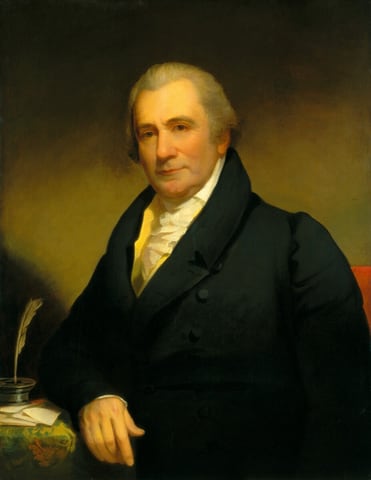
The image shows a man sitting and facing the viewer. He has his right hand on a table. The man's hair is gray and neatly styled. He is wearing a dark coat with a high collar, a white shirt, and a yellow vest peeking through. On the table are a quill, inkwell, and papers. The background is a dark, neutral tone.
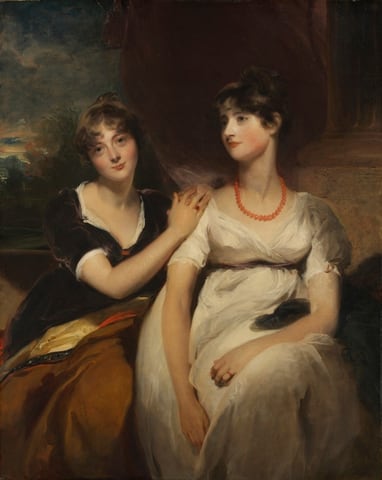
Portrait of Charlotte and Sarah Carteret-Hardy, by Thomas Lawrence, 1801
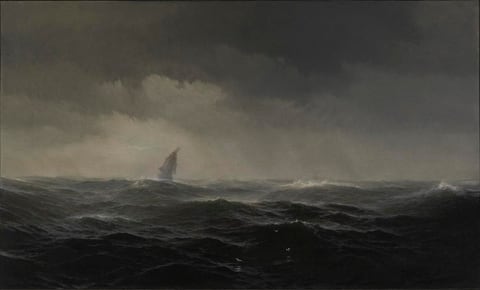
The Sea, by Edward Moran, 1870
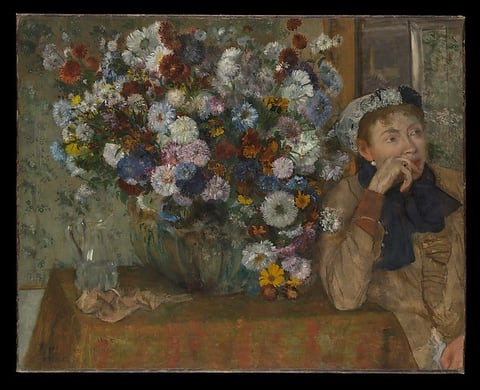
A Woman Seated beside a Vase of Flowers (Madame Paul Valpinçon?), by Edgar Degas, 1865
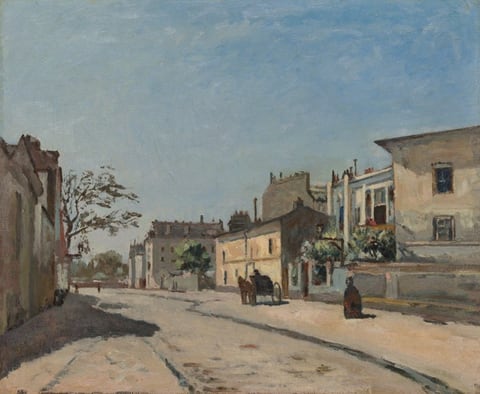
A work made of oil on panel.

The works in this room are listed below.

Works in this room

Paintings made in the 19th century, from every museum.

First room, north wall

  1. This painting depicts a wide, grassy green field with distant green hills under a blue sky with fluffy white clouds. To the right of center, two men and one woman seem to be engaged in conversation. One man wears a dark suit with a long jacket over it and a top hat, and the other man wears a red shirt with tan breeches, tall black boots, a shorter brown coat, and a round hat. The woman wears a long pink dress with a ruffled black neckline and a large pink hat. Behind them, on the left, are four people riding horses, all headed towards the back left. On the far left, more men and women in dresses and suits seem to watch as the horses and riders race by, one woman holding a large white parasol. All of the people appear to have light skin, and their facial features are indistinct. The brushstrokes in the painting are loose and visible, and the landscape and sky are painted with short, overlapping lines going in different directions, giving the scene a hazy impression.
    The Race TrackJean Louis Forain, c. 1891Courtesy National Gallery of Art, Washington
  2. The image shows a man sitting and facing the viewer. He has his right hand on a table. The man's hair is gray and neatly styled. He is wearing a dark coat with a high collar, a white shirt, and a yellow vest peeking through. On the table are a quill, inkwell, and papers. The background is a dark, neutral tone.
    Robert ColemanJacob Eichholtz, c. 1820Courtesy National Gallery of Art, Washington
  3. Portrait of Charlotte and Sarah Carteret-Hardy, by Thomas Lawrence, 1801
    Portrait of Charlotte and Sarah Carteret-HardyThomas Lawrence, 1801Courtesy of the Cleveland Museum of Art

First room, south wall

  1. The Sea, by Edward Moran, 1870
    The SeaEdward Moran, 1870Courtesy of the Smithsonian American Art Museum
  2. A Woman Seated beside a Vase of Flowers (Madame Paul Valpinçon?), by Edgar Degas, 1865
    A Woman Seated beside a Vase of Flowers (Madame Paul Valpinçon?)Edgar Degas, 1865Courtesy of The Metropolitan Museum of Art
  3. A work made of oil on panel.
    French Street SceneEdouard Béliard, 1873–77Courtesy of the Art Institute of Chicago

Second room, south wall
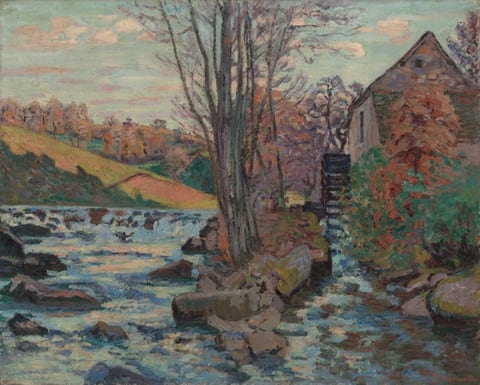
  1. A work made of oil on canvas.
    Mill of Pont MaupuitJean Baptiste Armand Guillaumin, c. 1900Courtesy of the Art Institute of Chicago
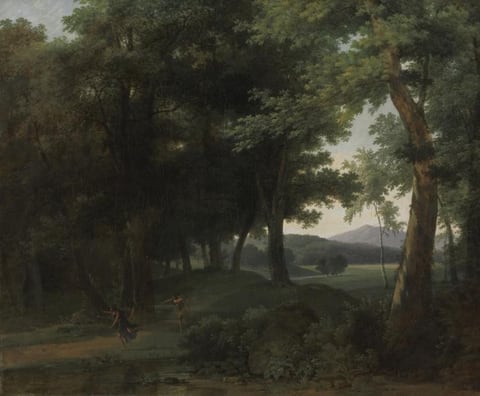
  2. A Forest with Apollo and Daphne, by Jean-Victor Bertin, 1810
    A Forest with Apollo and DaphneJean-Victor Bertin, 1810Courtesy of the Cleveland Museum of Art
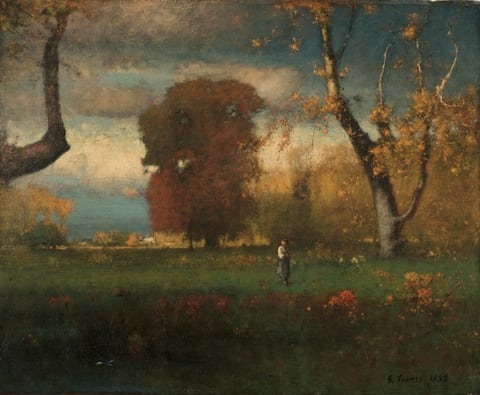
  3. Landscape, by George Inness, 1888
    LandscapeGeorge Inness, 1888Courtesy of the Cleveland Museum of Art

Second room, north wall
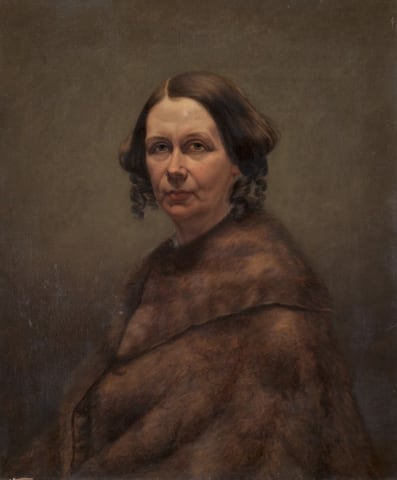
  1. Mrs. Goss (The Woman in Fur), by Caroline L. Ransom, c. 1850s
    Mrs. Goss (The Woman in Fur)Caroline L. Ransom, c. 1850sCourtesy of the Cleveland Museum of Art
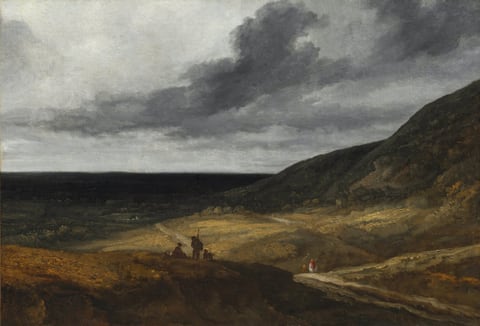
  2. Landscape Near Paris, by Georges Michel, c. 1840
    Landscape Near ParisGeorges Michel, c. 1840Courtesy of the Cleveland Museum of Art
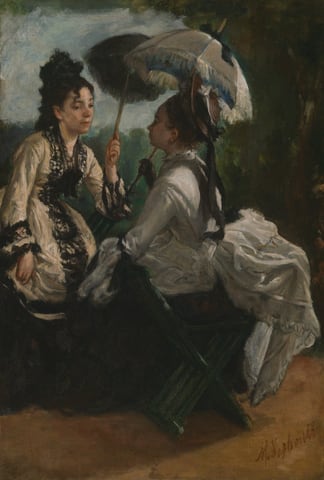
  3. A work made of oil on canvas.
    The ConversationMarcellin Gilbert Desboutin, 1875–79Courtesy of the Art Institute of Chicago

Third room, north wall
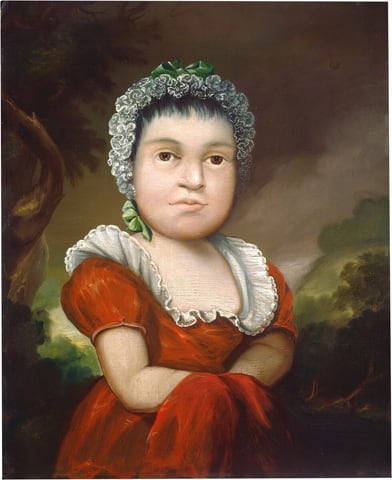
  1. A pale-skinned child wearing a short-sleeved red dress and a white bonnet stands before a shadowy green forest under dark clouds in this vertical portrait painting. The child’s over-large head is out of scale with the rest of her body. She looks toward us with brown eyes in her wide, round-jawed face. She has a broad nose, and her pale lips are set in a line. Her lace bonnet lines her black hair like frothy seafoam and is tied with spring-green bows at the top and under her right ear, to our left. The low neckline of her crimson dress is lined with a wide white ruffle. Red fabric covers her hands, which are gathered in front of her waist. Gray clouds sweep over the hazy green forest in the background. A gnarled tree grows up the left side of the painting, framing the girl.
    Portrait of a ChildEdward Hicks, c. 1840Courtesy National Gallery of Art, Washington
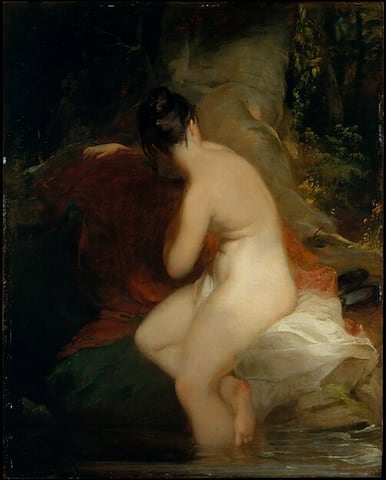
  2. Musidora, by Thomas Sully, 1813–35
    MusidoraThomas Sully, 1813–35Courtesy of The Metropolitan Museum of Art
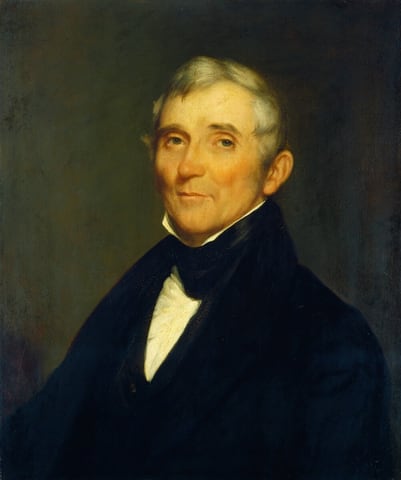
  3. The image is a portrait painting showing a man's upper body. He is positioned slightly turned to his right, with his head facing the viewer. The man has fair skin, defined cheekbones, and small, bright eyes. His hair is short, neatly combed, and grey or white. He is wearing a dark coat over a white shirt with a high collar, partially visible. The background is a muted, dark color, providing a simple setting that emphasizes the subject. There are no visible jewelry or objects in the image.
    Aaron BaldwinFrancis Alexander, c. 1835Courtesy National Gallery of Art, Washington
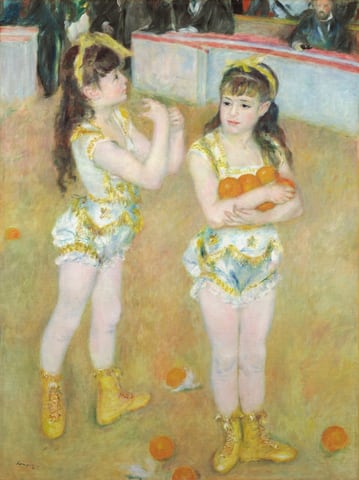
  4. Two girls in acrobatic uniforms stand in an arena, one holds oranges.
    Acrobats at the Cirque Fernando (Francisca and Angelina Wartenberg)Pierre-Auguste Renoir, 1879Courtesy of the Art Institute of Chicago