Floor plan

Style galleriesPaintings of the 15th century
Paintings of the 15th century
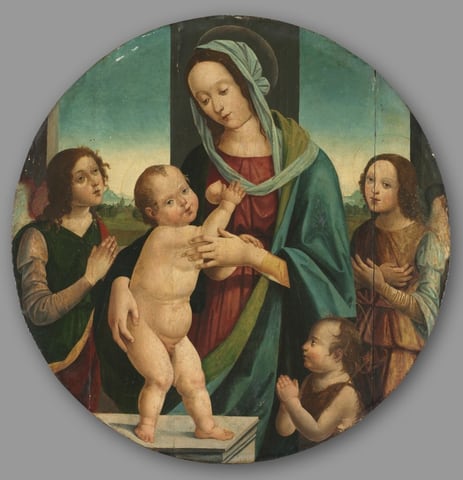
Virgin and Child with John the Baptist and Angels, by Pietro del Donzello, c. 1500
A work made of tempera on panel, transferred to canvas.
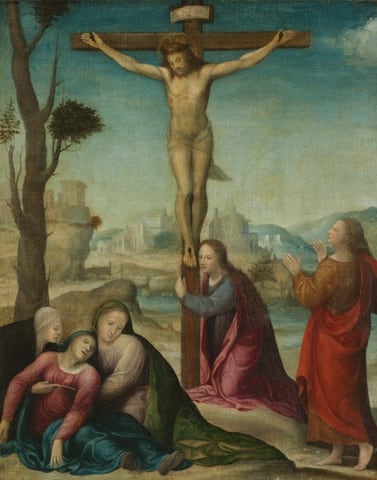
The Crucifixion, by Sodoma, 1500s
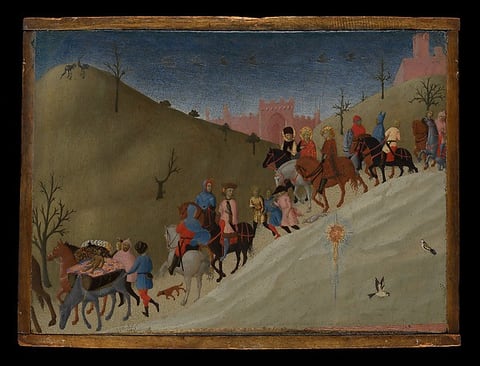
The Journey of the Magi, by Sassetta, ca. 1433–35
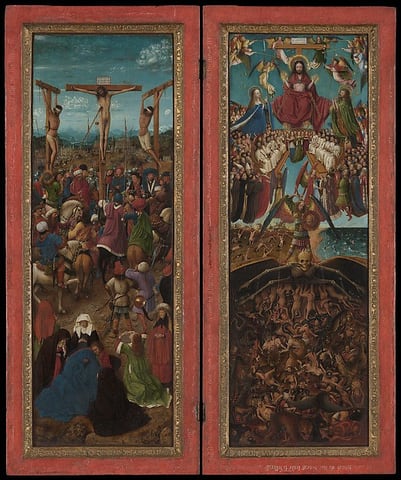
The Crucifixion; The Last Judgment, by Jan van Eyck, ca. 1436–38
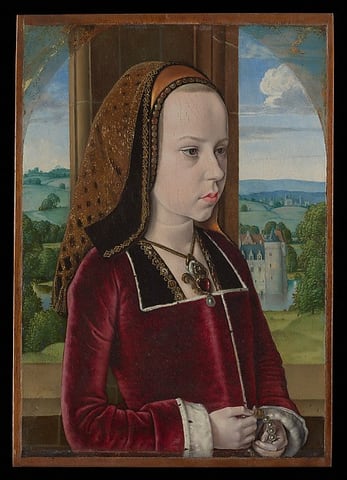
Margaret of Austria, by Jean Hey (called Master of Moulins), ca. 1490
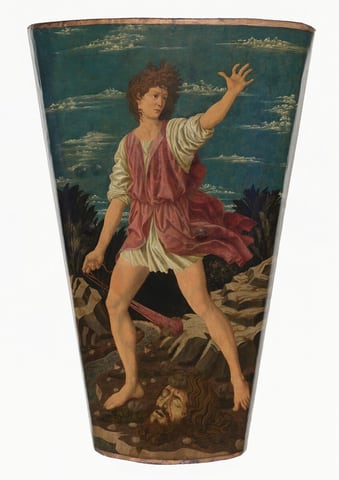
This shield-shaped painting shows a young man with pale, peachy skin and curling brown hair standing astride the severed head of a man with dark hair and tanned skin. The painting is wider at the top and tapers like a pint glass to a narrower base. The young man, David, holds the end of long red slingshot with his right hand. The slingshot is weighted by a rock and swings behind his body. His sleeveless rust-red garment is cinched at his waist over a long white shirt. Both garments skim David’s thighs and his legs and feet are bare. Long, curling brown hair frames the ashen and bloodied upturned face of the head at David’s feet. A palm-sized stone is embedded in that forehead. The landscape background is made up of gray boulders, a meandering river, and low palm-like trees. Frothy white clouds sweep across an azure-blue sky.
A work made of album leaf mounted as a hanging scroll; ink and light colors on silk.

The works in this room are listed below.

Works in this room

Paintings made in the 15th century, from every museum.

First room, north wall

  1. Virgin and Child with John the Baptist and Angels, by Pietro del Donzello, c. 1500
    Virgin and Child with John the Baptist and AngelsPietro del Donzello, c. 1500Courtesy of the Cleveland Museum of Art
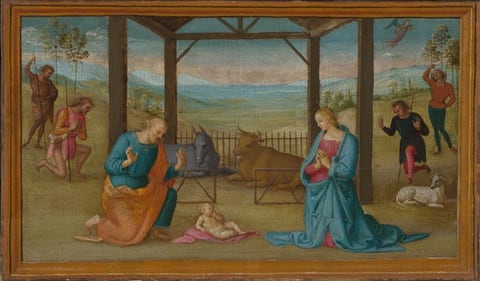
  2. A work made of tempera on panel, transferred to canvas.
    The NativityPerugino, 1500–05Courtesy of the Art Institute of Chicago
  3. The Crucifixion, by Sodoma, 1500s
    The CrucifixionSodoma, 1500sCourtesy of the Cleveland Museum of Art
  4. The Journey of the Magi, by Sassetta, ca. 1433–35
    The Journey of the MagiSassetta, ca. 1433–35Courtesy of The Metropolitan Museum of Art

First room, south wall

  1. The Crucifixion; The Last Judgment, by Jan van Eyck, ca. 1436–38
    The Crucifixion; The Last JudgmentJan van Eyck, ca. 1436–38Courtesy of The Metropolitan Museum of Art
  2. Margaret of Austria, by Jean Hey (called Master of Moulins), ca. 1490
    Margaret of AustriaJean Hey (called Master of Moulins), ca. 1490Courtesy of The Metropolitan Museum of Art
  3. This shield-shaped painting shows a young man with pale, peachy skin and curling brown hair standing astride the severed head of a man with dark hair and tanned skin. The painting is wider at the top and tapers like a pint glass to a narrower base. The young man, David, holds the end of long red slingshot with his right hand. The slingshot is weighted by a rock and swings behind his body. His sleeveless rust-red garment is cinched at his waist over a long white shirt. Both garments skim David’s thighs and his legs and feet are bare. Long, curling brown hair frames the ashen and bloodied upturned face of the head at David’s feet. A palm-sized stone is embedded in that forehead. The landscape background is made up of gray boulders, a meandering river, and low palm-like trees. Frothy white clouds sweep across an azure-blue sky.
    David with the Head of GoliathAndrea del Castagno, c. 1450/1455Courtesy National Gallery of Art, Washington
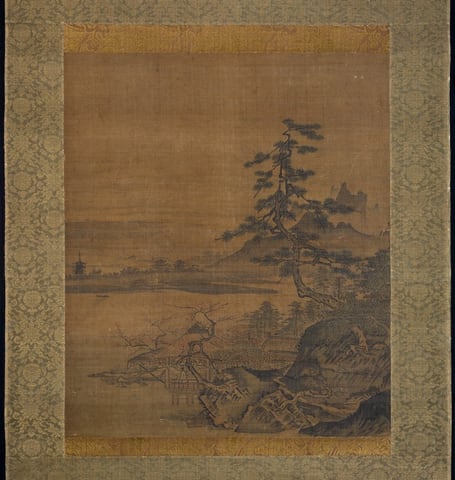
  4. A work made of album leaf mounted as a hanging scroll; ink and light colors on silk.
    Spring View from a Thatched Pavilion on the LakeshoreSchool of Sesshu, late 15th centuryCourtesy of the Art Institute of Chicago

Second room, south wall
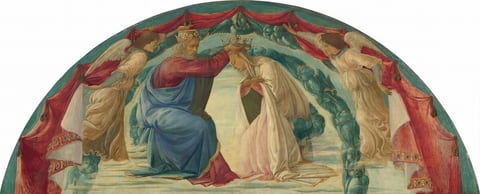
  1. In a wide, arched panel, a bearded man wearing a crown places another crown on the head of a woman. To our right, the woman bows her head with her eyes nearly closed and crosses her wrists over her chest. A white cloak covers her head, drapes over her shoulders, and pools in deep folds around her feet. The cloak is lined with pine green, and she wears a shell-pink dress. To our left, the man has shoulder-length, curly gray hair and a beard. His robe is dark rose pink, and the cloak is azure blue lined with pine green. Two winged angels have brown hair, short, white wings, and wear voluminous white robes. They stand to either side of the man and woman and hold up a swag of raspberry-red cloth hung with gold tassels. All the people have pale, peachy skin. Winged baby heads encircled with gold rays create an arch behind the man and woman, who sit on clouds. The background is pale blue sky.
    The Coronation of the VirginFilippino Lippi, c. 1475Courtesy National Gallery of Art, Washington
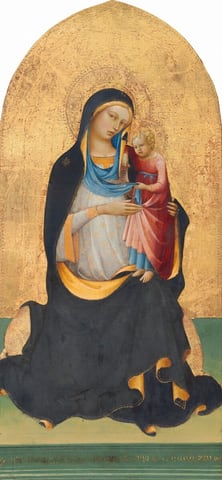
  2. A woman sits and supports a baby standing on her lap, both against a gold background in this arched, vertical painting. The woman and baby’s light skin is shaded with faint green, and they have pale pink cheeks. The woman’s body faces us. She tips her head toward the baby who stands on her knee, to our right. The woman looks at us with light brown eyes under curving brows. She has a long, straight nose, and her small pink lips are closed. Her blond hair is mostly covered by a midnight-blue robe that drapes over her shoulders, across her lap, and pools on the floor. The robe is lined with goldenrod yellow, edged with bright gold, and has gold starburst-like designs on the shoulder we can see and top of the head. The dress she wears underneath has more gold stars creating a pattern across the pearl-white fabric. A sky-blue scarf wraps over her head and loops across her shoulders. The baby holds one end of the scarf, and his other elbow rests on the woman’s shoulder. She props him up with both hands. He has a cap of blond curls and chubby cheeks with delicate features. His geranium-red garment falls over a pale blue skirt that reaches his bare feet. In the hand near the woman’s shoulder, he holds a scroll with the letters “EGO S.” The floor beneath them is mint green and has gold writing across the front, reading, “AVE.G ANN O.D M.CCCC.XIII.” The woman and baby’s disc-like gold halos blend into the gold background, which is visibly cracked in some areas. The panel comes to a pointed arch at the top.
    Madonna and ChildLorenzo Monaco, 1413Courtesy National Gallery of Art, Washington
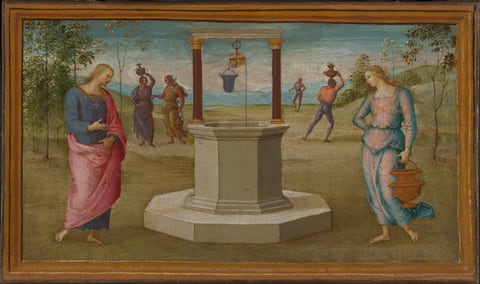
  3. A work made of tempera on panel, transferred to canvas.
    Christ and the Woman of SamariaPerugino, 1500–05Courtesy of the Art Institute of Chicago

Second room, north wall
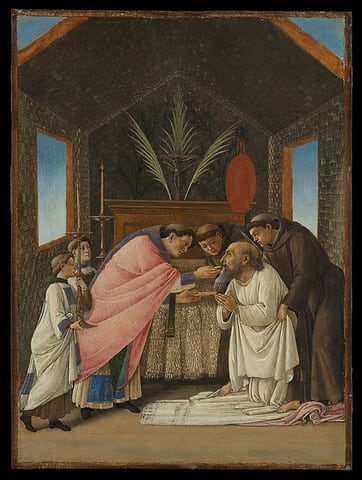
  1. The Last Communion of Saint Jerome, by Botticelli (Alessandro di Mariano Filipepi), early 1490s
    The Last Communion of Saint JeromeBotticelli (Alessandro di Mariano Filipepi), early 1490sCourtesy of The Metropolitan Museum of Art
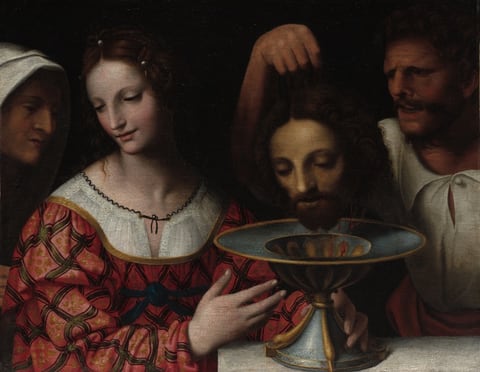
  2. Salome with the Head of Saint John the Baptist, by Bernardino Luini, 1500s or later
    Salome with the Head of Saint John the BaptistBernardino Luini, 1500s or laterCourtesy of the Cleveland Museum of Art
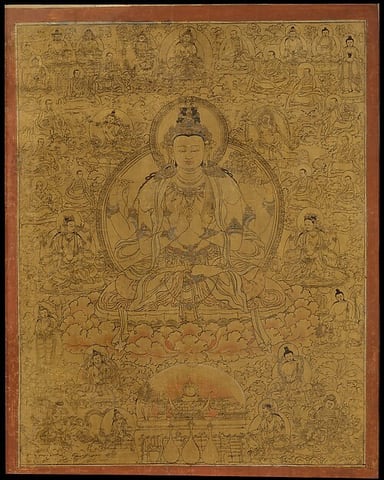
  3. Sadaksari-Lokeshvara Surrounded by Manifestations and Monks, late 15th century
    Sadaksari-Lokeshvara Surrounded by Manifestations and MonksUnrecorded Himalayan maker, late 15th centuryCourtesy of The Metropolitan Museum of Art

Third room, north wall
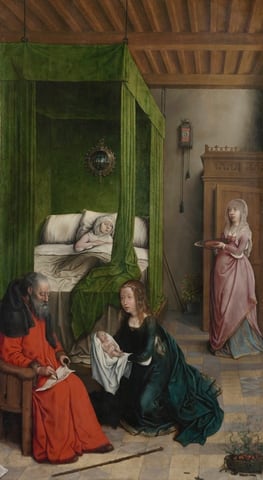
  1. The Birth and Naming of John the Baptist, by Juan de Flandes, 1496–99
    The Birth and Naming of John the BaptistJuan de Flandes, 1496–99Courtesy of the Cleveland Museum of Art
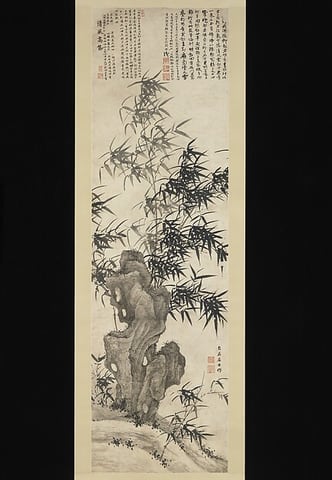
  2. Windblown bamboo, by Xia Chang, ca. 1460
    Windblown bambooXia Chang, ca. 1460Courtesy of The Metropolitan Museum of Art