Floor plan

Style galleriesNeoclassicism

Neoclassicism

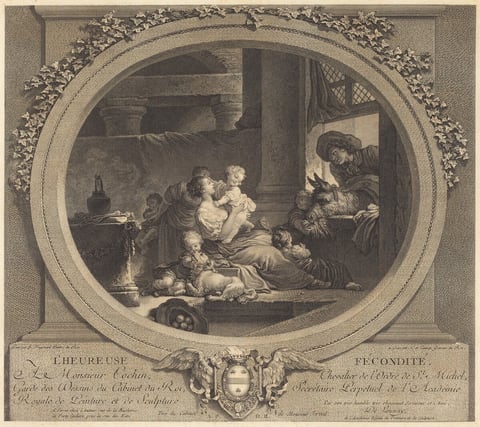
The engraving depicts a gathering around a woman holding a child in her arms in an indoor setting with stone columns and an arched background. Another woman is next to her, looking towards her while leaning over what appears to be a child or possibly a doll on a small donkey. Surrounding the central woman are several children, some seated and playing on the floor. A dog is resting at the central woman's feet. The image features lush drapery, creating a warm and intimate setting. The style suggests classical or historical fashion, and there is an ornate border with ivy leaves. The text and emblem below likely contain relevant inscriptions.
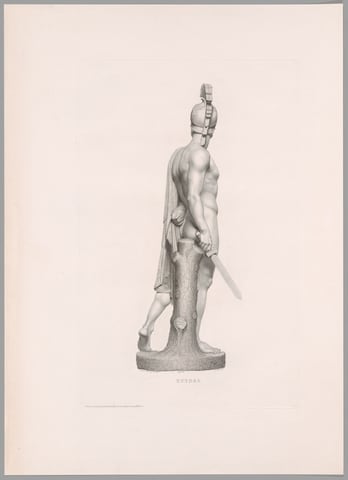
A work made of engraving and etching in black on ivory wove paper.
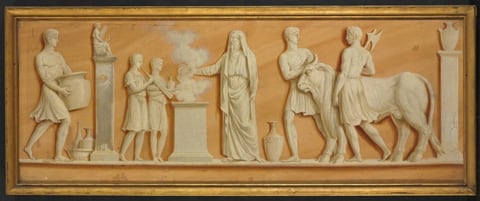
Overdoor Painting and Double-Leaf Doors, by Pierre Rousseau, 1790s
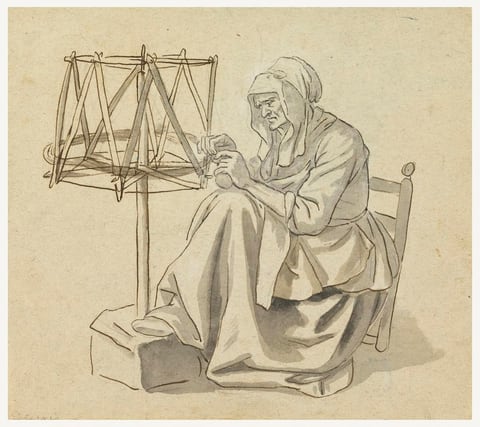
AN OLD WOMAN SPINNING
A work made of engraving and etching in black on ivory wove paper.
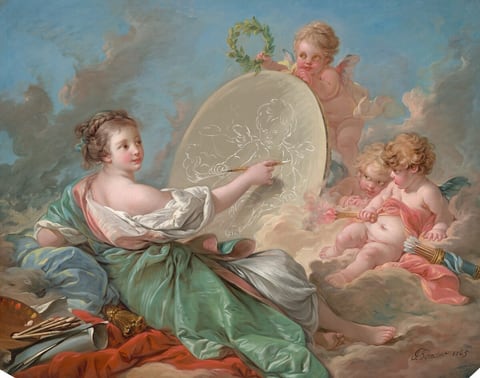
A young woman draws on an oval surface with white chalk while three winged, baby-like putti gather nearby, all on a bank of pale pink clouds in this horizontal painting. The woman and putti have pale, rosy skin, flushed cheeks, and hazel-brown eyes. To our left, the woman reclines with her upper body propped up on her far elbow, which rests on a steel-blue cushion as her legs stretch out to our right. Her light brown hair is braided and wrapped across the top of her head. She wears a loose, seafoam-green robe over a billowing ivory-white garment that has slipped off the shoulder closer to us. A round paint palette with brushes sticking out of its thumb hole and a roll of blue and white paper sit in the lower left corner, behind the woman. The woman and the objects are on a red cloth. In front of the woman is a rounded surface, perhaps a canvas, on which she draws. She holds up a gold-colored stylus with her right hand, closer to us, with a pointed piece of white chalk in one end and black chalk in the other. The canvas is taller than her head, so the child-like putto she draws on it is life-sized. The three nude putti on the far side of the canvas have copper or golden-blond, curly hair, flushed, rounded cheeks, short wings in white or peacock blue, pudgy torsos, and dimpled limbs. One putto, presumably the one the woman draws, sits back on the bank of clouds with a carnation-pink sash across his chest. He pulls his chin back and looks at her from under his eyebrows. He holds a gold-colored torch with a pink flame in one hand, and the other hand rests near a cylindrical quiver of arrows. Another putto peeks around the side of the canvas, and the third stands and props the canvas up. That third putto holds up a wreath of laurel leaves up over the canvas, above the woman’s drawing hand. The bank of clouds is parchment-brown with muted pink and blue highlights against a vivid blue sky. The artist signed and dated the lower right, “F Boucher – 1765.”

The works in this room are listed below.

Works in this room

Europe turns back to Greece and Rome: clear line, calm figures and civic virtue.

First room, north wall

  1. The engraving depicts a gathering around a woman holding a child in her arms in an indoor setting with stone columns and an arched background. Another woman is next to her, looking towards her while leaning over what appears to be a child or possibly a doll on a small donkey. Surrounding the central woman are several children, some seated and playing on the floor. A dog is resting at the central woman's feet. The image features lush drapery, creating a warm and intimate setting. The style suggests classical or historical fashion, and there is an ornate border with ivy leaves. The text and emblem below likely contain relevant inscriptions.
    L'heureuse féconditéNicolas Delaunay, 1777Courtesy National Gallery of Art, Washington
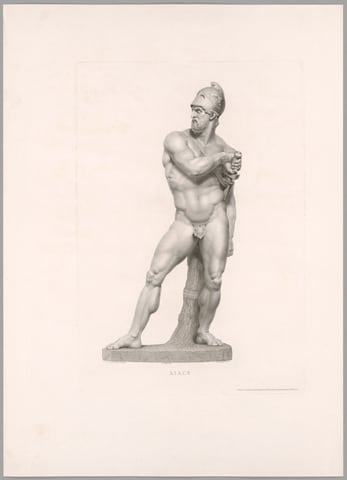
  2. A work made of engraving and etching in black on ivory wove paper.
    Ettore, Side View, from Oeuvre de CanovaAntonio Canova, 1817Courtesy of the Art Institute of Chicago
  3. Overdoor Painting and Double-Leaf Doors, by Pierre Rousseau, 1790s
    Overdoor Painting and Double-Leaf DoorsPierre Rousseau, 1790sCourtesy of the Cleveland Museum of Art

First room, south wall

  1. AN OLD WOMAN SPINNING
    An Old Woman SpinningClaude-Louis Desrais, 1810–30Courtesy of Cooper Hewitt, Smithsonian Design Museum
  2. A work made of engraving and etching in black on ivory wove paper.
    Ajax, Front View, from Oeuvre de CanovaAntonio Canova, 1817Courtesy of the Art Institute of Chicago
  3. A young woman draws on an oval surface with white chalk while three winged, baby-like putti gather nearby, all on a bank of pale pink clouds in this horizontal painting. The woman and putti have pale, rosy skin, flushed cheeks, and hazel-brown eyes. To our left, the woman reclines with her upper body propped up on her far elbow, which rests on a steel-blue cushion as her legs stretch out to our right. Her light brown hair is braided and wrapped across the top of her head. She wears a loose, seafoam-green robe over a billowing ivory-white garment that has slipped off the shoulder closer to us. A round paint palette with brushes sticking out of its thumb hole and a roll of blue and white paper sit in the lower left corner, behind the woman. The woman and the objects are on a red cloth. In front of the woman is a rounded surface, perhaps a canvas, on which she draws. She holds up a gold-colored stylus with her right hand, closer to us, with a pointed piece of white chalk in one end and black chalk in the other. The canvas is taller than her head, so the child-like putto she draws on it is life-sized. The three nude putti on the far side of the canvas have copper or golden-blond, curly hair, flushed, rounded cheeks, short wings in white or peacock blue, pudgy torsos, and dimpled limbs. One putto, presumably the one the woman draws, sits back on the bank of clouds with a carnation-pink sash across his chest. He pulls his chin back and looks at her from under his eyebrows. He holds a gold-colored torch with a pink flame in one hand, and the other hand rests near a cylindrical quiver of arrows. Another putto peeks around the side of the canvas, and the third stands and props the canvas up. That third putto holds up a wreath of laurel leaves up over the canvas, above the woman’s drawing hand. The bank of clouds is parchment-brown with muted pink and blue highlights against a vivid blue sky. The artist signed and dated the lower right, “F Boucher – 1765.”
    Allegory of PaintingFrançois Boucher, 1765Courtesy National Gallery of Art, Washington

Second room, south wall
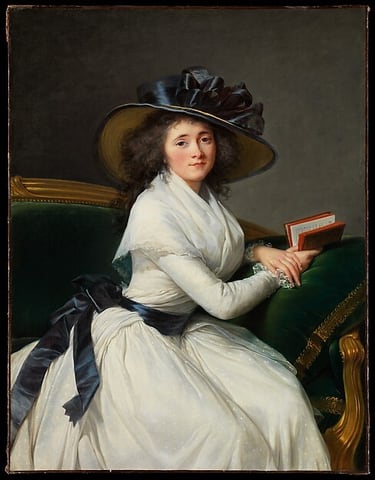
  1. Comtesse de la Châtre (Marie Charlotte Louise Perrette Aglaé Bontemps, 1762–1848), by Elisabeth Louise Vigée Le Brun, 1789
    Comtesse de la Châtre (Marie Charlotte Louise Perrette Aglaé Bontemps, 1762–1848)Elisabeth Louise Vigée Le Brun, 1789Courtesy of The Metropolitan Museum of Art
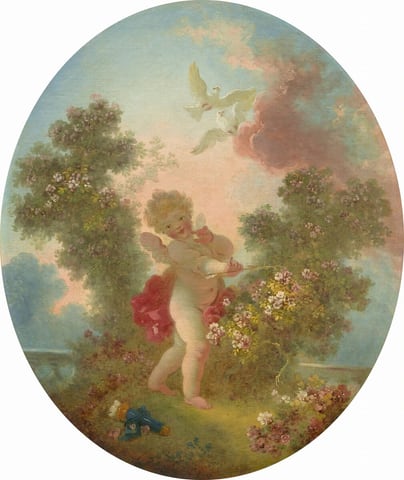
  2. This oval painting depicts a cherubic child in a garden setting. The child is standing with one foot in front of the other and has small wings on their back. The child has light skin, curly blond hair, rosy cheeks, and a playful expression. They are mostly nude, except for a cloth that wraps around their back and covers their groin. The child is holding a golden arrow. They are standing in front of a light green bush with pink flowers. In the bottom left, there is a dark blue object in the green grass that looks like a torch or cylindrical quiver. The setting includes lush greenery and more clusters of pink and white flowers. The background features a pastel blue sky with soft pink clouds and two white doves flying above.
    Love the SentinelJean Honoré Fragonard, c. 1773/1776Courtesy National Gallery of Art, Washington
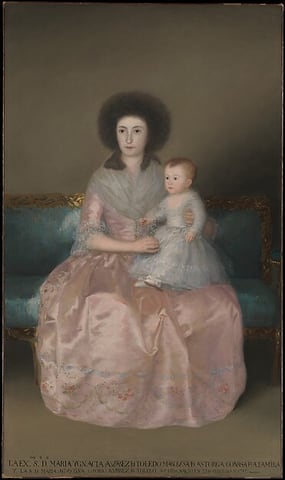
  3. Condesa de Altamira and Her Daughter, María Agustina, by Francisco Goya, 1787–88
    Condesa de Altamira and Her Daughter, María AgustinaFrancisco Goya, 1787–88Courtesy of The Metropolitan Museum of Art

Second room, north wall
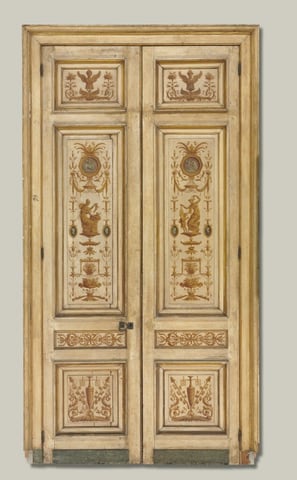
  1. Overdoor Painting, by Pierre Rousseau, 1790s
    Overdoor PaintingPierre Rousseau, 1790sCourtesy of the Cleveland Museum of Art
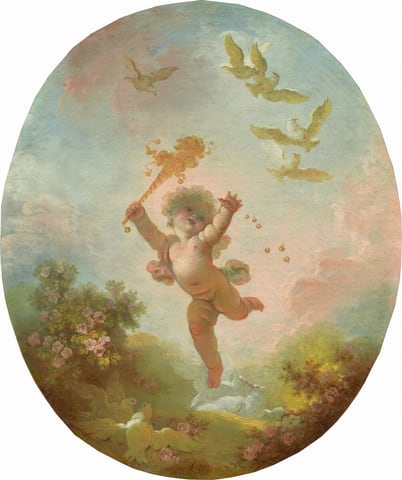
  2. This oval painting shows a cherubic child floating mid-air with one leg bent and their arms outstretched. The cherub has curly hair, a round face, and pale skin dusted with rosy pink and light teal shadows. They are smiling gently. The cherub is nude with a draped cloth over one shoulder, and in one hand they hold a flaming torch. Surrounding the cherub are white birds in flight. The background consists of pale blue and soft white clouds, with blooming pink flowers and foliage on the pale green ground.
    Love as FollyJean Honoré Fragonard, c. 1773/1776Courtesy National Gallery of Art, Washington
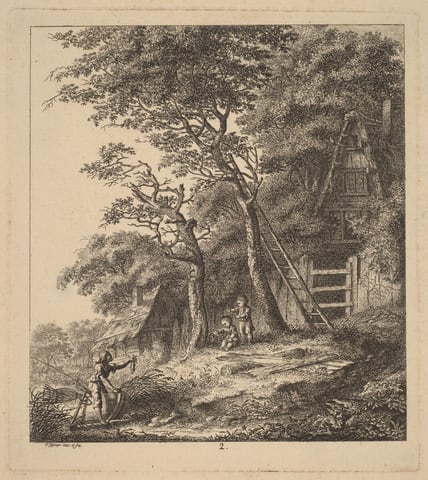
  3. The image shows a rustic scene with a house, trees, and a figure washing near a stream. Two children stand in the middle distance next to a ladder. In the background are two thatched houses among trees. The drawing style is detailed with fine lines and cross-hatching, creating texture. The color palette is monochromatic in shades of black and gray, emphasizing light and shadow.
    A Fisherman and Two Children in a Landscape with Thatched CottagesSalomon Gessner, 1764Courtesy National Gallery of Art, Washington
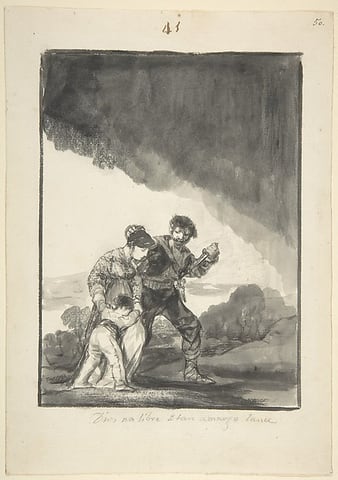
  4. God save us from such a bitter fate; a bandit threatening a woman and a child with a knife, page 41 from the "Black Border Album" (E), by Francisco Goya, ca. 1816–20
    God save us from such a bitter fate; a bandit threatening a woman and a child with a knife, page 41 from the "Black Border Album" (E)Francisco Goya, ca. 1816–20Courtesy of The Metropolitan Museum of Art

Third room, north wall
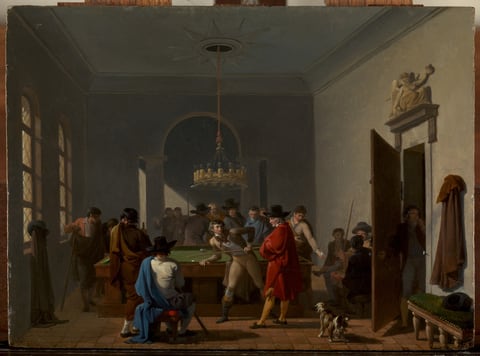
  1. The Billiard Room, by Nicolas Antoine Taunay, after 1810
    The Billiard RoomNicolas Antoine Taunay, after 1810Courtesy of The Metropolitan Museum of Art
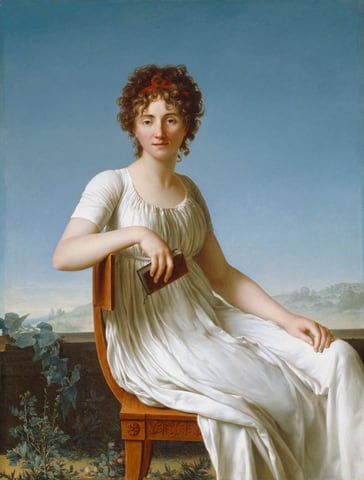
  2. A work made of oil on canvas.
    Portrait of Constance PipeletJean Baptiste François Désoria, 1797Courtesy of the Art Institute of Chicago
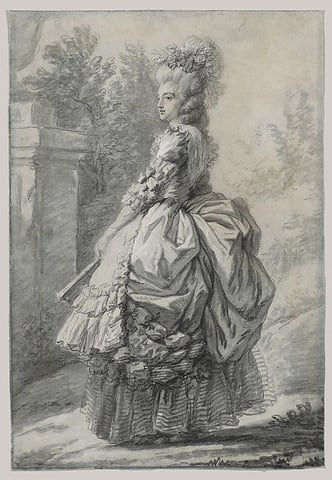
  3. Marie Antoinette in a Park, by Elisabeth Louise Vigée Le Brun, ca. 1780–81
    Marie Antoinette in a ParkElisabeth Louise Vigée Le Brun, ca. 1780–81Courtesy of The Metropolitan Museum of Art