Floor plan

Style galleriesThe Italian Renaissance
The Italian Renaissance
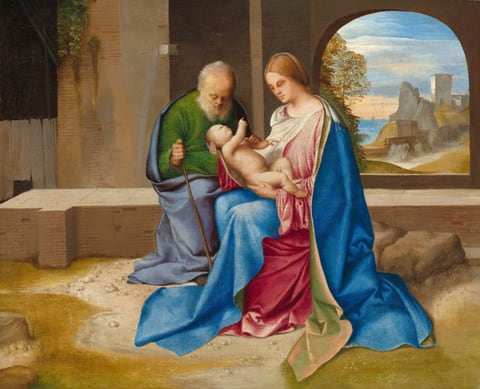
An old man and a young woman holding an infant are seated together in the center of this almost square painting. All three people have pale, peachy skin. To our left, the man sits on a low, tan brick wall with his head bowed to look at the baby on the woman’s lap. A periwinkle-blue cloak is wrapped around the kelly-green robe that covers his shoulders, back, and legs. One hand grips a short staff planted on the ground. His receding white hair and beard are thin and scraggly with tufts sticking out over his ears. The woman sits next to and slightly in front of him, to our right, on a low rock, her body angled toward the man. A long, cobalt-blue cloak is draped around her shoulders and covers her knees over her rose-pink gown. Her honey-brown hair is parted in the middle and gathered at the back of her head. Her brown eyes look down at the infant, who is blond with brown eyes. A long white shawl is tucked into the neckline of her dress, drapes over her shoulders, and wraps under the baby as she cradles his body with one hand under his backside and the other behind his head. The baby lies on his back with his head turned toward the woman, and he points to her with one outstretched arm. The dirt ground is scattered with pebbles that make a loose ring around the trio, with moss-green growth to either side. A brown brick wall fills the upper half of the composition behind the people and extends off the top edge. A rounded arch pierces the back wall to our right of the woman. On the other side of the opening, trees with copper-brown leaves grow up along the left and the landscape beyond opens onto rocky hills with a white, square tower. In the deep distance, the silhouette of a town is painted in robin’s egg-blue against a pale peach horizon line. Thin, white clouds skim across the blue sky above.
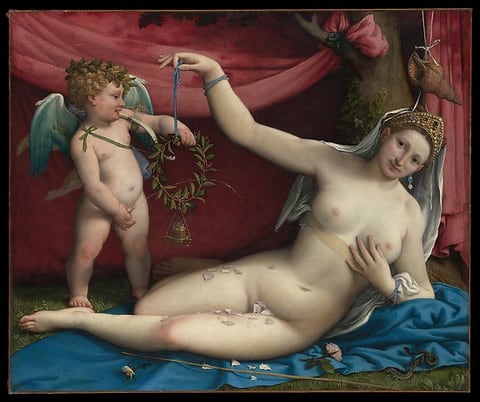
Venus and Cupid, by Lorenzo Lotto, 1520s
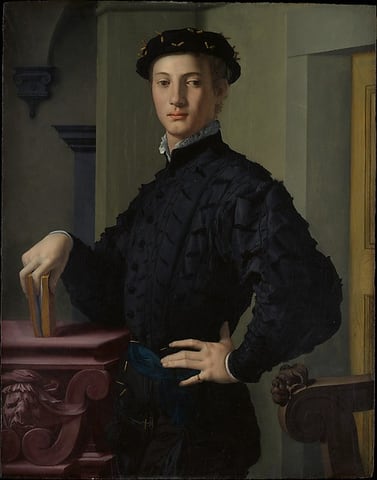
Portrait of a Young Man, by Agnolo Bronzino, 1530s
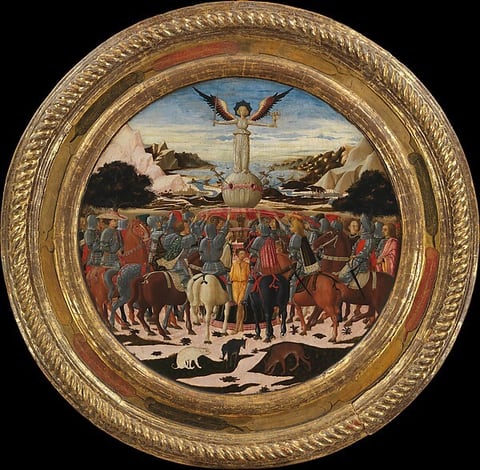
The Triumph of Fame; (reverse) Impresa of the Medici Family and Arms of the Medici and Tornabuoni Families, by Giovanni di ser Giovanni Guidi (called Scheggia), ca. 1449
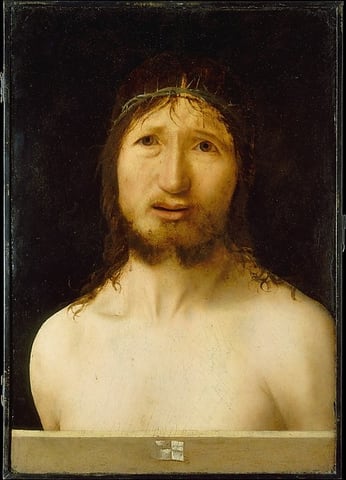
Christ Crowned with Thorns, by Antonello da Messina (Antonello di Giovanni d'Antonio)
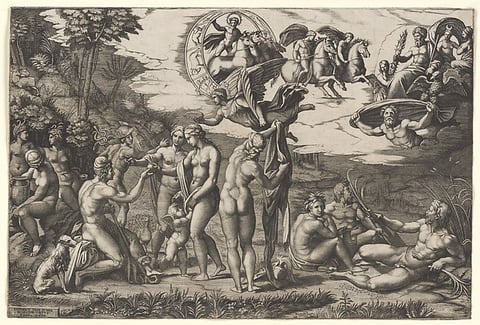
The Judgment of Paris: he is sitting at left with Venus, Juno and Pallas Athena, a winged victory above. In the upper section the Sun in his chariot preceeded by Castor and Pollux on horseback, at lower right two river gods and a naiad above whom Jupiter, an eagle, Ganymede, Diana and another goddess, by Marcantonio Raimondi, ca. 1510–20
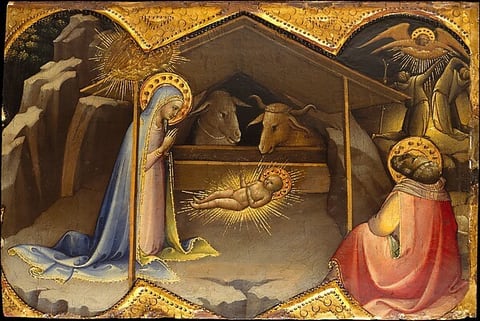
The Nativity, by Lorenzo Monaco, ca. 1406–10

The works in this room are listed below.

Works in this room

Florence, Venice and Rome from 1400 to 1600: perspective, anatomy and the classical past.

First room, north wall

  1. An old man and a young woman holding an infant are seated together in the center of this almost square painting. All three people have pale, peachy skin. To our left, the man sits on a low, tan brick wall with his head bowed to look at the baby on the woman’s lap. A periwinkle-blue cloak is wrapped around the kelly-green robe that covers his shoulders, back, and legs. One hand grips a short staff planted on the ground. His receding white hair and beard are thin and scraggly with tufts sticking out over his ears. The woman sits next to and slightly in front of him, to our right, on a low rock, her body angled toward the man. A long, cobalt-blue cloak is draped around her shoulders and covers her knees over her rose-pink gown. Her honey-brown hair is parted in the middle and gathered at the back of her head. Her brown eyes look down at the infant, who is blond with brown eyes. A long white shawl is tucked into the neckline of her dress, drapes over her shoulders, and wraps under the baby as she cradles his body with one hand under his backside and the other behind his head. The baby lies on his back with his head turned toward the woman, and he points to her with one outstretched arm. The dirt ground is scattered with pebbles that make a loose ring around the trio, with moss-green growth to either side. A brown brick wall fills the upper half of the composition behind the people and extends off the top edge. A rounded arch pierces the back wall to our right of the woman. On the other side of the opening, trees with copper-brown leaves grow up along the left and the landscape beyond opens onto rocky hills with a white, square tower. In the deep distance, the silhouette of a town is painted in robin’s egg-blue against a pale peach horizon line. Thin, white clouds skim across the blue sky above.
    The Holy FamilyGiorgione, probably c. 1500Courtesy National Gallery of Art, Washington
  2. Venus and Cupid, by Lorenzo Lotto, 1520s
    Venus and CupidLorenzo Lotto, 1520sCourtesy of The Metropolitan Museum of Art
  3. Portrait of a Young Man, by Agnolo Bronzino, 1530s
    Portrait of a Young ManAgnolo Bronzino, 1530sCourtesy of The Metropolitan Museum of Art

First room, south wall

  1. The Triumph of Fame; (reverse) Impresa of the Medici Family and Arms of the Medici and Tornabuoni Families, by Giovanni di ser Giovanni Guidi (called Scheggia), ca. 1449
    The Triumph of Fame; (reverse) Impresa of the Medici Family and Arms of the Medici and Tornabuoni FamiliesGiovanni di ser Giovanni Guidi (called Scheggia), ca. 1449Courtesy of The Metropolitan Museum of Art
  2. Christ Crowned with Thorns, by Antonello da Messina (Antonello di Giovanni d'Antonio)
    Christ Crowned with ThornsAntonello da Messina (Antonello di Giovanni d'Antonio)Courtesy of The Metropolitan Museum of Art
  3. The Judgment of Paris: he is sitting at left with Venus, Juno and Pallas Athena, a winged victory above. In the upper section the Sun in his chariot preceeded by Castor and Pollux on horseback, at lower right two river gods and a naiad above whom Jupiter, an eagle, Ganymede, Diana and another goddess, by Marcantonio Raimondi, ca. 1510–20
    The Judgment of Paris: he is sitting at left with Venus, Juno and Pallas Athena, a winged victory above. In the upper section the Sun in his chariot preceeded by Castor and Pollux on horseback, at lower right two river gods and a naiad above whom Jupiter, an eagle, Ganymede, Diana and another goddessMarcantonio Raimondi, ca. 1510–20Courtesy of The Metropolitan Museum of Art
  4. The Nativity, by Lorenzo Monaco, ca. 1406–10
    The NativityLorenzo Monaco, ca. 1406–10Courtesy of The Metropolitan Museum of Art

Second room, south wall
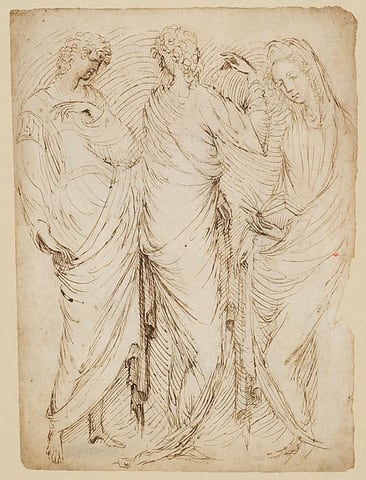
  1. Three Standing Figures (recto); Seated Woman and a Male Hermit in Half-length (verso), by Stefano da Verona (Stefano di Giovanni d'Arbosio di Francia), 1435–38
    Three Standing Figures (recto); Seated Woman and a Male Hermit in Half-length (verso)Stefano da Verona (Stefano di Giovanni d'Arbosio di Francia), 1435–38Courtesy of The Metropolitan Museum of Art
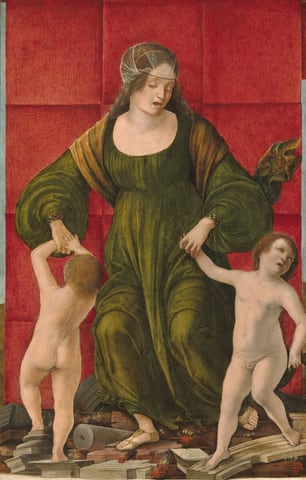
  2. A woman holds the hands of two nude children in front of a crimson-red cloth in this vertical painting. All three have pale skin and brown hair. The woman wears a forest-green dress with voluminous sleeves and a gauzy white headdress that wraps around her hair and is fastened with a band across her forehead. She stands crouching with one foot extended slightly forward in a sandal, surrounded by broken chunks of masonry and bits of burning logs. Her body faces us but she turns her head to the right. Her mouth is wide open, and her eyes cut back to our left. The woman clutches the children’s hands in both of her own. The child to our left turns away from us and reaches one hand up to touch the back of the woman’s hand. The child on the right twists away from the woman, eyes squinted up and to the right and mouth open. Behind them, fold lines create a grid across the red cloth. Slivers of grass and blue sky line each side of the composition.
    The Wife of Hasdrubal and Her ChildrenErcole de' Roberti, c. 1490/1493Courtesy National Gallery of Art, Washington
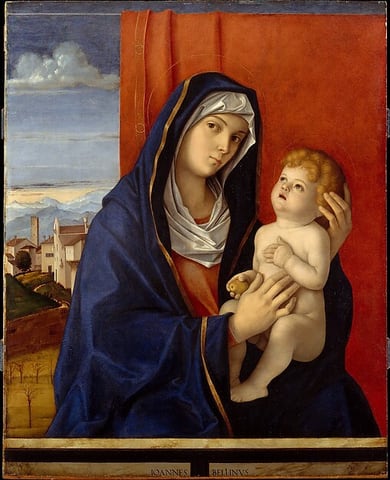
  3. Madonna and Child, by Giovanni Bellini, late 1480s
    Madonna and ChildGiovanni Bellini, late 1480sCourtesy of The Metropolitan Museum of Art
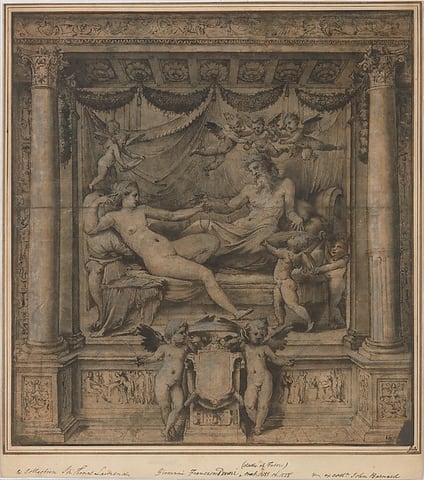
  4. Jupiter and Juno: Study for the "Furti di Giove" Tapestries, by Perino del Vaga (Pietro Buonaccorsi), ca. 1532–35
    Jupiter and Juno: Study for the "Furti di Giove" TapestriesPerino del Vaga (Pietro Buonaccorsi), ca. 1532–35Courtesy of The Metropolitan Museum of Art

Second room, north wall
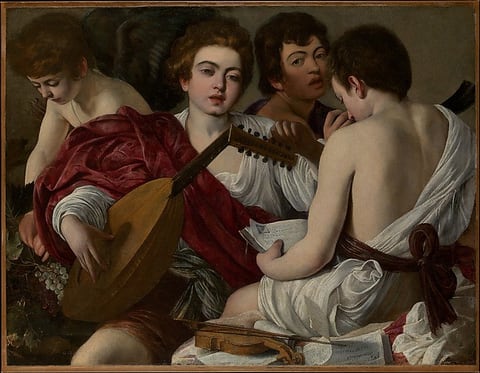
  1. The Musicians, by Caravaggio, 1597
    The MusiciansCaravaggio, 1597Courtesy of The Metropolitan Museum of Art
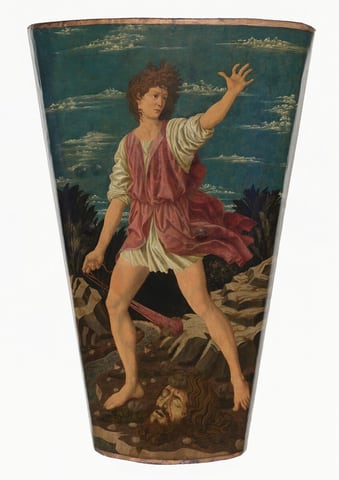
  2. This shield-shaped painting shows a young man with pale, peachy skin and curling brown hair standing astride the severed head of a man with dark hair and tanned skin. The painting is wider at the top and tapers like a pint glass to a narrower base. The young man, David, holds the end of long red slingshot with his right hand. The slingshot is weighted by a rock and swings behind his body. His sleeveless rust-red garment is cinched at his waist over a long white shirt. Both garments skim David’s thighs and his legs and feet are bare. Long, curling brown hair frames the ashen and bloodied upturned face of the head at David’s feet. A palm-sized stone is embedded in that forehead. The landscape background is made up of gray boulders, a meandering river, and low palm-like trees. Frothy white clouds sweep across an azure-blue sky.
    David with the Head of GoliathAndrea del Castagno, c. 1450/1455Courtesy National Gallery of Art, Washington
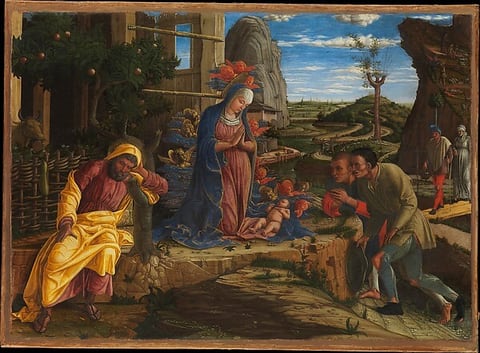
  3. The Adoration of the Shepherds, by Andrea Mantegna, shortly after 1450
    The Adoration of the ShepherdsAndrea Mantegna, shortly after 1450Courtesy of The Metropolitan Museum of Art

Third room, north wall
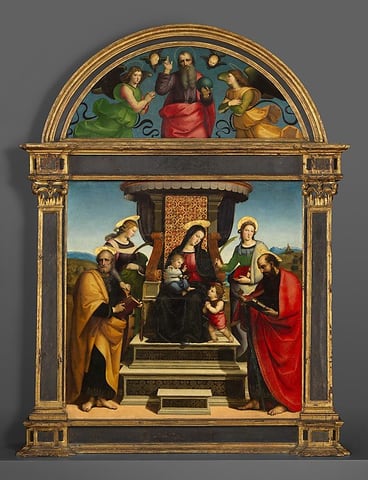
  1. Madonna and Child Enthroned with Saints, by Raphael, ca. 1504
    Madonna and Child Enthroned with SaintsRaphael, ca. 1504Courtesy of The Metropolitan Museum of Art
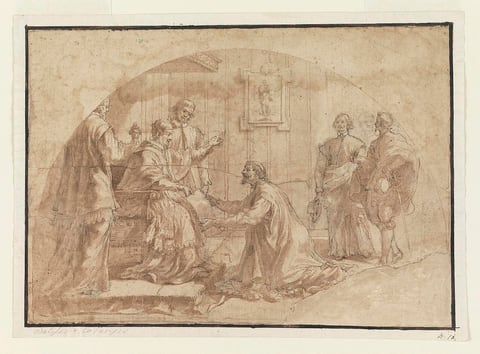
  2. POPE RECEIVING VISITOR
    Pope Receiving VisitorBelisario Corenzio, 1590–1646Courtesy of Cooper Hewitt, Smithsonian Design Museum