Floor plan

Style galleriesThe Italian Renaissance
The Italian Renaissance
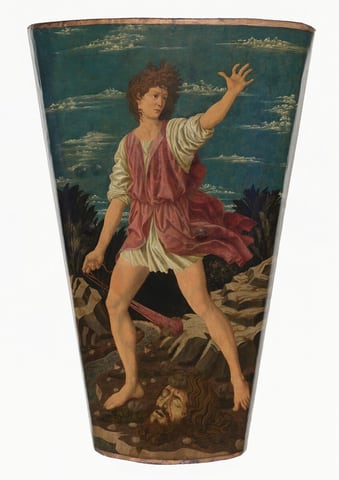
This shield-shaped painting shows a young man with pale, peachy skin and curling brown hair standing astride the severed head of a man with dark hair and tanned skin. The painting is wider at the top and tapers like a pint glass to a narrower base. The young man, David, holds the end of long red slingshot with his right hand. The slingshot is weighted by a rock and swings behind his body. His sleeveless rust-red garment is cinched at his waist over a long white shirt. Both garments skim David’s thighs and his legs and feet are bare. Long, curling brown hair frames the ashen and bloodied upturned face of the head at David’s feet. A palm-sized stone is embedded in that forehead. The landscape background is made up of gray boulders, a meandering river, and low palm-like trees. Frothy white clouds sweep across an azure-blue sky.
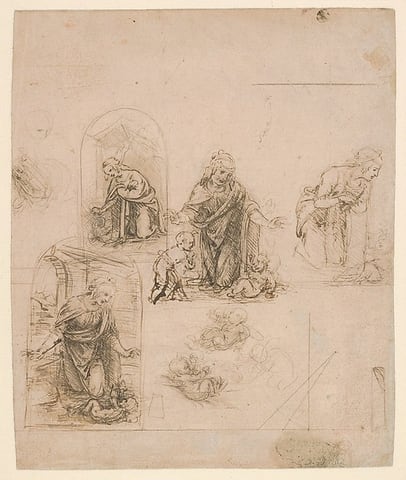
Compositional Sketches for the Virgin Adoring the Christ Child, with and without the Infant St. John the Baptist; Diagram of a Perspectival Projection (recto); Slight Doodles (verso), by Leonardo da Vinci, 1480–85
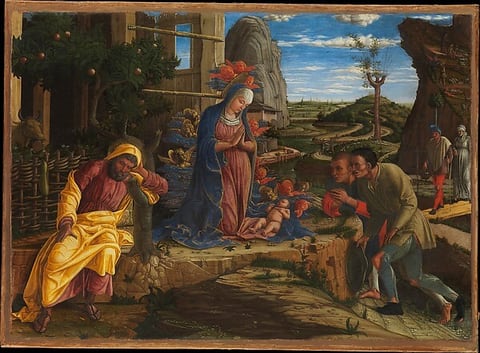
The Adoration of the Shepherds, by Andrea Mantegna, shortly after 1450
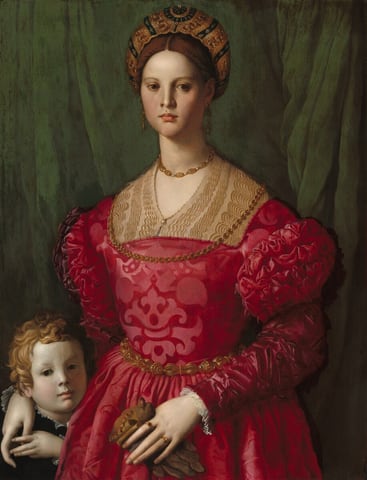
A woman wearing a crimson-red brocade dress and gold jewelry fills most of this vertical portrait, but her right hand, on our left, rests on the shoulder of a young boy tucked into the lower left corner of the panel. The woman and boy both have pale, white skin, and both face and look out at us against an emerald-green curtain that falls behind them. The woman has brown eyes, a straight nose, full pink lips, smooth cheeks, and a long neck. Her brown hair is pulled back under a turban densely embroidered with gold. The woman’s dress has puffed shoulders and decorative slashes on the sleeves. One gold chain rests on her throat and the other falls over her chest. She wears long gold earrings, a gold belt, and two gold rings. She holds a brown leather glove in her left hand. The boy’s face is even with the woman’s waist, and he raises his left hand to hold hers, which is draped over his shoulder. He has curly blond hair and dark eyes, and he wears black with a ruffled white shirt just visible at his collar.
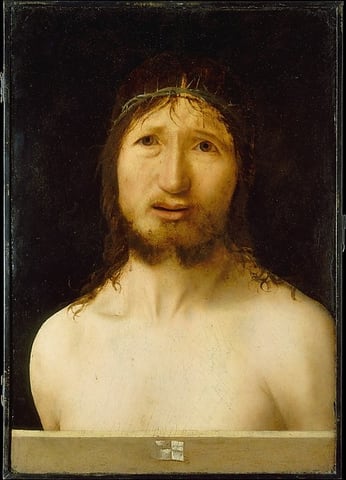
Christ Crowned with Thorns, by Antonello da Messina (Antonello di Giovanni d'Antonio)
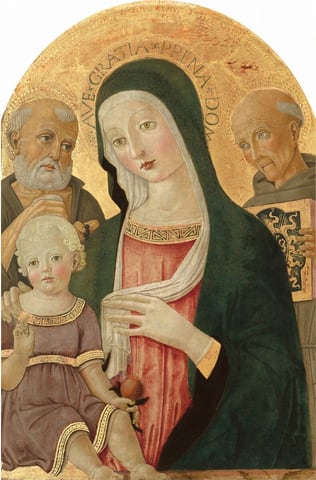
Madonna and Child with Saint Jerome and Saint Bernardino of Siena, by Benvenuto di Giovanni, c. 1480/1485
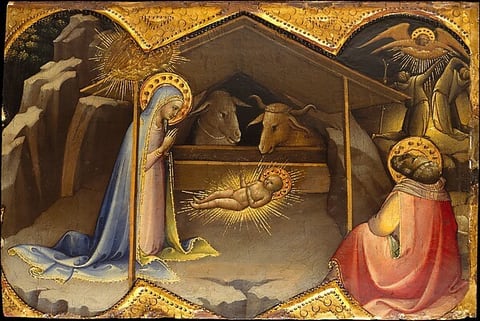
The Nativity, by Lorenzo Monaco, ca. 1406–10
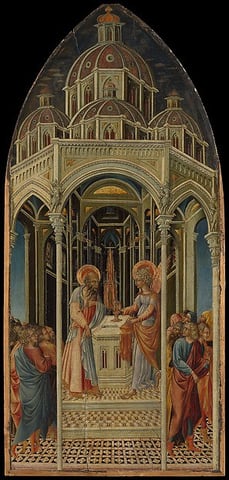
The Annunciation to Zacharias; (verso) The Angel of the Annunciation, by Giovanni di Paolo, ca. 1455–60

The works in this room are listed below.

Works in this room

Florence, Venice and Rome from 1400 to 1600: perspective, anatomy and the classical past.

First room, north wall

  1. This shield-shaped painting shows a young man with pale, peachy skin and curling brown hair standing astride the severed head of a man with dark hair and tanned skin. The painting is wider at the top and tapers like a pint glass to a narrower base. The young man, David, holds the end of long red slingshot with his right hand. The slingshot is weighted by a rock and swings behind his body. His sleeveless rust-red garment is cinched at his waist over a long white shirt. Both garments skim David’s thighs and his legs and feet are bare. Long, curling brown hair frames the ashen and bloodied upturned face of the head at David’s feet. A palm-sized stone is embedded in that forehead. The landscape background is made up of gray boulders, a meandering river, and low palm-like trees. Frothy white clouds sweep across an azure-blue sky.
    David with the Head of GoliathAndrea del Castagno, c. 1450/1455Courtesy National Gallery of Art, Washington
  2. Compositional Sketches for the Virgin Adoring the Christ Child, with and without the Infant St. John the Baptist; Diagram of a Perspectival Projection (recto); Slight Doodles (verso), by Leonardo da Vinci, 1480–85
    Compositional Sketches for the Virgin Adoring the Christ Child, with and without the Infant St. John the Baptist; Diagram of a Perspectival Projection (recto); Slight Doodles (verso)Leonardo da Vinci, 1480–85Courtesy of The Metropolitan Museum of Art
  3. The Adoration of the Shepherds, by Andrea Mantegna, shortly after 1450
    The Adoration of the ShepherdsAndrea Mantegna, shortly after 1450Courtesy of The Metropolitan Museum of Art
  4. A woman wearing a crimson-red brocade dress and gold jewelry fills most of this vertical portrait, but her right hand, on our left, rests on the shoulder of a young boy tucked into the lower left corner of the panel. The woman and boy both have pale, white skin, and both face and look out at us against an emerald-green curtain that falls behind them. The woman has brown eyes, a straight nose, full pink lips, smooth cheeks, and a long neck. Her brown hair is pulled back under a turban densely embroidered with gold. The woman’s dress has puffed shoulders and decorative slashes on the sleeves. One gold chain rests on her throat and the other falls over her chest. She wears long gold earrings, a gold belt, and two gold rings. She holds a brown leather glove in her left hand. The boy’s face is even with the woman’s waist, and he raises his left hand to hold hers, which is draped over his shoulder. He has curly blond hair and dark eyes, and he wears black with a ruffled white shirt just visible at his collar.
    A Young Woman and Her Little BoyAgnolo Bronzino, c. 1540Courtesy National Gallery of Art, Washington

First room, south wall

  1. Christ Crowned with Thorns, by Antonello da Messina (Antonello di Giovanni d'Antonio)
    Christ Crowned with ThornsAntonello da Messina (Antonello di Giovanni d'Antonio)Courtesy of The Metropolitan Museum of Art
  2. Madonna and Child with Saint Jerome and Saint Bernardino of Siena, by Benvenuto di Giovanni, c. 1480/1485
    Madonna and Child with Saint Jerome and Saint Bernardino of SienaBenvenuto di Giovanni, c. 1480/1485Courtesy National Gallery of Art, Washington
  3. The Nativity, by Lorenzo Monaco, ca. 1406–10
    The NativityLorenzo Monaco, ca. 1406–10Courtesy of The Metropolitan Museum of Art
  4. The Annunciation to Zacharias; (verso) The Angel of the Annunciation, by Giovanni di Paolo, ca. 1455–60
    The Annunciation to Zacharias; (verso) The Angel of the AnnunciationGiovanni di Paolo, ca. 1455–60Courtesy of The Metropolitan Museum of Art

Second room, south wall
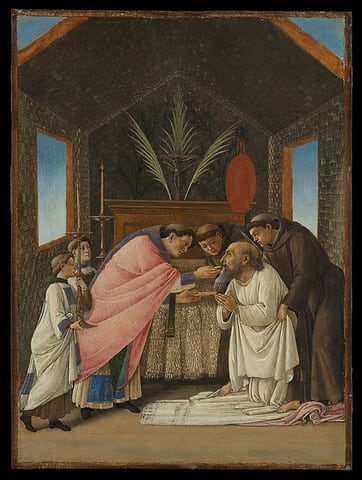
  1. The Last Communion of Saint Jerome, by Botticelli (Alessandro di Mariano Filipepi), early 1490s
    The Last Communion of Saint JeromeBotticelli (Alessandro di Mariano Filipepi), early 1490sCourtesy of The Metropolitan Museum of Art
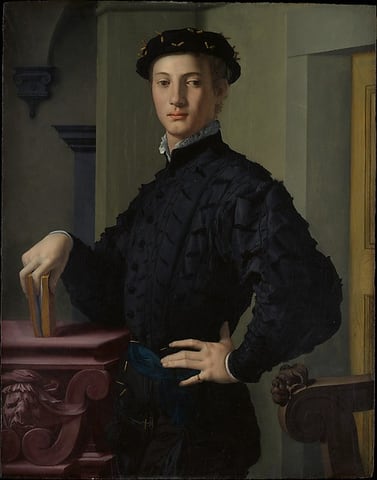
  2. Portrait of a Young Man, by Agnolo Bronzino, 1530s
    Portrait of a Young ManAgnolo Bronzino, 1530sCourtesy of The Metropolitan Museum of Art
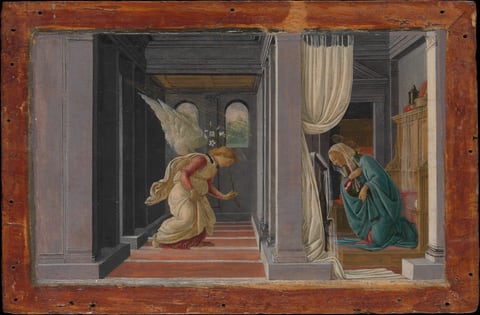
  3. The Annunciation, by Botticelli (Alessandro di Mariano Filipepi), ca. 1490
    The AnnunciationBotticelli (Alessandro di Mariano Filipepi), ca. 1490Courtesy of The Metropolitan Museum of Art
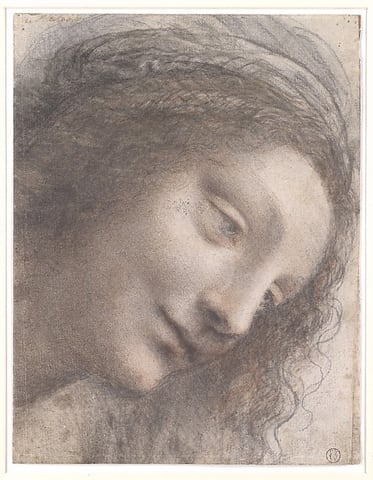
  4. The Head of the Virgin in Three-Quarter View Facing Right, by Leonardo da Vinci, 1510–13
    The Head of the Virgin in Three-Quarter View Facing RightLeonardo da Vinci, 1510–13Courtesy of The Metropolitan Museum of Art

Second room, north wall
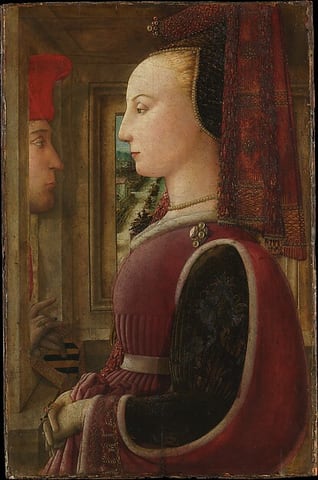
  1. Portrait of a Woman with a Man at a Casement, by Fra Filippo Lippi, ca. 1440
    Portrait of a Woman with a Man at a CasementFra Filippo Lippi, ca. 1440Courtesy of The Metropolitan Museum of Art
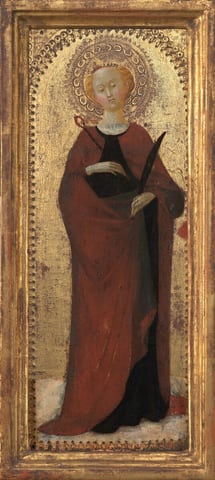
  2. This painting shows a person standing, their head slightly tilted to the left. They have a pale complexion, and short, wavy blonde hair adorned with a thin red crown. They have rosy, pink cheeks, arched eyebrows, a straight nose, and small lips set in a neutral expression. The individual is wearing a long red robe over a black tunic or dress and is holding a long black quill-like object in one hand, and what looks like a thin staff with a red loop at the end in the other. A detailed golden halo surrounds their head, and the background features an ornate gold pattern which is slightly worn and peeling in some places. The painting is bordered by a golden frame.
    Saint ApolloniaSassetta, c. 1435Courtesy National Gallery of Art, Washington
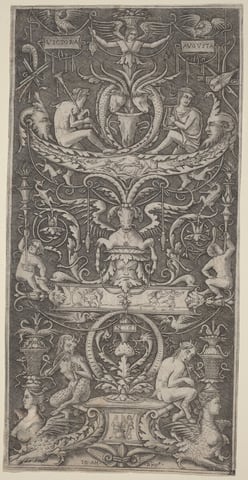
  3. This is a drawing of an ornamental design featuring mythological creatures and motifs. The artwork depicts a symmetrical arrangement with two central figures holding musical instruments, surrounded by acanthus leaves, griffins, and sphinxes. In the upper portion, there is a winged figure with a crown-like headdress carrying symbols or trophies. The design is detailed with decorative elements including floral patterns and architectural motifs. Throughout the drawing, there are various mythological creatures integrated into the composition.
    Ornamental Panel Inscribed "Victoria Augusta"Giovanni Antonio da Brescia, c. 1516Courtesy National Gallery of Art, Washington
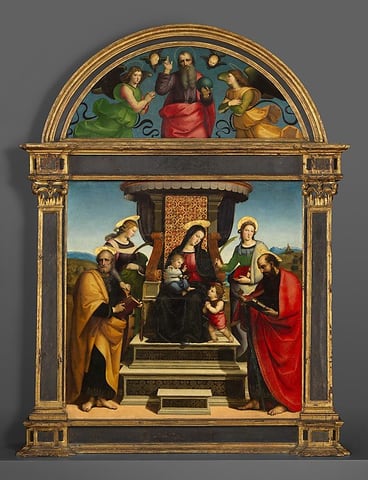
  4. Madonna and Child Enthroned with Saints, by Raphael, ca. 1504
    Madonna and Child Enthroned with SaintsRaphael, ca. 1504Courtesy of The Metropolitan Museum of Art