Floor plan

Style galleriesThe Italian Renaissance
The Italian Renaissance
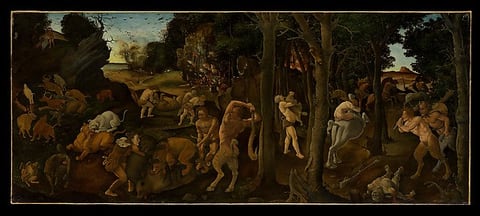
A Hunting Scene, by Piero di Cosimo (Piero di Lorenzo di Piero d'Antonio), ca. 1494–1500
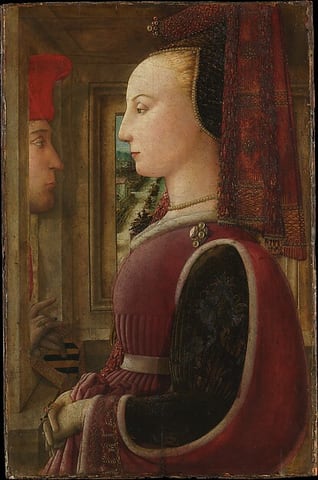
Portrait of a Woman with a Man at a Casement, by Fra Filippo Lippi, ca. 1440
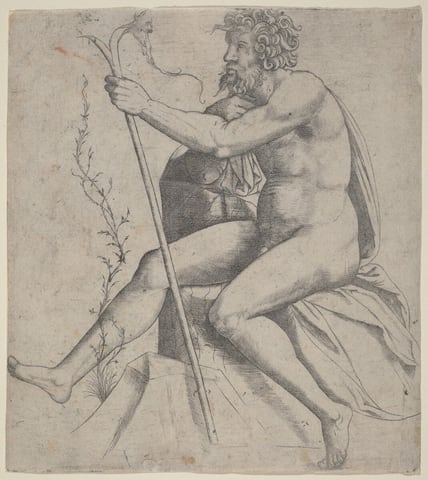
The image shows a man seated with a slight forward tilt. He is muscular, with one leg bent and the other extended. His head is turned to the left in profile, revealing his facial features, which include a large nose, full beard, and curly hair. He appears naked except for a fabric drape over his shoulders. In his left hand, he holds a staff, and there is a plant with twisting vines near him. The background is a shaded rocky surface with no other details.
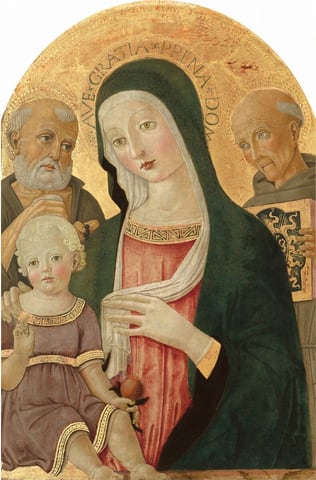
Madonna and Child with Saint Jerome and Saint Bernardino of Siena, by Benvenuto di Giovanni, c. 1480/1485
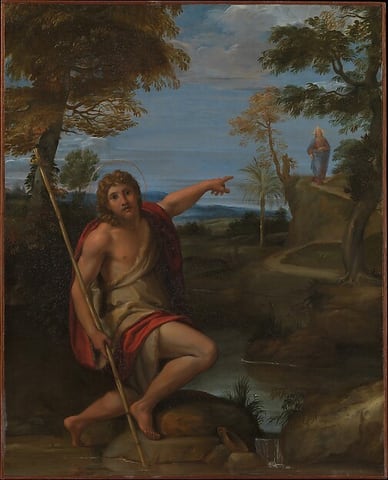
Saint John the Baptist Bearing Witness, by Annibale Carracci, ca. 1600
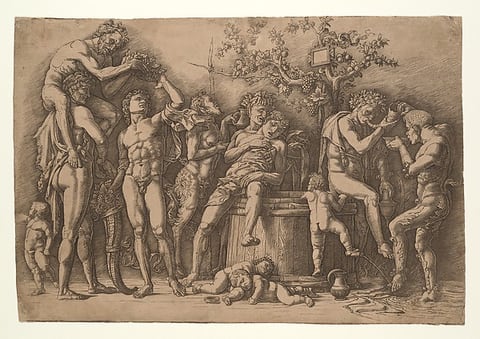
Bacchanal with a Wine Vat, by Andrea Mantegna, Before 1475
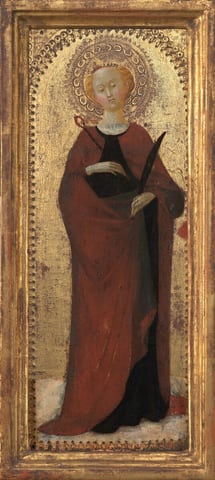
This painting shows a person standing, their head slightly tilted to the left. They have a pale complexion, and short, wavy blonde hair adorned with a thin red crown. They have rosy, pink cheeks, arched eyebrows, a straight nose, and small lips set in a neutral expression. The individual is wearing a long red robe over a black tunic or dress and is holding a long black quill-like object in one hand, and what looks like a thin staff with a red loop at the end in the other. A detailed golden halo surrounds their head, and the background features an ornate gold pattern which is slightly worn and peeling in some places. The painting is bordered by a golden frame.

The works in this room are listed below.

Works in this room

Florence, Venice and Rome from 1400 to 1600: perspective, anatomy and the classical past.

First room, north wall

  1. A Hunting Scene, by Piero di Cosimo (Piero di Lorenzo di Piero d'Antonio), ca. 1494–1500
    A Hunting ScenePiero di Cosimo (Piero di Lorenzo di Piero d'Antonio), ca. 1494–1500Courtesy of The Metropolitan Museum of Art
  2. Portrait of a Woman with a Man at a Casement, by Fra Filippo Lippi, ca. 1440
    Portrait of a Woman with a Man at a CasementFra Filippo Lippi, ca. 1440Courtesy of The Metropolitan Museum of Art
  3. The image shows a man seated with a slight forward tilt. He is muscular, with one leg bent and the other extended. His head is turned to the left in profile, revealing his facial features, which include a large nose, full beard, and curly hair. He appears naked except for a fabric drape over his shoulders. In his left hand, he holds a staff, and there is a plant with twisting vines near him. The background is a shaded rocky surface with no other details.
    Man Seated Holding a Forked StaffGiovanni Antonio da Brescia, c. 1514/1515Courtesy National Gallery of Art, Washington

First room, south wall

  1. Madonna and Child with Saint Jerome and Saint Bernardino of Siena, by Benvenuto di Giovanni, c. 1480/1485
    Madonna and Child with Saint Jerome and Saint Bernardino of SienaBenvenuto di Giovanni, c. 1480/1485Courtesy National Gallery of Art, Washington
  2. Saint John the Baptist Bearing Witness, by Annibale Carracci, ca. 1600
    Saint John the Baptist Bearing WitnessAnnibale Carracci, ca. 1600Courtesy of The Metropolitan Museum of Art
  3. Bacchanal with a Wine Vat, by Andrea Mantegna, Before 1475
    Bacchanal with a Wine VatAndrea Mantegna, Before 1475Courtesy of The Metropolitan Museum of Art
  4. This painting shows a person standing, their head slightly tilted to the left. They have a pale complexion, and short, wavy blonde hair adorned with a thin red crown. They have rosy, pink cheeks, arched eyebrows, a straight nose, and small lips set in a neutral expression. The individual is wearing a long red robe over a black tunic or dress and is holding a long black quill-like object in one hand, and what looks like a thin staff with a red loop at the end in the other. A detailed golden halo surrounds their head, and the background features an ornate gold pattern which is slightly worn and peeling in some places. The painting is bordered by a golden frame.
    Saint ApolloniaSassetta, c. 1435Courtesy National Gallery of Art, Washington

Second room, south wall
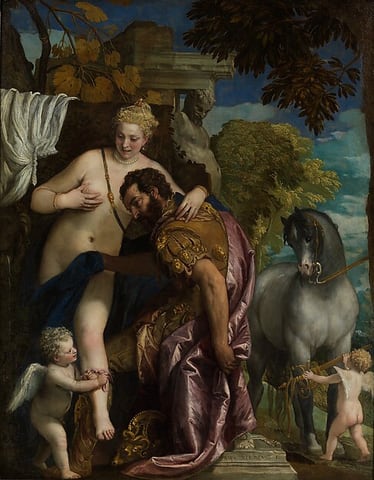
  1. Mars and Venus United by Love, by Paolo Veronese (Paolo Caliari), 1570s
    Mars and Venus United by LovePaolo Veronese (Paolo Caliari), 1570sCourtesy of The Metropolitan Museum of Art
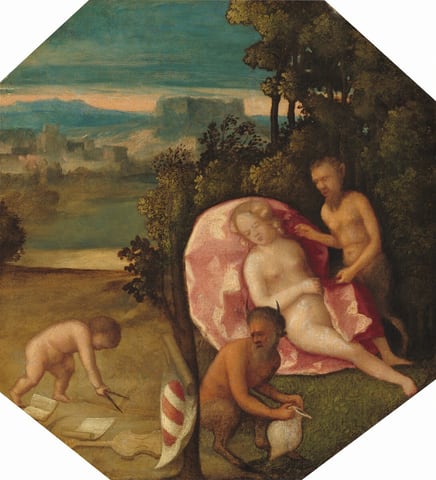
  2. A nude woman, pudgy child, and two satyrs, which have men’s heads and torsos with goat’s legs and horns, are in a landscape in this octagonal painting. The scene is divided in half by a tree stump which only reaches to the center of the composition. To the left of the stump, the pale-skinned, nude child stands and hunches over to draw on the ground with a V-shaped compass. Two pieces of paper and a violin lie nearby. The landscape behind him has a body of water leading back to a town with buildings streaked with peach, perhaps flames. A band of peach sky separates the blue silhouettes of mountains lining the horizon from the vivid blue sky above. At the bottom center of the painting, a shield with an oval horizontally striped with red and white leans on the boy’s side of the tree, which has one leafy branch growing on the left side. One satyr holds a jug and kneels close to the tree with his back to it as he looks back over one shoulder. He and the other satyr both have dark, peach-toned skin and full beards. The second satyr hovers to the right of the nude, sleeping woman, both hands reaching for her or the rose-pink cloth surrounding her. The woman has blond curls, a round face, and she sleeps with one hand resting across her belly and her head tipped to our left. The trio are on a grassy area enclosed by dense, dark-green bushes and trees.
    AllegoryPietro degli Ingannati, c. 1515-1525Courtesy National Gallery of Art, Washington

Second room, north wall
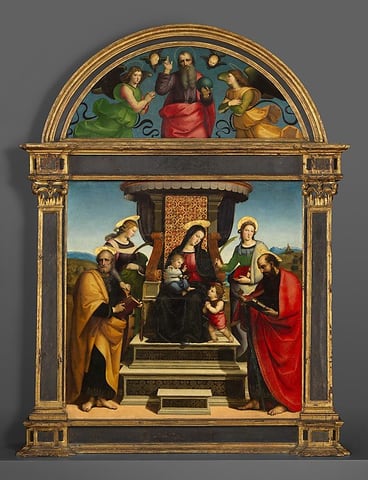
  1. Madonna and Child Enthroned with Saints, by Raphael, ca. 1504
    Madonna and Child Enthroned with SaintsRaphael, ca. 1504Courtesy of The Metropolitan Museum of Art
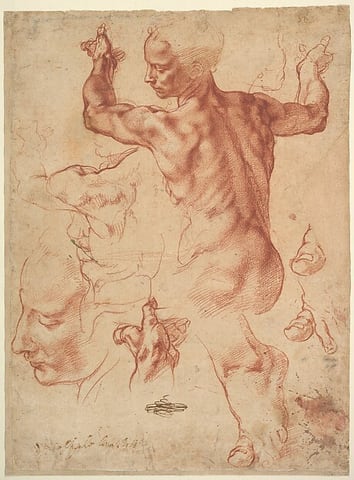
  2. Studies for the Libyan Sibyl (recto); Studies for the Libyan Sibyl and a small Sketch for a Seated Figure (verso), by Michelangelo Buonarroti, ca. 1510–11
    Studies for the Libyan Sibyl (recto); Studies for the Libyan Sibyl and a small Sketch for a Seated Figure (verso)Michelangelo Buonarroti, ca. 1510–11Courtesy of The Metropolitan Museum of Art
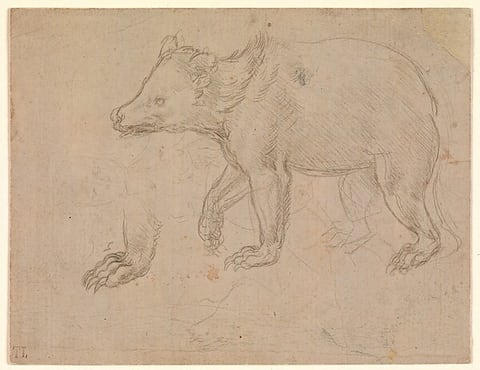
  3. A Bear Walking, by Leonardo da Vinci, ca. 1482–85
    A Bear WalkingLeonardo da Vinci, ca. 1482–85Courtesy of The Metropolitan Museum of Art

Third room, north wall
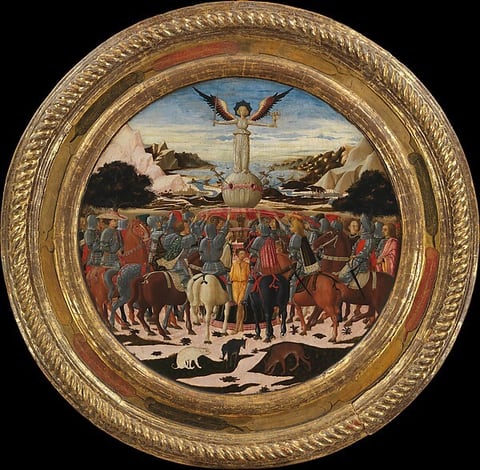
  1. The Triumph of Fame; (reverse) Impresa of the Medici Family and Arms of the Medici and Tornabuoni Families, by Giovanni di ser Giovanni Guidi (called Scheggia), ca. 1449
    The Triumph of Fame; (reverse) Impresa of the Medici Family and Arms of the Medici and Tornabuoni FamiliesGiovanni di ser Giovanni Guidi (called Scheggia), ca. 1449Courtesy of The Metropolitan Museum of Art
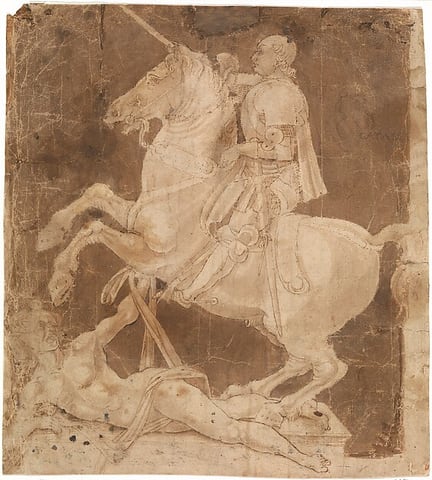
  2. Study for the Equestrian Monument to Francesco Sforza, by Antonio Pollaiuolo, early to mid 1480s
    Study for the Equestrian Monument to Francesco SforzaAntonio Pollaiuolo, early to mid 1480sCourtesy of The Metropolitan Museum of Art
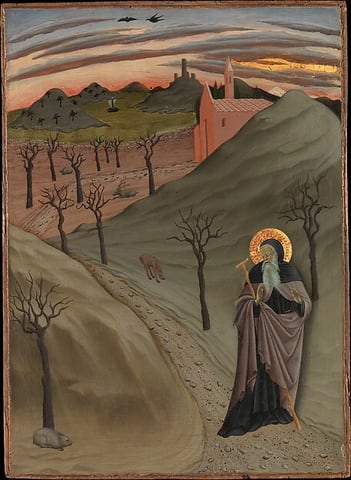
  3. Saint Anthony the Abbot in the Wilderness, by Sano di Pietro (Ansano di Pietro di Mencio), ca. 1440
    Saint Anthony the Abbot in the WildernessSano di Pietro (Ansano di Pietro di Mencio), ca. 1440Courtesy of The Metropolitan Museum of Art
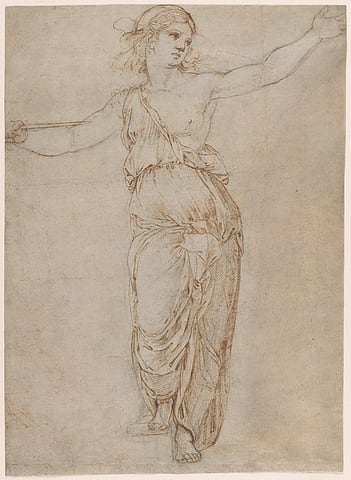
  4. Lucretia, by Raphael, 1508–10
    LucretiaRaphael, 1508–10Courtesy of The Metropolitan Museum of Art