Floor plan

Style galleriesThe Etching Revival

The Etching Revival

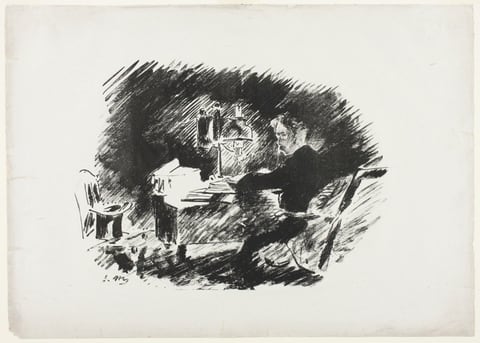
A work made of transfer lithograph in black on gray china paper.
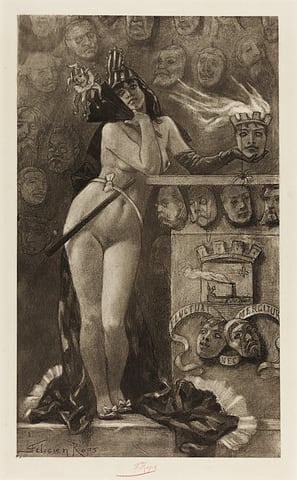
A work made of photogravure in dark brown retouched with soft varnish (vernis mou), roulette and blue handcoloring on thick cream wove paper.
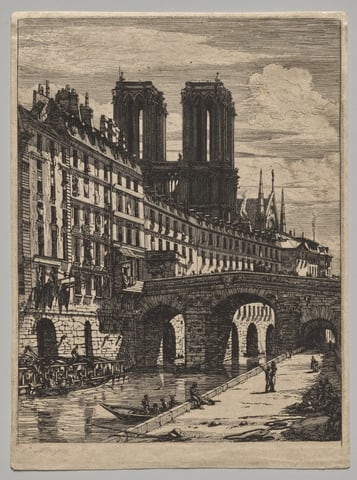
The Petit Pont, by Charles Meryon, 1850
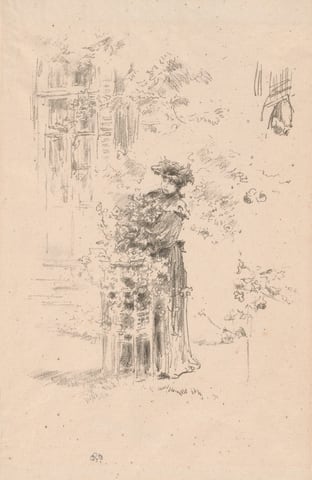
A work made of transfer lithograph in black, with stumping and scraping, on cream laid paper, laid down on a heavy backing sheet.
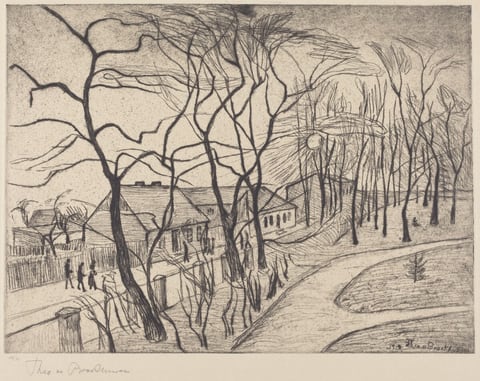
The image shows a residential area with barren trees, rooftops of houses, and people walking along fences. The trees sway in the wind, their branches extending in various directions. The scene is depicted in a monochromatic black and white style, with expressive lines creating a sense of movement and a sketch-like quality. The horizon is high, showing rooftops and the sun above it.
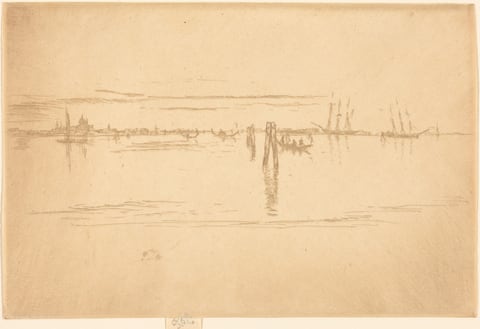
The image shows a landscape with a waterscape. The horizon separates the water and the sky. In the distance, there are buildings, structures, and ships with tall masts. Close to us, there are reflections of the ships and structures in the water with fine brushstrokes. The style is impressionistic with thin lines conveying details. The color palette is monochromatic with sepia tones.

The works in this room are listed below.

Works in this room

Artists who took up the etching needle again, from Whistler to the Paris printmakers.

Section 1, north wall

  1. A work made of transfer lithograph in black on gray china paper.
    Under the Lamp ("Once upon a midnight dreary..."), from The Raven (Le Corbeau)Édouard Manet, 1875Courtesy of the Art Institute of Chicago
  2. A work made of photogravure in dark brown retouched with soft varnish (vernis mou), roulette and blue handcoloring on thick cream wove paper.
    Modern MasksFélicien Rops, 1889Courtesy of the Art Institute of Chicago
  3. The Petit Pont, by Charles Meryon, 1850
    The Petit PontCharles Meryon, 1850Courtesy of the Cleveland Museum of Art

Section 1, south wall

  1. A work made of transfer lithograph in black, with stumping and scraping, on cream laid paper, laid down on a heavy backing sheet.
    La Belle JardinièreJames McNeill Whistler, 1894Courtesy of the Art Institute of Chicago
  2. The image shows a residential area with barren trees, rooftops of houses, and people walking along fences. The trees sway in the wind, their branches extending in various directions. The scene is depicted in a monochromatic black and white style, with expressive lines creating a sense of movement and a sketch-like quality. The horizon is high, showing rooftops and the sun above it.
    LandscapeTheo von BrockhusenCourtesy National Gallery of Art, Washington
  3. The image shows a landscape with a waterscape. The horizon separates the water and the sky. In the distance, there are buildings, structures, and ships with tall masts. Close to us, there are reflections of the ships and structures in the water with fine brushstrokes. The style is impressionistic with thin lines conveying details. The color palette is monochromatic with sepia tones.
    Long LagoonJames McNeill Whistler, 1880Courtesy National Gallery of Art, Washington

Section 2, south wall
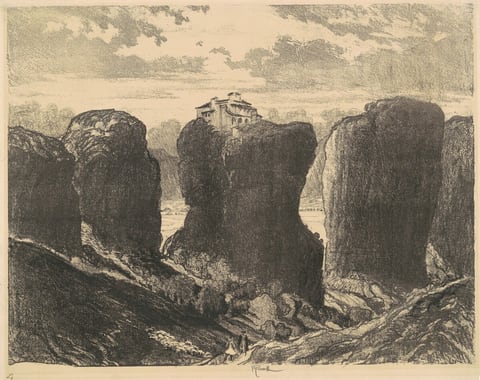
  1. The image depicts a landscape with towering rock formations dominating the scene. The ground is rugged and textured, leading the eye towards the rock pillars in the center. A structure or building is perched atop one of these rocks. The background shows the horizon above the structure, with clouds and sky stretching out beyond. The artwork features detailed brushstrokes adding texture to the rocks. The color palette is monochromatic with varying shades of charcoal or ink, emphasizing the contrast between the rocks and the sky.
    The Cliffs of the TrinityJoseph Pennell, 1913Courtesy National Gallery of Art, Washington
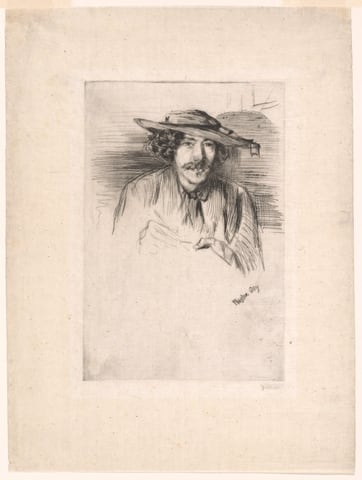
  2. A work made of drypoint with light plate tone on thin ivory japanese paper.
    Whistler with a HatJames McNeill Whistler, 1859Courtesy of the Art Institute of Chicago

Section 2, north wall
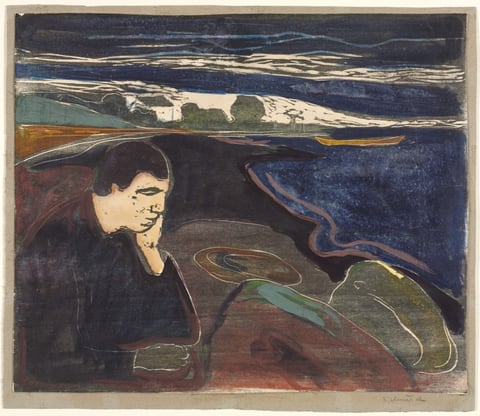
  1. Evening, Melancholy I, by Edvard Munch, 1896
    Evening, Melancholy IEdvard Munch, 1896Courtesy of the Cleveland Museum of Art
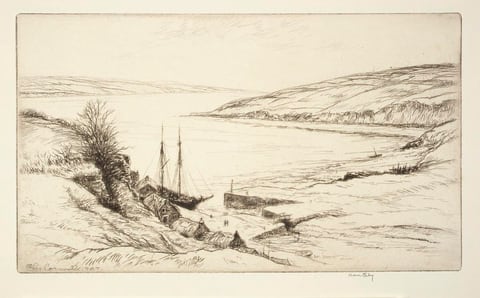
  2. Cornwall, by Kerr Eby, 1927
    CornwallKerr Eby, 1927Courtesy of the Smithsonian American Art Museum
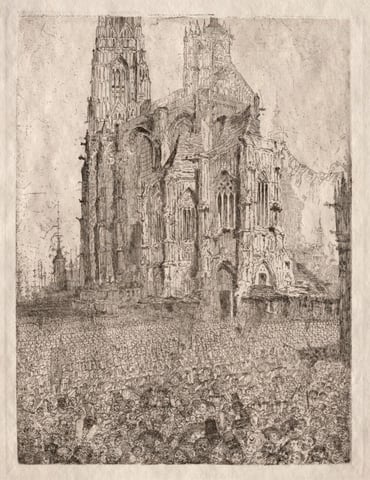
  3. The Cathedral, by James Ensor, 1886
    The CathedralJames Ensor, 1886Courtesy of the Cleveland Museum of Art

Section 3, north wall
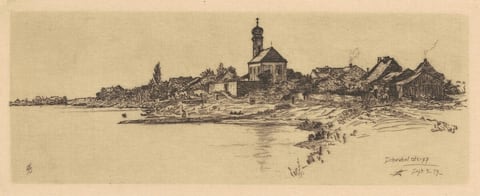
  1. The image shows a village scene viewed from a low vantage point near a water's edge. A row of small, closely packed buildings and a church with an onion-shaped dome are prominently featured. There are gentle slopes leading towards the structures. The image uses fine, detailed line work to depict texture and depth in the buildings and natural landscape. The lines are delicate and varied, creating a sense of detail and softness. The color palette is monochromatic, with dark ink on a pale background, resulting in a classic and timeless feel.
    SchwabelweissOtto Henry Bacher, 1879Courtesy National Gallery of Art, Washington
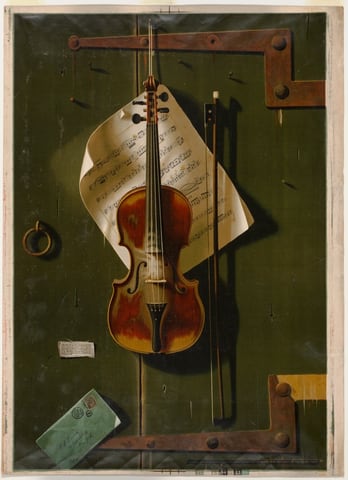
  2. A work made of color lithograph on paper.
    The Old ViolinWilliam Michael Harnett, 1887Courtesy of the Art Institute of Chicago

Section 3, south wall
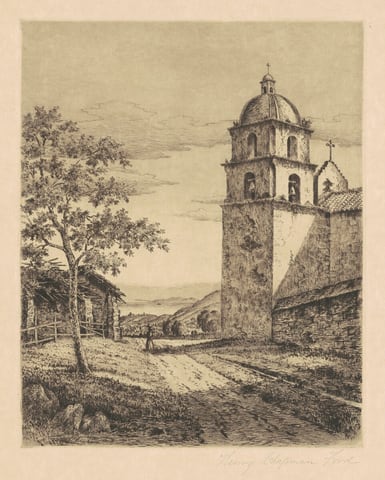
  1. The image features a large building with a domed tower on the right side. The horizon shows hills, trees, and the sky. The brushstrokes give detailed texture to the scene, with a focus on the landscape and architecture. The color palette is sepia-toned. A tree, fence, smaller buildings, and a figure on a path add depth and perspective to the scene.
    Mission Santa Barbara, Looking SouthHenry Chapman Ford, 1888Courtesy National Gallery of Art, Washington
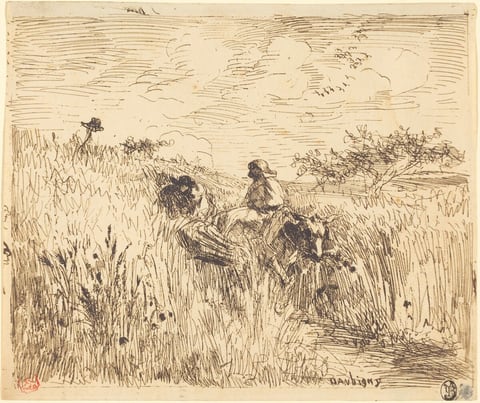
  2. This image shows an elevated view of a grassy landscape with sparse trees and vegetation at the horizon. The linear brushstrokes create texture and movement in the grass and sky. The color palette is monochromatic with sepia tones. In the foreground, a figure is on a horse amidst tall grasses, while in the distance, another figure stands on the left and a cluster of trees is on the right. The sky has wisps of clouds.
    Path through a Wheat Field (Sentier dans les bles)Charles-François Daubigny, 1862Courtesy National Gallery of Art, Washington
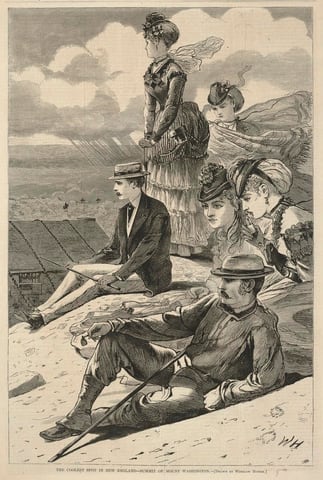
  3. The Coolest Spot in New England--Summit of Mount Washington, from Harper's Bazar, July 23, 1870, by Winslow Homer, 1870
    The Coolest Spot in New England--Summit of Mount Washington, from Harper's Bazar, July 23, 1870Winslow Homer, 1870Courtesy of the Smithsonian American Art Museum