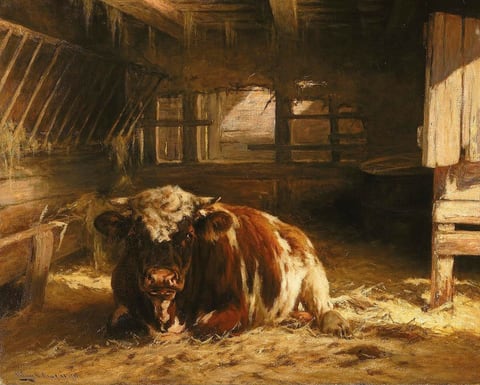
Floor plan

Style galleriesEarly modernism

Early modernism

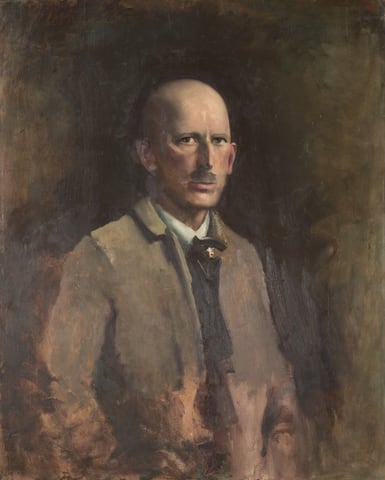
Self-Portrait, by Abbott Handerson Thayer, 1920
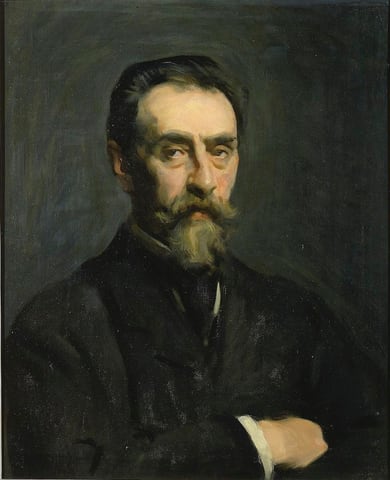
Portrait of William E. Norton, by William Penhallow Henderson, 1901
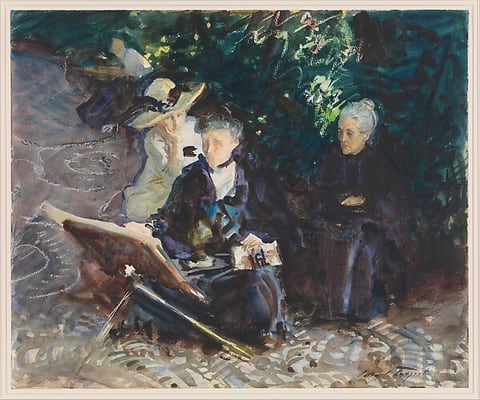
In the Generalife, by John Singer Sargent, 1912
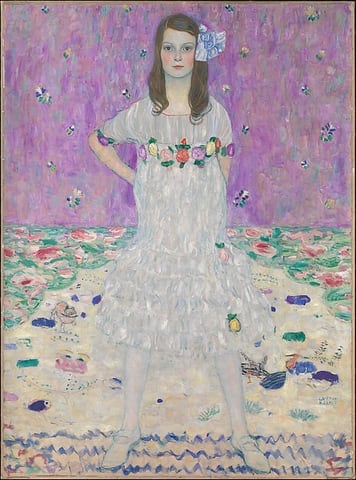
Mäda Primavesi (1903–2000), by Gustav Klimt, 1912–13
My Day at Home, by William H. Howe, 1906
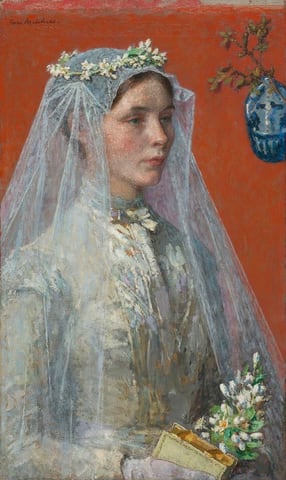
The Bride, by Gari Melchers, ca. 1907

The works in this room are listed below.

Works in this room

The first decades of the twentieth century, when artists broke with the academy.

First room, north wall

  1. Self-Portrait, by Abbott Handerson Thayer, 1920
    Self-PortraitAbbott Handerson Thayer, 1920Courtesy of the Cleveland Museum of Art
  2. Portrait of William E. Norton, by William Penhallow Henderson, 1901
    Portrait of William E. NortonWilliam Penhallow Henderson, 1901Courtesy of the Smithsonian American Art Museum
  3. In the Generalife, by John Singer Sargent, 1912
    In the GeneralifeJohn Singer Sargent, 1912Courtesy of The Metropolitan Museum of Art

First room, south wall

  1. Mäda Primavesi (1903–2000), by Gustav Klimt, 1912–13
    Mäda Primavesi (1903–2000)Gustav Klimt, 1912–13Courtesy of The Metropolitan Museum of Art
  2. My Day at Home, by William H. Howe, 1906
    My Day at HomeWilliam H. Howe, 1906Courtesy of the Smithsonian American Art Museum
  3. The Bride, by Gari Melchers, ca. 1907
    The BrideGari Melchers, ca. 1907Courtesy of the Smithsonian American Art Museum

Second room, south wall
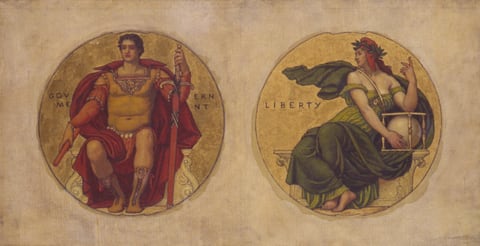
  1. Study for mosaic in the Wisconsin State Capital "Government and Liberty", by Kenyon Cox, ca. 1912
    Study for mosaic in the Wisconsin State Capital "Government and Liberty"Kenyon Cox, ca. 1912Courtesy of the Smithsonian American Art Museum
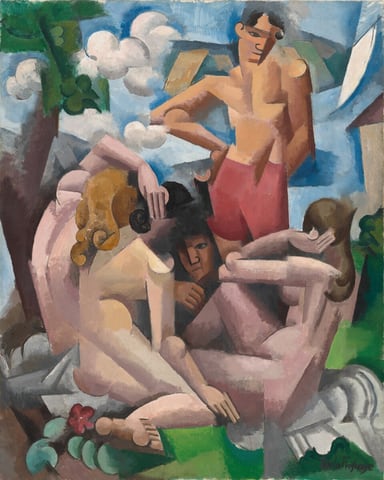
  2. This painting depicts a group of men and women created by a collection of angular, geometric shapes with flat planes and blocks of color. One person is standing, and they appear to be a bare-chested man with tan skin and short, dark hair, who is wearing red shorts. He has his hand on his hip and looks off to the right. At his feet appear to be several seated people, although they are only partially visible. Three women with pale skin seem to be facing away from us; we can see their legs, arms, and torsos, although these don't all fit together. The woman on the left has blonde hair, the woman on the right has brown hair, and the woman between them has short black hair. None of their faces are visible. In the middle of this group, at the center of the painting, we see the face and hand of another person who is looking to the left. This person has light brown skin, and we can't see the rest of their body. Surrounding elements include a blue sky with abstract cloud forms, an angular tree on the left, and patches of brown, white, and green on the ground, with one red flower. A tan rectangle under a red triangle on the right edge suggests a building.
    The BathersRoger de La Fresnaye, 1912Courtesy National Gallery of Art, Washington

Second room, north wall
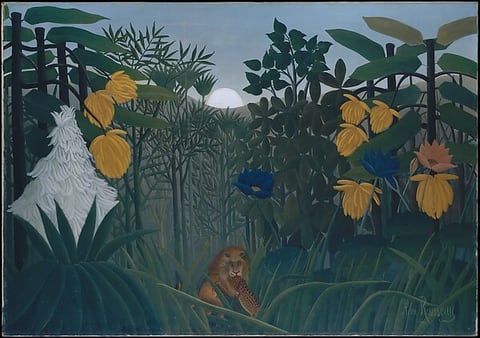
  1. The Repast of the Lion, by Henri Rousseau, ca. 1907
    The Repast of the LionHenri Rousseau, ca. 1907Courtesy of The Metropolitan Museum of Art
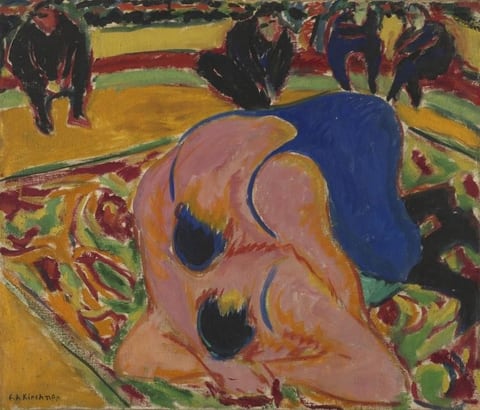
  2. Wrestlers in a Circus, by Ernst Ludwig Kirchner, 1909
    Wrestlers in a CircusErnst Ludwig Kirchner, 1909Courtesy of the Cleveland Museum of Art
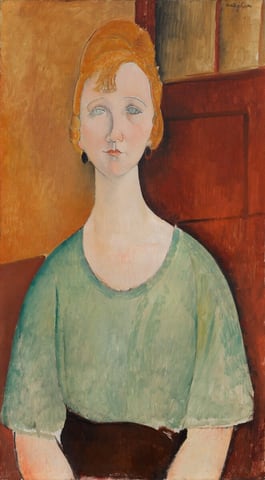
  3. Shown from the lap up, a pale-skinned woman with an oval face and long neck sits facing us in this vertical painting. The portrait is created with areas of mottled colors outlined with black lines. Her body faces us, and she looks out with pale blue eyes, the irises almost white. Her thin eyebrows slope down the sides and her small, dark peach lips are closed. Golden-orange hair is piled atop her head and a few bangs fall onto her high forehead. Black oval earrings hang from her lobes. Her shoulders also slope unnaturally down. Her mint-green shirt has a scooped neckline and elbow-length sleeves, and it appears to be tucked into a brown skirt or pants. The background is honey orange in the top left quadrant, amber brown in the lower left, and a russet brown door with windows across the top fills the right half. The artist signed the top right corner, “modigliani.”
    Girl in a Green BlouseAmedeo Modigliani, 1917Courtesy National Gallery of Art, Washington

Third room, north wall
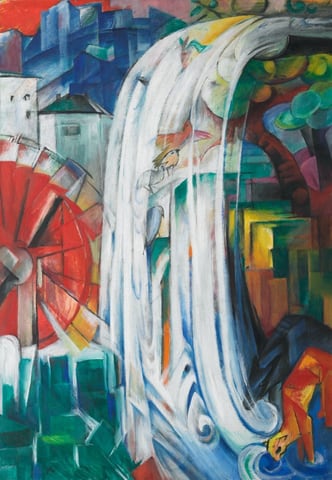
  1. Vibrantly colored geometric painting of a central white and blue waterfall with birds visible through it. A stylized red jungle cat and black wild boar drink at bottom right. Red water wheel at left, angular blue and white cityscape top at left, tree top at right.
    The Bewitched MillFranz Marc, 1913Courtesy of the Art Institute of Chicago
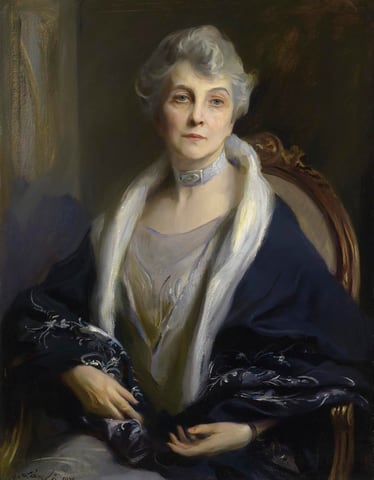
  2. Artist: Philip Alexius de László, Sitter: Clara Margaret Cook Kellogg, Current owner: National Portrait Gallery, Smithsonian Institution
    Clara Cook KelloggPhilip Alexius de László, 1929Courtesy of the National Portrait Gallery, Smithsonian Institution
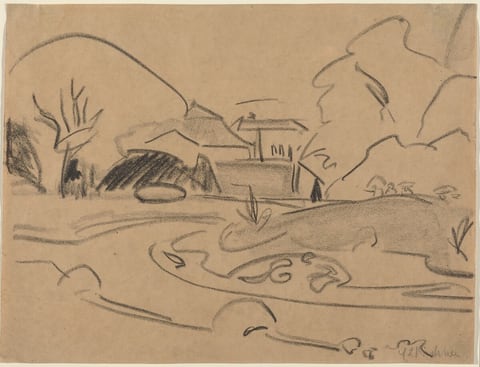
  3. The image shows a landscape drawing with buildings, trees, and a winding path or water feature. The drawing is done in black charcoal on brownish background paper, creating a monochromatic color palette.
    Footpaths and Pavilion in the Dresden Grosser GartenErnst Ludwig Kirchner, c. 1909Courtesy National Gallery of Art, Washington

Third room, south wall
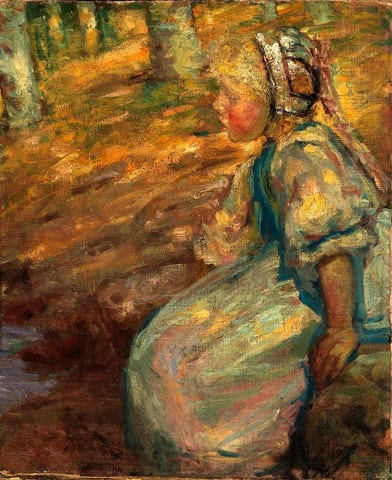
  1. Peasant Girl, by Alice Pike Barney, 1900
    Peasant GirlAlice Pike Barney, 1900Courtesy of the Smithsonian American Art Museum
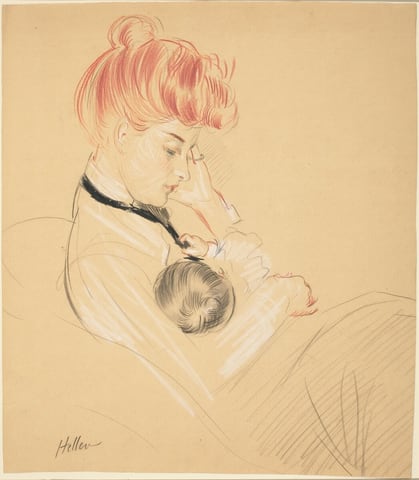
  2. Madame Helleu Cradling Paulette in Her Arms, by Paul-César Helleu, 1904/1905
    Madame Helleu Cradling Paulette in Her ArmsPaul-César Helleu, 1904/1905Courtesy National Gallery of Art, Washington