Floor plan

Style galleriesDutch and Flemish Baroque
Dutch and Flemish Baroque
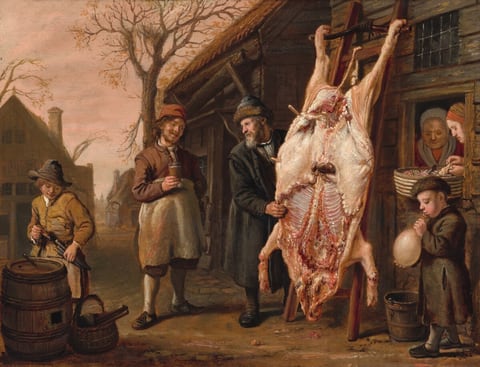
In the center of this painting, a large animal carcass is hanging upside down from a wooden frame, with several people attending to it. The carcass is light pink and has been cut open to reveal white ribs, red muscles, and purple organs. On the far left, a young boy stands next to a barrel and a basket, holding several small knives. To the right, a man in a red cap and white apron observes the carcass while holding a drink. An older man in a furred cap and dark clothing looks towards him and holds one edge of the carcass. On the other side of the animal, a young boy blows up a round object. Two women peer out from the doorway of a wooden building in the background, one holding a basket full of what looks like meat. Behind this group of people are several brown structures and a bare tree against a light pink sky.
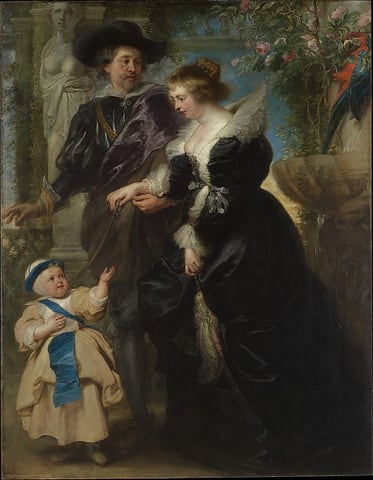
Rubens, Helena Fourment (1614–1673), and Their Son Frans (1633–1678), by Peter Paul Rubens, ca. 1635
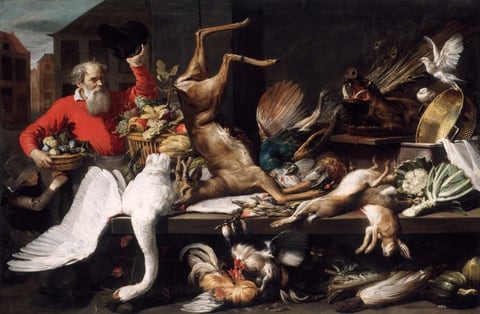
An older man at left in red raises his hat toward a central table chaotically overflowing with dead game, fruits, and vegetables. The wings of dead birds and limbs of animals are splayed out at dramatic angles; a deer at center is suspended by his back legs. Live birds and a cat animate the scene.
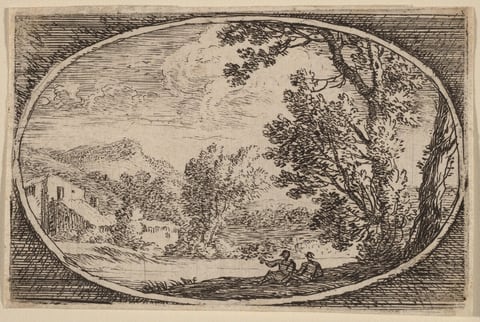
The image shows an oval framing a scene with mountains, clouds, and trees. Delicate etched lines create textures in the landscape. The color palette is monochrome. Two figures are sitting under leafy trees, with a structure nearby.

The works in this room are listed below.

Works in this room

The Low Countries in the 1600s: Rubens's Antwerp and the painters of the Dutch Republic.

First room, north wall

  1. In the center of this painting, a large animal carcass is hanging upside down from a wooden frame, with several people attending to it. The carcass is light pink and has been cut open to reveal white ribs, red muscles, and purple organs. On the far left, a young boy stands next to a barrel and a basket, holding several small knives. To the right, a man in a red cap and white apron observes the carcass while holding a drink. An older man in a furred cap and dark clothing looks towards him and holds one edge of the carcass. On the other side of the animal, a young boy blows up a round object. Two women peer out from the doorway of a wooden building in the background, one holding a basket full of what looks like meat. Behind this group of people are several brown structures and a bare tree against a light pink sky.
    The Slaughtered HogJan Victors, 1653Courtesy National Gallery of Art, Washington
  2. Rubens, Helena Fourment (1614–1673), and Their Son Frans (1633–1678), by Peter Paul Rubens, ca. 1635
    Rubens, Helena Fourment (1614–1673), and Their Son Frans (1633–1678)Peter Paul Rubens, ca. 1635Courtesy of The Metropolitan Museum of Art

First room, south wall

  1. An older man at left in red raises his hat toward a central table chaotically overflowing with dead game, fruits, and vegetables. The wings of dead birds and limbs of animals are splayed out at dramatic angles; a deer at center is suspended by his back legs. Live birds and a cat animate the scene.
    Still Life with Dead Game, Fruits, and Vegetables in a MarketFrans Snyders, 1614Courtesy of the Art Institute of Chicago
  2. The image shows an oval framing a scene with mountains, clouds, and trees. Delicate etched lines create textures in the landscape. The color palette is monochrome. Two figures are sitting under leafy trees, with a structure nearby.
    Two Men Seated Near the WatersideHerman van SwaneveltCourtesy National Gallery of Art, Washington

Second room, south wall
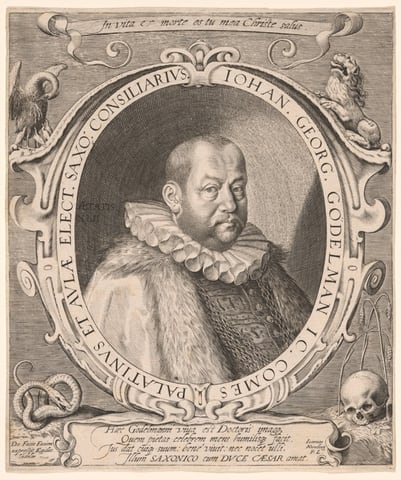
  1. A work made of engraving on paper.
    Johann Georg von Gödelmann, Law Professor, DiplomatAegidius Sadeler, II, c. 1601Courtesy of the Art Institute of Chicago
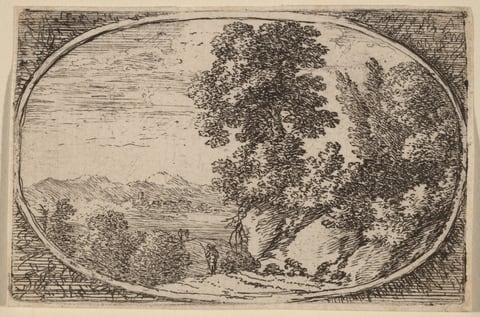
  2. The image shows a landscape viewed from above. The scene is oval, framed by tree branches on each side. Distant mountains form a boundary near the top. Delicate, finely executed lines create detailed foliage and landscape features. A winding path with a small figure adds scale. Lush trees climb upwards, with a muted color palette of the paper and dark brown and black lines providing contrast.
    The Boulder Crowned with TreesHerman van SwaneveltCourtesy National Gallery of Art, Washington
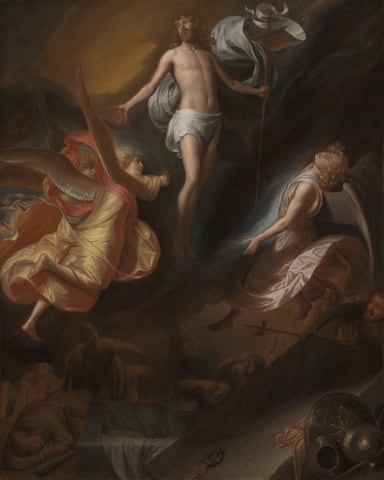
  3. A work made of oil on canvas.
    Resurrection of ChristSamuel van Hoogstraten, c. 1665Courtesy of the Art Institute of Chicago
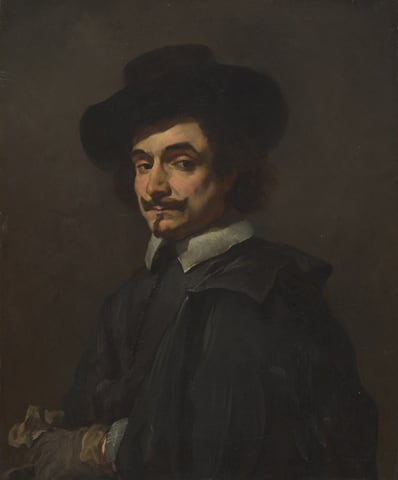
  4. A work made of oil on copper.
    Portrait of a ManJan Baptist Weenix, c. 1650Courtesy of the Art Institute of Chicago

Second room, north wall
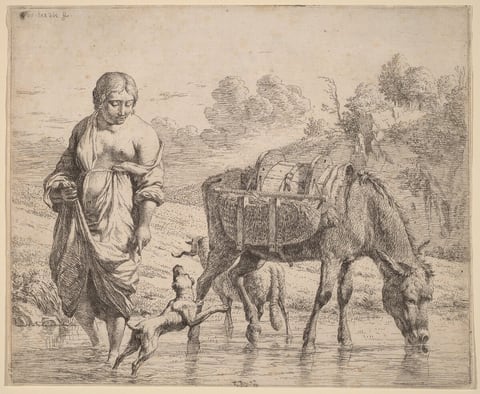
  1. The image shows a woman standing close to us, slightly turned to the side, looking down, with a hand supporting her draped attire and the other grasping a stick. Next to her, a donkey drinks from a shallow stream, carrying a large wicker basket with barrels inside. A dog is splashing in the water beside them. The horizon is low, meeting a rise of land with trees and shrubs, leading the eye to a distant pathway where a couple of small figures can be seen. The sky above has sketchily rendered clouds. The style involves fine, detailed linework, characteristic of etching, emphasizing textures such as the fur of the donkey and the folds of the fabric. The color palette is monochromatic, relying on various intensities of ink and line density to render shadows and highlights.
    Woman Crossing a StreamKarel Dujardin, 1662Courtesy National Gallery of Art, Washington
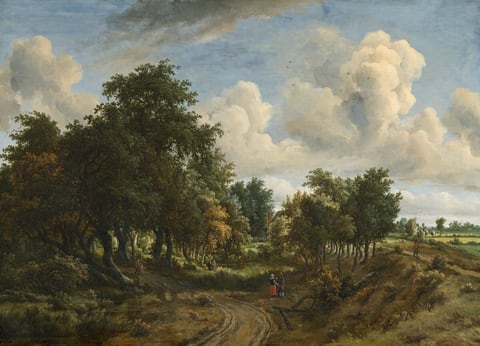
  2. A rutted, dirt road curves from the bottom center of the canvas toward and behind a grove of tall trees to our left, beneath a pale blue sky with fluffy white clouds that fills the top two-thirds of this horizontal landscape painting. The broad, green canopies of the trees to our left create deep shade over twisting trunks, shrubs, and grasses. A narrow stream meandering alongside the road to our left reflects the moss, pine, and sage greens of the leaves. The land rises in a sloping bank to our right, and leads back to open fields with hedgerows that stretch to the horizon. Shorter, more spindly trees cluster along the bank in the distance. Tiny in scale, people are sprinkled throughout the landscape, either singly or in small groups. In the shade of the grove to our left, a man with dark pantaloons, a brown hat and coat, and a walking stick strolls along the road with a woman wearing a red skirt, a dark shirt, and a white apron and cap. Just off the curve of the road to our right, another man with a walking stick, tan hat, and dark gray pantaloons talks to a woman also wearing red, black, and white. Another person, slightly smaller in stature, stands between them. At a pond farther back from this trio, a man with a broad-brimmed hat sits fishing at the edge of the water. Barely visible, a house with a pitched roof, a tall, brick-red chimney, and a white picket fence peeks out from behind the trees beyond the pond. Finally, a man wearing a rust-orange coat, gray pantaloons with white stockings, and a tall hat, carrying a pole propped on his shoulder, walks toward us on a footpath running alongside the fields. Tall, cream-white clouds dot the pale blue sky above, and tiny dots of dark paint suggest flying birds. Soft sunlight pours across the countryside. The artist signed and dated the painting in small script in the lower right corner: “meijndert Hobbema F 1663.”
    A Wooded LandscapeMeindert Hobbema, 1663Courtesy National Gallery of Art, Washington
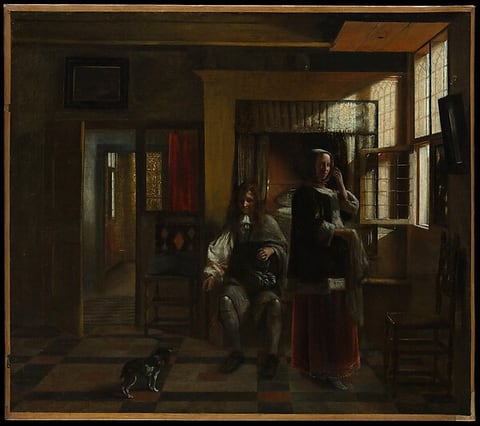
  3. Interior with a Young Couple, by Pieter de Hooch, probably ca. 1662–65
    Interior with a Young CouplePieter de Hooch, probably ca. 1662–65Courtesy of The Metropolitan Museum of Art

Third room, north wall
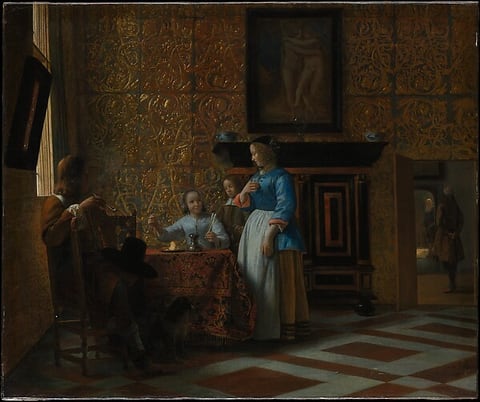
  1. Leisure Time in an Elegant Setting, by Pieter de Hooch, ca. 1663–65
    Leisure Time in an Elegant SettingPieter de Hooch, ca. 1663–65Courtesy of The Metropolitan Museum of Art
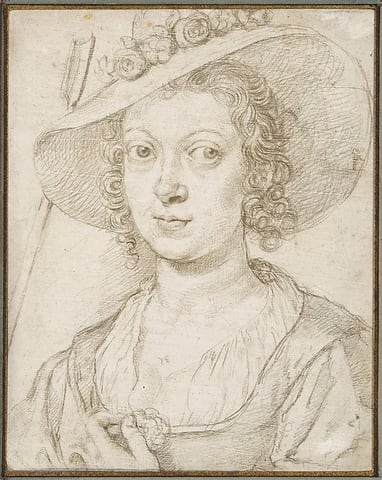
  2. Portrait of a woman as a shepherdess, by Crispijn de Passe the Younger, 1635-40
    Portrait of a woman as a shepherdessCrispijn de Passe the Younger, 1635-40Courtesy of The Metropolitan Museum of Art
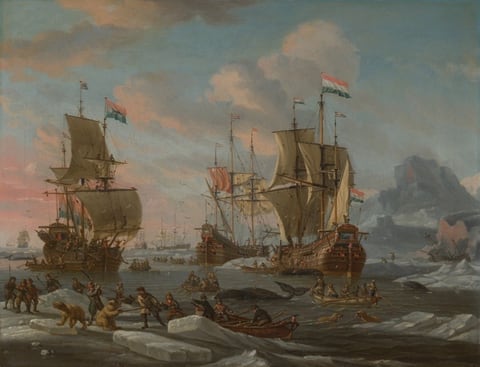
  3. A work made of oil on canvas.
    The Dutch Whaling FleetAbraham Storck, c. 1695Courtesy of the Art Institute of Chicago

Third room, south wall
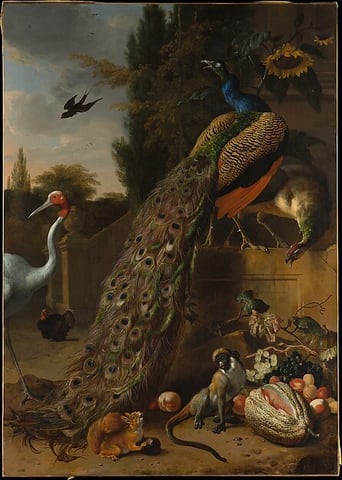
  1. Peacocks, by Melchior d' Hondecoeter, 1683
    PeacocksMelchior d' Hondecoeter, 1683Courtesy of The Metropolitan Museum of Art
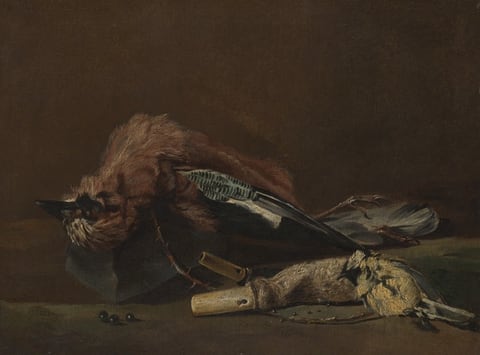
  2. A work made of oil on canvas.
    Dead Birds and Shot BagsPieter Boel, c. 1660Courtesy of the Art Institute of Chicago