Floor plan

Time and placeItaly

Italy

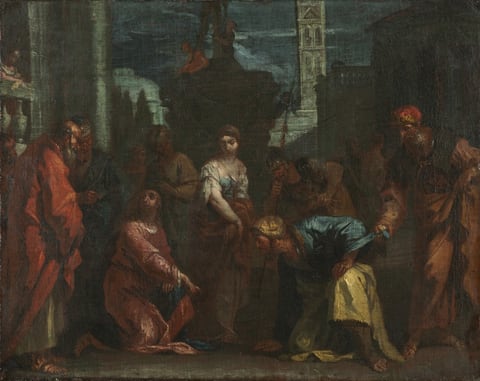
Christ and the Woman Taken in Adultery, by Sebastiano Ricci, mid-1700s
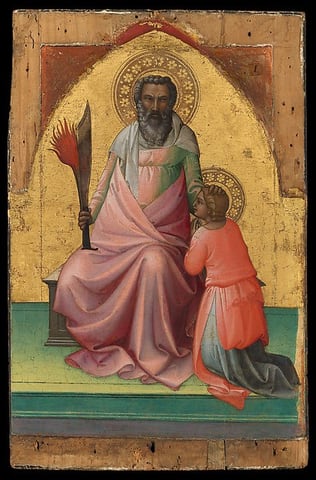
Abraham, by Lorenzo Monaco, ca. 1408–10
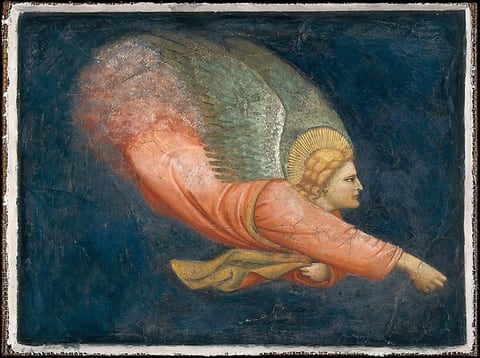
Two Angels, by North Italian Painter (Verona?), ca. 1330
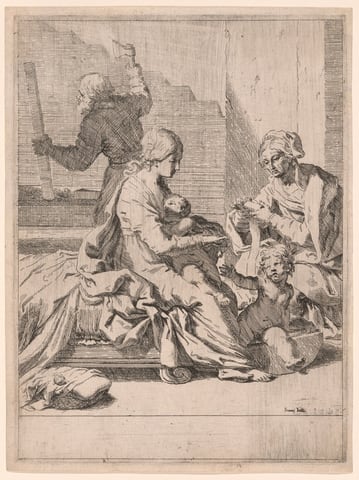
A work made of etching in black on cream laid paper.
This is a drawing of mythical sea creatures in a marine landscape. The central figures are depicted as mythical beings, possibly mermen, with human torsos and fish-like tails, partially submerged in water. One figure prominently holds a large seashell with text written on it. Around them are various other marine creatures and features such as a distant rocky shore, birds flying in the sky, and waves creating a dynamic setting. The drawing is detailed in line work.
Shown from the waist up, a woman wearing a garnet-red robe rests a book and a palm frond against a spiked wheel, all against a gold background in this arched, vertical painting. The woman’s light skin is tinged with pale green, and her cheeks are faint pink. Her shoulders face us, and she slightly looks up and off to our right with gray eyes under curved brows. She has a long, straight nose, and her small, full, bow-shaped lips are closed. Her wavy blond hair is parted down the middle and pulled back at the base of her head. Her red robe has a pattern of delicate diamond shapes and the underside is white, visible where it turns over around the neck. The robe is fastened with a round, gold disk the size of a DVD. Letters there read, “S.K.A.T.E.R.I.N.A.” around the perimeter of a four-lobed, red, blue, and gold geometric design at the center of the brooch. The sky-blue garment beneath her robe has a marine-blue collar. She clasps the palm frond in her left hand, to our right. The hand rests on the book, which is propped against the wheel in front of her, so the frond reaches beyond and above that shoulder, nearly to the edge of the painting. The wheel is edged with short, curving spikes like talons. The woman’s gold crown and round halo blend into the shimmering gold background, which is visibly cracked in some areas. The top of the panel curves up as if into an arch but is cut across the panel over her halo.
A work made of engraving and etching in black on ivory wove paper.
Virgin and Child with John the Baptist and Angels, by Pietro del Donzello, c. 1500

The works in this room are listed below.

Works in this room

Works made in Italy, from every century in the collection.

Section 1, north wall

  1. Christ and the Woman Taken in Adultery, by Sebastiano Ricci, mid-1700s
    Christ and the Woman Taken in AdulterySebastiano Ricci, mid-1700sCourtesy of the Cleveland Museum of Art
  2. Abraham, by Lorenzo Monaco, ca. 1408–10
    AbrahamLorenzo Monaco, ca. 1408–10Courtesy of The Metropolitan Museum of Art
  3. Two Angels, by North Italian Painter (Verona?), ca. 1330
    Two AngelsNorth Italian Painter (Verona?), ca. 1330Courtesy of The Metropolitan Museum of Art
  4. A work made of etching in black on cream laid paper.
    Holy Family with Saint Elizabeth and Saint John the BaptistElisabetta Sirani, 1650/60Courtesy of the Art Institute of Chicago

Section 1, south wall

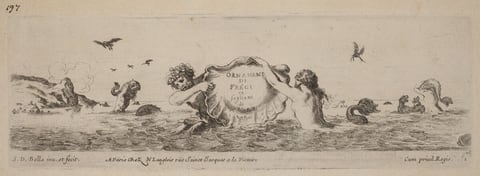
  1. This is a drawing of mythical sea creatures in a marine landscape. The central figures are depicted as mythical beings, possibly mermen, with human torsos and fish-like tails, partially submerged in water. One figure prominently holds a large seashell with text written on it. Around them are various other marine creatures and features such as a distant rocky shore, birds flying in the sky, and waves creating a dynamic setting. The drawing is detailed in line work.
    Title Page for "Ornamenti di fregi e fogliani"Stefano della Bella, probably 1648Courtesy National Gallery of Art, Washington
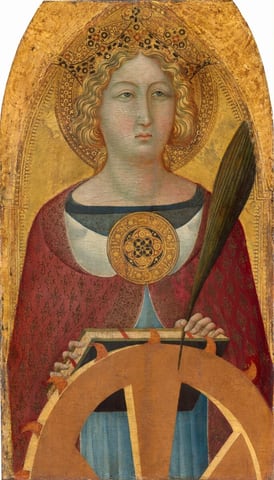
  2. Shown from the waist up, a woman wearing a garnet-red robe rests a book and a palm frond against a spiked wheel, all against a gold background in this arched, vertical painting. The woman’s light skin is tinged with pale green, and her cheeks are faint pink. Her shoulders face us, and she slightly looks up and off to our right with gray eyes under curved brows. She has a long, straight nose, and her small, full, bow-shaped lips are closed. Her wavy blond hair is parted down the middle and pulled back at the base of her head. Her red robe has a pattern of delicate diamond shapes and the underside is white, visible where it turns over around the neck. The robe is fastened with a round, gold disk the size of a DVD. Letters there read, “S.K.A.T.E.R.I.N.A.” around the perimeter of a four-lobed, red, blue, and gold geometric design at the center of the brooch. The sky-blue garment beneath her robe has a marine-blue collar. She clasps the palm frond in her left hand, to our right. The hand rests on the book, which is propped against the wheel in front of her, so the frond reaches beyond and above that shoulder, nearly to the edge of the painting. The wheel is edged with short, curving spikes like talons. The woman’s gold crown and round halo blend into the shimmering gold background, which is visibly cracked in some areas. The top of the panel curves up as if into an arch but is cut across the panel over her halo.
    Saint Catherine of AlexandriaBartolomeo Bulgarini, c. 1335/1340Courtesy National Gallery of Art, Washington
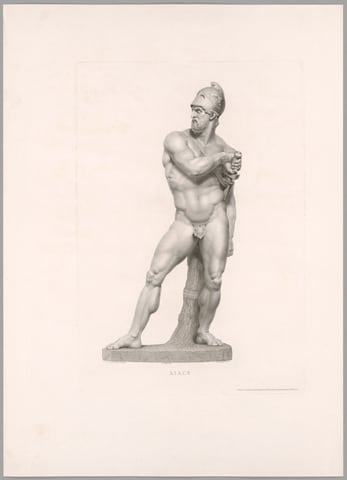
  3. A work made of engraving and etching in black on ivory wove paper.
    Ajax, Front View, from Oeuvre de CanovaAntonio Canova, 1817Courtesy of the Art Institute of Chicago
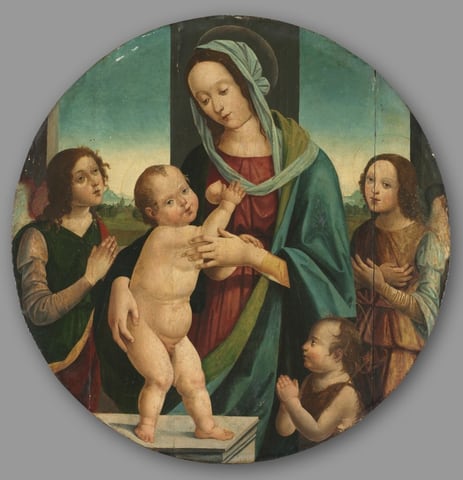
  4. Virgin and Child with John the Baptist and Angels, by Pietro del Donzello, c. 1500
    Virgin and Child with John the Baptist and AngelsPietro del Donzello, c. 1500Courtesy of the Cleveland Museum of Art

Section 2, south wall
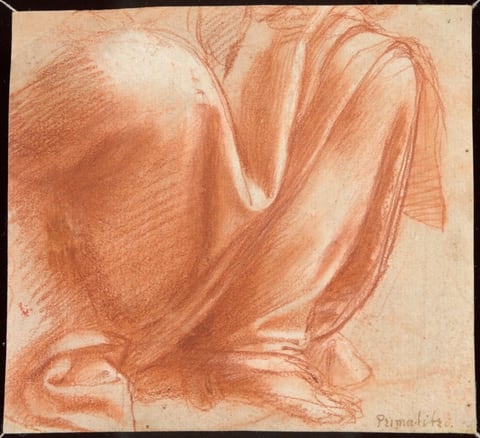
  1. A work made of red chalk and brush and red chalk wash (recto) and black chalk, with black chalk grid lines, (verso) on cream laid paper.
    A Drapery Study for the Knees of a Seated Allegorical Figure of Charity (recto); Bust of a Naked Allegorical Figure of Charity with Two Putti (verso)Giovanni Antonio di Francesco Sogliani, 1520/30Courtesy of the Art Institute of Chicago
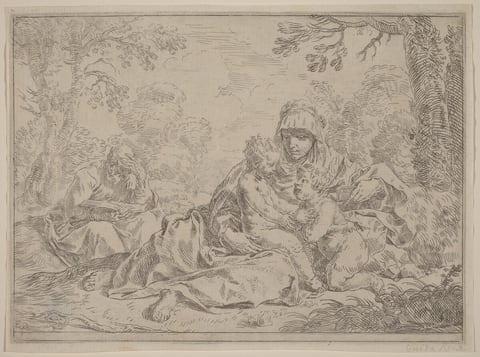
  2. The image shows an etching of four individuals, two adults, and two children. The main adult is sitting with a child on each knee. This person is wearing a hooded cloak with soft facial features. The children have curly hair and are reaching towards each other. The second adult is seated behind them, wearing a loose robe and appears to be holding something, possibly a book. The background features trees, bushes, foliage, and a calm sky.
    The Holy FamilySimone CantariniCourtesy National Gallery of Art, Washington
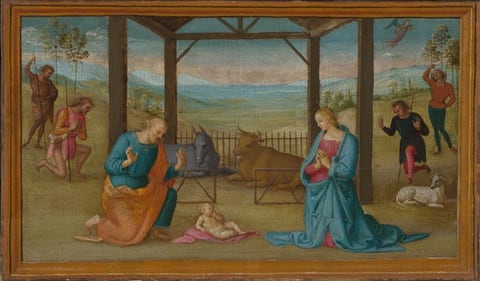
  3. A work made of tempera on panel, transferred to canvas.
    The NativityPerugino, 1500–05Courtesy of the Art Institute of Chicago

Section 2, north wall
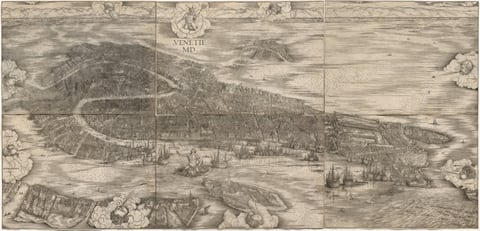
  1. View of Venice, by Jacopo de' Barbari, 1500
    View of VeniceJacopo de' Barbari, 1500Courtesy of the Cleveland Museum of Art
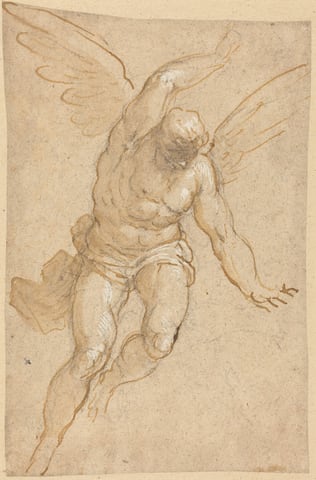
  2. The image shows a human figure with wings positioned as though in flight. The figure is captured from a slightly frontal perspective, with the head turned downwards and the right arm outstretched. The facial features are undefined, focusing more on the body's muscular structure. The figure wears a cloth or drapery around the waist and has well-defined muscles on the chest, arms, and legs. Large wings extend out behind the figure, adding to the sense of flight. The background is plain with a light texture.
    A Flying AngelJacopo Palma il Giovane, 1580/1590Courtesy National Gallery of Art, Washington
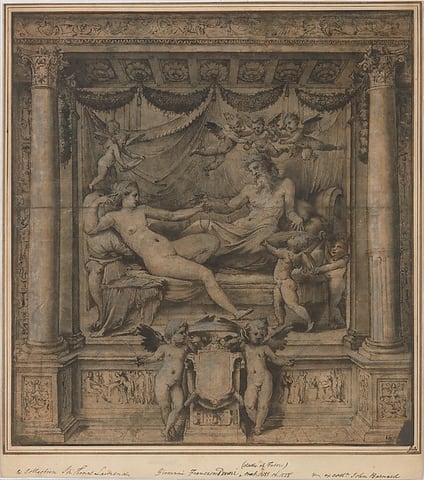
  3. Jupiter and Juno: Study for the "Furti di Giove" Tapestries, by Perino del Vaga (Pietro Buonaccorsi), ca. 1532–35
    Jupiter and Juno: Study for the "Furti di Giove" TapestriesPerino del Vaga (Pietro Buonaccorsi), ca. 1532–35Courtesy of The Metropolitan Museum of Art

Section 3, north wall
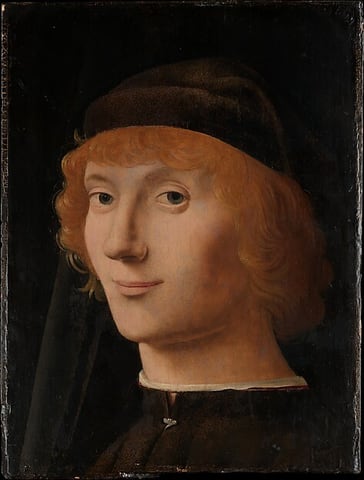
  1. Portrait of a Young Man, by Antonello da Messina (Antonello di Giovanni d'Antonio), ca. 1470
    Portrait of a Young ManAntonello da Messina (Antonello di Giovanni d'Antonio), ca. 1470Courtesy of The Metropolitan Museum of Art
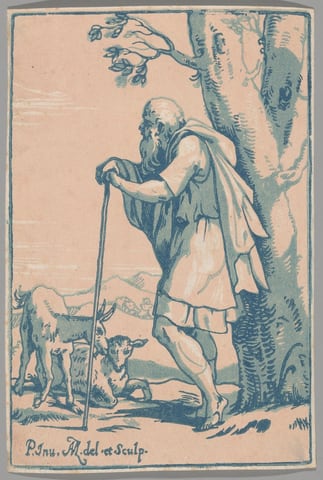
  2. A work made of chiaroscuro woodcut, from three blocks in pink, dark blue, and light blue, on cream laid paper.
    The Old ShepherdConte Antonio Maria Zanetti, the Elder, 1722Courtesy of the Art Institute of Chicago