Floor plan

Time and placeItaly

Italy

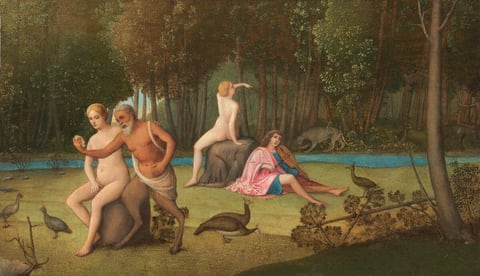
Two women, a man, and a satyr, a man with goat’s legs, are in two pairs in a forested landscape in this horizontal painting. The pale-skinned women are nude, and their blond hair is tied up and back. One woman sits on a brown boulder to the left of center. One hand covers her groin, and the other hand rests on the satyr’s shoulder. The satyr has deeply tanned skin, short white hair, and a long white beard. A white cloth wraps over one shoulder and across his hips. He holds up an object, perhaps a shell, with one hand. That arm crosses over the woman’s breasts. His other hand is by his lower belly, and he looks at the shell. A bit farther back and to our right, a second nude woman also sits on a boulder. She faces away from us and holds up a long stick with her left arm, which arcs over her body. A clean-shaven, pale-skinned man sits with his back against the boulder. He has long brown hair and looks off to the distance to our right. He wears a carnation-pink robe over a sapphire-blue tunic. His legs splay in front of him, his feet bare, as he holds a bow to a violin-like instrument tucked under his chin. The two pairs sit in a grassy glade occupied also by five pheasant- or peacock-like birds. A thin river running behind the glade is lined with spindly trees that together make an impenetrable bronze-brown and laurel-green canopy. The second woman’s stick points or is directed to a gray, mountain lion-like cat on the far bank. Closer inspection reveals deer and another person, who points, tucked among the trunks. A glimpse of blue sky is visible through a break in the tree trunks.
A work made of tempera on panel, transferred to canvas.
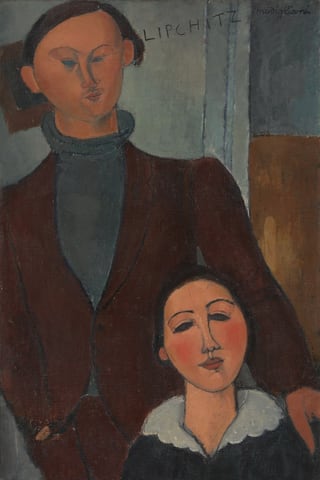
Large painting, standing man blue turtleneck, sitting woman with white collar.
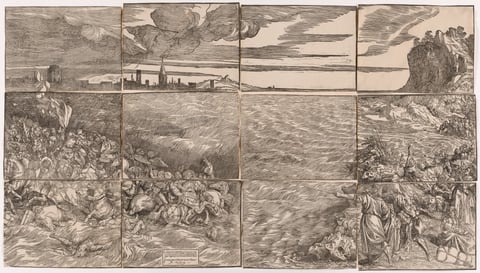
The Submersion of Pharaoh's Army in the Red Sea, by Titian, 1514–15, printed 1549
A work made of engraving in black on cream laid paper.
A work made of etching in black on cream laid paper.
We look slightly down across a sun-drenched plaza with people scattered among ruins, buildings, and around a free-standing column in this vertical landscape painting. The people we can see have light skin. Towering trees with celery, sage, and forest-green leaves frame a small plaza paved with flax-colored stones. A tree to our right almost reaches the top of the painting, and a shorter tree in front of it has toppled onto the plaza. To our left, in the lower corner, a man sits behind a shadowy balustrade, looking down. In the lower center of the painting, a man walks toward us, holding a basket over one arm and dead poultry in the other hand, and a dog sits nearby. Slightly farther back is a tall stone column with a door in its base and a statue on top. A woman wearing a red shirt and blue skirt sits on a step in front of the door. Along the left side, the plaza gives way to a tree-lined, dirt road that meanders toward a stone arch in the middle distance, and to a cluster of low buildings beyond. Two towers catch the light, one with a slate-blue dome and the other with a peach-colored steeple. Farther back from the buildings is a dark line of trees at the base of a steep green hill dotted with groves of trees, which rises high over the plaza below. Another building complex, glowing in warm tones of straw yellow, sits at its top. Small dots of red, white, and blue suggest a handful of people making their way up the hill’s wide path. A river with moss-green water pouring over a dam extends from the lower right corner into the distance along the right edge of the painting. Near the column, a man fishes at the water’s edge. The water winds back to a row of silvery-gray buildings in the far distance. Several people in red, yellow, or white, tiny in scale, dot the riverbanks and cross the bridge. A screen of thin, pale pink clouds float across the light blue sky.
A work made of engraving in black on ivory laid paper.

The works in this room are listed below.

Works in this room

Works made in Italy, from every century in the collection.

Section 1, north wall

  1. Two women, a man, and a satyr, a man with goat’s legs, are in two pairs in a forested landscape in this horizontal painting. The pale-skinned women are nude, and their blond hair is tied up and back. One woman sits on a brown boulder to the left of center. One hand covers her groin, and the other hand rests on the satyr’s shoulder. The satyr has deeply tanned skin, short white hair, and a long white beard. A white cloth wraps over one shoulder and across his hips. He holds up an object, perhaps a shell, with one hand. That arm crosses over the woman’s breasts. His other hand is by his lower belly, and he looks at the shell. A bit farther back and to our right, a second nude woman also sits on a boulder. She faces away from us and holds up a long stick with her left arm, which arcs over her body. A clean-shaven, pale-skinned man sits with his back against the boulder. He has long brown hair and looks off to the distance to our right. He wears a carnation-pink robe over a sapphire-blue tunic. His legs splay in front of him, his feet bare, as he holds a bow to a violin-like instrument tucked under his chin. The two pairs sit in a grassy glade occupied also by five pheasant- or peacock-like birds. A thin river running behind the glade is lined with spindly trees that together make an impenetrable bronze-brown and laurel-green canopy. The second woman’s stick points or is directed to a gray, mountain lion-like cat on the far bank. Closer inspection reveals deer and another person, who points, tucked among the trunks. A glimpse of blue sky is visible through a break in the tree trunks.
    OrpheusUnrecorded Italian maker, c. 1515Courtesy National Gallery of Art, Washington
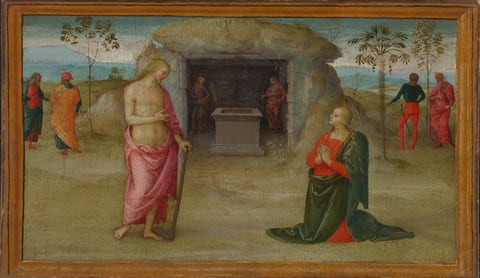
  2. A work made of tempera on panel, transferred to canvas.
    Noli Me TangerePerugino, 1500–05Courtesy of the Art Institute of Chicago
  3. Large painting, standing man blue turtleneck, sitting woman with white collar.
    Jacques and Berthe LipchitzAmedeo Modigliani, 1916Courtesy of the Art Institute of Chicago
  4. The Submersion of Pharaoh's Army in the Red Sea, by Titian, 1514–15, printed 1549
    The Submersion of Pharaoh's Army in the Red SeaTitian, 1514–15, printed 1549Courtesy of the Cleveland Museum of Art

Section 1, south wall

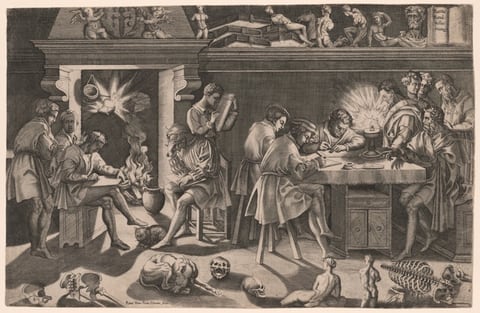
  1. A work made of engraving in black on cream laid paper.
    The Academy of Baccio BandinelliEnea Vico, 1544/50, printed c. 1560sCourtesy of the Art Institute of Chicago
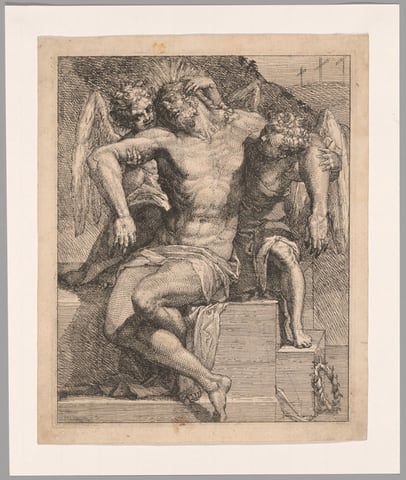
  2. A work made of etching in black on cream laid paper.
    Dead Christ Held by AngelsOrazio Samacchini, 1580/1620Courtesy of the Art Institute of Chicago
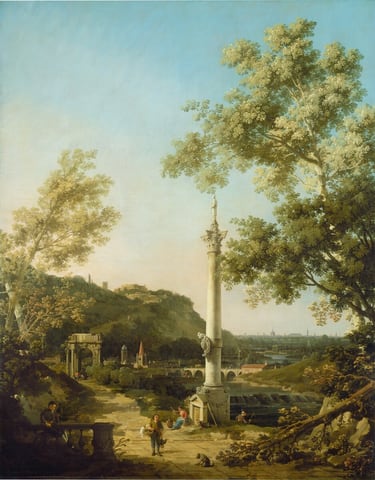
  3. We look slightly down across a sun-drenched plaza with people scattered among ruins, buildings, and around a free-standing column in this vertical landscape painting. The people we can see have light skin. Towering trees with celery, sage, and forest-green leaves frame a small plaza paved with flax-colored stones. A tree to our right almost reaches the top of the painting, and a shorter tree in front of it has toppled onto the plaza. To our left, in the lower corner, a man sits behind a shadowy balustrade, looking down. In the lower center of the painting, a man walks toward us, holding a basket over one arm and dead poultry in the other hand, and a dog sits nearby. Slightly farther back is a tall stone column with a door in its base and a statue on top. A woman wearing a red shirt and blue skirt sits on a step in front of the door. Along the left side, the plaza gives way to a tree-lined, dirt road that meanders toward a stone arch in the middle distance, and to a cluster of low buildings beyond. Two towers catch the light, one with a slate-blue dome and the other with a peach-colored steeple. Farther back from the buildings is a dark line of trees at the base of a steep green hill dotted with groves of trees, which rises high over the plaza below. Another building complex, glowing in warm tones of straw yellow, sits at its top. Small dots of red, white, and blue suggest a handful of people making their way up the hill’s wide path. A river with moss-green water pouring over a dam extends from the lower right corner into the distance along the right edge of the painting. Near the column, a man fishes at the water’s edge. The water winds back to a row of silvery-gray buildings in the far distance. Several people in red, yellow, or white, tiny in scale, dot the riverbanks and cross the bridge. A screen of thin, pale pink clouds float across the light blue sky.
    English Landscape Capriccio with a ColumnCanaletto, c. 1754Courtesy National Gallery of Art, Washington
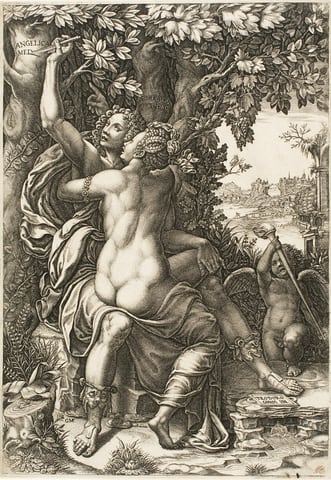
  4. A work made of engraving in black on ivory laid paper.
    Angelica and MedoroGiorgio Ghisi, c. 1570Courtesy of the Art Institute of Chicago

Section 2, south wall
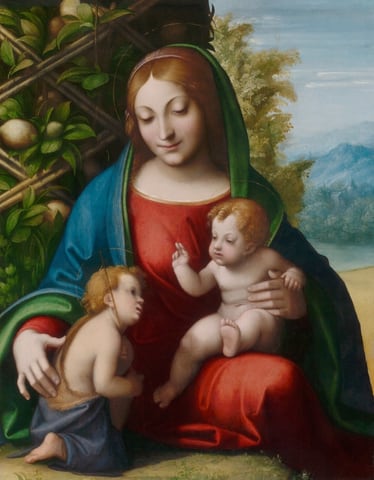
  1. Vividly colored painting of Virgin Mary with baby Jesus and baby John the Baptist.
    Virgin and Child with the Young Saint John the BaptistAntonio da Correggio, c. 1515Courtesy of the Art Institute of Chicago
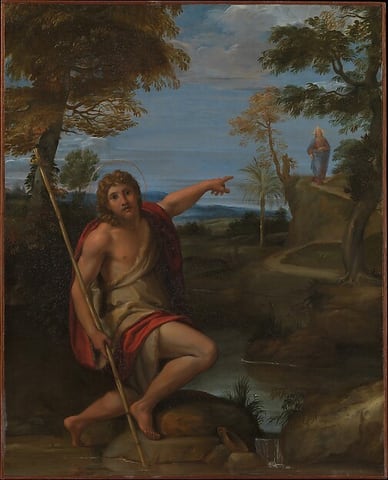
  2. Saint John the Baptist Bearing Witness, by Annibale Carracci, ca. 1600
    Saint John the Baptist Bearing WitnessAnnibale Carracci, ca. 1600Courtesy of The Metropolitan Museum of Art
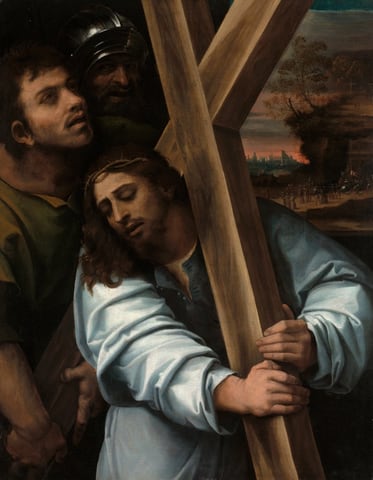
  3. A work made of oil on panel.
    Christ Carrying the CrossSebastiano del Piombo, c. 1515–17Courtesy of the Art Institute of Chicago
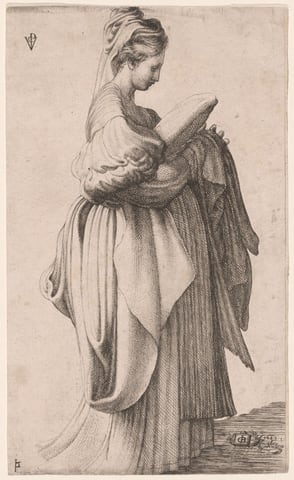
  4. A work made of etching in black ink on cream laid paper.
    A Young Woman Holding a CushionMonogrammist VCP, 1643Courtesy of the Art Institute of Chicago

Section 2, north wall
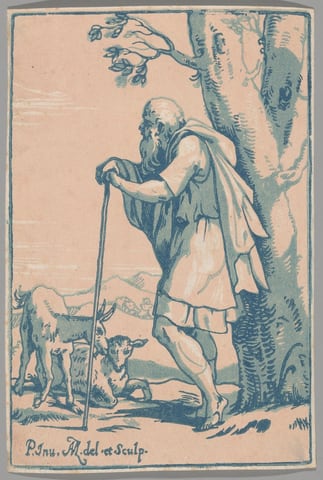
  1. A work made of chiaroscuro woodcut, from three blocks in pink, dark blue, and light blue, on cream laid paper.
    The Old ShepherdConte Antonio Maria Zanetti, the Elder, 1722Courtesy of the Art Institute of Chicago
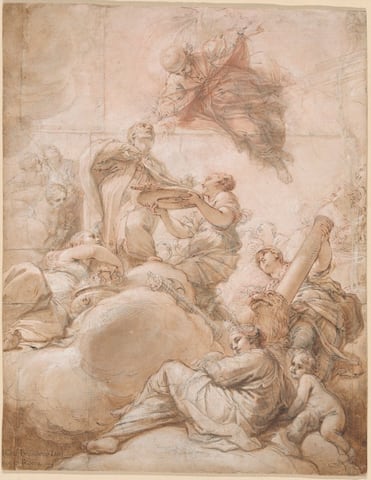
  2. A work made of pen and brown ink and brush and brown wash, over black and red chalk, heightened with white opaque watercolor, on joined sheets of laid paper, mounted to paperboard.
    Allegory of the Elevation of Cardinal Deacon Oddone Colonna to the Papal Chair as Pope Martin VBenedetto Luti, 1700Courtesy of the Art Institute of Chicago
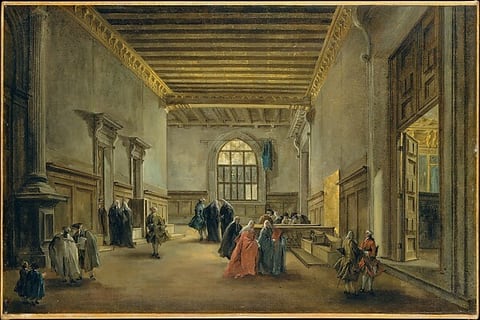
  3. The Antechamber of the Sala del Maggior Consiglio, by Francesco Guardi, ca. 1765–68
    The Antechamber of the Sala del Maggior ConsiglioFrancesco Guardi, ca. 1765–68Courtesy of The Metropolitan Museum of Art
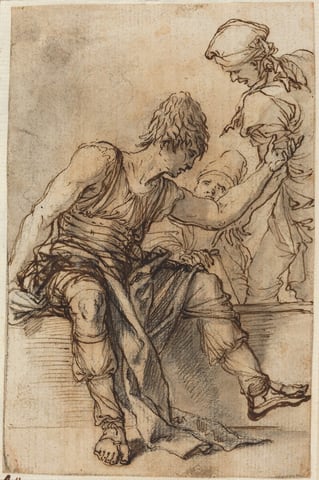
  4. The image shows a drawing of three figures. The central figure is seated, leaning slightly forward with one arm outstretched towards the standing figures. They have short, slightly messy hair, traditional clothing, and muscular limbs. The standing figures on the right are partially obscured but appear to interact with the seated figure. One of them is extending their arm towards the seated figure. The individuals wear layered clothing, with one wearing a head covering. The background is simple, emphasizing the interaction between the figures. The drawing style is classical or historical, using ink and wash for texture and depth.
    Youth Sitting on a Wall in Conversation with Two MenSalvator Rosa, c. 1656/1657Courtesy National Gallery of Art, Washington