Floor plan

Time and placeThe 20th century

The 20th century

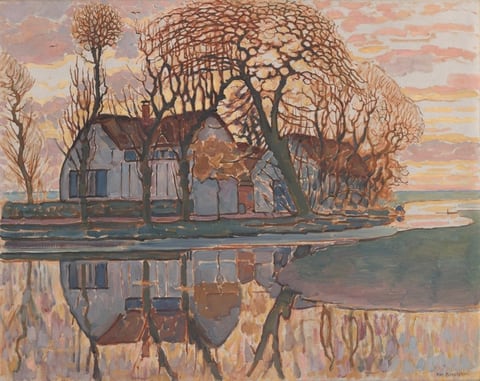
A work made of oil on canvas.
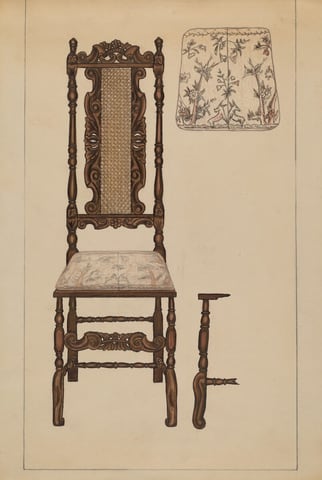
This is a drawing of a wooden chair with detailed upholstery. The chair has an ornate, high backrest with elaborate scrollwork and a woven central panel. The seat is cushioned and covered with a floral patterned fabric. There is also a separate drawing of the fabric pattern used on the seat and a sketch of one of the chair's legs to show the craftsmanship and decorative elements.
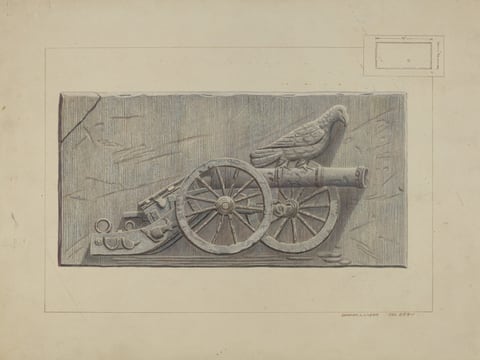
This image shows an engraved design featuring a cannon with large wheels next to an eagle perched on top, situated on the left side of a rectangular stone slab. The color scheme is predominantly grayscale with subtle hints of blue and gray tones throughout the stone surface. The cannon is positioned slightly to the left in the composition, with its barrel pointing to the right, while the eagle is perched on the cannon barrel facing forward, wings tucked close to its body. To accompany the cannon, a stack of cannonballs is carved on the lower left, further anchoring the scene within the carved rectangle.
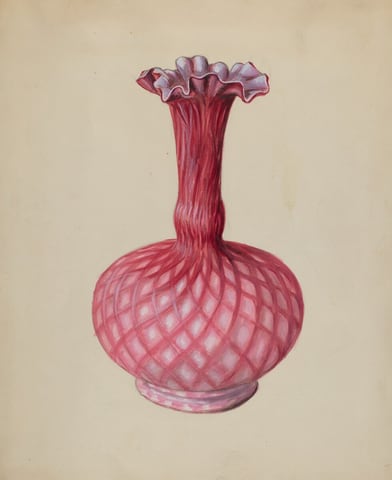
The image displays a single ornate vase with a bulbous base and a ruffled top, taking up most of the frame. The vase is predominantly pink with red accents, the ruffled top is highlighted with white on the inner edges, and there's a crisscross pattern visible on the body. Against a plain beige background, the vase is centrally positioned.
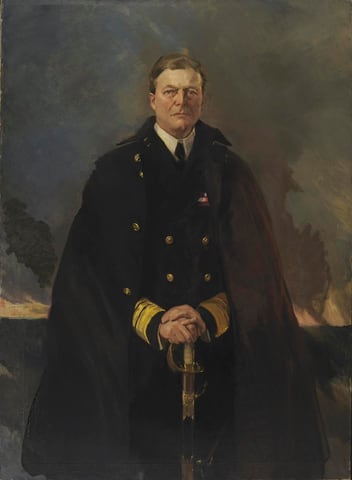
Admiral Sir David Beatty, Lord Beatty, by Cecilia Beaux, ca. 1920
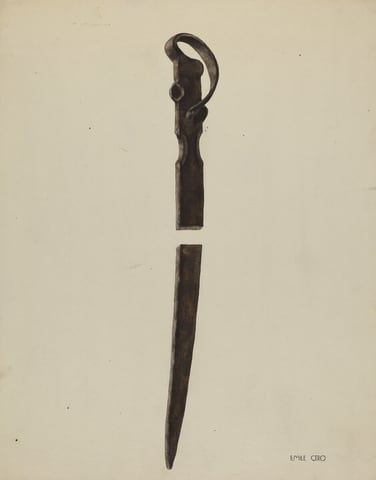
The image shows a dark metal object with two parts: a handle and a blade. The color palette consists of shades of dark brown on a light beige background. The handle is located at the top center, and the blade portion is positioned below it, both aligned vertically in the center of the frame.
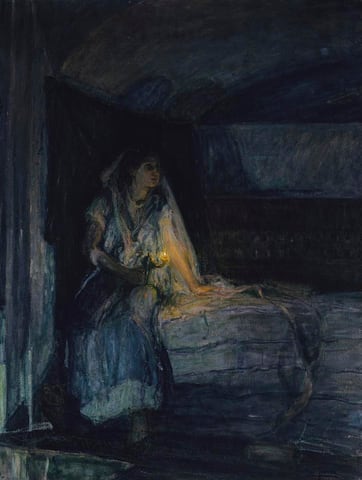
Mary, by Henry Ossawa Tanner, ca. 1914

The works in this room are listed below.

Works in this room

Works made in the 20th century, anywhere in the world.

Section 1, north wall

  1. A work made of oil on canvas.
    Farm near DuivendrechtPiet Mondrian, c. 1916Courtesy of the Art Institute of Chicago
  2. This is a drawing of a wooden chair with detailed upholstery. The chair has an ornate, high backrest with elaborate scrollwork and a woven central panel. The seat is cushioned and covered with a floral patterned fabric. There is also a separate drawing of the fabric pattern used on the seat and a sketch of one of the chair's legs to show the craftsmanship and decorative elements.
    Side ChairUnrecorded American maker, 1935/1942Courtesy National Gallery of Art, Washington
  3. This image shows an engraved design featuring a cannon with large wheels next to an eagle perched on top, situated on the left side of a rectangular stone slab. The color scheme is predominantly grayscale with subtle hints of blue and gray tones throughout the stone surface. The cannon is positioned slightly to the left in the composition, with its barrel pointing to the right, while the eagle is perched on the cannon barrel facing forward, wings tucked close to its body. To accompany the cannon, a stack of cannonballs is carved on the lower left, further anchoring the scene within the carved rectangle.
    Bas ReliefEdward L. Loper, c. 1938Courtesy National Gallery of Art, Washington
  4. The image displays a single ornate vase with a bulbous base and a ruffled top, taking up most of the frame. The vase is predominantly pink with red accents, the ruffled top is highlighted with white on the inner edges, and there's a crisscross pattern visible on the body. Against a plain beige background, the vase is centrally positioned.
    Ornamental Ruby VaseRobert Stewart, c. 1936Courtesy National Gallery of Art, Washington

Section 1, south wall

  1. Admiral Sir David Beatty, Lord Beatty, by Cecilia Beaux, ca. 1920
    Admiral Sir David Beatty, Lord BeattyCecilia Beaux, ca. 1920Courtesy of the Smithsonian American Art Museum
  2. The image shows a dark metal object with two parts: a handle and a blade. The color palette consists of shades of dark brown on a light beige background. The handle is located at the top center, and the blade portion is positioned below it, both aligned vertically in the center of the frame.
    SpitEmile Cero, c. 1938Courtesy National Gallery of Art, Washington
  3. Mary, by Henry Ossawa Tanner, ca. 1914
    MaryHenry Ossawa Tanner, ca. 1914Courtesy of the Smithsonian American Art Museum

Section 2, south wall
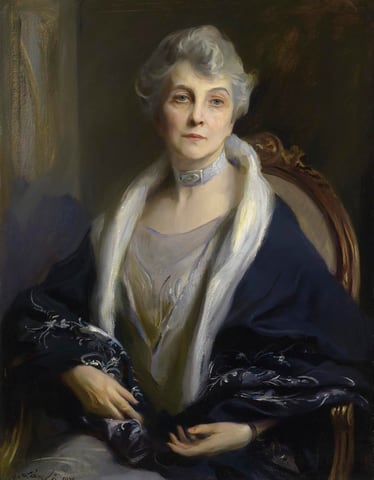
  1. Artist: Philip Alexius de László, Sitter: Clara Margaret Cook Kellogg, Current owner: National Portrait Gallery, Smithsonian Institution
    Clara Cook KelloggPhilip Alexius de László, 1929Courtesy of the National Portrait Gallery, Smithsonian Institution
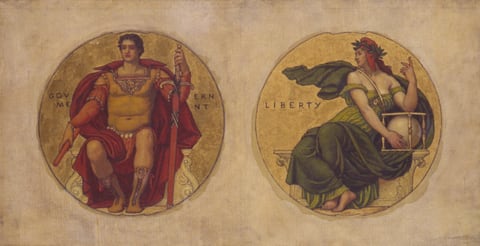
  2. Study for mosaic in the Wisconsin State Capital "Government and Liberty", by Kenyon Cox, ca. 1912
    Study for mosaic in the Wisconsin State Capital "Government and Liberty"Kenyon Cox, ca. 1912Courtesy of the Smithsonian American Art Museum
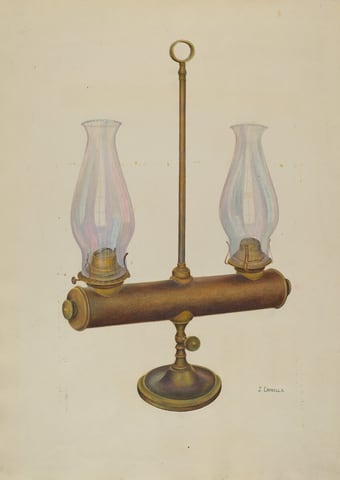
  3. The image shows an antique double kerosene lamp with ornate glass chimneys set atop a horizontal cylindrical base with a central vertical support ending in a circular handle. The base and lamp parts have a bronze-like color with a textured appearance, and the glass chimneys are primarily clear but show hints of colorful reflections. Positioned centrally in the image, the lamp stands upright with the two chimneys equally spaced on either side of the vertical support, which is topped by a circular loop handle, while the signature "J. Cannella" is visible towards the lower right side of the image.
    Reading LampJoseph Cannella, 1941Courtesy National Gallery of Art, Washington
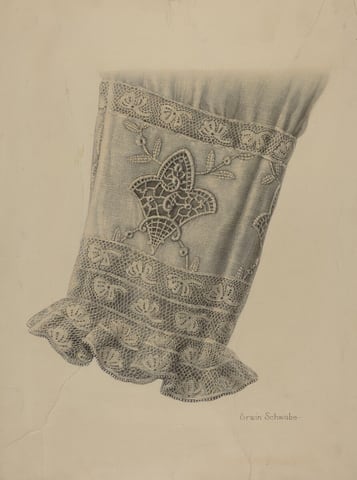
  4. The image shows a lace-trimmed sleeve with a floral lace design in the center, primarily in shades of gray and off-white. The sleeve is positioned vertically in the center of the image, with the top slightly obscured by shadow and the ruffled lace edge at the bottom. The lace details are intricate and precise, enhancing the texture and complexity of the design.
    Cuff LaceErwin Schwabe, c. 1937Courtesy National Gallery of Art, Washington

Section 2, north wall
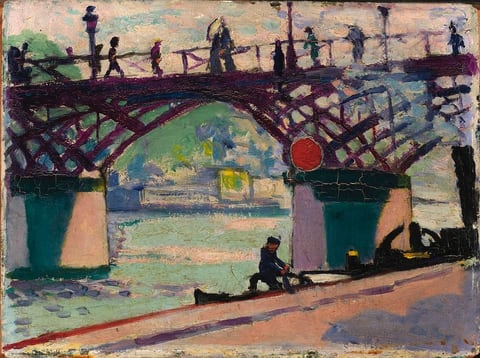
  1. Pont des Arts, by H. Lyman Saÿen, 1908-1911
    Pont des ArtsH. Lyman Saÿen, 1908-1911Courtesy of the Smithsonian American Art Museum
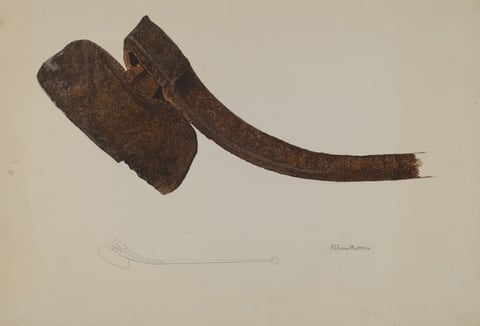
  2. The image shows a large, rusted ax with a curved brown handle placed diagonally across the canvas. The color palette consists of muted browns and beiges, highlighting the aged appearance of the ax. Beneath the ax, there is a faint outline sketch of a similar object, and the artist's signature is located to the right of the sketch. The ax is in the upper half of the image, while the sketch and signature are in the center-bottom section.
    Dumb IronAlfonso Moreno, c. 1938Courtesy National Gallery of Art, Washington
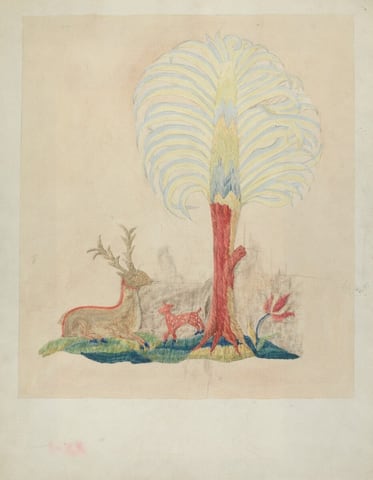
  3. This is a painting of two deer under a tree. The larger deer has antlers and is resting next to a smaller deer. They are depicted with red and brown strokes. The background shows a patch of earth and grass in green and blue. Beside the deer is a tree with colorful leaves or a feather-like structure and a red trunk. A pink flower is near the tree's base. The background is neutral. This painting is in the style of Henri Rousseau.
    Crewel EmbroideryHelen Dana, 1935/1942Courtesy National Gallery of Art, Washington

Section 3, north wall
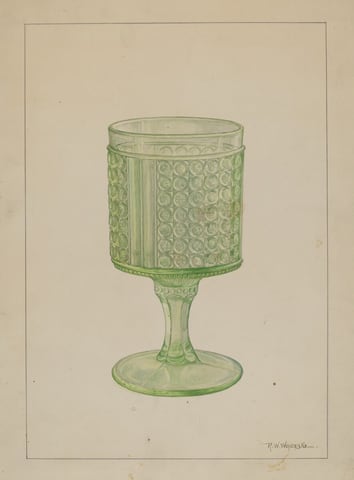
  1. The image shows a green glass goblet with a textured, bubble-like pattern on the cup and a smooth stem. The color palette consists of shades of green with varying tones, depending on the glass's thickness and pattern. The goblet is positioned centrally, seen straight-on with the cup's pattern visible across its surface. It rests on a flat surface, slightly above the center of the image.
    GobletRonau William Woiceske, 1935/1942Courtesy National Gallery of Art, Washington
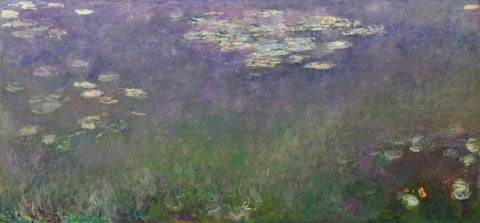
  2. Water Lilies (Agapanthus), by Claude Monet, c. 1915–26
    Water Lilies (Agapanthus)Claude Monet, c. 1915–26Courtesy of the Cleveland Museum of Art