Floor plan

Time and placeThe 20th century

The 20th century

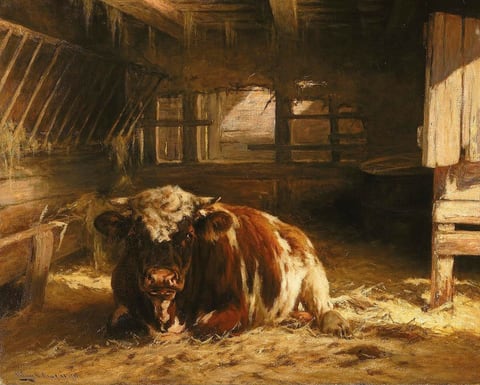
My Day at Home, by William H. Howe, 1906
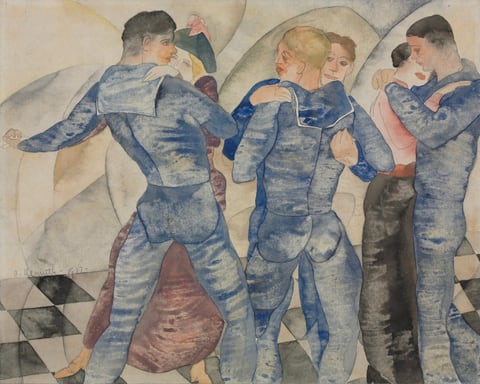
Dancing Sailors, by Charles Demuth, 1917
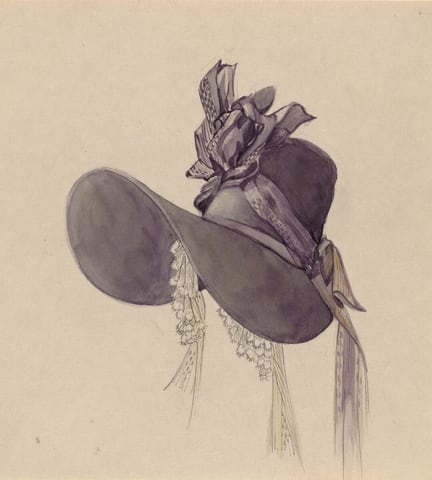
The image shows a large hat with a broad brim, decorated with a ribbon and floral or lace-like embellishments. The color palette consists of shades of gray and soft purples. The hat is centered in the frame, with its brim curving to the left and the decorative elements extending to the sides.
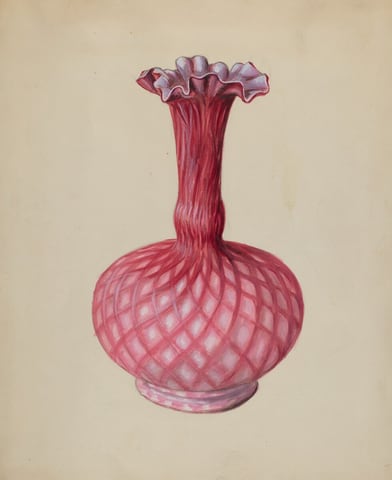
The image displays a single ornate vase with a bulbous base and a ruffled top, taking up most of the frame. The vase is predominantly pink with red accents, the ruffled top is highlighted with white on the inner edges, and there's a crisscross pattern visible on the body. Against a plain beige background, the vase is centrally positioned.
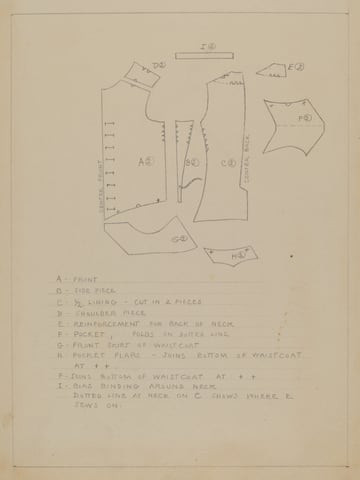
This is a drawing depicting instructional annotations on a pattern for tailoring or assembling clothing. The pattern includes various pieces labeled with letters and numbers corresponding to specific parts of a garment, like "FRONT," "SIDE BACK," and "COLLAR." The layout is precise and technical, resembling a guide for constructing a garment with detailed cutting and assembly instructions.
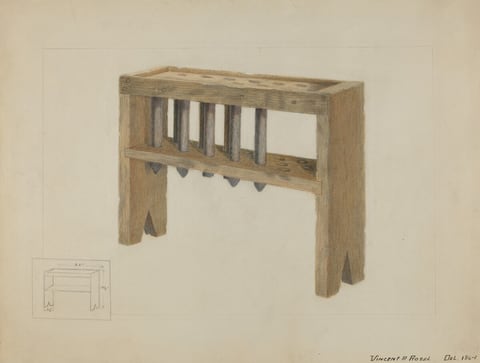
The image shows a wooden frame with six vertical cylindrical pegs evenly spaced. The color palette consists of light and medium brown tones. The structure is angled to the right with four visible legs. In the bottom left corner, there is a smaller sketched diagram with measurements.
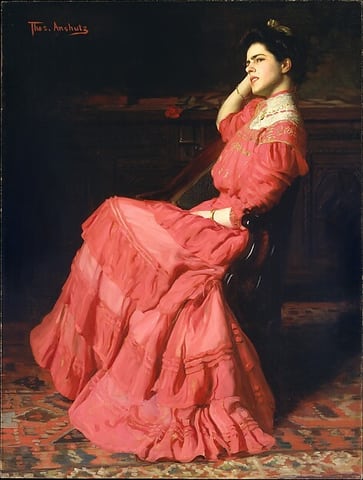
A Rose, by Thomas Anshutz, 1907

The works in this room are listed below.

Works in this room

Works made in the 20th century, anywhere in the world.

Section 1, north wall

  1. My Day at Home, by William H. Howe, 1906
    My Day at HomeWilliam H. Howe, 1906Courtesy of the Smithsonian American Art Museum
  2. Dancing Sailors, by Charles Demuth, 1917
    Dancing SailorsCharles Demuth, 1917Courtesy of the Cleveland Museum of Art
  3. The image shows a large hat with a broad brim, decorated with a ribbon and floral or lace-like embellishments. The color palette consists of shades of gray and soft purples. The hat is centered in the frame, with its brim curving to the left and the decorative elements extending to the sides.
    BonnetRosalia Lane, 1935/1942Courtesy National Gallery of Art, Washington
  4. The image displays a single ornate vase with a bulbous base and a ruffled top, taking up most of the frame. The vase is predominantly pink with red accents, the ruffled top is highlighted with white on the inner edges, and there's a crisscross pattern visible on the body. Against a plain beige background, the vase is centrally positioned.
    Ornamental Ruby VaseRobert Stewart, c. 1936Courtesy National Gallery of Art, Washington

Section 1, south wall

  1. This is a drawing depicting instructional annotations on a pattern for tailoring or assembling clothing. The pattern includes various pieces labeled with letters and numbers corresponding to specific parts of a garment, like "FRONT," "SIDE BACK," and "COLLAR." The layout is precise and technical, resembling a guide for constructing a garment with detailed cutting and assembly instructions.
    Waistcoat PatternRosalia Lane, c. 1936Courtesy National Gallery of Art, Washington
  2. The image shows a wooden frame with six vertical cylindrical pegs evenly spaced. The color palette consists of light and medium brown tones. The structure is angled to the right with four visible legs. In the bottom left corner, there is a smaller sketched diagram with measurements.
    Candle MoldVincent P. Rosel, c. 1936Courtesy National Gallery of Art, Washington
  3. A Rose, by Thomas Anshutz, 1907
    A RoseThomas Anshutz, 1907Courtesy of The Metropolitan Museum of Art

Section 2, south wall
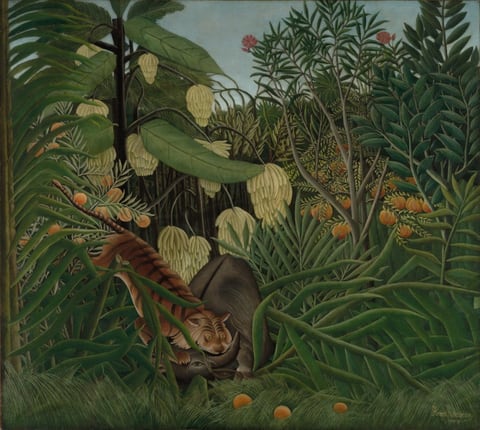
  1. Fight Between a Tiger and a Buffalo, by Henri Rousseau, 1908
    Fight Between a Tiger and a BuffaloHenri Rousseau, 1908Courtesy of the Cleveland Museum of Art
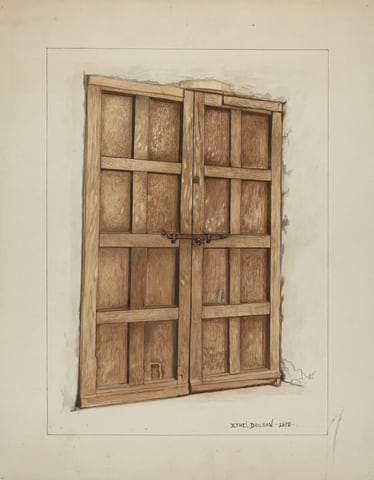
  2. This is a drawing of a wooden window shutter in a light-colored wall. The detailed study shows the craftsmanship of the shutter, with a focus on texture, form, wood grain, and panels. The aged and weathered texture suggests exposure to the elements. The shutter is secured with a metal latch in the center. The wall is subtly shaded to imply depth and setting, with slight distress marks adding to the aged ambiance of the scene.
    Sacristy Door at Mission San Juan BautistaEthel Dougan, 1938Courtesy National Gallery of Art, Washington

Section 2, north wall
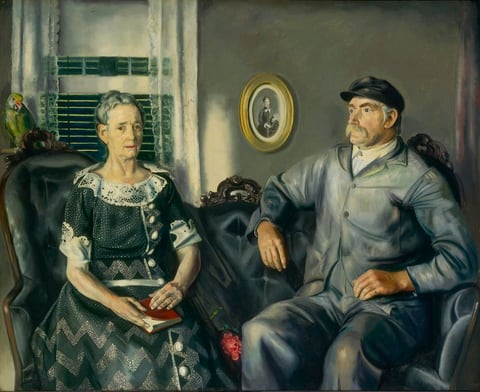
  1. Mr. and Mrs. Phillip Wase, by George Bellows, 1924
    Mr. and Mrs. Phillip WaseGeorge Bellows, 1924Courtesy of the Smithsonian American Art Museum
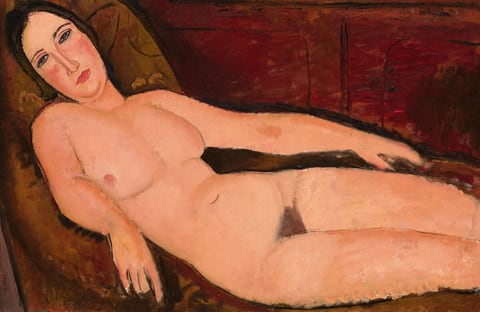
  2. A nude woman lying across a brown divan in front of a russet-red wall is loosely painted with areas of mottled color in this horizontal composition. The woman fills the wide canvas so her head is angled into the upper left corner, and her legs extend off the right edge of the composition below the knees. Her long, oval face rests back against the couch, and she looks at us with slitted, almond-shaped eyes under dark, shallowly arched brows. She has a long, straight nose, flushed cheeks, a double chin, and her pink lips are closed. Her breasts fall to each side so we only see the pink nipple closer to us. She has a rounded belly and a triangle of brown hair at her groin. Her arms rest alongside her body. The couch has a low, upholstered arms sweeping down the sides. Black lines in the red wall behind the couch suggest molding or cabinetry. The artist signed the painting in the upper right corner, “modigliani.”
    Nude on a DivanAmedeo Modigliani, 1918Courtesy National Gallery of Art, Washington
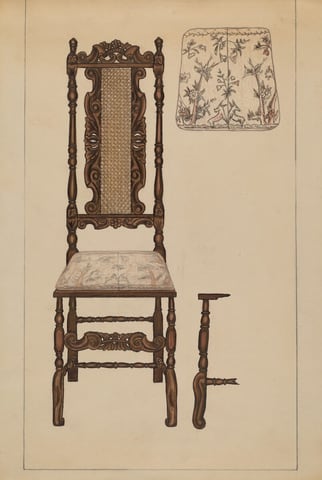
  3. This is a drawing of a wooden chair with detailed upholstery. The chair has an ornate, high backrest with elaborate scrollwork and a woven central panel. The seat is cushioned and covered with a floral patterned fabric. There is also a separate drawing of the fabric pattern used on the seat and a sketch of one of the chair's legs to show the craftsmanship and decorative elements.
    Side ChairUnrecorded American maker, 1935/1942Courtesy National Gallery of Art, Washington

Section 3, north wall
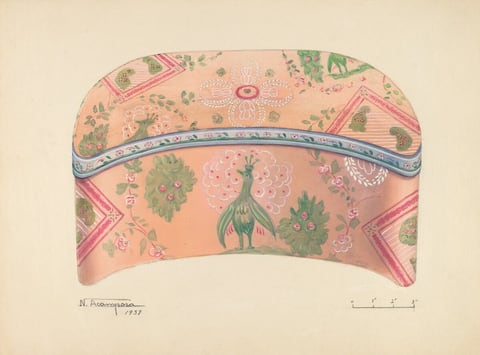
  1. The image shows a decorative curved object with intricate patterns. There is a large green peacock motif in the center, surrounded by floral and geometric patterns. The color palette includes soft pinks, greens, and blue accents outlining the curve of the object. The object is placed on a plain light background.
    BandboxNicholas Acampora, 1937Courtesy National Gallery of Art, Washington
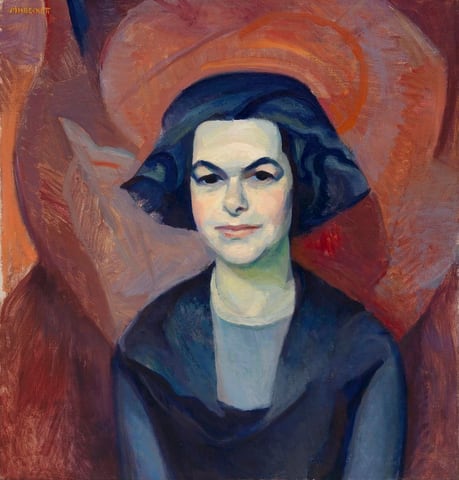
  2. Artist: Marion H. Beckett, Sitter: Theresa Helburn, Current owner: National Portrait Gallery, Smithsonian Institution
    Theresa HelburnMarion H. Beckett, 1922Courtesy of the National Portrait Gallery, Smithsonian Institution
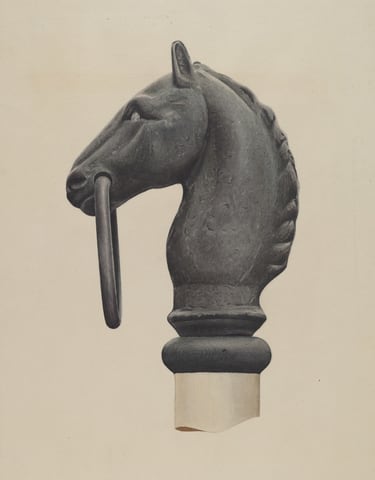
  3. The sculpture is a depiction of a horse's head crafted from a dark material that appears to be metal. The horse's ears are perked up, and its mane is depicted with smooth, curving lines trailing down the back of the neck. The sculpture includes a ring that extends from the horse's mouth. Positioned on a simple cylindrical pedestal, the sculpture's material and design suggest a robust and timeless feel. The details of the horse's expression and mane are rendered with a smooth finish.
    Hitching PostAlbert Ryder, c. 1938Courtesy National Gallery of Art, Washington
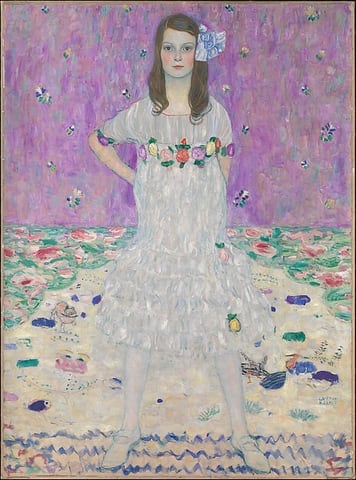
  4. Mäda Primavesi (1903–2000), by Gustav Klimt, 1912–13
    Mäda Primavesi (1903–2000)Gustav Klimt, 1912–13Courtesy of The Metropolitan Museum of Art