Floor plan

Time and placeThe 20th century

The 20th century

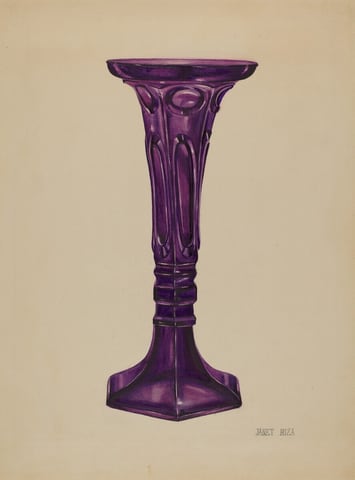
The image shows a tall, intricately designed purple candlestick against a light beige background. The overall color palette is dominated by shades of purple. The candlestick is centrally positioned and stands upright with detailed patterns visible.
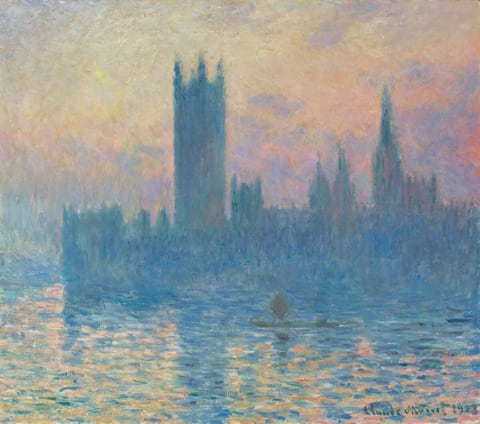
A row of spire-like structures of different heights is silhouetted in azure blue against a soft pink, yellow, peach, and lavender-purple sunset and reflected in a rippling river in this nearly square landscape painting. Along the horizon, the buildings stretch from our right, almost fully across the canvas, and are painted with vertical brushstrokes in cool shades of blue. The sky behind the towers seems hazy with intermingling, pastel-colored clouds. The buildings are reflected in the river, which fills the bottom third of the painting. The surface of the water is painted with short, horizontal brushstrokes in azure blue for the buildings, and apricot, rose, and marigold orange for the sky’s reflection. A streak and smudge of olive-green paint on the water represents a person in a boat near the center of the painting. The artist signed and dated the work in the same olive color at the lower right: “Claude Monet 1903.”
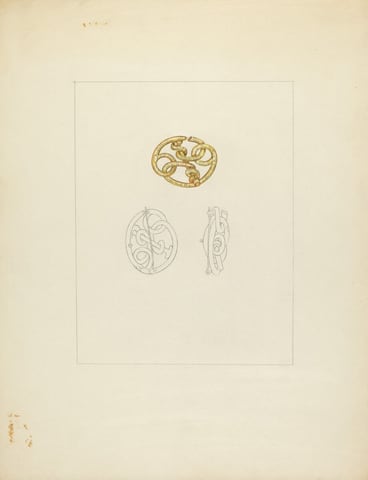
This is a drawing of decorative motifs. The image shows three distinct designs with ornate, swirling patterns. The uppermost design is in gold color. Two additional designs are sketched below in a lighter tone, likely pencil. The use of line and form emphasizes intricate looping patterns that suggest inspiration from natural forms such as vines or waves. The composition is against a plain background, drawing attention to the details and shapes of the motifs, presenting a sense of simplicity and artistry.
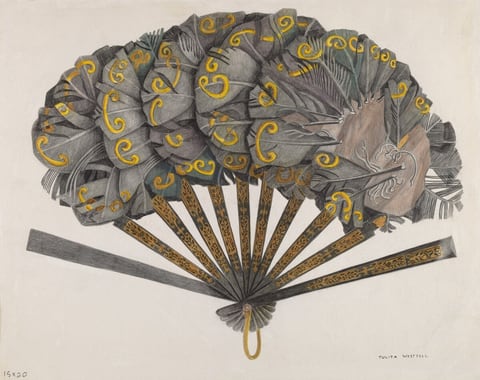
The image shows a large fan with intricate feather-like segments adorned with yellow patterns and a bird depiction. The color palette is grey with hints of yellow, brown, and metallic sheen on the ribs. The fan is positioned upright with the handle at the bottom center, and the feathers extend outward in a semi-circular shape.
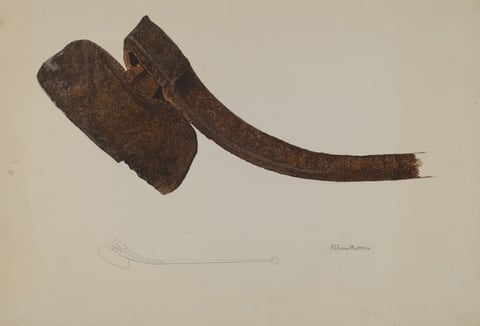
The image shows a large, rusted ax with a curved brown handle placed diagonally across the canvas. The color palette consists of muted browns and beiges, highlighting the aged appearance of the ax. Beneath the ax, there is a faint outline sketch of a similar object, and the artist's signature is located to the right of the sketch. The ax is in the upper half of the image, while the sketch and signature are in the center-bottom section.
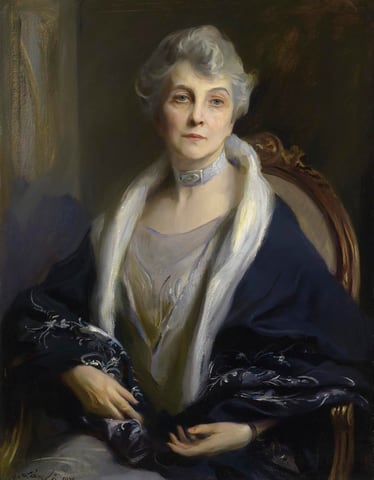
Artist: Philip Alexius de László, Sitter: Clara Margaret Cook Kellogg, Current owner: National Portrait Gallery, Smithsonian Institution
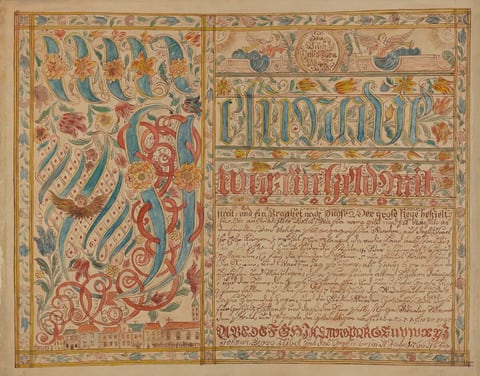
This is a painting of an intricate and colorful illuminated manuscript page. The full-description includes a richly decorated page featuring elaborate calligraphy and floral motifs. The left side showcases swirling ornamental patterns with vibrant colors - blues, reds, and golds - interwoven with blooming flowers and a small figure with wings. In the lower portion, there is a depiction of small buildings. The right side contains text in different styles, with the top section written in large decorative letters and the lower section in a more detailed script. The overall design is bordered with floral elements and intertwining vines. This is in the style of illuminated manuscripts found in historical European documents and books.
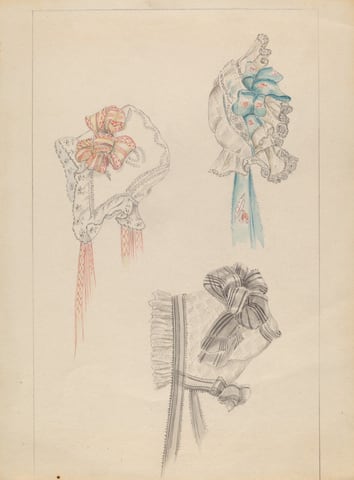
This is a drawing of three decorative bonnets. The drawing features three different hat designs, each embellished with lace, ribbon, and bow details. The upper left bonnet is adorned with pink hues and intricate lace, displaying a floral-like bow. The top right bonnet showcases a turquoise ribbon and bow, surrounded by soft lace. The lower bonnet is in grayscale, with shadowing for dimension, featuring a checkered ribbon. Each hat is detailed with line work and shading, conveying elegance.

The works in this room are listed below.

Works in this room

Works made in the 20th century, anywhere in the world.

Section 1, north wall

  1. The image shows a tall, intricately designed purple candlestick against a light beige background. The overall color palette is dominated by shades of purple. The candlestick is centrally positioned and stands upright with detailed patterns visible.
    VaseJanet Riza, c. 1937Courtesy National Gallery of Art, Washington
  2. A row of spire-like structures of different heights is silhouetted in azure blue against a soft pink, yellow, peach, and lavender-purple sunset and reflected in a rippling river in this nearly square landscape painting. Along the horizon, the buildings stretch from our right, almost fully across the canvas, and are painted with vertical brushstrokes in cool shades of blue. The sky behind the towers seems hazy with intermingling, pastel-colored clouds. The buildings are reflected in the river, which fills the bottom third of the painting. The surface of the water is painted with short, horizontal brushstrokes in azure blue for the buildings, and apricot, rose, and marigold orange for the sky’s reflection. A streak and smudge of olive-green paint on the water represents a person in a boat near the center of the painting. The artist signed and dated the work in the same olive color at the lower right: “Claude Monet 1903.”
    The Houses of Parliament, SunsetClaude Monet, 1903Courtesy National Gallery of Art, Washington
  3. This is a drawing of decorative motifs. The image shows three distinct designs with ornate, swirling patterns. The uppermost design is in gold color. Two additional designs are sketched below in a lighter tone, likely pencil. The use of line and form emphasizes intricate looping patterns that suggest inspiration from natural forms such as vines or waves. The composition is against a plain background, drawing attention to the details and shapes of the motifs, presenting a sense of simplicity and artistry.
    Gold BroochIsidore Steinberg, c. 1940Courtesy National Gallery of Art, Washington
  4. The image shows a large fan with intricate feather-like segments adorned with yellow patterns and a bird depiction. The color palette is grey with hints of yellow, brown, and metallic sheen on the ribs. The fan is positioned upright with the handle at the bottom center, and the feathers extend outward in a semi-circular shape.
    Feather FanTulita Westfall, c. 1937Courtesy National Gallery of Art, Washington

Section 1, south wall

  1. The image shows a large, rusted ax with a curved brown handle placed diagonally across the canvas. The color palette consists of muted browns and beiges, highlighting the aged appearance of the ax. Beneath the ax, there is a faint outline sketch of a similar object, and the artist's signature is located to the right of the sketch. The ax is in the upper half of the image, while the sketch and signature are in the center-bottom section.
    Dumb IronAlfonso Moreno, c. 1938Courtesy National Gallery of Art, Washington
  2. Artist: Philip Alexius de László, Sitter: Clara Margaret Cook Kellogg, Current owner: National Portrait Gallery, Smithsonian Institution
    Clara Cook KelloggPhilip Alexius de László, 1929Courtesy of the National Portrait Gallery, Smithsonian Institution
  3. This is a painting of an intricate and colorful illuminated manuscript page. The full-description includes a richly decorated page featuring elaborate calligraphy and floral motifs. The left side showcases swirling ornamental patterns with vibrant colors - blues, reds, and golds - interwoven with blooming flowers and a small figure with wings. In the lower portion, there is a depiction of small buildings. The right side contains text in different styles, with the top section written in large decorative letters and the lower section in a more detailed script. The overall design is bordered with floral elements and intertwining vines. This is in the style of illuminated manuscripts found in historical European documents and books.
    FrakturAlbert Levone, 1935/1942Courtesy National Gallery of Art, Washington
  4. This is a drawing of three decorative bonnets. The drawing features three different hat designs, each embellished with lace, ribbon, and bow details. The upper left bonnet is adorned with pink hues and intricate lace, displaying a floral-like bow. The top right bonnet showcases a turquoise ribbon and bow, surrounded by soft lace. The lower bonnet is in grayscale, with shadowing for dimension, featuring a checkered ribbon. Each hat is detailed with line work and shading, conveying elegance.
    CapsUnrecorded American maker, 1935/1942Courtesy National Gallery of Art, Washington

Section 2, south wall
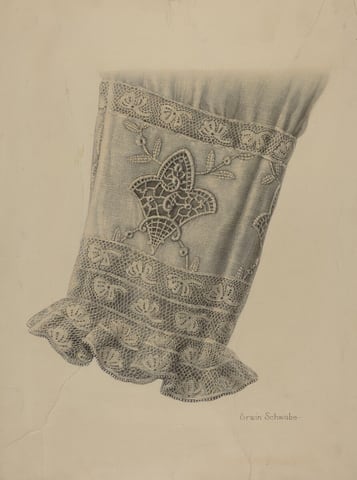
  1. The image shows a lace-trimmed sleeve with a floral lace design in the center, primarily in shades of gray and off-white. The sleeve is positioned vertically in the center of the image, with the top slightly obscured by shadow and the ruffled lace edge at the bottom. The lace details are intricate and precise, enhancing the texture and complexity of the design.
    Cuff LaceErwin Schwabe, c. 1937Courtesy National Gallery of Art, Washington
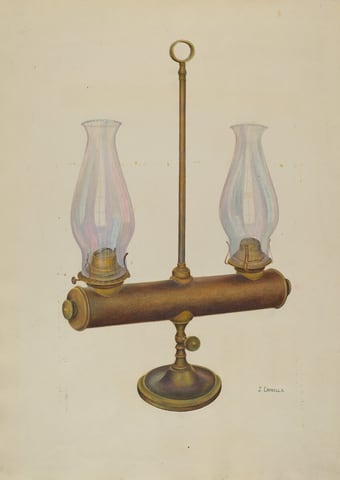
  2. The image shows an antique double kerosene lamp with ornate glass chimneys set atop a horizontal cylindrical base with a central vertical support ending in a circular handle. The base and lamp parts have a bronze-like color with a textured appearance, and the glass chimneys are primarily clear but show hints of colorful reflections. Positioned centrally in the image, the lamp stands upright with the two chimneys equally spaced on either side of the vertical support, which is topped by a circular loop handle, while the signature "J. Cannella" is visible towards the lower right side of the image.
    Reading LampJoseph Cannella, 1941Courtesy National Gallery of Art, Washington
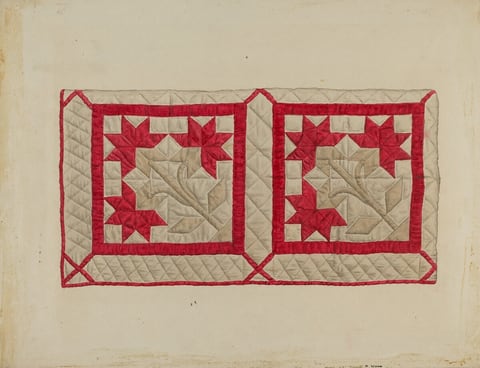
  3. The image shows two large quilt blocks with a matching design, side by side. Each block consists of red and beige fabric with quilted stitching creating a textured appearance. The color palette includes primarily red, beige, and dark stitching outlining the patterns. The quilt blocks are placed centrally on a light-colored surface.
    Patchwork QuiltPaul Ward, c. 1936Courtesy National Gallery of Art, Washington
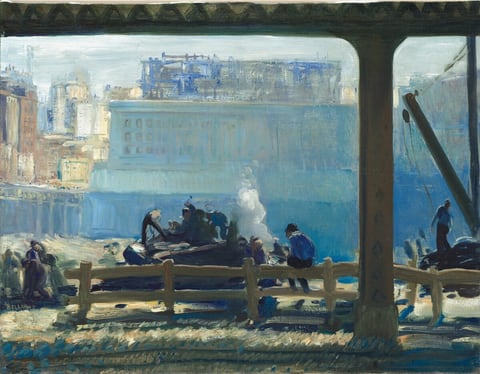
  4. From under an elevated train track, we look at a cluster of people hammering and working on the far side of a wooden fence, all against a silvery-blue building that fills most of the background in this horizontal painting. The scene is loosely painted mostly in tones of hazy and saturated blues, so many of the details are indistinct. About a quarter of the way in from the right edge of the composition, a thin iron column holds up the train platform. The column nearly spans the height of the painting, and the track it supports runs across the top edge of the canvas. At the foot of the column, along the bottom edge, are two parallel tracks embedded in an area otherwise painted with short, diagonal strokes in topaz blue, olive green, and straw yellow. Just beyond the tracks, the split-rail wooden fence runs across most of the painting, though there is an opening at the left edge of the canvas. A man sits with his back to us on the railing to our right of center. He wears a dark cap, a lapis-blue shirt, and navy-blue pants. Several men work on or near a mound-shaped form, perhaps a piece of machinery, just beyond the fence, near the center of the painting. One man holds a hammer high overhead while another reaches down or strikes the mound with his feet planted wide. More people work together to our left, and a man to our right stands near a crane. The people and these areas are painted with broad strokes and touches of cobalt blue, charcoal gray, khaki brown, and a few swipes of shell pink and bright white. A puff of white smoke billows up behind the central group, before the land drops precipitously away. The chasm is painted with shimmering tones of aquamarine and cerulean blue. A sky-blue, rectangular building perches at the far edge. A few windows are outlined in royal blue to our left but the rest of the building is loosely painted with long, vertical strokes so no architectural details can be made out. Behind this structure are more city buildings, suggested with strokes of muted rust red, parchment and bright white, and cobalt blue. The ice-blue sky fills the band between the top of the buildings and the train track running overhead. The artist signed his name near the lower left corner, “BELLOWS.”
    Blue MorningGeorge Bellows, 1909Courtesy National Gallery of Art, Washington

Section 2, north wall
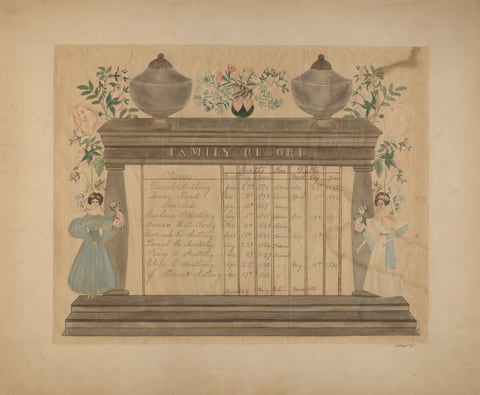
  1. This is a drawing of a decorative family record. The central feature is a structure resembling a classical monument or altar labeled "FAMILY RECORD" at the top. The structure has columns and a pediment with names and dates. Flanking the list are two figures holding flowers, dressed in long gowns of blue and white. Above the structure are two large urns and a floral arrangement with pink flowers and green foliage. The background is a soft, neutral color. Green leaves and small flowers further embellish the scene.
    Family Record of Susan B. AnthonyJohn Wilkes, c. 1937Courtesy National Gallery of Art, Washington
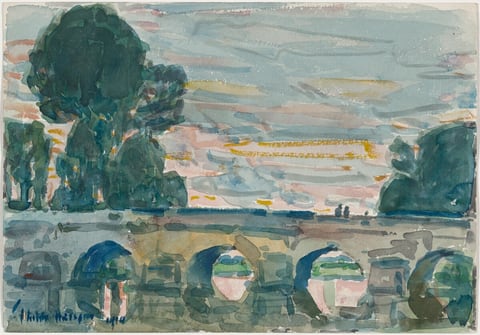
  2. The Bridge at Grez [recto], by Childe Hassam, 1904
    The Bridge at Grez [recto]Childe Hassam, 1904Courtesy National Gallery of Art, Washington
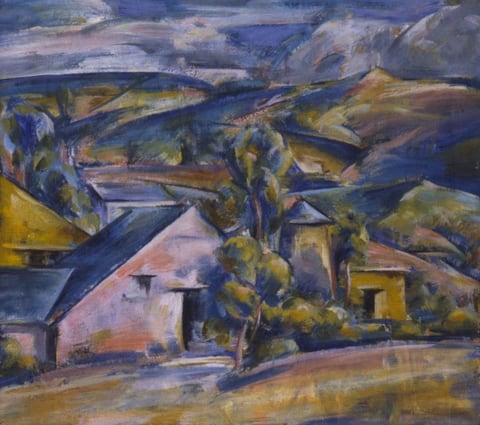
  3. The Hills, by Preston Dickinson, ca. 1919
    The HillsPreston Dickinson, ca. 1919Courtesy of the Smithsonian American Art Museum
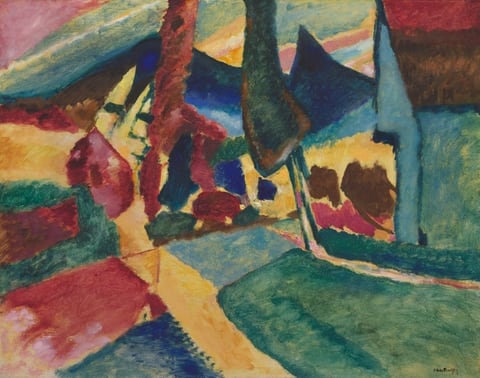
  4. Vibrant yellow, red, blue, and green painting of landscape with trees and mountains.
    Landscape with Two PoplarsVasily Kandinsky, 1912Courtesy of the Art Institute of Chicago