Floor plan

Time and placeThe 19th century

The 19th century

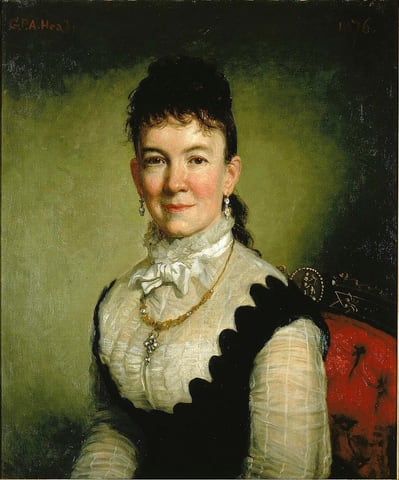
Mrs. Albert J. Myer (Catherine Walden), by George Peter Alexander Healy, 1876
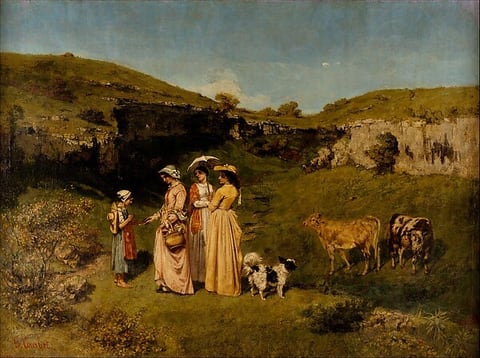
Young Ladies of the Village, by Gustave Courbet, 1851–52
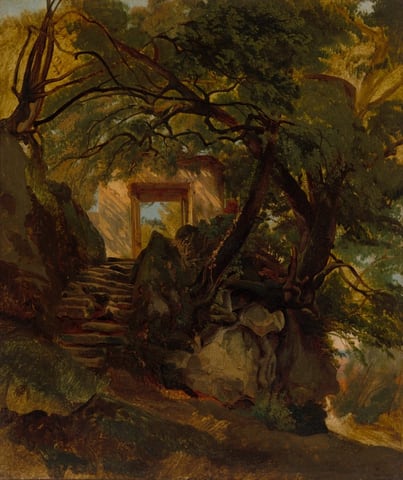
A work made of oil on paper, laid on canvas.
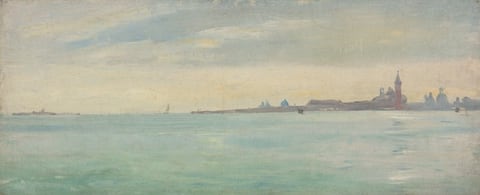
A work made of oil on paper, mounted on canvas.
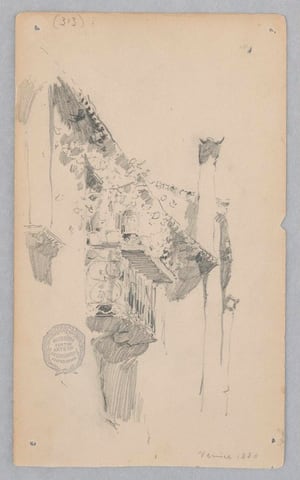
BALCONY
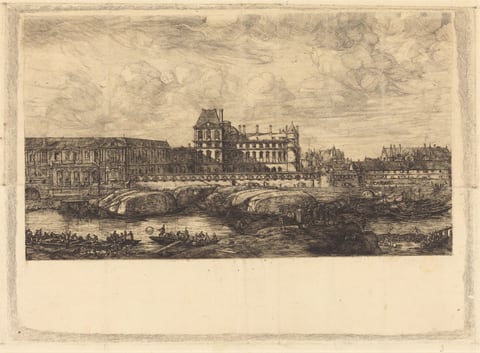
The image features a riverside scene with a large building in the center and smaller structures in the background. The sky is filled with clouds, and there are boats on the water. The artwork is done in an etching style, with detailed lines showing architectural elements, boats, and water ripples. The color scheme is monochromatic in shades of brown and black.
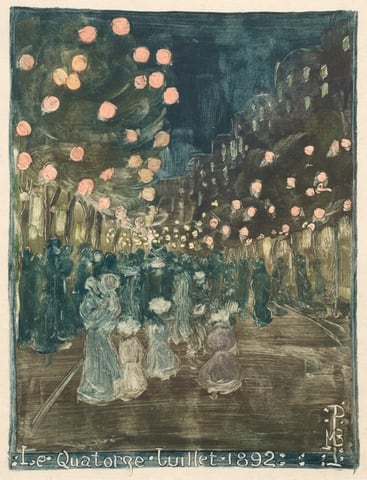
Bastille Day, by Maurice Prendergast, 1892

The works in this room are listed below.

Works in this room

Works made in the 19th century, anywhere in the world.

Section 1, north wall

  1. Mrs. Albert J. Myer (Catherine Walden), by George Peter Alexander Healy, 1876
    Mrs. Albert J. Myer (Catherine Walden)George Peter Alexander Healy, 1876Courtesy of the Smithsonian American Art Museum
  2. Young Ladies of the Village, by Gustave Courbet, 1851–52
    Young Ladies of the VillageGustave Courbet, 1851–52Courtesy of The Metropolitan Museum of Art
  3. A work made of oil on paper, laid on canvas.
    Staircase in the Park of Villa Chigi di AricciaAlexandre Calame, 1844–1845Courtesy of the Art Institute of Chicago

Section 1, south wall

  1. A work made of oil on paper, mounted on canvas.
    Venice Seen from the Public GardenJean Jules Antoine Lecomte du Noüy, 1873Courtesy of the Art Institute of Chicago
  2. BALCONY
    BalconyRobert Frederick Blum, 1880Courtesy of Cooper Hewitt, Smithsonian Design Museum
  3. The image features a riverside scene with a large building in the center and smaller structures in the background. The sky is filled with clouds, and there are boats on the water. The artwork is done in an etching style, with detailed lines showing architectural elements, boats, and water ripples. The color scheme is monochromatic in shades of brown and black.
    L'ancien Louvre d'après une peinture de Zeeman, 1651 (The Old Louvre, from a Painting by Zeeman, l651)Charles Meryon, 1866Courtesy National Gallery of Art, Washington
  4. Bastille Day, by Maurice Prendergast, 1892
    Bastille DayMaurice Prendergast, 1892Courtesy of the Cleveland Museum of Art

Section 2, south wall
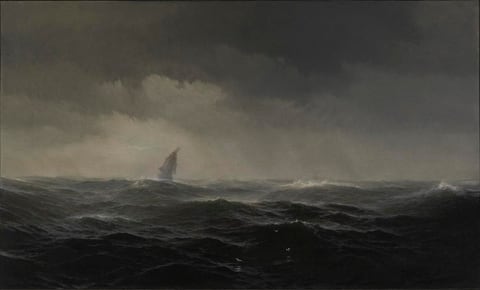
  1. The Sea, by Edward Moran, 1870
    The SeaEdward Moran, 1870Courtesy of the Smithsonian American Art Museum
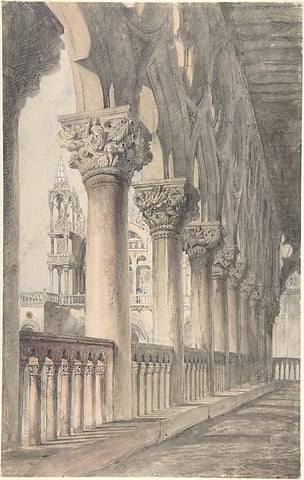
  2. Loggia of the Ducal Palace, Venice, by John Ruskin, 1849–50
    Loggia of the Ducal Palace, VeniceJohn Ruskin, 1849–50Courtesy of The Metropolitan Museum of Art
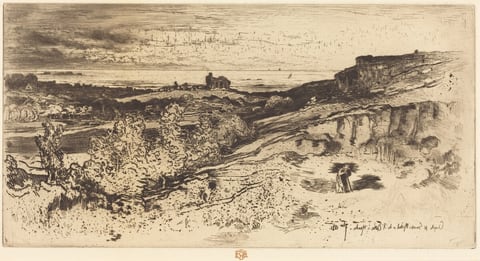
  3. The image shows an elevated view of a landscape with detailed line work in warm sepia tones. The horizon is located near the top, with a cluster of structures visible in the distance. Close to us, there is textured shrubbery, and the ground is marked with dots and lines. Rolling hills and flat areas lead towards the horizon, where the sky is depicted with horizontal lines and hatchings.
    La Chapelle Saint-Michel à l'EstreFélix-Hilaire BuhotCourtesy National Gallery of Art, Washington
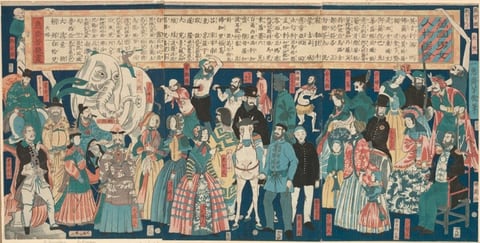
  4. A work made of color woodblock print; oban triptych.
    Picture of Men and Women from Many Countries (Bankoku danjo jinbutsu zue)Utagawa Yoshiiku, 1861Courtesy of the Art Institute of Chicago

Section 2, north wall
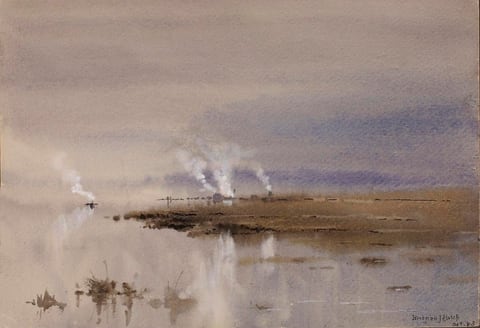
  1. Sketch on the Potomac, by Lorenzo J. Hatch, 1883
    Sketch on the PotomacLorenzo J. Hatch, 1883Courtesy of the Smithsonian American Art Museum
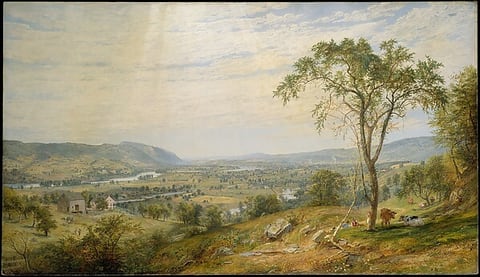
  2. The Valley of Wyoming, by Jasper Francis Cropsey, 1865
    The Valley of WyomingJasper Francis Cropsey, 1865Courtesy of The Metropolitan Museum of Art
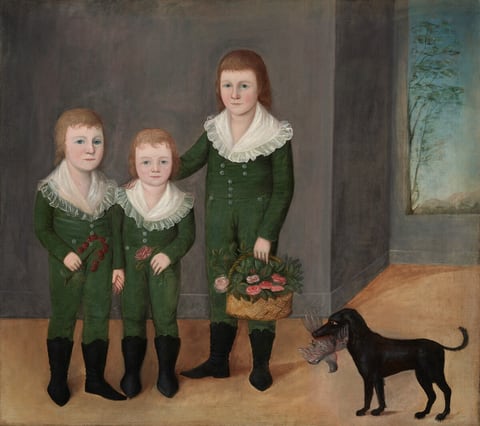
  3. Three pale-skinned, blue-eyed children wearing green suits stand in a row facing us in this horizontal portrait painting. They all have round faces and full, pink cheeks. The tallest child is to the right, and he has shoulder-length cinnamon-brown hair. The other two come up to his shoulder and have blond hair. The tallest puts one arm on the far shoulder of the middle child, and the two smaller children hold hands. Each wears a pine-green, one-piece outfit with pewter-gray buttons, a wide, ivory-white collar lined with ruffles, and black, shin-high boots. The boy on our left holds a branch of dark red cherries. The middle child holds a pink rose, and the tallest a basket filled with pink roses. A black dog holding a gray and mauve-pink bird in its mouth stands in profile facing our left in the lower right corner of the canvas. The room around them has a tan-colored floor and gray walls. The room opens onto an alcove to our right with a rectangular window. A slender tree is along the left edge of the opening and a few pale, pink-tinged gray mountains line the bottom edge. Clear blue sky fills the rest of the window.
    The Westwood ChildrenJoshua Johnson, c. 1807Courtesy National Gallery of Art, Washington

Section 3, north wall
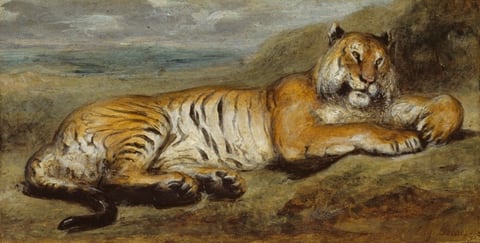
  1. A boldly painted orange tiger lies on brown, rocky ground, his body nearly filling the canvas, blue water and gray sky in the background.
    Tiger RestingPierre Andrieu, c. 1845Courtesy of the Art Institute of Chicago
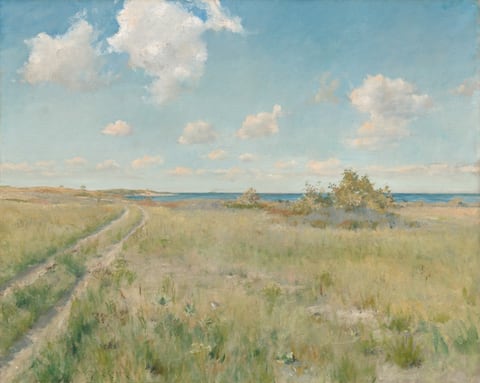
  2. The Old Road to the Sea, by William Merritt Chase, c. 1893
    The Old Road to the SeaWilliam Merritt Chase, c. 1893Courtesy of the Cleveland Museum of Art