Floor plan

Time and place19th-century United States
19th-century United States
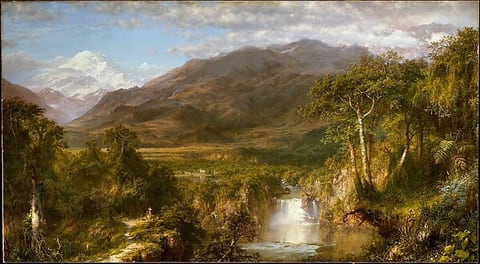
Heart of the Andes, by Frederic Edwin Church, 1859
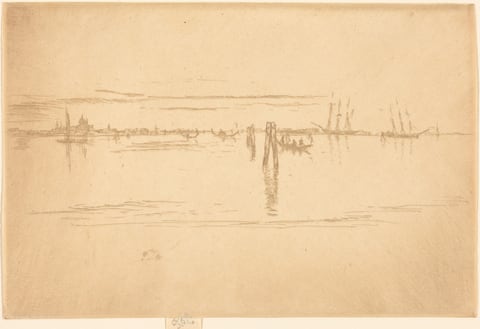
The image shows a landscape with a waterscape. The horizon separates the water and the sky. In the distance, there are buildings, structures, and ships with tall masts. Close to us, there are reflections of the ships and structures in the water with fine brushstrokes. The style is impressionistic with thin lines conveying details. The color palette is monochromatic with sepia tones.
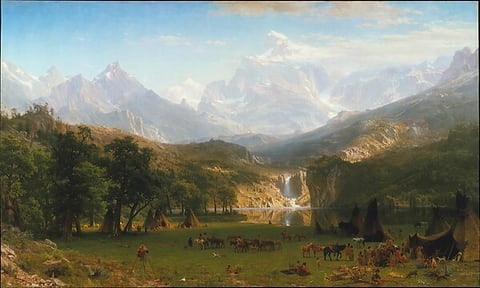
The Rocky Mountains, Lander's Peak, by Albert Bierstadt, 1863
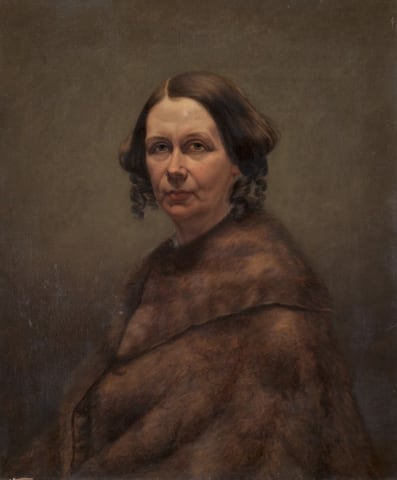
Mrs. Goss (The Woman in Fur), by Caroline L. Ransom, c. 1850s
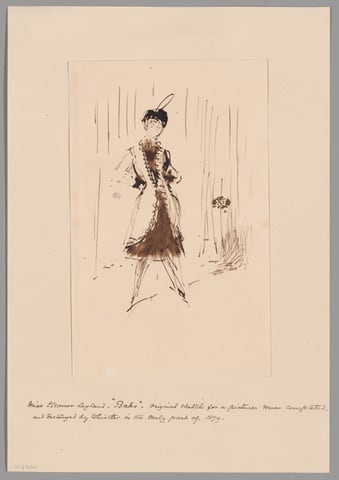
A work made of pen and brown ink, with brush and brown ink, on cream pseudo-laid paper tipped onto cream wove paper.

The works in this room are listed below.

Works in this room

Works made in the United States in the 19th century.

Section 1, north wall

  1. Heart of the Andes, by Frederic Edwin Church, 1859
    Heart of the AndesFrederic Edwin Church, 1859Courtesy of The Metropolitan Museum of Art
  2. The image shows a landscape with a waterscape. The horizon separates the water and the sky. In the distance, there are buildings, structures, and ships with tall masts. Close to us, there are reflections of the ships and structures in the water with fine brushstrokes. The style is impressionistic with thin lines conveying details. The color palette is monochromatic with sepia tones.
    Long LagoonJames McNeill Whistler, 1880Courtesy National Gallery of Art, Washington

Section 1, south wall

  1. The Rocky Mountains, Lander's Peak, by Albert Bierstadt, 1863
    The Rocky Mountains, Lander's PeakAlbert Bierstadt, 1863Courtesy of The Metropolitan Museum of Art
  2. Mrs. Goss (The Woman in Fur), by Caroline L. Ransom, c. 1850s
    Mrs. Goss (The Woman in Fur)Caroline L. Ransom, c. 1850sCourtesy of the Cleveland Museum of Art
  3. A work made of pen and brown ink, with brush and brown ink, on cream pseudo-laid paper tipped onto cream wove paper.
    Study for "The Blue Girl: Portrait of Miss Elinor Leyland"James McNeill Whistler, c. 1879Courtesy of the Art Institute of Chicago

Section 2, south wall
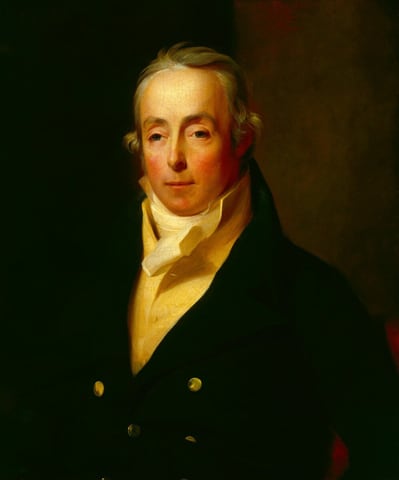
  1. This painting is a portrait of a man from the waist up. He is facing us, with pale skin, thin lips, rosy cheeks, light green eyes, and gray hair styled into curls around his ears. He has a neutral expression. The man is wearing a dark coat with gold buttons on the front, with a pale-yellow shirt underneath and a white cravat around his neck. The background is a dark and indistinct brown color.
    Abraham KintzingThomas Sully, 1815Courtesy National Gallery of Art, Washington
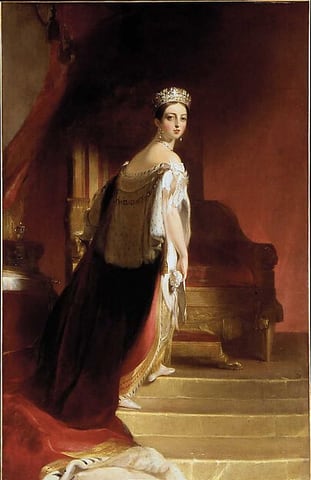
  2. Queen Victoria, by Thomas Sully, 1838
    Queen VictoriaThomas Sully, 1838Courtesy of The Metropolitan Museum of Art
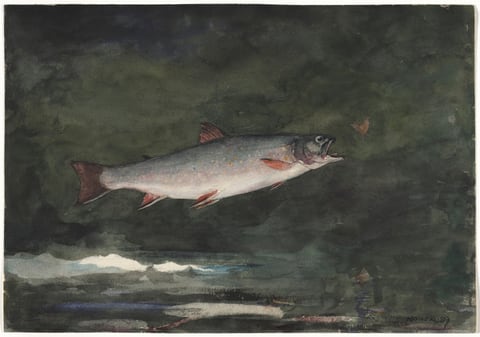
  3. Leaping Trout, by Winslow Homer, 1889
    Leaping TroutWinslow Homer, 1889Courtesy of the Cleveland Museum of Art

Section 2, north wall
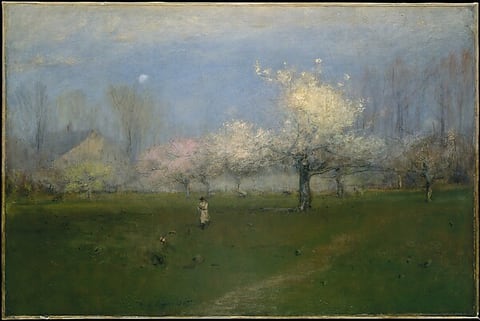
  1. Spring Blossoms, Montclair, New Jersey, by George Inness, ca. 1891
    Spring Blossoms, Montclair, New JerseyGeorge Inness, ca. 1891Courtesy of The Metropolitan Museum of Art
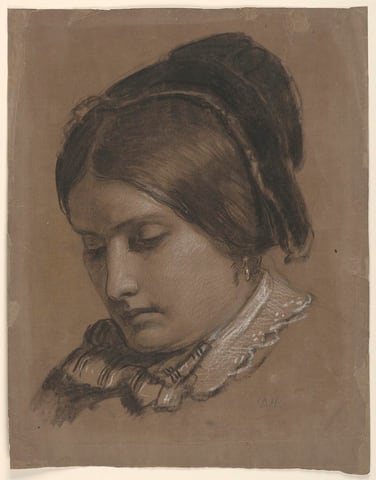
  2. THE ARTIST'S WIFE SOPHIE
    The Artist's Wife SophieDaniel Huntington, 1853Courtesy of Cooper Hewitt, Smithsonian Design Museum
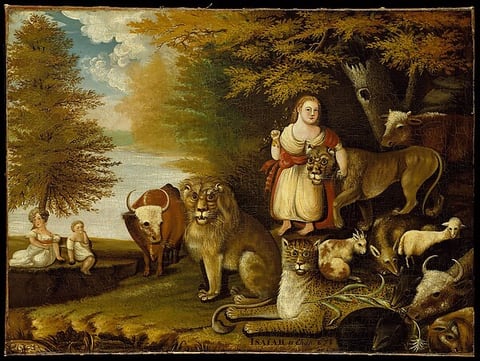
  3. Peaceable Kingdom, by Edward Hicks, ca. 1830–32
    Peaceable KingdomEdward Hicks, ca. 1830–32Courtesy of The Metropolitan Museum of Art

Section 3, north wall
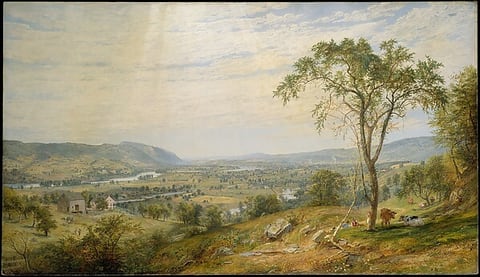
  1. The Valley of Wyoming, by Jasper Francis Cropsey, 1865
    The Valley of WyomingJasper Francis Cropsey, 1865Courtesy of The Metropolitan Museum of Art
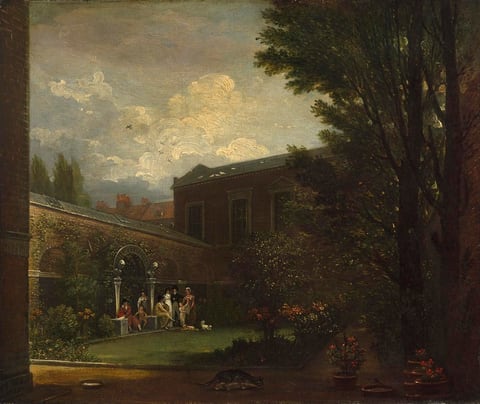
  2. Artist: Benjamin West, Sitter: Benjamin West, Current owner: National Portrait Gallery, Smithsonian Institution
    West Family in the Studio GardenBenjamin West, 1808-09Courtesy of the National Portrait Gallery, Smithsonian Institution
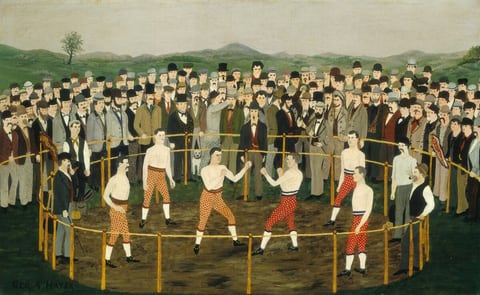
  3. This is a painting depicting a bare-knuckle boxing match with two fighters in a ring surrounded by a crowd. Both fighters are men with light skin, and they wear no shirts. The fighter on the left wears orange pants with black dots, while the fighter on the right wears red pants with white dots. Behind these men are two other shirtless men wearing the same types of pants, as well as two other men wearing more formal attire, including jackets, vests, and hats. Outside the ring, a semi-circle of light-skinned men in formal attire watch the central fight. The setting is outdoors, with grass around the feet of the spectators and green hills in the background. Above the group, the sky is light gray.
    Bare KnucklesGeorge A. Hayes, c. 1870/1885Courtesy National Gallery of Art, Washington

Section 3, south wall
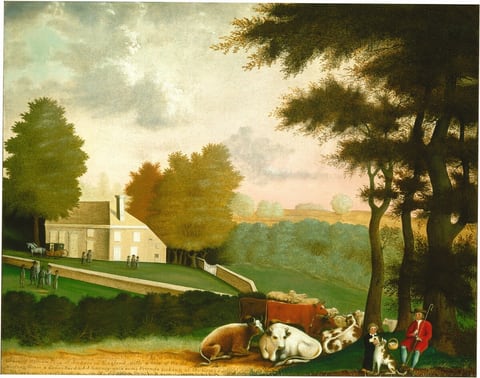
  1. This painting shows a pastoral setting with a large white-and-gray house on a hill to the left. Distant people stand in front of the house, along with a horse-drawn wagon. In the bottom right corner, two people sit in the grass under a tree, one dressed in red holding a tall crook and the other wearing a black garment and a yellow hat and petting a large brown-and-white dog. There is a basket on the ground between them, and next to them is a large herd of cows and sheep, all resting on the grass. The landscape includes trees with green leaves and yellow hills in the distance. The sky above is in pastel shades of pink and blue, with fluffy clouds. In the bottom left, a patch of yellow ground has several lines of text written over it.
    The Grave of William PennEdward Hicks, c. 1847/1848Courtesy National Gallery of Art, Washington
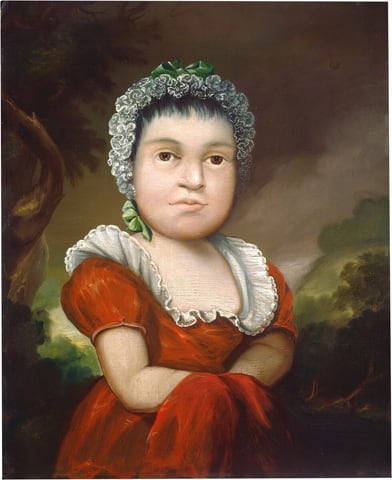
  2. A pale-skinned child wearing a short-sleeved red dress and a white bonnet stands before a shadowy green forest under dark clouds in this vertical portrait painting. The child’s over-large head is out of scale with the rest of her body. She looks toward us with brown eyes in her wide, round-jawed face. She has a broad nose, and her pale lips are set in a line. Her lace bonnet lines her black hair like frothy seafoam and is tied with spring-green bows at the top and under her right ear, to our left. The low neckline of her crimson dress is lined with a wide white ruffle. Red fabric covers her hands, which are gathered in front of her waist. Gray clouds sweep over the hazy green forest in the background. A gnarled tree grows up the left side of the painting, framing the girl.
    Portrait of a ChildEdward Hicks, c. 1840Courtesy National Gallery of Art, Washington