Floor plan

Time and place19th-century United States
19th-century United States
White Mare, by Winslow Homer, c. 1868
NEAR MEADOW CREEK, UTAH
Diving Cormorant, by Otto H. Bacher, 1900
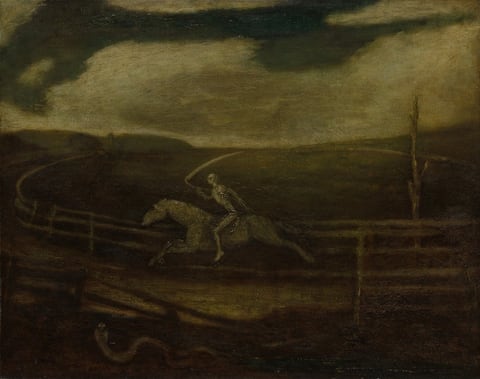
The Race Track (Death on a Pale Horse), by Albert Pinkham Ryder, c. 1896–1908
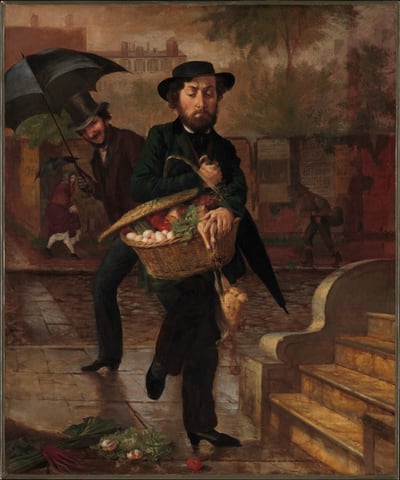
Young Husband: First Marketing, by Lilly Martin Spencer, 1854
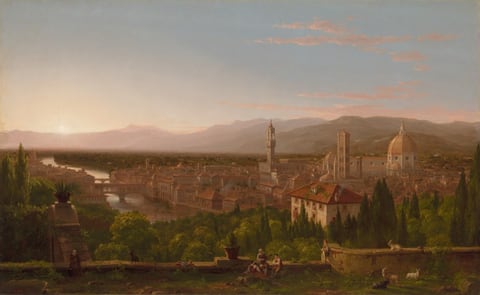
View of Florence, by Thomas Cole, 1837
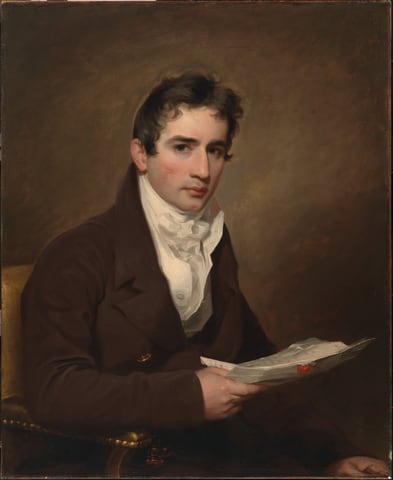
Artist: Thomas Sully, Sitter: John Sergeant, Current owner: National Portrait Gallery, Smithsonian Institution

The works in this room are listed below.

Works in this room

Works made in the United States in the 19th century.

Section 1, north wall

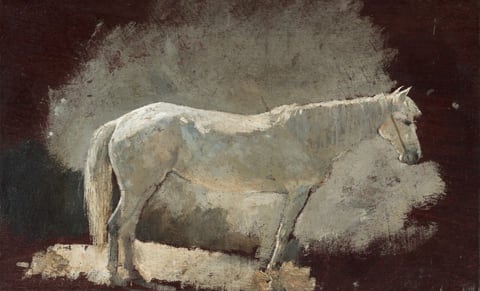
  1. White Mare, by Winslow Homer, c. 1868
    White MareWinslow Homer, c. 1868Courtesy of the Cleveland Museum of Art
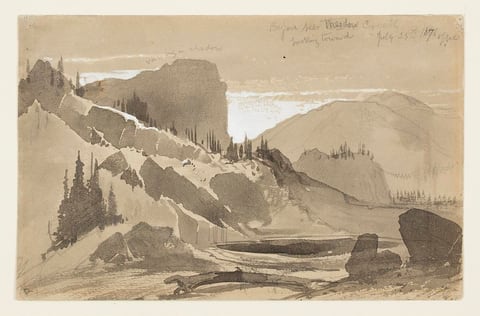
  2. NEAR MEADOW CREEK, UTAH
    Near Meadow Creek, UtahThomas Moran, July 25, 1871Courtesy of Cooper Hewitt, Smithsonian Design Museum
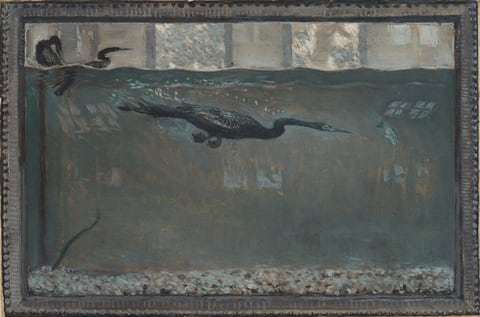
  3. Diving Cormorant, by Otto H. Bacher, 1900
    Diving CormorantOtto H. Bacher, 1900Courtesy of the Cleveland Museum of Art
  4. The Race Track (Death on a Pale Horse), by Albert Pinkham Ryder, c. 1896–1908
    The Race Track (Death on a Pale Horse)Albert Pinkham Ryder, c. 1896–1908Courtesy of the Cleveland Museum of Art

Section 1, south wall

  1. Young Husband: First Marketing, by Lilly Martin Spencer, 1854
    Young Husband: First MarketingLilly Martin Spencer, 1854Courtesy of The Metropolitan Museum of Art
  2. View of Florence, by Thomas Cole, 1837
    View of FlorenceThomas Cole, 1837Courtesy of the Cleveland Museum of Art
  3. Artist: Thomas Sully, Sitter: John Sergeant, Current owner: National Portrait Gallery, Smithsonian Institution
    John SergeantThomas Sully, 1811Courtesy of the National Portrait Gallery, Smithsonian Institution

Section 2, south wall
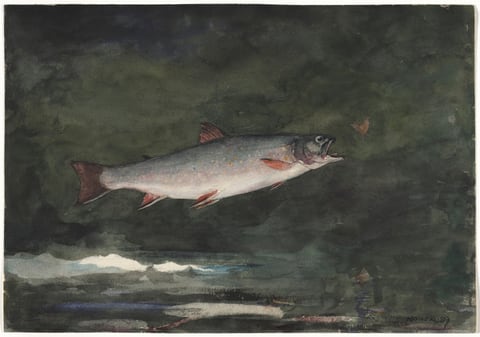
  1. Leaping Trout, by Winslow Homer, 1889
    Leaping TroutWinslow Homer, 1889Courtesy of the Cleveland Museum of Art
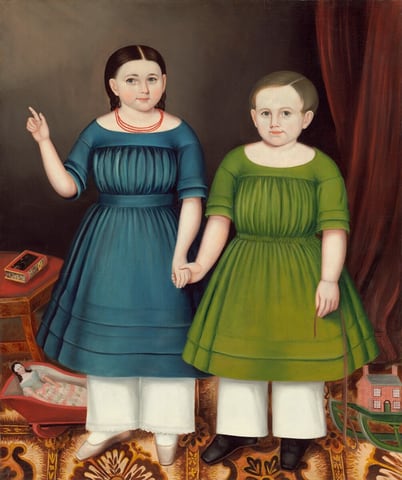
  2. The image features two young children standing side by side. The child on the left extends one arm sideways and has the other arm lowered, while the child on the right has both arms relaxed by their sides, one holding a string. Both children have round faces with light complexions; the child on the left has dark brown hair styled in waves down to the shoulders, while the child on the right has light brown hair. The child on the left is dressed in a blue dress with a loosely gathered waist and short sleeves, white stockings, white shoes, and a red beaded necklace. The child on the right wears a green dress with similar design features, white stockings, and black shoes. Near their feet are a toy doll in a red cradle and a small toy house. In the background, there is a plain dark wall, a deep red drapery, a carpet with elaborate patterns, and a small wooden table with a box on top.
    Mary and Francis WilcoxJoseph Whiting Stock, 1845Courtesy National Gallery of Art, Washington
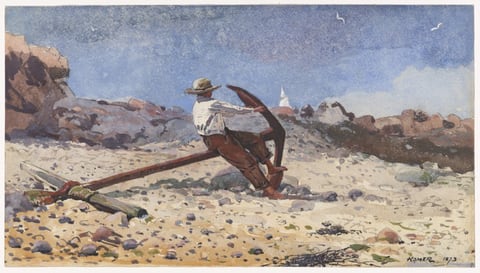
  3. Boy with Anchor, by Winslow Homer, 1873
    Boy with AnchorWinslow Homer, 1873Courtesy of the Cleveland Museum of Art
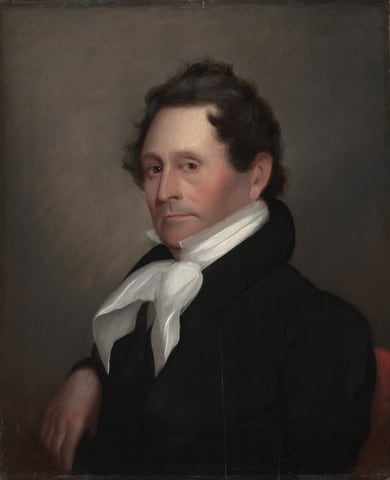
  4. Senator Thomas Hart Benton, by Matthew Harris Jouett, 1820s
    Senator Thomas Hart BentonMatthew Harris Jouett, 1820sCourtesy of the Cleveland Museum of Art

Section 2, north wall
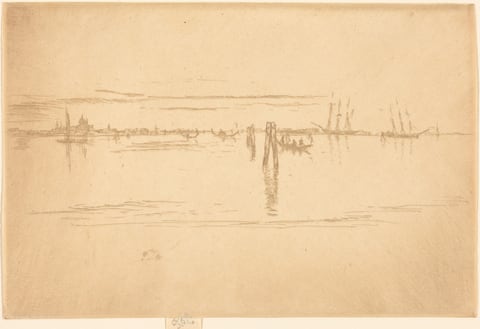
  1. The image shows a landscape with a waterscape. The horizon separates the water and the sky. In the distance, there are buildings, structures, and ships with tall masts. Close to us, there are reflections of the ships and structures in the water with fine brushstrokes. The style is impressionistic with thin lines conveying details. The color palette is monochromatic with sepia tones.
    Long LagoonJames McNeill Whistler, 1880Courtesy National Gallery of Art, Washington
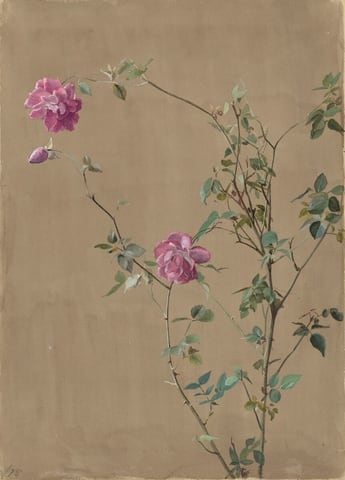
  2. This detailed painting shows two pink roses and a pink bud on a long, thin green stem with green leaves and small green thorns. The tall stem rises near the right edge of the painting, with some thin branches reaching out to either side. The largest rose is positioned near the top left corner of the painting, with the small bud right below it. The other large flower is right around the center of the painting. The background is a flat beige color.
    Pink RosesFidelia Bridges, 1875Courtesy National Gallery of Art, Washington
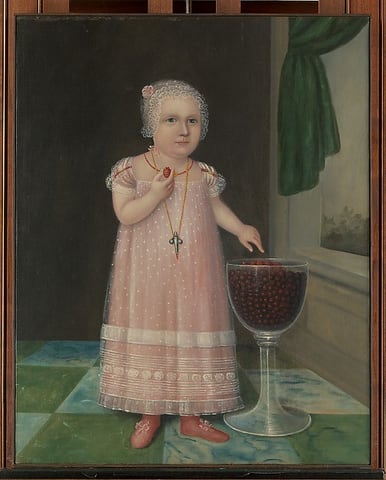
  3. Emma Van Name, by Joshua Johnson, ca. 1805
    Emma Van NameJoshua Johnson, ca. 1805Courtesy of The Metropolitan Museum of Art

Section 3, north wall
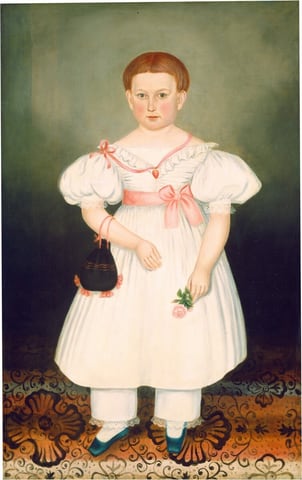
  1. The image shows a child standing upright, facing forward. They have fair skin, rounded cheeks, short reddish-brown hair, and are wearing a white dress with lace details and a pink ribbon, white pants with lace trim, blue shoes, a red necklace and a heart-shaped pendant. They hold a light pink rose in their left hand and a small black drawstring purse with red accents in their right hand. The background is a gradient from dark green to light green, with a floral-patterned carpet in black, brown, and red on the floor.
    Girl with Reticule and RoseJoseph Whiting Stock, c. 1840Courtesy National Gallery of Art, Washington
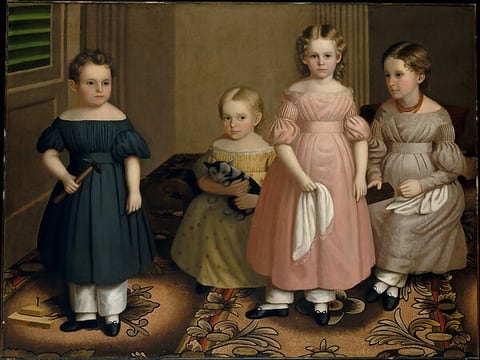
  2. The Alling Children, by Oliver Tarbell Eddy, ca. 1839
    The Alling ChildrenOliver Tarbell Eddy, ca. 1839Courtesy of The Metropolitan Museum of Art