Floor plan

Time and place19th-century France

19th-century France

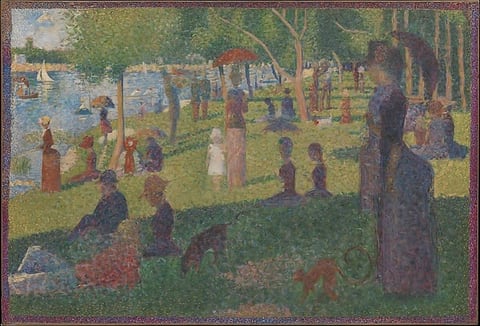
Study for "A Sunday on La Grande Jatte", by Georges Seurat, 1884
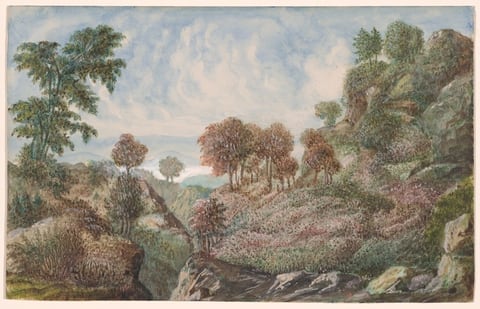
A work made of watercolor and opaque watercolor on cream wove paper.
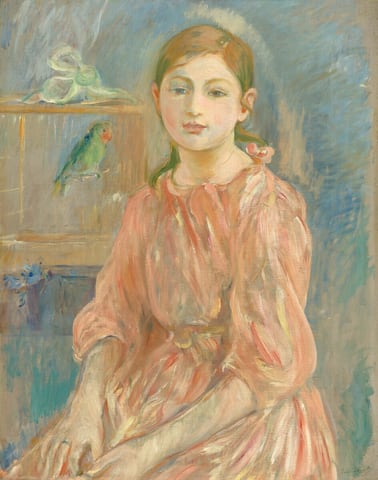
Shown from the knees up, a young girl with pale skin, wearing a coral-peach dress, sits facing and looking at us in this loosely painted, vertical portrait. Her knees are angled slightly to our left, and her hands rest in her lap. She has a round face and smooth, lightly flushed cheeks. She has brown eyes under arched brows, a delicate, snub nose, and her rose-pink lips are closed. Her hair, which is painted with broad strokes of caramel brown and moss green, is parted on one side and pulled smoothly back, presumably tied behind her head. Tendrils fall over her shoulders. Her dress is gathered around her neck and tied with a bow at the back. The loose sleeves fall to just below her elbows, and the dress is belted around the waist. A curving swipe of canary-yellow paint could be a buckle at the front. The fabric of the dress is painted with long, visible strokes of shell and rose pink, butter yellow, and ivory white, and a few touches of sage green and periwinkle blue for shadows. She wears a ring on the middle finger of her right hand. The space around her is loosely painted with strokes of electric and cobalt blue, with unpainted canvas visible at some of the edges. To our left, over the girl's shoulder, a wooden bird cage holds an emerald-green parakeet. The bird is streaked with royal blue along its back, and the area around its hooked beak is apple red. The cage has a mint-green bow and ribbon along the top. The artist signed the painting in green on the lower right corner: “Berthe Morisot.”
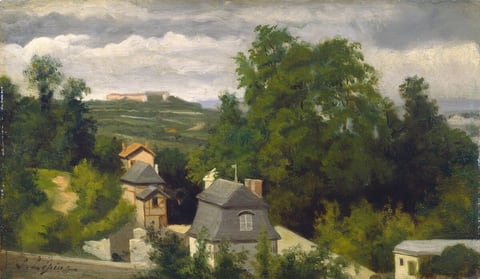
The painting shows an elevated perspective overlooking a landscape with green hills and leafy trees. Closest to us, there are cream-colored buildings among dense foliage. These buildings have roofs in shades of pale blue-gray and reddish-brown, and the one in the center has wispy white smoke coming out of a chimney. In the distance on the left, a large, low structure sits atop a hill, with faint paths winding towards it through the green landscape. Beyond the trees, the distant landscape on the right is painted in shades of pale blue and green. The sky above is filled with puffy clouds in shades of gray.
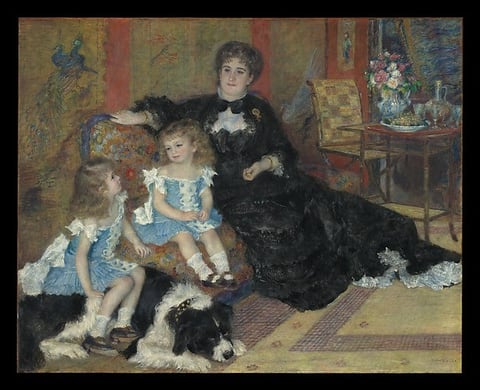
Madame Georges Charpentier (Marguerite-Louise Lemonnier, 1848–1904) and Her Children, Georgette-Berthe (1872–1945) and Paul-Emile-Charles (1875–1895), by Pierre-Auguste Renoir, 1878
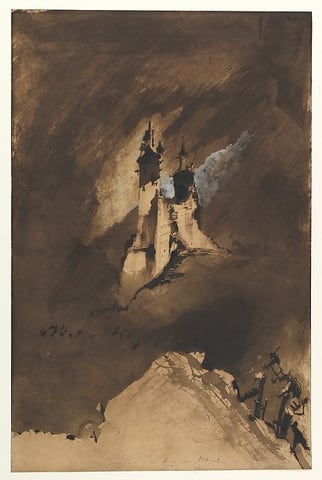
Souvenir of a Castle in Vosges, by Victor Hugo, 1857
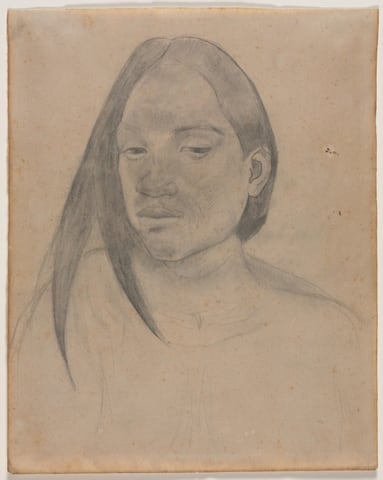
Head of a Tahitian Woman, by Paul Gauguin, 1891

The works in this room are listed below.

Works in this room

Works made in France in the 19th century.

First room, north wall

  1. Study for "A Sunday on La Grande Jatte", by Georges Seurat, 1884
    Study for "A Sunday on La Grande Jatte"Georges Seurat, 1884Courtesy of The Metropolitan Museum of Art
  2. A work made of watercolor and opaque watercolor on cream wove paper.
    Landscape with River GorgeGeorge Sand, 1860/69Courtesy of the Art Institute of Chicago
  3. Shown from the knees up, a young girl with pale skin, wearing a coral-peach dress, sits facing and looking at us in this loosely painted, vertical portrait. Her knees are angled slightly to our left, and her hands rest in her lap. She has a round face and smooth, lightly flushed cheeks. She has brown eyes under arched brows, a delicate, snub nose, and her rose-pink lips are closed. Her hair, which is painted with broad strokes of caramel brown and moss green, is parted on one side and pulled smoothly back, presumably tied behind her head. Tendrils fall over her shoulders. Her dress is gathered around her neck and tied with a bow at the back. The loose sleeves fall to just below her elbows, and the dress is belted around the waist. A curving swipe of canary-yellow paint could be a buckle at the front. The fabric of the dress is painted with long, visible strokes of shell and rose pink, butter yellow, and ivory white, and a few touches of sage green and periwinkle blue for shadows. She wears a ring on the middle finger of her right hand. The space around her is loosely painted with strokes of electric and cobalt blue, with unpainted canvas visible at some of the edges. To our left, over the girl's shoulder, a wooden bird cage holds an emerald-green parakeet. The bird is streaked with royal blue along its back, and the area around its hooked beak is apple red. The cage has a mint-green bow and ribbon along the top. The artist signed the painting in green on the lower right corner: “Berthe Morisot.”
    The Artist's Daughter with a ParakeetBerthe Morisot, 1890Courtesy National Gallery of Art, Washington
  4. The painting shows an elevated perspective overlooking a landscape with green hills and leafy trees. Closest to us, there are cream-colored buildings among dense foliage. These buildings have roofs in shades of pale blue-gray and reddish-brown, and the one in the center has wispy white smoke coming out of a chimney. In the distance on the left, a large, low structure sits atop a hill, with faint paths winding towards it through the green landscape. Beyond the trees, the distant landscape on the right is painted in shades of pale blue and green. The sky above is filled with puffy clouds in shades of gray.
    View on the Outskirts of CaenStanislas Lépine, 1872/1875Courtesy National Gallery of Art, Washington

First room, south wall

  1. Madame Georges Charpentier (Marguerite-Louise Lemonnier, 1848–1904) and Her Children, Georgette-Berthe (1872–1945) and Paul-Emile-Charles (1875–1895), by Pierre-Auguste Renoir, 1878
    Madame Georges Charpentier (Marguerite-Louise Lemonnier, 1848–1904) and Her Children, Georgette-Berthe (1872–1945) and Paul-Emile-Charles (1875–1895)Pierre-Auguste Renoir, 1878Courtesy of The Metropolitan Museum of Art
  2. Souvenir of a Castle in Vosges, by Victor Hugo, 1857
    Souvenir of a Castle in VosgesVictor Hugo, 1857Courtesy of The Metropolitan Museum of Art
  3. Head of a Tahitian Woman, by Paul Gauguin, 1891
    Head of a Tahitian WomanPaul Gauguin, 1891Courtesy of the Cleveland Museum of Art

Second room, south wall
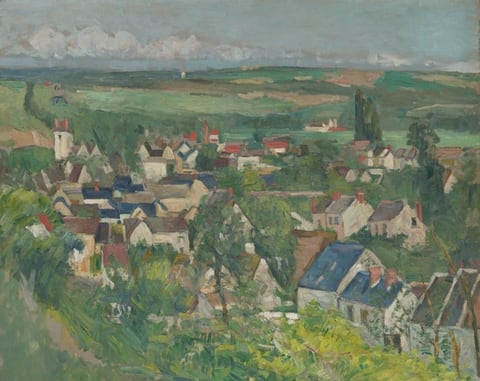
  1. View of a village surrounded by hills, fields, and trees, shown from a vantage point above the scene. Subtly rolling hills recede into a bluish gray-ish sky punctuated by white clouds. Thick brushstrokes built up atop each other are visible throughout.
    Auvers, Panoramic ViewPaul Cézanne, 1873–75Courtesy of the Art Institute of Chicago
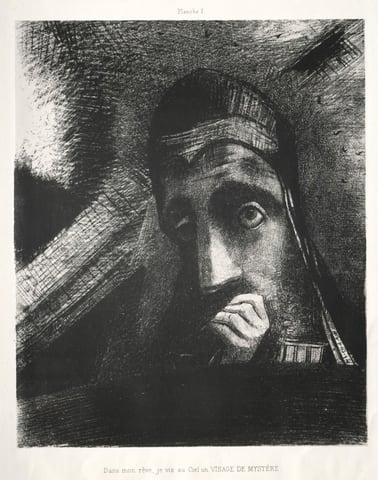
  2. In My Dream I Saw in the Sky a Face of Mystery, by Odilon Redon, 1885
    In My Dream I Saw in the Sky a Face of MysteryOdilon Redon, 1885Courtesy of the Cleveland Museum of Art
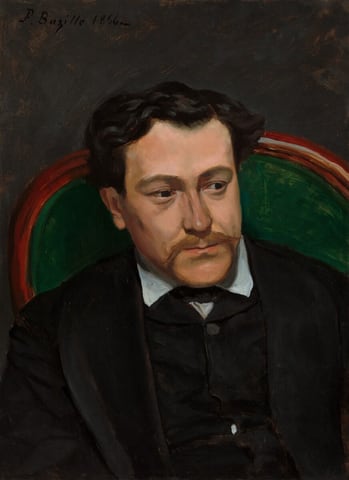
  3. Shown from the chest up, a pale-skinned man in a suit sits in a high-backed chair, looking slightly to our right in this vertical portrait painting. His eyes and head are both turned slightly to our right, with only one ear visible on our left. His shoulder on our right and the right side of the chair are slightly cut off by the edge of the painting. He has a straight nose, high cheekbones, and pale pink closed lips. His eyes are dark, with small shadows beneath them. His black, wavy hair is parted on our right and cropped short on the sides of his head, with thick, defined waves on top. He has a light brown mustache that extends past the edge of his lips and flips up at the ends and a small, thin goatee. Beneath his chin, the collar of his white shirt is visible. The man wears an open suit jacket with a black vest, which folds slightly just below his chest, revealing a glimpse of his white shirt beneath it in a gap between buttons. The chair is only visible from the man’s shoulders up and ends at his forehead. It has a curved, round top back with a red frame and dark green upholstery. The part of the red frame on the right side of the painting has white and yellow highlights. The background is dark gray with visible brushstrokes. The artist signed and dated the painting at the top left, “F. Bazille. 1866.”
    Edouard BlauFrédéric Bazille, probably 1869Courtesy National Gallery of Art, Washington
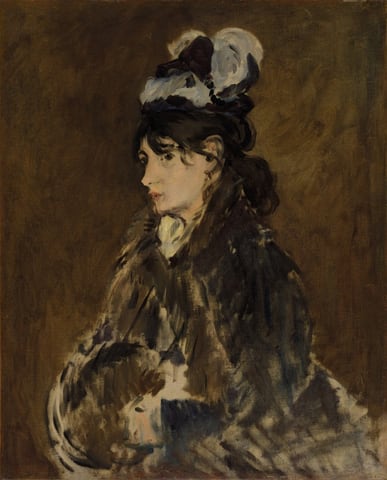
  4. Berthe Morisot with a Muff, by Édouard Manet, c. 1871–72
    Berthe Morisot with a MuffÉdouard Manet, c. 1871–72Courtesy of the Cleveland Museum of Art

Second room, north wall
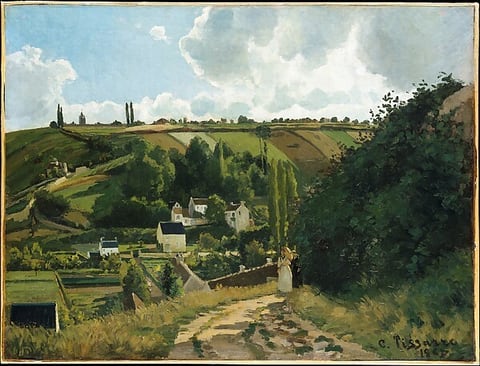
  1. Jalais Hill, Pontoise, by Camille Pissarro, 1867
    Jalais Hill, PontoiseCamille Pissarro, 1867Courtesy of The Metropolitan Museum of Art
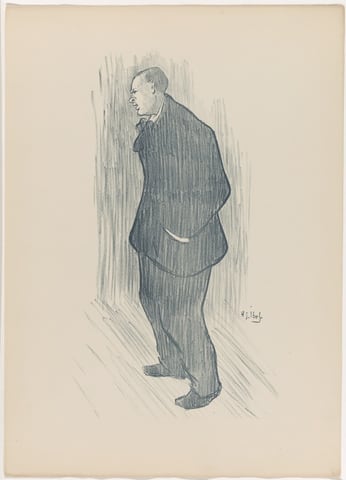
  2. A work made of lithograph in dark green on cream wove paper.
    Mévisto, from Le Café-ConcertHenri-Gabriel Ibels, 1893Courtesy of the Art Institute of Chicago
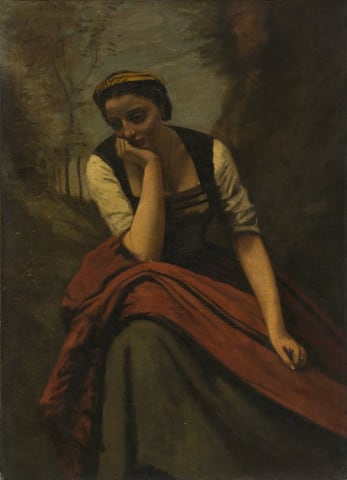
  3. Woman Meditating, by Jean Baptiste Camille Corot, after 1868
    Woman MeditatingJean Baptiste Camille Corot, after 1868Courtesy of the Cleveland Museum of Art

Third room, north wall
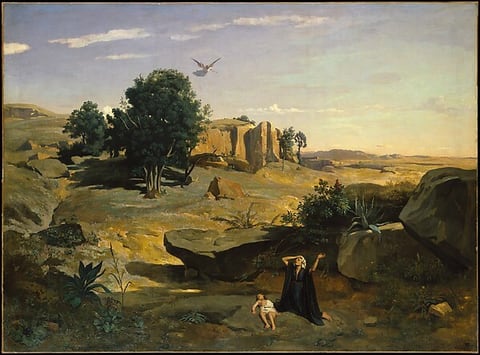
  1. Hagar in the Wilderness, by Jean Baptiste Camille Corot, 1835
    Hagar in the WildernessJean Baptiste Camille Corot, 1835Courtesy of The Metropolitan Museum of Art
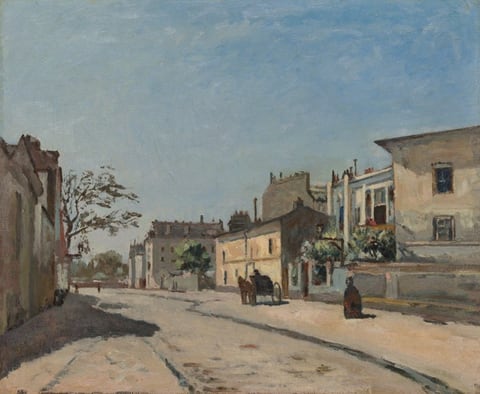
  2. A work made of oil on panel.
    French Street SceneEdouard Béliard, 1873–77Courtesy of the Art Institute of Chicago