Floor plan

Time and place19th-century France

19th-century France

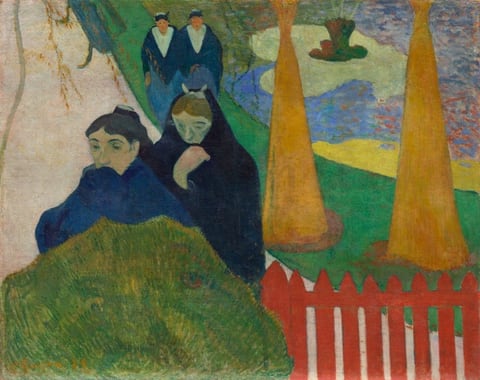
Painting of four women with blue shawls walking near red fence.
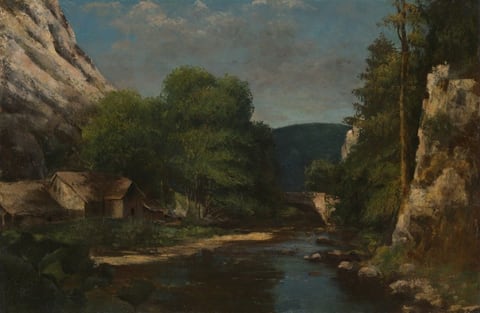
A work made of oil on canvas.
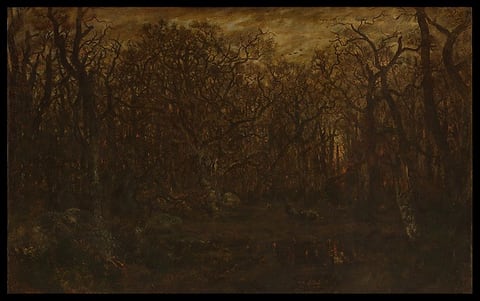
The Forest in Winter at Sunset, by Théodore Rousseau, ca. 1846–67
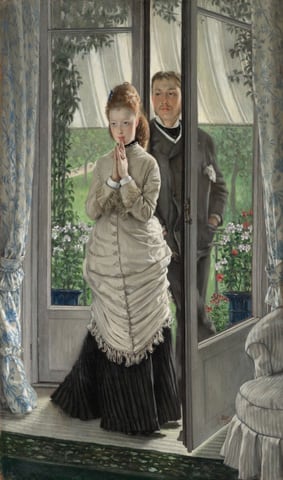
The Lovers, by James Tissot, 1872
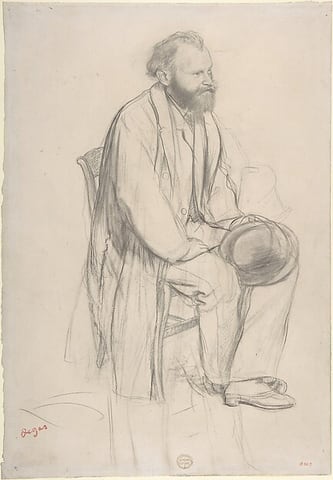
Édouard Manet, Seated, Holding His Hat, by Edgar Degas, ca. 1868

The works in this room are listed below.

Works in this room

Works made in France in the 19th century.

First room, north wall

  1. Painting of four women with blue shawls walking near red fence.
    Arlésiennes (Mistral)Paul Gauguin, 1888Courtesy of the Art Institute of Chicago
  2. A work made of oil on canvas.
    LandscapeMarcel Ordinaire, 1867Courtesy of the Art Institute of Chicago

First room, south wall

  1. The Forest in Winter at Sunset, by Théodore Rousseau, ca. 1846–67
    The Forest in Winter at SunsetThéodore Rousseau, ca. 1846–67Courtesy of The Metropolitan Museum of Art
  2. The Lovers, by James Tissot, 1872
    The LoversJames Tissot, 1872Courtesy of the Cleveland Museum of Art
  3. Édouard Manet, Seated, Holding His Hat, by Edgar Degas, ca. 1868
    Édouard Manet, Seated, Holding His HatEdgar Degas, ca. 1868Courtesy of The Metropolitan Museum of Art

Second room, south wall
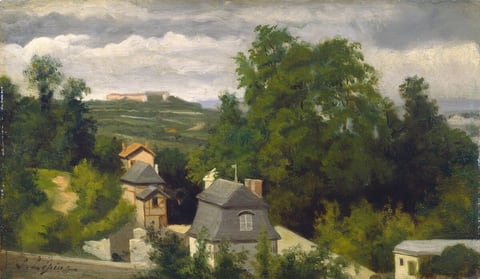
  1. The painting shows an elevated perspective overlooking a landscape with green hills and leafy trees. Closest to us, there are cream-colored buildings among dense foliage. These buildings have roofs in shades of pale blue-gray and reddish-brown, and the one in the center has wispy white smoke coming out of a chimney. In the distance on the left, a large, low structure sits atop a hill, with faint paths winding towards it through the green landscape. Beyond the trees, the distant landscape on the right is painted in shades of pale blue and green. The sky above is filled with puffy clouds in shades of gray.
    View on the Outskirts of CaenStanislas Lépine, 1872/1875Courtesy National Gallery of Art, Washington
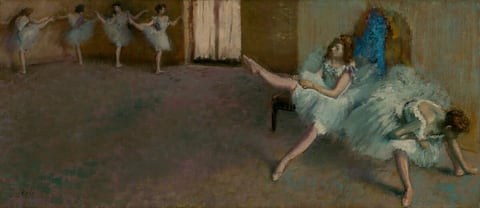
  2. In a dance studio, two ballerinas wearing knee-length tutus and ballet slippers sit on a bench and stretch to our right while four more pose at the back of the space, to our left, in this long, horizontal painting. The scene and dancers are loosely painted so many features are indistinct. All the women have light skin and dark brown hair. Each pale, robins’ egg-blue costume has a low-cut, tightly fitting, sleeveless bodice and a full skirt. Dabs of off white, teal, and blue suggest flowers lining the deep U of the neckline at the front and down the back of each bodice. Closest to us and nearly brushing the edges of the lower right corner of the canvas, one dancer sits on the end of a wooden bench and leans down between her legs, her feet widely planted. She rests her torso on an elbow folded onto one knee as she reaches for her left foot, farther from us, with her other hand. Her hair is pulled up and her face, looking downward, is deep in shadow. Sitting behind her on the bench, to our left, a second dancer lifts her right leg, toe pointing, as she pulls on her pale pink tights. Her other leg stretches straight, pointed toe brushing the floor, in front of her. This woman’s hair hangs loose around her shoulders. The pair is brightly lit from a source to our right, and an arched area of electric blue and mustard yellow behind them is difficult to interpret. The floor, which takes up about two-thirds of the composition, is painted with dabs of teal blue, pale fuchsia pink, and caramel brown. It leads us back to the upper left corner of the painting where four more four ballerinas stand in a line. The pair to our left stands with their backs to us, facing the wall with their right legs raised to shoulder height, toes pointed. The pair to our right faces us. They also stand with their right legs raised, creating a wide angle with their standing legs. All four ballerinas bend their arms gently at the elbow, and some tip their heads toward the raised legs. The rightmost dancer is illuminated by a pair of French doors at the back corner, at the top center of the painting. The wall behind the bench is streaked with mint green over honey brown, and the wall at the back of the room is leather brown. The visible, soft brushstrokes give the image a blurred, ethereal appearance in the dimmed studio. The artist signed the painting in the lower left corner, “Degas.”
    Before the BalletEdgar Degas, 1890/1892Courtesy National Gallery of Art, Washington
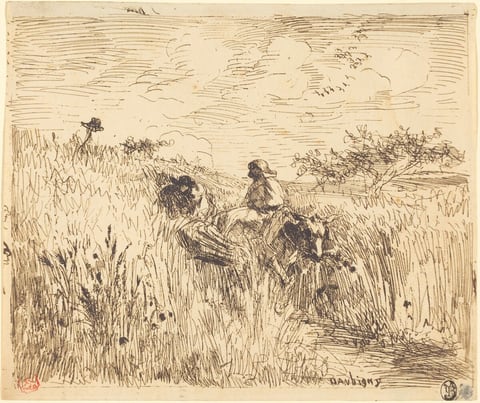
  3. This image shows an elevated view of a grassy landscape with sparse trees and vegetation at the horizon. The linear brushstrokes create texture and movement in the grass and sky. The color palette is monochromatic with sepia tones. In the foreground, a figure is on a horse amidst tall grasses, while in the distance, another figure stands on the left and a cluster of trees is on the right. The sky has wisps of clouds.
    Path through a Wheat Field (Sentier dans les bles)Charles-François Daubigny, 1862Courtesy National Gallery of Art, Washington

Second room, north wall
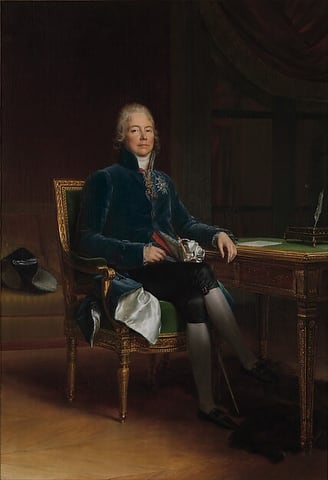
  1. Charles Maurice de Talleyrand Périgord (1754–1838), Prince de Bénévent, by baron François Gérard, 1808
    Charles Maurice de Talleyrand Périgord (1754–1838), Prince de Bénéventbaron François Gérard, 1808Courtesy of The Metropolitan Museum of Art
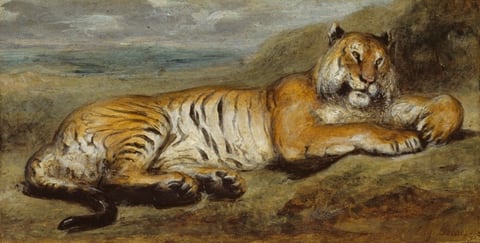
  2. A boldly painted orange tiger lies on brown, rocky ground, his body nearly filling the canvas, blue water and gray sky in the background.
    Tiger RestingPierre Andrieu, c. 1845Courtesy of the Art Institute of Chicago
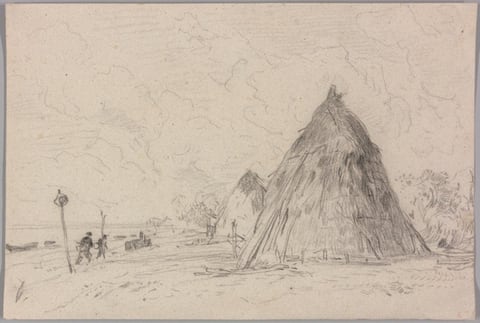
  3. A work made of conté crayon on gray-blue wove paper.
    Landscape with HaystacksConstant Troyon, n.d.Courtesy of the Art Institute of Chicago

Third room, north wall
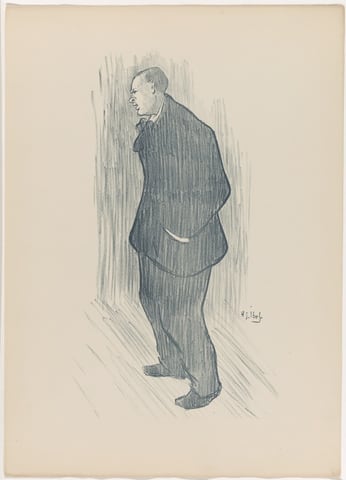
  1. A work made of lithograph in dark green on cream wove paper.
    Mévisto, from Le Café-ConcertHenri-Gabriel Ibels, 1893Courtesy of the Art Institute of Chicago
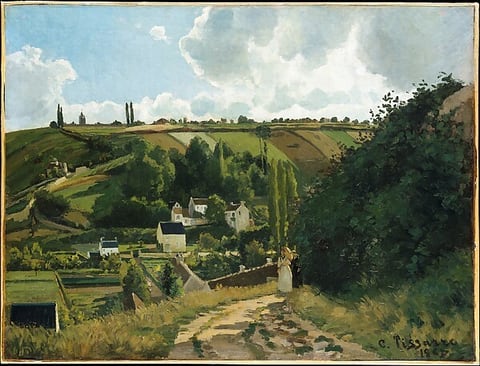
  2. Jalais Hill, Pontoise, by Camille Pissarro, 1867
    Jalais Hill, PontoiseCamille Pissarro, 1867Courtesy of The Metropolitan Museum of Art
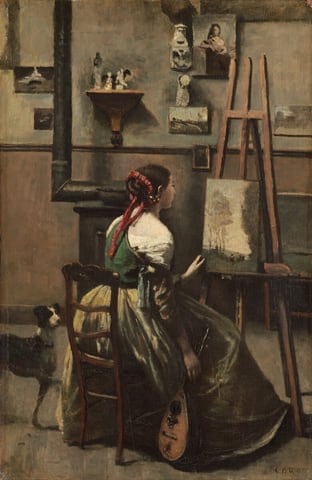
  3. A young, pale-skinned woman sits with her back to us as she looks at a painting on an easel in a studio in this vertical painting. She sits in a ladder-back wood chair so her knees angle away from us, toward the back right corner of the studio. We look onto the side of her right cheek as she leans forward. Her brown hair is combed back and twisted into a bun wrapped with a raspberry-red ribbon that trails down her back. Touches of pearl white, pale pink, and silvery gray suggest flowers by the ear we can see. A cream-white chemise falls off the shoulder closer to us, under a grass-green bodice. She holds a mandolin down by her right side, which is closer to us, to nestle in the folds of her voluminous, olive-green skirt. She reaches forward with her other hand to touch the lower left corner of the painting resting on the easel. That vertically-oriented scene is loosely painted and shows a few people gathered in a landscape. A white and black dog stands with one front leg lifted to the left of the woman's chair, looking at her. The wall opposite us is parchment white over a strip of molding, like a high chair rail, and muted mauve pink below. An L-shaped pipe leads to an iron stove to our left of center. A narrow shelf tucked into the L of the pipe holds three hand-sized sculptures or casts. Small paintings and plaster casts hang around it on the wall above the molding. The artist signed the painting in the lower right: “COROT.”
    Corot's Studio: Woman Seated Before an Easel, a Mandolin in her HandJean Baptiste Camille Corot, c. 1868Courtesy National Gallery of Art, Washington

Third room, south wall
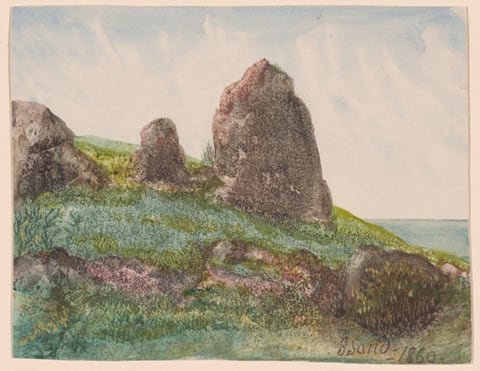
  1. A work made of transparent and opaque watercolor on cream wove paper.
    Landscape with RocksGeorge Sand, c. 1868/76Courtesy of the Art Institute of Chicago
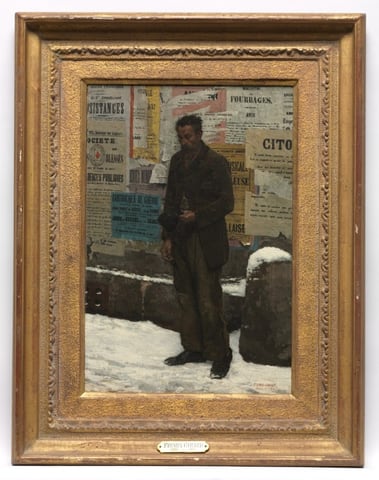
  2. The Veteran, by Marie-François Firmin-Girard, 1870
    The VeteranMarie-François Firmin-Girard, 1870Courtesy of the Cleveland Museum of Art