Floor plan

Time and placeThe 17th century

The 17th century

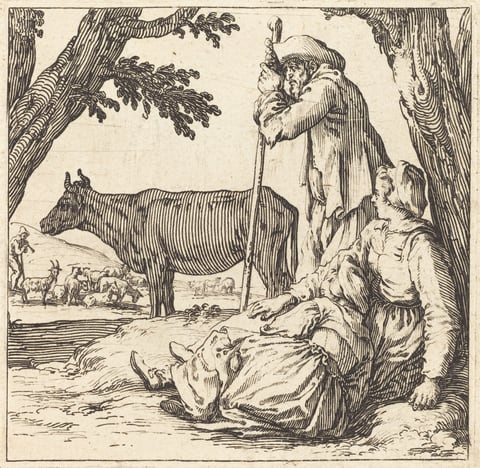
The image has an elevated perspective showing two figures with animals in the scene. One person is leaning against a tree with a stick, while the other is seated on the ground. A cow is between them and other livestock in the middle distance. A person in the distance is tending to the animals. The horizon is low in the image, hidden by rolling hills. The artwork is in monochrome with fine linework, creating texture through hatching and cross-hatching, emphasizing depth and dimensionality.
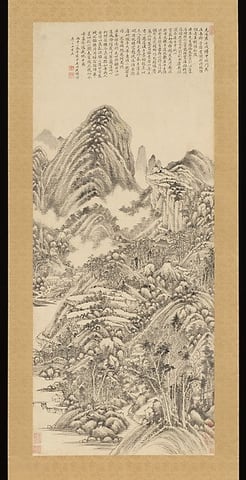
Landscape in the style of Huang Gongwang, by Wang Shimin, 1666
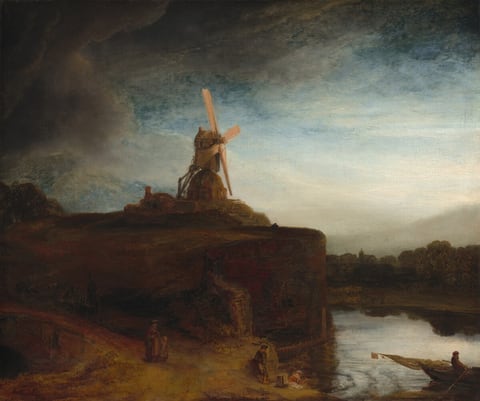
A windmill stands on a promontory cutting into a waterway under a partially stormy sky in this square landcape painting. The promontory and mill are painted in muted tones of brown and rust orange, while steel-gray and white clouds encircle a topaz-blue sky above. The promontory juts into the scene from our left, and the front of the windmill is angled to our right so its golden-tan sails catch the light. Silvery water winds around the base of the promontory and extends to a dark green, shadowy bank on the far side. A boat in the lower right corner of the composition is rowed by a man wearing a red jacket and cap. A path runs to the water’s edge from the left edge of the painting, in front of the promontory’s retaining wall, which is shored up with stones or panels. A person in dark clothing close to the windmill seems to rest their arms on the retaining wall, their back to us. Closer to us, a woman holds a child’s hand as they walk down the path to the bank. A bearded man with tattered brown clothes and bare feet stands leaning against the wall near a woman wearing burnt-orange garment. She sits or kneels at the water’s edge in front of a basket of clothes and holds up a brown cloth. The olive-green forms of the trees on the far bank are reflected in the water, and closer inspection reveals two cows near the water there. Charcoal-gray clouds pile up along the left of the painting and span the top edge. There is a brilliant blue sky beyond and a screen of white clouds near the horizon, which comes about a third of the way up the canvas.
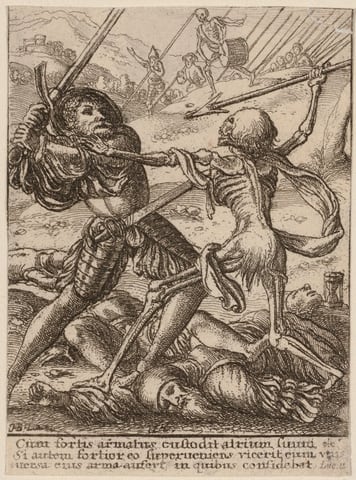
A work made of etching in black on ivory wove paper.
A work made of oil on canvas.
This is a drawing of multiple sheep in various poses. The full-page illustration depicts several sheep lying down. The fur of the sheep is textured with detailed pencil strokes, and there are subtle hints of shadow beneath each animal. There is a combination of different angles and poses, showing the sheep from different perspectives. The drawing also contains some rough sketches and outlines, suggesting movement and presence without complete detail. The background is plain.
Merrymakers at Shrovetide, by Frans Hals, ca. 1616–17
The Four Seasons: Autumn, by Abraham Bosse, 1635

The works in this room are listed below.

Works in this room

Works made in the 17th century, anywhere in the world.

Section 1, north wall

  1. The image has an elevated perspective showing two figures with animals in the scene. One person is leaning against a tree with a stick, while the other is seated on the ground. A cow is between them and other livestock in the middle distance. A person in the distance is tending to the animals. The horizon is low in the image, hidden by rolling hills. The artwork is in monochrome with fine linework, creating texture through hatching and cross-hatching, emphasizing depth and dimensionality.
    Peasant Couple with CowJacques Callot, c. 1621Courtesy National Gallery of Art, Washington
  2. Landscape in the style of Huang Gongwang, by Wang Shimin, 1666
    Landscape in the style of Huang GongwangWang Shimin, 1666Courtesy of The Metropolitan Museum of Art
  3. A windmill stands on a promontory cutting into a waterway under a partially stormy sky in this square landcape painting. The promontory and mill are painted in muted tones of brown and rust orange, while steel-gray and white clouds encircle a topaz-blue sky above. The promontory juts into the scene from our left, and the front of the windmill is angled to our right so its golden-tan sails catch the light. Silvery water winds around the base of the promontory and extends to a dark green, shadowy bank on the far side. A boat in the lower right corner of the composition is rowed by a man wearing a red jacket and cap. A path runs to the water’s edge from the left edge of the painting, in front of the promontory’s retaining wall, which is shored up with stones or panels. A person in dark clothing close to the windmill seems to rest their arms on the retaining wall, their back to us. Closer to us, a woman holds a child’s hand as they walk down the path to the bank. A bearded man with tattered brown clothes and bare feet stands leaning against the wall near a woman wearing burnt-orange garment. She sits or kneels at the water’s edge in front of a basket of clothes and holds up a brown cloth. The olive-green forms of the trees on the far bank are reflected in the water, and closer inspection reveals two cows near the water there. Charcoal-gray clouds pile up along the left of the painting and span the top edge. There is a brilliant blue sky beyond and a screen of white clouds near the horizon, which comes about a third of the way up the canvas.
    The MillRembrandt van Rijn, 1645/1648Courtesy National Gallery of Art, Washington
  4. A work made of etching in black on ivory wove paper.
    The Knight and Death, from The Dance of DeathWenceslaus Hollar, 1651Courtesy of the Art Institute of Chicago

Section 1, south wall

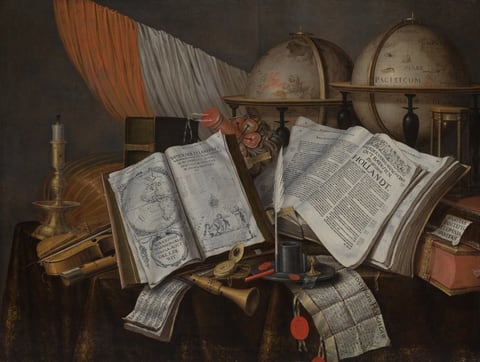
  1. A work made of oil on canvas.
    A Vanitas Still Life with a Flag, Candlestick, Musical Instruments, Books, Writing Paraphernalia, Globes, and HourglassEdwaert Collier, 1662Courtesy of the Art Institute of Chicago
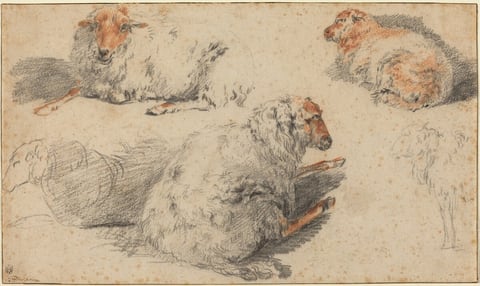
  2. This is a drawing of multiple sheep in various poses. The full-page illustration depicts several sheep lying down. The fur of the sheep is textured with detailed pencil strokes, and there are subtle hints of shadow beneath each animal. There is a combination of different angles and poses, showing the sheep from different perspectives. The drawing also contains some rough sketches and outlines, suggesting movement and presence without complete detail. The background is plain.
    SheepNicolaes BerchemCourtesy National Gallery of Art, Washington
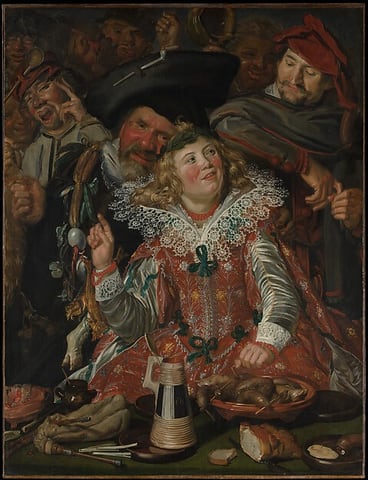
  3. Merrymakers at Shrovetide, by Frans Hals, ca. 1616–17
    Merrymakers at ShrovetideFrans Hals, ca. 1616–17Courtesy of The Metropolitan Museum of Art
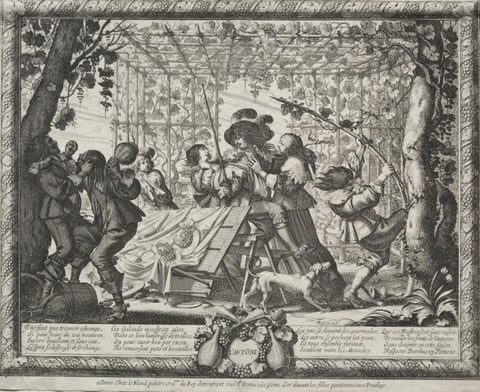
  4. The Four Seasons: Autumn, by Abraham Bosse, 1635
    The Four Seasons: AutumnAbraham Bosse, 1635Courtesy of the Cleveland Museum of Art

Section 2, south wall
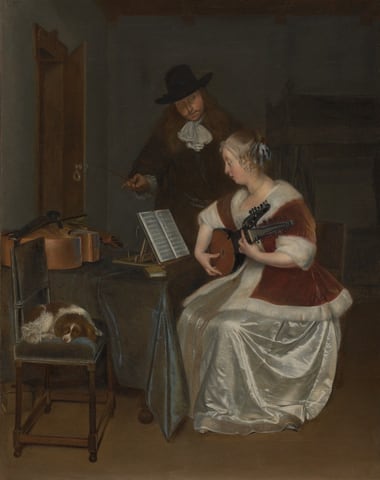
  1. A work made of oil on canvas.
    The Music LessonGerard ter Borch the Younger, c. 1670Courtesy of the Art Institute of Chicago
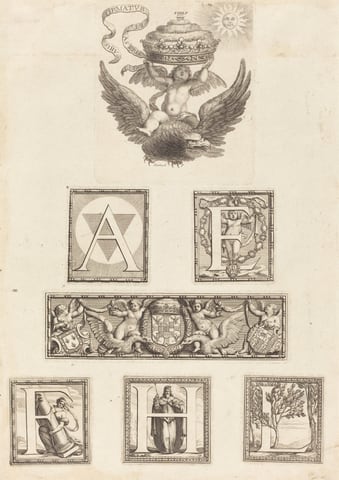
  2. This image features intricately designed ornate letters of the alphabet surrounded by elaborate illustrations. The top of the composition shows a cherub riding on an eagle, holding a crown above their head. A ribbon with inscriptions unfurls around the crown, and a sun with a human face is visible in the corner. The letters "A," "F," "D," "H," and another "H" are decorated with classical elements like putti, garlands, and mythological figures. The central panel is adorned with heraldic symbols, angelic figures, and coats of arms. The overall style of the artwork reflects baroque or renaissance decorative artistry, known for its ornamental details and classical themes.
    PendantRobert NanteuilCourtesy National Gallery of Art, Washington
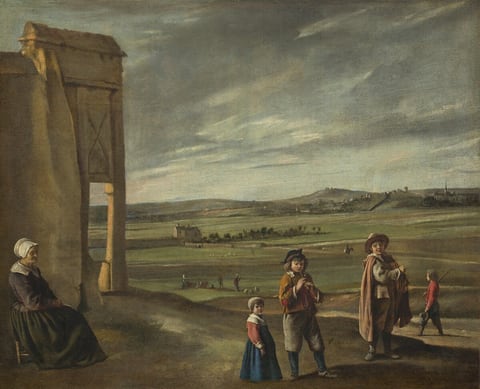
  3. An elderly woman sits on a small stool and four children stand along the foreground of a landscape with rolling, olive-green fields leading back to low, slate-gray mountains in this nearly square painting. The horizon comes about halfway up the painting, and the sky above is filled with a sheet of steel-gray clouds that break to reveal patches of ice-blue sky. Closest to us and along the left edge of the painting, the woman sits near a structure with a fragment of wall and a column that could be made from tan-colored stone. The woman faces our right in profile and looks at or toward three children gathered on a low hill to our right. Her lined face is partially cast in shadow by her white bonnet, but her skin is yellowed where the light falls across the side closer to us. A wide, white collar lies over the shoulders of her muted, plum-purple jacket, which is tied with a narrow red belt. Her hands rest in the lap of her full, moss-green skirt that falls to her feet and covers most of the stool. To our right, two boys and a little girl stand on a low hill. They all stand with their bodies angled to our right, and all have pale skin and brown hair. To our left in the trio, the young girl wears a royal-blue dress with brick-red, long sleeves and a wide, white collar, cuffs, and cap. Next to her, a slightly older boy wearing gray knee-britches, a honey-orange jacket with a white collar, and a blue tricorn hat looks down and plays a thin pipe. His jacket is torn at the elbows, revealing a red shirt beneath. To our right, the oldest boy wears a brown cloak over a gray jacket, tan trousers, and a tan brimmed hat. He holds his right arm, closer to us, across his chest as he touches an instrument nestled in the crook of his other elbow. Another bareheaded boy wearing a red shirt and blue trousers walks beyond this trio, holding a short pole over one shoulder and a brimmed hat in his other hand. He walks to our left and looks to the horizon. More people with sheep, cows, and a person on horseback dot the rolling fields that stretch back to low hills. One house sits next to a line of trees to the left of center, in the middle distance, and more buildings, including a church spire, cluster on the horizon to our right.
    Landscape with PeasantsLouis Le Nain, c. 1640Courtesy National Gallery of Art, Washington
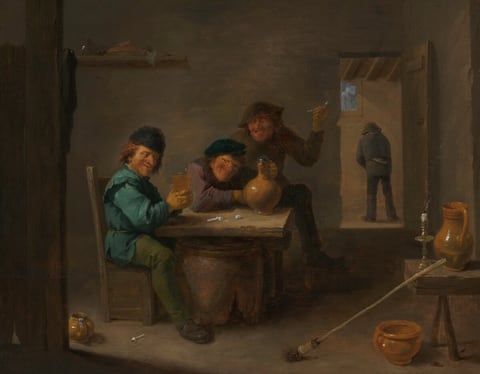
  4. Three pale-skinned people gather around a wooden table in a dimly lit tavern as a fourth person urinates against a wall in a back room in this horizontal painting. The table is a square board resting on a broken barrel. All three men at the table have prominent, reddened noses set in wide faces, and they wear clothing and hats in tones of spruce blue, olive green, muted purple, gray, or brown. One man sits on the left side of the table, holding a glass of beer with both hands. He wears what might be a furry cap. His face is turned slightly toward us but he looks down and to our right. The other seated man is across from us. He grins widely as he hunches over one forearm and holds the neck of a lidded ceramic jug with his other hand. He has a long, chunky chin and stares out at us from under a prominent brow ridge. The third man here stands behind, holding up a white clay pipe. His mouth is open, his eyes slitted, possibly crossed, and he hunches down. One foot rests on a low wooden box, a foot warmer. Another white clay pipe and the broken bowl of a pipe sit on the table, and another pipe lies by the first man’s feet. Also across the floor are two pots and a stubby broom, the long handle of which lies against a table holding a brass candlestick. A wisp of smoke rises from the wick in the candle stub. A shelf hung on the wall near the upper left corner of the painting holds a glass vessel and perhaps a plate. Two wooden beams line the left edge of the composition, and a cloth is draped over a nail there. The floor and wall are nearly uniform taupe gray. A rectangular doorway opens into the next room, in the top right corner of the painting. There a man stands facing the wall with both hands down in front of his torso. A window is set high in the wall there and the timbered ceiling is visible. The artist signed the lower left corner the painting, “D Teniers f.” The first two digits of the date read “16.”
    Peasants in a TavernDavid Teniers the Younger, c. 1633Courtesy National Gallery of Art, Washington

Section 2, north wall
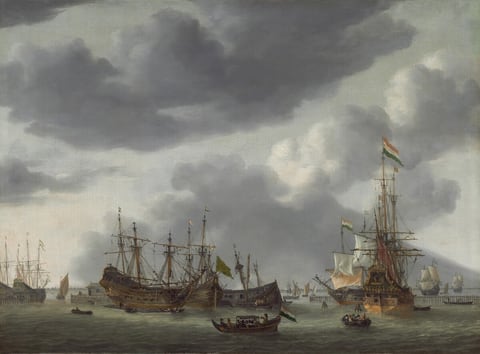
  1. A sage-green harbor teems with more than a dozen sailing ships and rowboats under a pale gray sky in this horizontal painting. The horizon comes about one-fifth of the way up the composition, and dark gray and white clouds tower above. Light filters onto the scene through the clouds from our left to fall across the ships while casting shadows on the water nearest us. Painted in tones of slate gray and warm brown, most of the ships closest to us have their sails furled so the masts and horizontal yard arms bristle against the sky. The larger ships have cannons poking out of square portholes. On our right, a war ship floats with its ornately carved and gilded stern facing us. A flag flying from the tallest of the three masts has red, white, and green stripes. The artist painted his name on that flag, “R. Zeeman.” The ship is tied to a buoy with a length of rope, and an empty rowboat is tethered to the right side of the ship. A similar ship but with the sails hanging loosely is tied to a buoy just beyond this one. A row of pickets, like a fence, extends into the water behind these two ships. To our left, a rowboat full of men has pulled up alongside a partially sunken ship, its masts tilting toward us. A few people stand on two more ships nearby. A black temporary dock floats next to the leftmost ship here. A person mixes something that smokes on the platform, and another person stands on a board lifted halfway up the ship’s side, presumably working on a repair. Two women in another rowboat next to the floating dock lean over the side, washing clothes. Another fence encloses the harbor to our left, and a hut in the middle of the harbor is surrounded by a similar structure. Two rowboats closer to us are filled with men wearing tall hats and black or brown coats, and women wearing black bonnets and white shawls. More sailing ships and rowboats move back or around beyond the harbor, out to sea. Visible cracks cover the surface of the painting.
    Amsterdam Harbor SceneReinier Nooms, called Zeeman, c. 1654/1655Courtesy National Gallery of Art, Washington
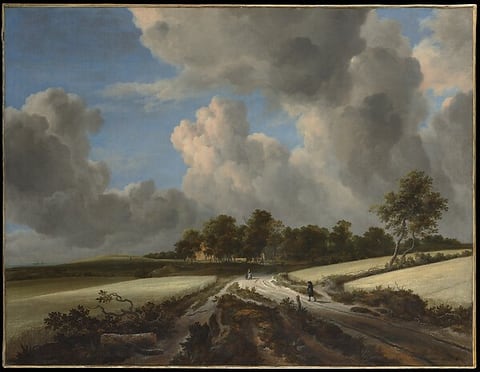
  2. Wheat Fields, by Jacob van Ruisdael, ca. 1670
    Wheat FieldsJacob van Ruisdael, ca. 1670Courtesy of The Metropolitan Museum of Art

Section 3, north wall
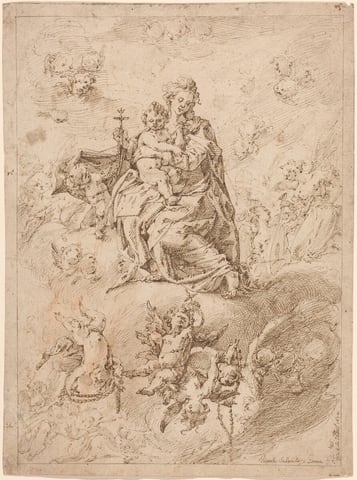
  1. The image depicts a woman seated with a child in her lap. The woman looks down at the child, who has curly hair. Both figures are intricately drawn in a detailed line drawing style. The woman wears a headdress and flowing garment, holding a cross-topped staff. The child clutches her arm. Surrounding them are cloud-like forms and cherubic figures with wings, some holding rosary beads. In the background, more clouds and angelic faces are sketched.
    The Madonna of the RosaryVicente Salvador Gómez, 1674Courtesy National Gallery of Art, Washington
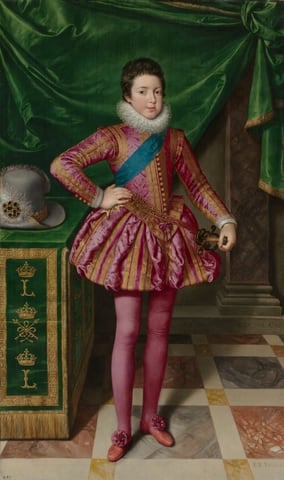
  2. Portrait of King Louis XIII of France, by Frans Pourbus, 1611
    Portrait of King Louis XIII of FranceFrans Pourbus, 1611Courtesy of the Cleveland Museum of Art