Floor plan

Time and placeThe 17th century

The 17th century

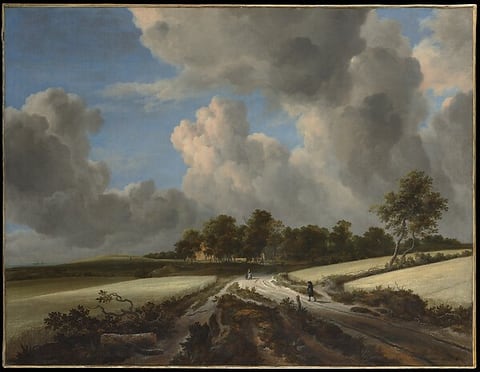
Wheat Fields, by Jacob van Ruisdael, ca. 1670
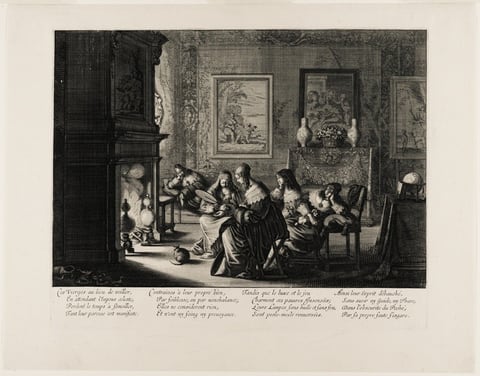
A work made of engraving and etching on ivory laid paper.
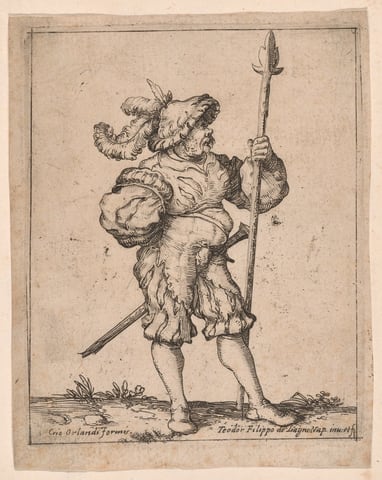
A work made of etching in black on cream laid paper.
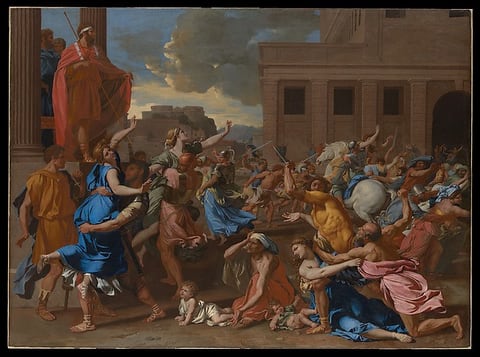
The Abduction of the Sabine Women, by Nicolas Poussin, probably 1633–34
A work made of oil on canvas.
The image displays three figures. The central figure is seated and supported by the other two. The central figure has wavy dark hair, eyes closed, and wears a robe with a cross. The figure on the left looks serene, while the one on the right holds onto the cross. The background is sketchy with dark and light contrast, possibly depicting a dimly lit or nighttime setting with visible wooden beams.

The works in this room are listed below.

Works in this room

Works made in the 17th century, anywhere in the world.

Section 1, north wall

  1. Wheat Fields, by Jacob van Ruisdael, ca. 1670
    Wheat FieldsJacob van Ruisdael, ca. 1670Courtesy of The Metropolitan Museum of Art
  2. A work made of engraving and etching on ivory laid paper.
    The Wise and Foolish Virgins, plate fiveAbraham Bosse, 1635Courtesy of the Art Institute of Chicago
  3. A work made of etching in black on cream laid paper.
    Soldier in Profile Holding a Pike, from Capricci e habiti militariFilippo Napoletano, 1610/29Courtesy of the Art Institute of Chicago

Section 1, south wall

  1. The Abduction of the Sabine Women, by Nicolas Poussin, probably 1633–34
    The Abduction of the Sabine WomenNicolas Poussin, probably 1633–34Courtesy of The Metropolitan Museum of Art
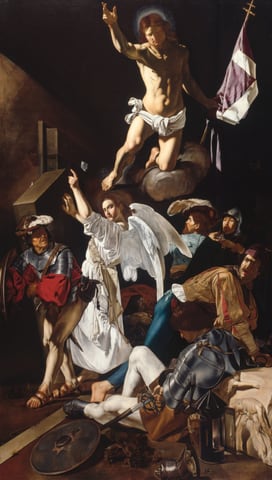
  2. A work made of oil on canvas.
    The ResurrectionCecco del Caravaggio, c. 1619-20Courtesy of the Art Institute of Chicago
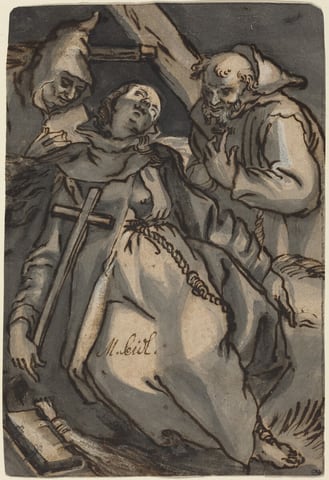
  3. The image displays three figures. The central figure is seated and supported by the other two. The central figure has wavy dark hair, eyes closed, and wears a robe with a cross. The figure on the left looks serene, while the one on the right holds onto the cross. The background is sketchy with dark and light contrast, possibly depicting a dimly lit or nighttime setting with visible wooden beams.
    Saint EuphrosyneMelchior Steidl, c. 1695Courtesy National Gallery of Art, Washington

Section 2, south wall
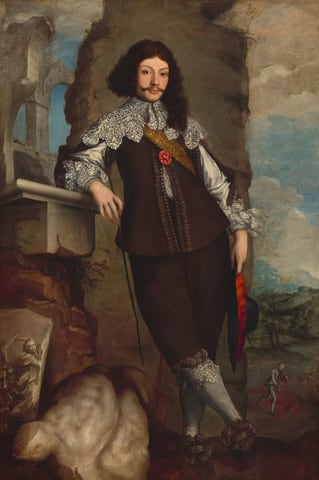
  1. Lodovico Widmann, by Tiberio Tinelli, probably 1637
    Lodovico WidmannTiberio Tinelli, probably 1637Courtesy National Gallery of Art, Washington
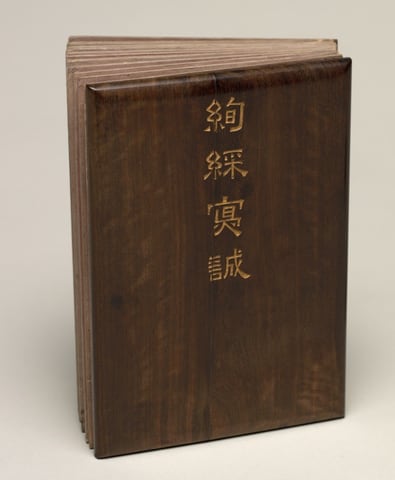
  2. Desk Album: Flower and Bird Paintings, by Zhang Ruoai, 1700s
    Desk Album: Flower and Bird PaintingsZhang Ruoai, 1700sCourtesy of the Cleveland Museum of Art
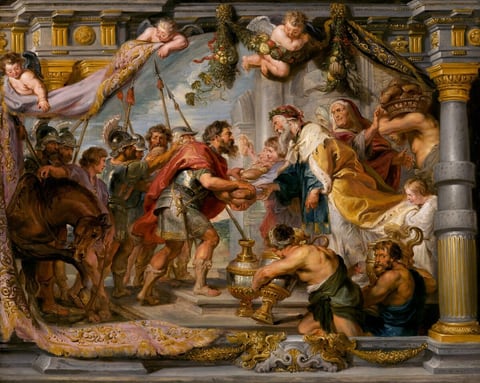
  3. This horizontal painting shows a tapestry being unfurled and held up by winged, baby-like putti against a structure with gray and gold columns, seen at the edges of the composition. Taking up most of the composition, the tapestry shows two ranks of men, women, and children gathered behind two central men, who meet at the center. All the people have light or tanned skin, and the bodies we can see are muscular. In the central pair of men, the one to our left, Abraham, faces our right in profile as he holds two loaves of bread. He has a brown beard and short, wavy hair, and dark brows over a prominent nose. He looks at the other man with dark eyes and leans toward him, to our right. Abraham wears an armored breastplate over silver chainmail edged with gold, which falls to mid-thigh. A crimson-red cape wraps around his shoulders and swirls around his back. A sword hangs by his hip, and tan sandals cover his heels and shins. Behind him are seven men and one brown horse, who gnaws at its foreleg. Most of the men are bearded and five wear armored helmets. A cleanshaven man wearing a lavender-purple tunic stands with his arm slung over the horse’s neck, holding the rein between thumb and forefinger. The man to our right, Melchizedek has a long white beard and short white hair. His red cap is encircled with a wreath of dark green leaves. He wears a long-sleeved, waist-length, aquamarine-blue garment over a white skirt. A heavy, golden-yellow cape with a broad, white fur collar and lining drapes over his shoulders, and is supported by at least one attendant. Behind and around Melchizedek are eight men, women, and children, standing near stone, gray ruins. Behind Melchizedek, one portly person wearing a dark pink mantle reaches into a basket of bread held across the shoulders of a blond, bearded, bare-chested man. Closer to us, in the lower right corner of the tapestry, one man wearing a green toga and another wearing blue kneel and sit, holding oversized silver and gold urns, the size of their torsos. The man in blue, to our right, turns to look at us over his shoulder. A third large urn sits near the other man. A view into the landscape with a low, green hill and a pale blue sky is glimpsed between the groups. The tapestry showing this scene curls over at the edges where the pudgy angels lift the top edge. The top right corner of the tapestry wraps around the edge of an unseen feature of the building, next to a gray column that rises the height of the painting up along the right edge. The border of the tapestry is rose pink with stylized gold designs. One putto with brown hair holds up the left corner, and one with light gray hair holds up the middle one arm slung over the front of the tapestry. The third putto, with blond hair, hooks an arm over a leafy garland with fruit that hangs from the cornice near the top center of the composition.
    The Meeting of Abraham and MelchizedekPeter Paul Rubens, c. 1626Courtesy National Gallery of Art, Washington

Section 2, north wall
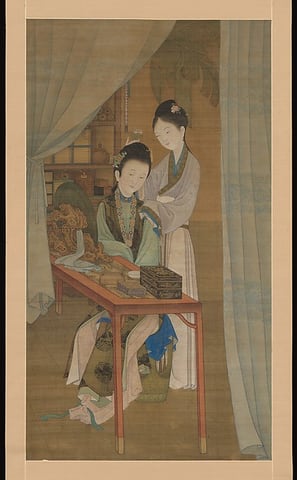
  1. Woman at her dressing table, by Leng Mei, early 18th century
    Woman at her dressing tableLeng Mei, early 18th centuryCourtesy of The Metropolitan Museum of Art
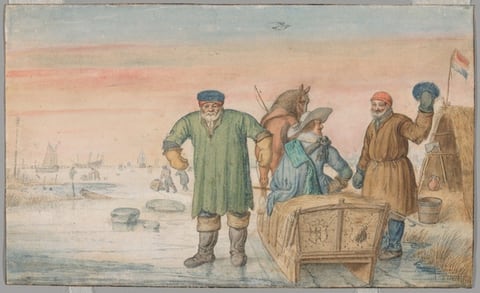
  2. A work made of opaque and translucent watercolors, with pen and brown ink, over graphite, on cream laid paper.
    Two Old Men beside a Sled Bearing the Coats of Arms of Amsterdam and UtrechtHendric Avercamp, 1620/33Courtesy of the Art Institute of Chicago
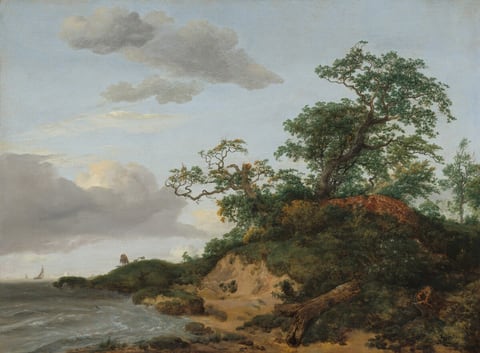
  3. Water laps at a curving shoreline in front of a steep sandy dune carpeted in grass, shrubs, and trees in this horizontal landscape painting. The dune takes up the lower right quadrant of the composition. A few broken tree trunks are overgrown with vines and plants across the top and down the sloping side of the dune facing us. A red brick wall cuts through the vegetation up the side of the dune and disappears into the shrubbery at the top. The twisting branches and canopies of three large trees reach into the upper right quadrant of the composition. The vegetation stops abruptly along the sheer edge of the dune where it faces the water. The land curves like a backward capital letter C so it almost reaches the left edge of the painting along the horizon, which comes a quarter of the way up the composition. A cow and three more animals, perhaps sheep or more cows, graze or lie on a grassy mound in the distance, and sailboats line the horizon in the deep distance. White ripples swirl in the steel-blue water. The artist signed and dated the lower center, “J Ruisdael . 1648.”
    Dunes by the SeaJacob van Ruisdael, 1648Courtesy National Gallery of Art, Washington
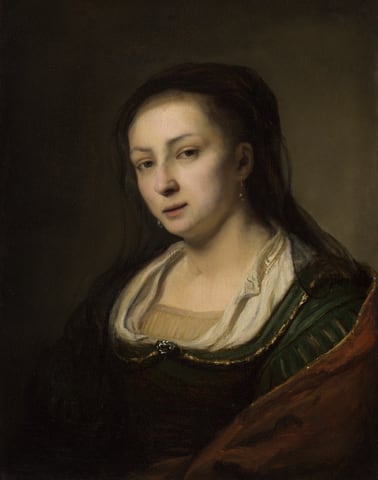
  4. A work made of oil on canvas.
    Portrait of a womanFerdinand Bol, c. 1655Courtesy of the Art Institute of Chicago

Section 3, north wall
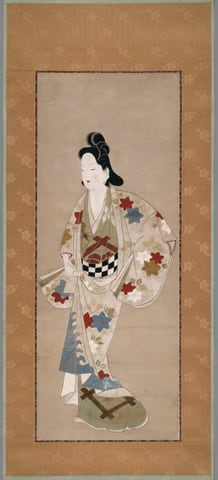
  1. A work made of hanging scroll; ink, color, and gold on paper.
    Standing BeautyUnrecorded Japanese maker, 1661/73Courtesy of the Art Institute of Chicago
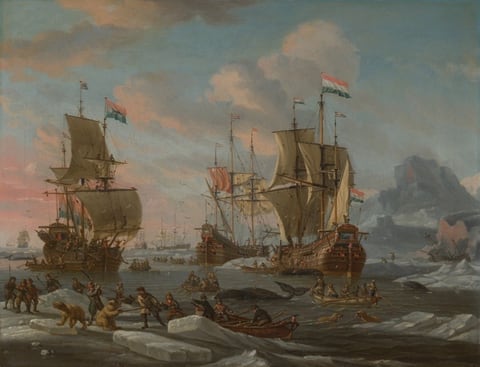
  2. A work made of oil on canvas.
    The Dutch Whaling FleetAbraham Storck, c. 1695Courtesy of the Art Institute of Chicago
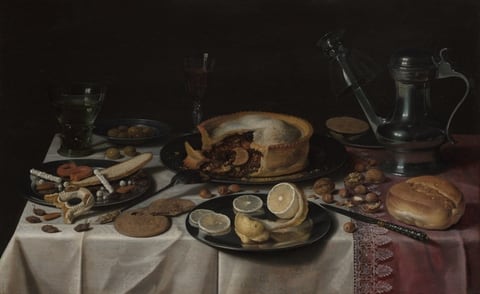
  3. A work made of oil on panel.
    Still LifePieter Claesz, c. 1625Courtesy of the Art Institute of Chicago