Floor plan

Time and place17th-century Netherlands
17th-century Netherlands
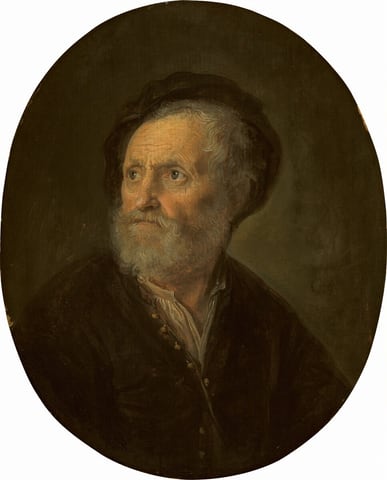
Shown from the chest up, a light-skinned man with a wrinkled face and a silvery gray beard and hair gazes into the distance in this oval portrait painting. His chest is angled to our right but he turns his head to look off over his other shoulder, to our left. His slate-blue eyes are a little sunken and lined with wrinkles. Shading marks the hollows of the temple and cheek we can see. His thin lips are closed and framed by his curly mustache and beard. A dark, mahogany-brown cap is pushed back on his head, and his brown jacket has gold-colored buttons down the front. The collar of a cream-colored shirt shows through at the neckline. The background is dark olive green. The artist signed the work near the man’s shoulder, to our right: “GDOV.”
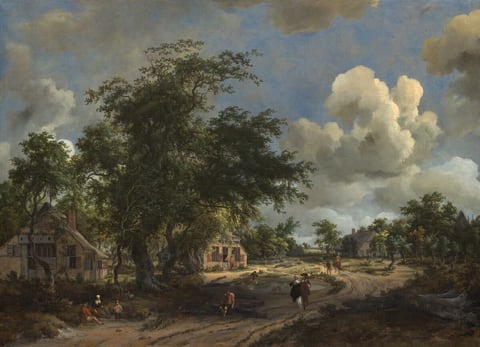
Several people sit, stand, or stroll along a dirt road that winds from the lower left corner of this horizontal landscape painting into the distance, past trees and cottages under a vivid blue sky. The horizon line comes about a third of the way up the canvas, and the cloud studded, azure-blue sky fills the space above. Sunlight filtered through puffy white and steel-gray clouds illuminates the scene from the upper right, creating patches of light and shadow throughout. The road meanders through the center of the composition and is lined with dark and sage-green shrubs, scrubby growth, and gnarled, crooked trees. Closest to us and to our left, two tan cottages are tucked into deep shade created by a grove of several tall trees. The cottages have steeply pitched roofs and windows flanked by gray or brick-red shutters. Three people sit and stand near the path outside the closest building. A short distance to our right, a man sitting on a fallen log carries walking stick and a bundle on his back. His body faces us but his head is turned to our right to gaze toward the man and woman about to stroll past him, headed in our direction. The woman wears a black dress over a white skirt, and a white head covering and shawl. The man wears a brimmed hat with a red decoration, a brown coat with gold buttons down the front and a wide white collar, and heeled shoes. Beyond them, the road curves to our left around a small pond in front of the second cottage. Two people crouch to set a toy sailboat afloat by the edge of the pond, and a brown dog sniffs the ground nearby. Two more people stand talking at the doorway to the second cottage and another dog leaps up at the half-door. Further along the road, the light becomes stronger, illuminating a horse, rider, and another person walking alongside the horse. The road continues to curve around a butter-yellow cottage nestled in a grove of trees on the right. A sunny field is visible in the far distance.
A work made of oil on canvas.
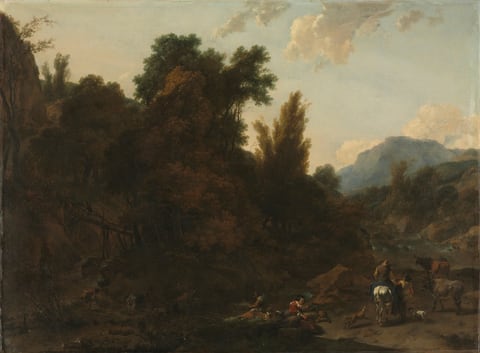
Rush Gatherers, by Nicolaes Berchem, 1657
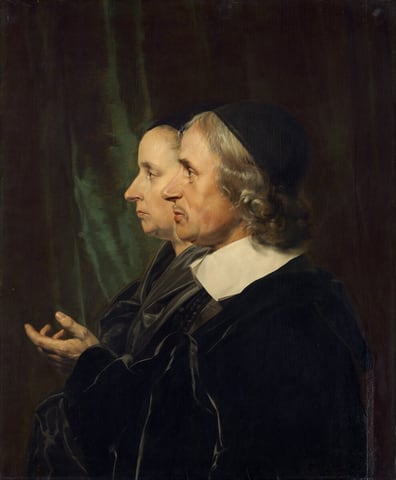
Shown from the shoulders up, a man and woman face our left in profile against a shadowy, dark green curtain in this vertical portrait painting. They both look steadily to our left, they and have pale skin and wear black. The man is closer to us so he overlaps the woman, whose profile is shifted to our left. A black cap sits on the man's curly, silver, shoulder-length hair. He has a slight double chin and soft jowls. A thin mustache curves over his upper lip, and a line of hair runs down his chin as a narrow beard. A broad, flat, white collar lies across his shoulders over a velvety black coat. He lifts his left hand, closer to us, in front of his chest with the fingers curled gently inward. The woman also has a double chin and soft jowls. Her thin lips are closed and downturned. Her hair is pulled back under a black covering, and her black garment has a sheen, suggesting satin.
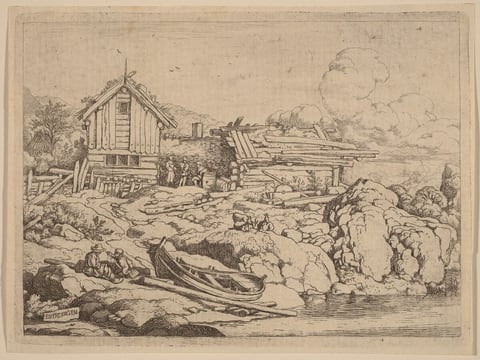
The image shows a landscape with figures near a body of water. There are buildings made of logs, people gathered near a structure, and trees in the background. The style is detailed with precise linework, shading, and hatching. The color palette is monochrome, emphasizing light and shadow.

The works in this room are listed below.

Works in this room

Works made in the Netherlands in the 17th century.

First room, north wall

  1. Shown from the chest up, a light-skinned man with a wrinkled face and a silvery gray beard and hair gazes into the distance in this oval portrait painting. His chest is angled to our right but he turns his head to look off over his other shoulder, to our left. His slate-blue eyes are a little sunken and lined with wrinkles. Shading marks the hollows of the temple and cheek we can see. His thin lips are closed and framed by his curly mustache and beard. A dark, mahogany-brown cap is pushed back on his head, and his brown jacket has gold-colored buttons down the front. The collar of a cream-colored shirt shows through at the neckline. The background is dark olive green. The artist signed the work near the man’s shoulder, to our right: “GDOV.”
    Bust of a Bearded ManGerrit Dou, c. 1642/1645Courtesy National Gallery of Art, Washington
  2. Several people sit, stand, or stroll along a dirt road that winds from the lower left corner of this horizontal landscape painting into the distance, past trees and cottages under a vivid blue sky. The horizon line comes about a third of the way up the canvas, and the cloud studded, azure-blue sky fills the space above. Sunlight filtered through puffy white and steel-gray clouds illuminates the scene from the upper right, creating patches of light and shadow throughout. The road meanders through the center of the composition and is lined with dark and sage-green shrubs, scrubby growth, and gnarled, crooked trees. Closest to us and to our left, two tan cottages are tucked into deep shade created by a grove of several tall trees. The cottages have steeply pitched roofs and windows flanked by gray or brick-red shutters. Three people sit and stand near the path outside the closest building. A short distance to our right, a man sitting on a fallen log carries walking stick and a bundle on his back. His body faces us but his head is turned to our right to gaze toward the man and woman about to stroll past him, headed in our direction. The woman wears a black dress over a white skirt, and a white head covering and shawl. The man wears a brimmed hat with a red decoration, a brown coat with gold buttons down the front and a wide white collar, and heeled shoes. Beyond them, the road curves to our left around a small pond in front of the second cottage. Two people crouch to set a toy sailboat afloat by the edge of the pond, and a brown dog sniffs the ground nearby. Two more people stand talking at the doorway to the second cottage and another dog leaps up at the half-door. Further along the road, the light becomes stronger, illuminating a horse, rider, and another person walking alongside the horse. The road continues to curve around a butter-yellow cottage nestled in a grove of trees on the right. A sunny field is visible in the far distance.
    A View on a High RoadMeindert Hobbema, 1665Courtesy National Gallery of Art, Washington
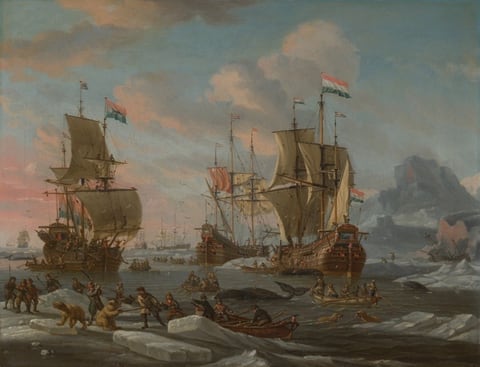
  3. A work made of oil on canvas.
    The Dutch Whaling FleetAbraham Storck, c. 1695Courtesy of the Art Institute of Chicago

First room, south wall

  1. Rush Gatherers, by Nicolaes Berchem, 1657
    Rush GatherersNicolaes Berchem, 1657Courtesy of the Cleveland Museum of Art
  2. Shown from the shoulders up, a man and woman face our left in profile against a shadowy, dark green curtain in this vertical portrait painting. They both look steadily to our left, they and have pale skin and wear black. The man is closer to us so he overlaps the woman, whose profile is shifted to our left. A black cap sits on the man's curly, silver, shoulder-length hair. He has a slight double chin and soft jowls. A thin mustache curves over his upper lip, and a line of hair runs down his chin as a narrow beard. A broad, flat, white collar lies across his shoulders over a velvety black coat. He lifts his left hand, closer to us, in front of his chest with the fingers curled gently inward. The woman also has a double chin and soft jowls. Her thin lips are closed and downturned. Her hair is pulled back under a black covering, and her black garment has a sheen, suggesting satin.
    Portrait of the Artist's Parents, Salomon de Bray and Anna WesterbaenJan de Bray, 1664Courtesy National Gallery of Art, Washington
  3. The image shows a landscape with figures near a body of water. There are buildings made of logs, people gathered near a structure, and trees in the background. The style is detailed with precise linework, shading, and hatching. The color palette is monochrome, emphasizing light and shadow.
    Boat at a River Bank with Three GoatsAllart van Everdingen, probably c. 1645/1656Courtesy National Gallery of Art, Washington

Second room, south wall
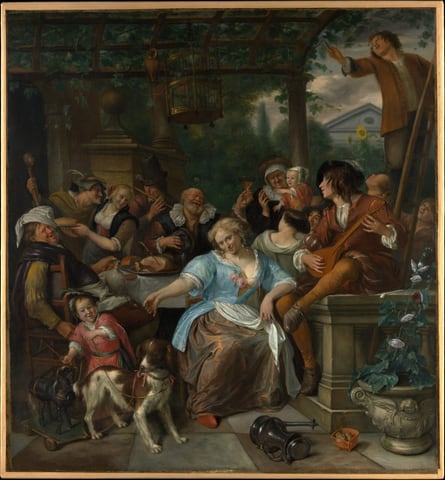
  1. Merry Company on a Terrace, by Jan Steen, ca. 1670
    Merry Company on a TerraceJan Steen, ca. 1670Courtesy of The Metropolitan Museum of Art
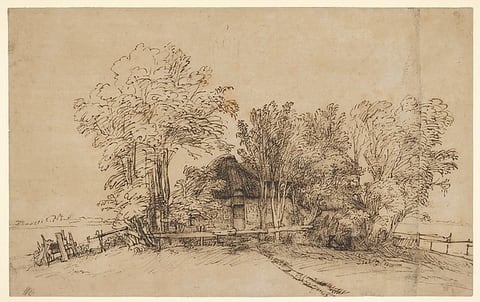
  2. Cottage among Trees, by Rembrandt van Rijn, ca. 1650
    Cottage among TreesRembrandt van Rijn, ca. 1650Courtesy of The Metropolitan Museum of Art
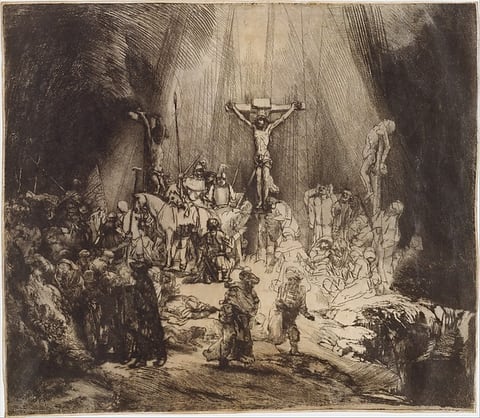
  3. Christ Crucified between the Two Thieves: The Three Crosses, by Rembrandt van Rijn, 1653
    Christ Crucified between the Two Thieves: The Three CrossesRembrandt van Rijn, 1653Courtesy of The Metropolitan Museum of Art

Second room, north wall
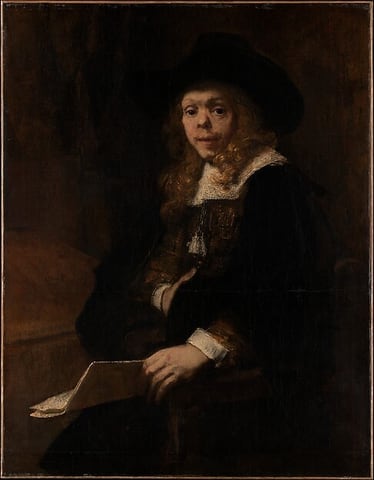
  1. Portrait of Gerard de Lairesse, by Rembrandt van Rijn, 1665–67
    Portrait of Gerard de LairesseRembrandt van Rijn, 1665–67Courtesy of The Metropolitan Museum of Art
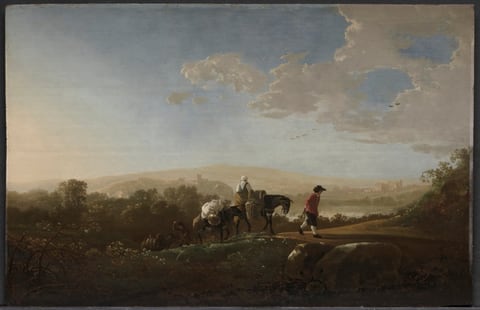
  2. Travelers in Hilly Countryside, by Aelbert Cuyp, c. 1650
    Travelers in Hilly CountrysideAelbert Cuyp, c. 1650Courtesy of the Cleveland Museum of Art
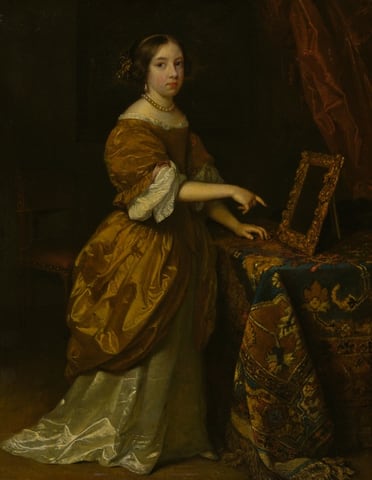
  3. A work made of oil on panel.
    Girl Standing before a MirrorCaspar Netscher, 1668Courtesy of the Art Institute of Chicago

Third room, north wall
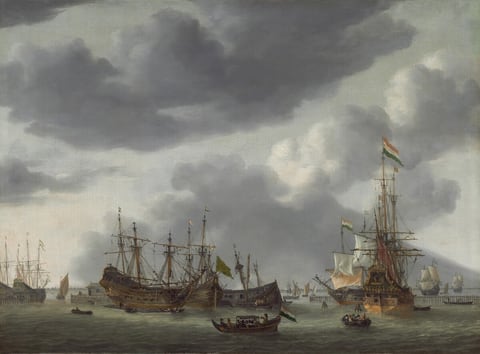
  1. A sage-green harbor teems with more than a dozen sailing ships and rowboats under a pale gray sky in this horizontal painting. The horizon comes about one-fifth of the way up the composition, and dark gray and white clouds tower above. Light filters onto the scene through the clouds from our left to fall across the ships while casting shadows on the water nearest us. Painted in tones of slate gray and warm brown, most of the ships closest to us have their sails furled so the masts and horizontal yard arms bristle against the sky. The larger ships have cannons poking out of square portholes. On our right, a war ship floats with its ornately carved and gilded stern facing us. A flag flying from the tallest of the three masts has red, white, and green stripes. The artist painted his name on that flag, “R. Zeeman.” The ship is tied to a buoy with a length of rope, and an empty rowboat is tethered to the right side of the ship. A similar ship but with the sails hanging loosely is tied to a buoy just beyond this one. A row of pickets, like a fence, extends into the water behind these two ships. To our left, a rowboat full of men has pulled up alongside a partially sunken ship, its masts tilting toward us. A few people stand on two more ships nearby. A black temporary dock floats next to the leftmost ship here. A person mixes something that smokes on the platform, and another person stands on a board lifted halfway up the ship’s side, presumably working on a repair. Two women in another rowboat next to the floating dock lean over the side, washing clothes. Another fence encloses the harbor to our left, and a hut in the middle of the harbor is surrounded by a similar structure. Two rowboats closer to us are filled with men wearing tall hats and black or brown coats, and women wearing black bonnets and white shawls. More sailing ships and rowboats move back or around beyond the harbor, out to sea. Visible cracks cover the surface of the painting.
    Amsterdam Harbor SceneReinier Nooms, called Zeeman, c. 1654/1655Courtesy National Gallery of Art, Washington
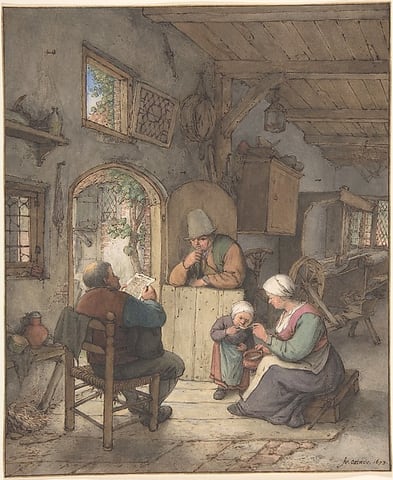
  2. Reading the News at the Weavers' Cottage, by Adriaen van Ostade, 1673
    Reading the News at the Weavers' CottageAdriaen van Ostade, 1673Courtesy of The Metropolitan Museum of Art

Third room, south wall
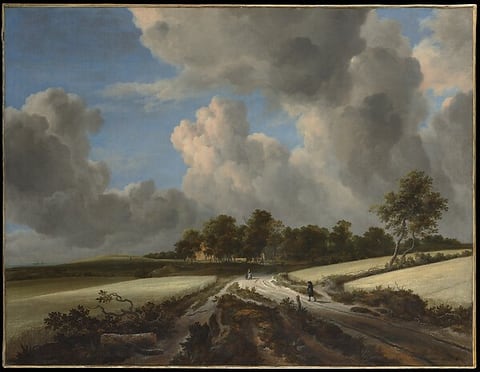
  1. Wheat Fields, by Jacob van Ruisdael, ca. 1670
    Wheat FieldsJacob van Ruisdael, ca. 1670Courtesy of The Metropolitan Museum of Art
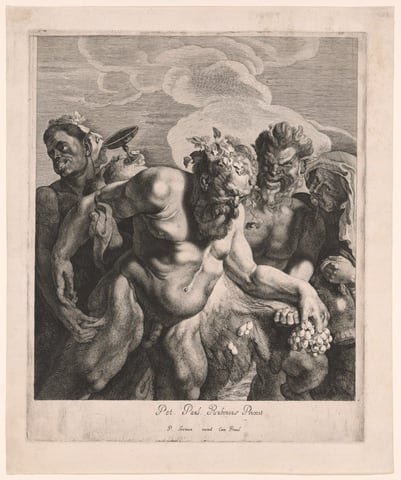
  2. A work made of engraving in black on cream laid paper.
    Drunken SilenusJonas Suyderhoef, 1642Courtesy of the Art Institute of Chicago