Floor plan

Time and placeThe 16th century

The 16th century

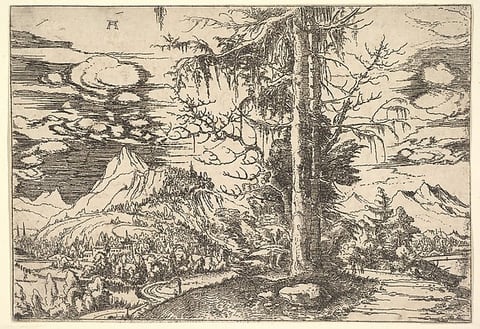
Landscape with a Double Spruce, by Albrecht Altdorfer, ca. 1521–22
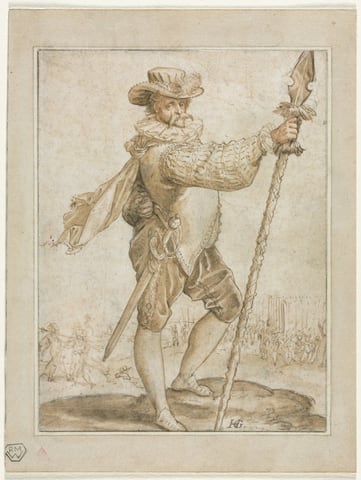
Standing Officer Holding a Boar's Spear, by Hendrick Goltzius, 1586
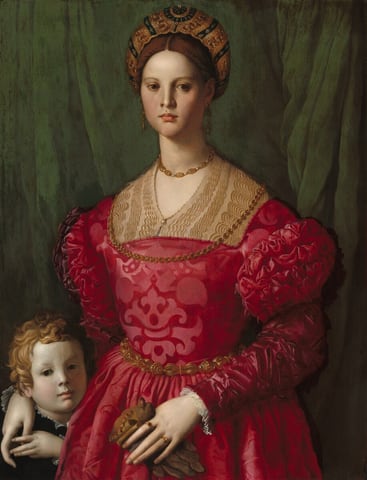
A woman wearing a crimson-red brocade dress and gold jewelry fills most of this vertical portrait, but her right hand, on our left, rests on the shoulder of a young boy tucked into the lower left corner of the panel. The woman and boy both have pale, white skin, and both face and look out at us against an emerald-green curtain that falls behind them. The woman has brown eyes, a straight nose, full pink lips, smooth cheeks, and a long neck. Her brown hair is pulled back under a turban densely embroidered with gold. The woman’s dress has puffed shoulders and decorative slashes on the sleeves. One gold chain rests on her throat and the other falls over her chest. She wears long gold earrings, a gold belt, and two gold rings. She holds a brown leather glove in her left hand. The boy’s face is even with the woman’s waist, and he raises his left hand to hold hers, which is draped over his shoulder. He has curly blond hair and dark eyes, and he wears black with a ruffled white shirt just visible at his collar.
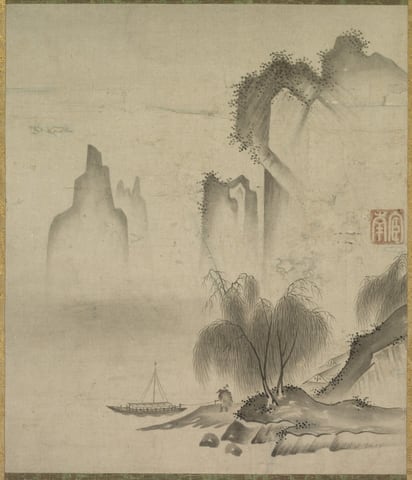
Figure Mooring a Boat, by Kannan, mid-1500s
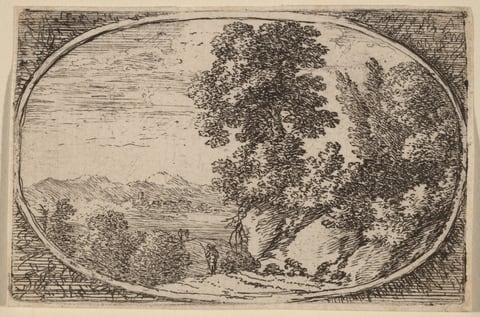
The image shows a landscape viewed from above. The scene is oval, framed by tree branches on each side. Distant mountains form a boundary near the top. Delicate, finely executed lines create detailed foliage and landscape features. A winding path with a small figure adds scale. Lush trees climb upwards, with a muted color palette of the paper and dark brown and black lines providing contrast.
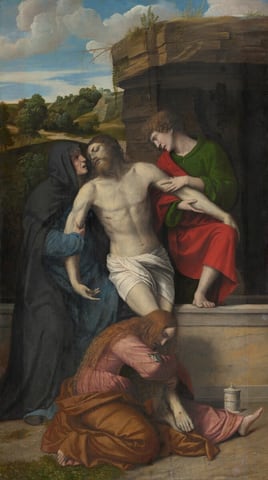
Two women and a man support the gray, lifeless body of a nearly nude man along a stone ledge in this vertical painting. The people have pale skin, except for the dead man at the center, Jesus, who has ash-white skin with dark shadows around his closed eyes. He has a long straight nose, and his lips are slightly parted. He has a brown beard, and his long, wavy hair falls away from his face. A white cloth wraps across his hips, and blood trickles from a gash over his right ribs and holes in his feet. A woman and man prop him up on either side, each holding Jesus by a limp arm, and each has a faint, gold halo encircling their heads. To our left, the woman holds her face close to his, her brows deeply furrowed and her mouth wide open, teeth showing. Her forehead, chin, and neck are covered by a white veil, worn under navy-blue cloak that covers her head and body. The cloak falls open over one arm and a bent knee to reveal her long-sleeved, lighter blue dress. On Jesus’s other side, a cleanshaven man with curly brown hair holds Jesus’s arm with both hands. The man’s eyes squint with tears as he tips his head toward Jesus. His pink lips are parted, and the corner of the mouth we can see is pulled down. He wears an emerald-green, long-sleeved tunic under a vivid red cloth that wraps around his right arm, waist, and left leg. The fourth and final person is a woman sitting on the ground, her arms wrapped tightly around Jesus’s crossed ankles. She sits with one foot tucked under her body and the other leg out straight. Waist-length, wavy, auburn-brown hair falls freely over her shoulders and across her face, but we can see her downturned, open mouth and nearly closed eyes. She wears a rose-pink dress, cinched at the waist. A brown cloth wraps around her waist and right leg. A cylindrical, lidded, white jar sits on the dirt ground nearby. The group is arranged in front a thigh-high stone ledge, except for the man in green and red, who steps into what is presumably the coffin. A rocky outcropping to our right has a cave-like opening with grasses and growth along the top. The landscape beyond has a dirt path winding between pine-green hills dotted with trees. Two slate-blue buildings perch atop one hill. White clouds float across the blue sky above.
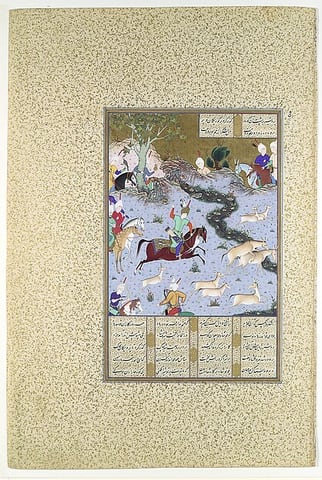
"Bahram Gur Pins the Coupling Onagers", Folio 568r from the Shahnama (Book of Kings) of Shah Tahmasp, by Abu'l Qasim Firdausi, ca. 1530–35

The works in this room are listed below.

Works in this room

Works made in the 16th century, anywhere in the world.

First room, north wall

  1. Landscape with a Double Spruce, by Albrecht Altdorfer, ca. 1521–22
    Landscape with a Double SpruceAlbrecht Altdorfer, ca. 1521–22Courtesy of The Metropolitan Museum of Art
  2. Standing Officer Holding a Boar's Spear, by Hendrick Goltzius, 1586
    Standing Officer Holding a Boar's SpearHendrick Goltzius, 1586Courtesy of the Cleveland Museum of Art
  3. A woman wearing a crimson-red brocade dress and gold jewelry fills most of this vertical portrait, but her right hand, on our left, rests on the shoulder of a young boy tucked into the lower left corner of the panel. The woman and boy both have pale, white skin, and both face and look out at us against an emerald-green curtain that falls behind them. The woman has brown eyes, a straight nose, full pink lips, smooth cheeks, and a long neck. Her brown hair is pulled back under a turban densely embroidered with gold. The woman’s dress has puffed shoulders and decorative slashes on the sleeves. One gold chain rests on her throat and the other falls over her chest. She wears long gold earrings, a gold belt, and two gold rings. She holds a brown leather glove in her left hand. The boy’s face is even with the woman’s waist, and he raises his left hand to hold hers, which is draped over his shoulder. He has curly blond hair and dark eyes, and he wears black with a ruffled white shirt just visible at his collar.
    A Young Woman and Her Little BoyAgnolo Bronzino, c. 1540Courtesy National Gallery of Art, Washington
  4. Figure Mooring a Boat, by Kannan, mid-1500s
    Figure Mooring a BoatKannan, mid-1500sCourtesy of the Cleveland Museum of Art

First room, south wall

  1. The image shows a landscape viewed from above. The scene is oval, framed by tree branches on each side. Distant mountains form a boundary near the top. Delicate, finely executed lines create detailed foliage and landscape features. A winding path with a small figure adds scale. Lush trees climb upwards, with a muted color palette of the paper and dark brown and black lines providing contrast.
    The Boulder Crowned with TreesHerman van SwaneveltCourtesy National Gallery of Art, Washington
  2. Two women and a man support the gray, lifeless body of a nearly nude man along a stone ledge in this vertical painting. The people have pale skin, except for the dead man at the center, Jesus, who has ash-white skin with dark shadows around his closed eyes. He has a long straight nose, and his lips are slightly parted. He has a brown beard, and his long, wavy hair falls away from his face. A white cloth wraps across his hips, and blood trickles from a gash over his right ribs and holes in his feet. A woman and man prop him up on either side, each holding Jesus by a limp arm, and each has a faint, gold halo encircling their heads. To our left, the woman holds her face close to his, her brows deeply furrowed and her mouth wide open, teeth showing. Her forehead, chin, and neck are covered by a white veil, worn under navy-blue cloak that covers her head and body. The cloak falls open over one arm and a bent knee to reveal her long-sleeved, lighter blue dress. On Jesus’s other side, a cleanshaven man with curly brown hair holds Jesus’s arm with both hands. The man’s eyes squint with tears as he tips his head toward Jesus. His pink lips are parted, and the corner of the mouth we can see is pulled down. He wears an emerald-green, long-sleeved tunic under a vivid red cloth that wraps around his right arm, waist, and left leg. The fourth and final person is a woman sitting on the ground, her arms wrapped tightly around Jesus’s crossed ankles. She sits with one foot tucked under her body and the other leg out straight. Waist-length, wavy, auburn-brown hair falls freely over her shoulders and across her face, but we can see her downturned, open mouth and nearly closed eyes. She wears a rose-pink dress, cinched at the waist. A brown cloth wraps around her waist and right leg. A cylindrical, lidded, white jar sits on the dirt ground nearby. The group is arranged in front a thigh-high stone ledge, except for the man in green and red, who steps into what is presumably the coffin. A rocky outcropping to our right has a cave-like opening with grasses and growth along the top. The landscape beyond has a dirt path winding between pine-green hills dotted with trees. Two slate-blue buildings perch atop one hill. White clouds float across the blue sky above.
    PietàMoretto da Brescia, 1520sCourtesy National Gallery of Art, Washington
  3. "Bahram Gur Pins the Coupling Onagers", Folio 568r from the Shahnama (Book of Kings) of Shah Tahmasp, by Abu'l Qasim Firdausi, ca. 1530–35
    "Bahram Gur Pins the Coupling Onagers", Folio 568r from the Shahnama (Book of Kings) of Shah TahmaspAbu'l Qasim Firdausi, ca. 1530–35Courtesy of The Metropolitan Museum of Art

Second room, south wall
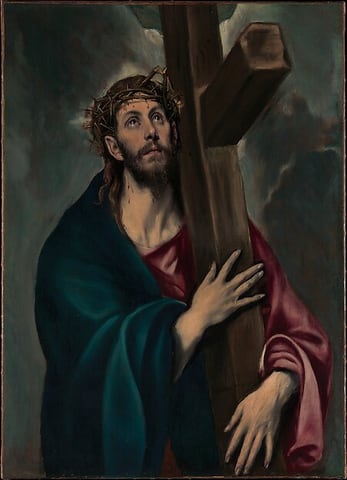
  1. Christ Carrying the Cross, by El Greco, ca. 1577–87
    Christ Carrying the CrossEl Greco, ca. 1577–87Courtesy of The Metropolitan Museum of Art
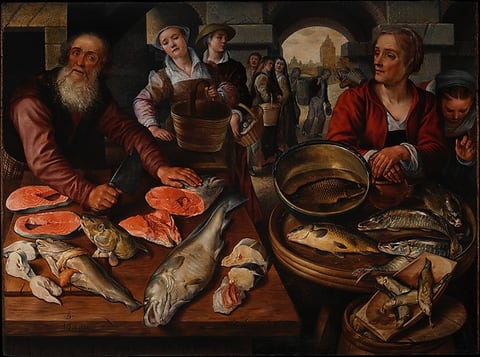
  2. Fish Market, by Joachim Beuckelaer, 1568
    Fish MarketJoachim Beuckelaer, 1568Courtesy of The Metropolitan Museum of Art
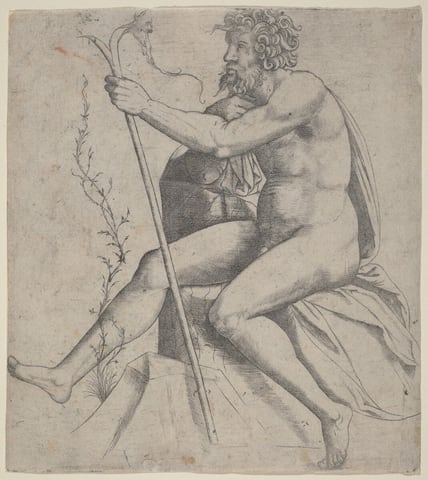
  3. The image shows a man seated with a slight forward tilt. He is muscular, with one leg bent and the other extended. His head is turned to the left in profile, revealing his facial features, which include a large nose, full beard, and curly hair. He appears naked except for a fabric drape over his shoulders. In his left hand, he holds a staff, and there is a plant with twisting vines near him. The background is a shaded rocky surface with no other details.
    Man Seated Holding a Forked StaffGiovanni Antonio da Brescia, c. 1514/1515Courtesy National Gallery of Art, Washington

Second room, north wall
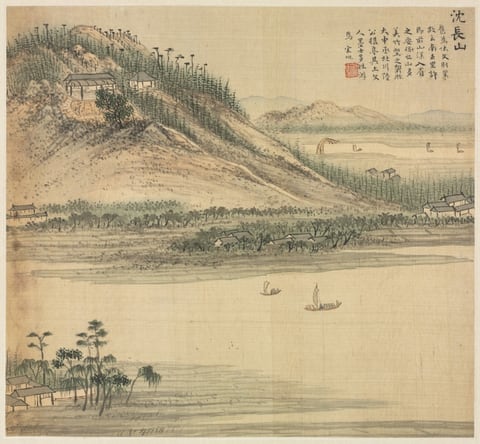
  1. Mt. Shenchang, by Song Xu, c. 1588
    Mt. ShenchangSong Xu, c. 1588Courtesy of the Cleveland Museum of Art
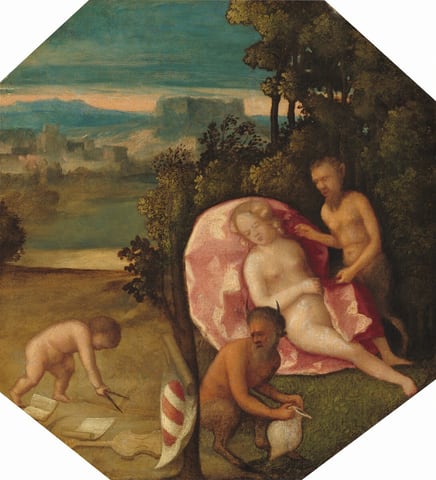
  2. A nude woman, pudgy child, and two satyrs, which have men’s heads and torsos with goat’s legs and horns, are in a landscape in this octagonal painting. The scene is divided in half by a tree stump which only reaches to the center of the composition. To the left of the stump, the pale-skinned, nude child stands and hunches over to draw on the ground with a V-shaped compass. Two pieces of paper and a violin lie nearby. The landscape behind him has a body of water leading back to a town with buildings streaked with peach, perhaps flames. A band of peach sky separates the blue silhouettes of mountains lining the horizon from the vivid blue sky above. At the bottom center of the painting, a shield with an oval horizontally striped with red and white leans on the boy’s side of the tree, which has one leafy branch growing on the left side. One satyr holds a jug and kneels close to the tree with his back to it as he looks back over one shoulder. He and the other satyr both have dark, peach-toned skin and full beards. The second satyr hovers to the right of the nude, sleeping woman, both hands reaching for her or the rose-pink cloth surrounding her. The woman has blond curls, a round face, and she sleeps with one hand resting across her belly and her head tipped to our left. The trio are on a grassy area enclosed by dense, dark-green bushes and trees.
    AllegoryPietro degli Ingannati, c. 1515-1525Courtesy National Gallery of Art, Washington
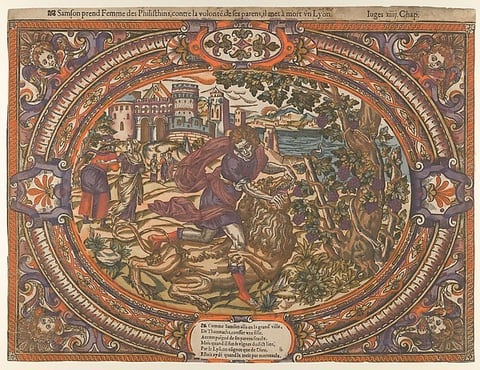
  3. Samson and the Lion, from "The Story of Samson", ca. 1560–80
    Samson and the Lion, from "The Story of Samson"Unrecorded French maker, ca. 1560–80Courtesy of The Metropolitan Museum of Art
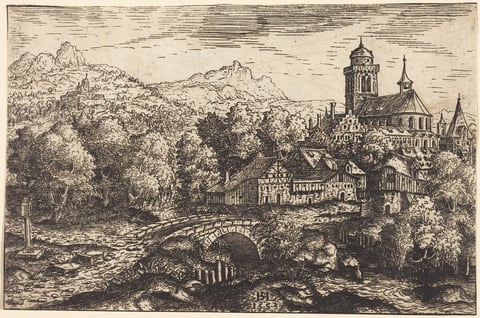
  4. The image features a landscape view of a medieval village scene. It includes a stone bridge over a river, buildings, a church with a tower, trees, hills, mountains, and cloudy sky. The image is depicted in intricate detail using a monochromatic palette, focusing on contrasts of light and shadow.
    Mountainous Landscape with a VillageHanns Lautensack, 1553Courtesy National Gallery of Art, Washington

Third room, north wall
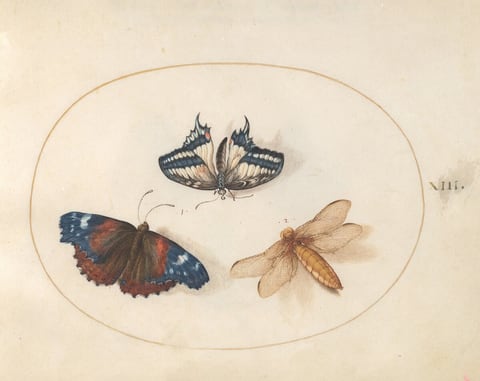
  1. Three insects are depicted in the image: a butterfly with dark blue and red wings on the bottom left, a larger butterfly with white, black, and blue patterns at the top center, and a dragonfly with brown and gold tones on the bottom right. The color palette includes rich blues, reds, browns, and golds against a neutral background. The central butterfly is positioned higher than the other two insects, with the left butterfly and right dragonfly symmetrically arranged below.
    Plate 13: Yellow Swallowtail and Red Admiral Butterflies with a Dragonfly (Broad-Bodied Chaser?)Joris Hoefnagel, c.1575/1590sCourtesy National Gallery of Art, Washington
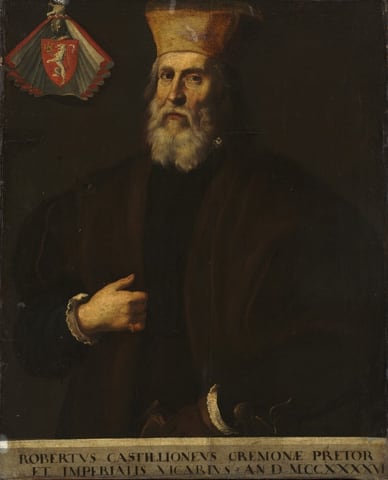
  2. Portrait of Roberto Castiglione, early 1600s
    Portrait of Roberto CastiglioneUnrecorded Italian maker, early 1600sCourtesy of the Cleveland Museum of Art