Floor plan

Time and placeThe 16th century

The 16th century

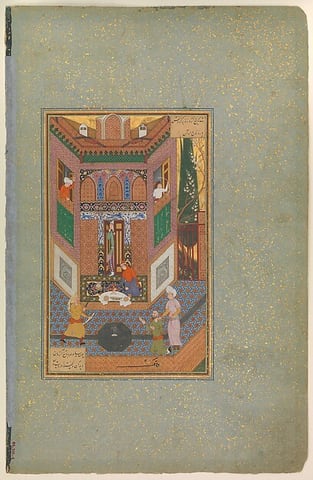
"A Ruffian Spares the Life of a Poor Man", Folio 4v from a Mantiq al-Tayr (Language of the Birds), by Farid al-Din `Attar, ca. 1600
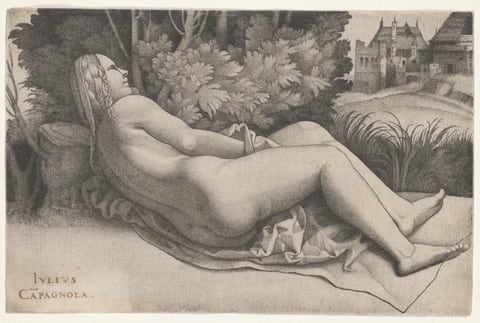
Venus Reclining in a Landscape, by Giulio Campagnola, c. 1508–9
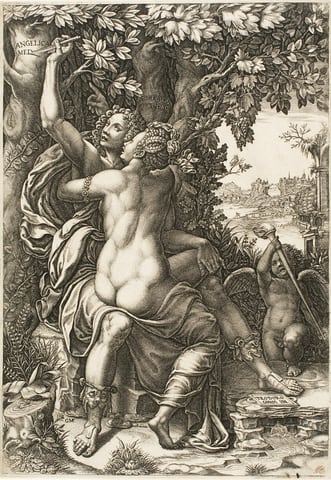
A work made of engraving in black on ivory laid paper.
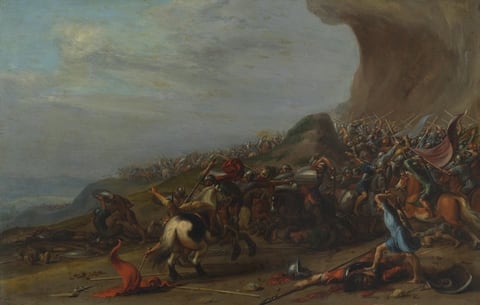
A work made of oil on copper.
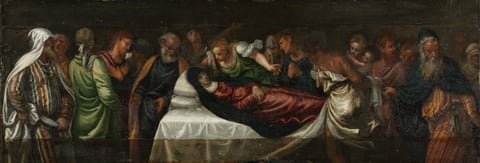
Death of the Virgin, mid-1500s
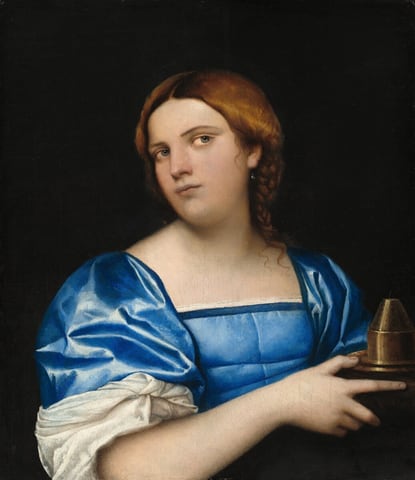
A young woman with a pale, peachy skin is shown from waist up, wearing a shimmering, royal-blue dress in this vertical painting. Her body is angled to our right as she holds a metal object, perhaps a vessel or incense burner, in her hands by her chest. She turns and tilts her head to our left, but then looks back across her body, off to our right with flint-gray eyes. She has a full, oval-shaped face with a straight nose, smooth cheeks, and her pale pink lips are closed. A gray pearl earring hangs from the ear we can see. Her auburn-brown hair is parted down the middle, and loosely pulled back into a braid that brushes her left shoulder, to our right. The blue dress has a square neckline and a fitted bodice. Light glints off the fabric, shading it from royal to sapphire blue. A voluminous white sleeve is rolled back to her right elbow, to our left. That arm and hand nearly span the width of the painting as she holds the vessel, which has a conical top, near the lower right corner of the composition. The background is solid black.
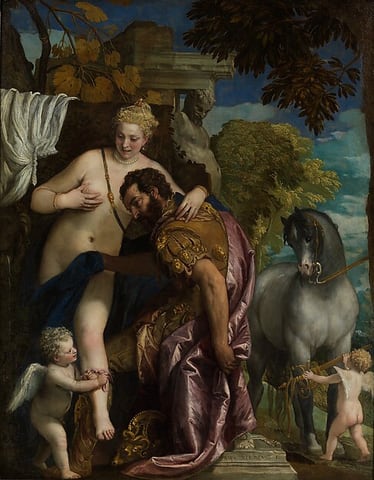
Mars and Venus United by Love, by Paolo Veronese (Paolo Caliari), 1570s

The works in this room are listed below.

Works in this room

Works made in the 16th century, anywhere in the world.

First room, north wall

  1. "A Ruffian Spares the Life of a Poor Man", Folio 4v from a Mantiq al-Tayr (Language of the Birds), by Farid al-Din `Attar, ca. 1600
    "A Ruffian Spares the Life of a Poor Man", Folio 4v from a Mantiq al-Tayr (Language of the Birds)Farid al-Din `Attar, ca. 1600Courtesy of The Metropolitan Museum of Art
  2. Venus Reclining in a Landscape, by Giulio Campagnola, c. 1508–9
    Venus Reclining in a LandscapeGiulio Campagnola, c. 1508–9Courtesy of the Cleveland Museum of Art
  3. A work made of engraving in black on ivory laid paper.
    Angelica and MedoroGiorgio Ghisi, c. 1570Courtesy of the Art Institute of Chicago
  4. A work made of oil on copper.
    David Slaying GoliathDutch, 1600–50Courtesy of the Art Institute of Chicago

First room, south wall

  1. Death of the Virgin, mid-1500s
    Death of the VirginUnrecorded Italian maker, mid-1500sCourtesy of the Cleveland Museum of Art
  2. A young woman with a pale, peachy skin is shown from waist up, wearing a shimmering, royal-blue dress in this vertical painting. Her body is angled to our right as she holds a metal object, perhaps a vessel or incense burner, in her hands by her chest. She turns and tilts her head to our left, but then looks back across her body, off to our right with flint-gray eyes. She has a full, oval-shaped face with a straight nose, smooth cheeks, and her pale pink lips are closed. A gray pearl earring hangs from the ear we can see. Her auburn-brown hair is parted down the middle, and loosely pulled back into a braid that brushes her left shoulder, to our right. The blue dress has a square neckline and a fitted bodice. Light glints off the fabric, shading it from royal to sapphire blue. A voluminous white sleeve is rolled back to her right elbow, to our left. That arm and hand nearly span the width of the painting as she holds the vessel, which has a conical top, near the lower right corner of the composition. The background is solid black.
    Portrait of a Young Woman as a Wise VirginSebastiano del Piombo, c. 1510Courtesy National Gallery of Art, Washington
  3. Mars and Venus United by Love, by Paolo Veronese (Paolo Caliari), 1570s
    Mars and Venus United by LovePaolo Veronese (Paolo Caliari), 1570sCourtesy of The Metropolitan Museum of Art

Second room, south wall
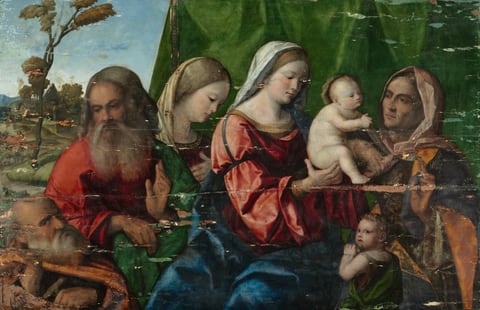
  1. Virgin and Child with Saints, c. 1510
    Virgin and Child with SaintsUnrecorded Italian maker, c. 1510Courtesy of the Cleveland Museum of Art
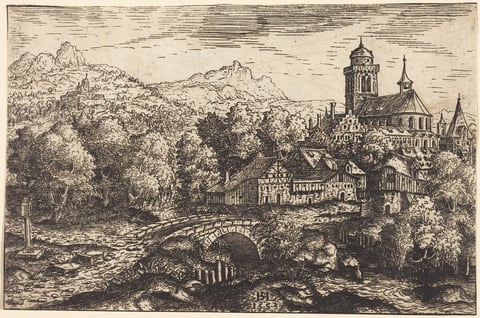
  2. The image features a landscape view of a medieval village scene. It includes a stone bridge over a river, buildings, a church with a tower, trees, hills, mountains, and cloudy sky. The image is depicted in intricate detail using a monochromatic palette, focusing on contrasts of light and shadow.
    Mountainous Landscape with a VillageHanns Lautensack, 1553Courtesy National Gallery of Art, Washington
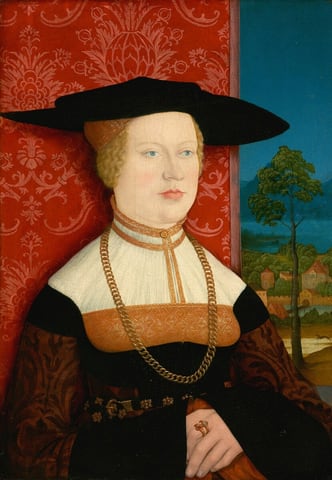
  3. Shown from the waist up, a light-skinned woman sits angled slightly to our right in this vertical portrait painting. The woman has blue eyes, faint brows, and a sloping nose ending in a small bulb. Her upper lip is thin and her lower lip full over a slight double chin. Her blond hair is pulled back under a gold, cap-like headdress and a black, wide-brimmed hat with a shallow crown. She wears a high-necked white, black, and gold dress with intricate detailing, a gold chain necklace that falls to her waist, and a black belt with a gold clasp and medallions. She wears two gold rings set with gems on the pointer finger of her left hand, which is folded across her belly over the other hand. A scarlet-red wallcovering with pink floral designs fills two-thirds of the space behind her. The rightmost third of the background opens onto a landscape with a tall, spindly tree, a leaping animal, presumably a dog, and a bridge across a body of water leading to a town. Across another body of water, perhaps a lake, mountains are marine blue in the distance under a clear, celestial-blue sky.
    Margarethe Vöhlin [obverse]Bernhard Strigel, 1527Courtesy National Gallery of Art, Washington
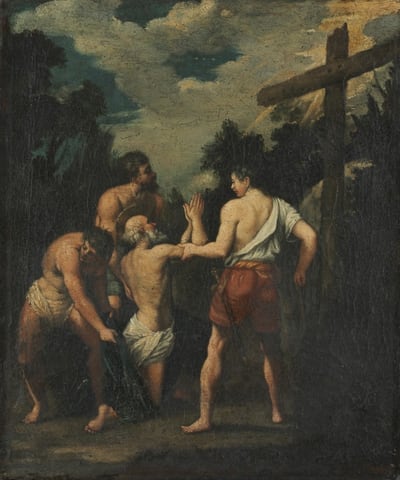
  4. Martyrdom of Saint Andrew, by Guido Reni, 1600s
    Martyrdom of Saint AndrewGuido Reni, 1600sCourtesy of the Cleveland Museum of Art

Second room, north wall
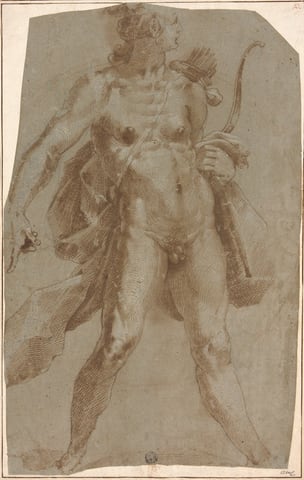
  1. A work made of pen and brown ink, heightened with lead white (partly discolored), over black chalk, on blue laid paper, laid down on ivory laid paper.
    ApolloJan Harmensz. Muller, c. 1600-1620Courtesy of the Art Institute of Chicago
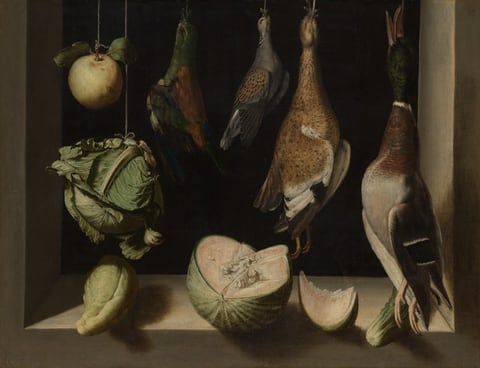
  2. Still life painting of dead waterfowl and vegetables in windowsill.
    Still Life with Game FowlJuan Sánchez Cotán, c. 1600–3Courtesy of the Art Institute of Chicago
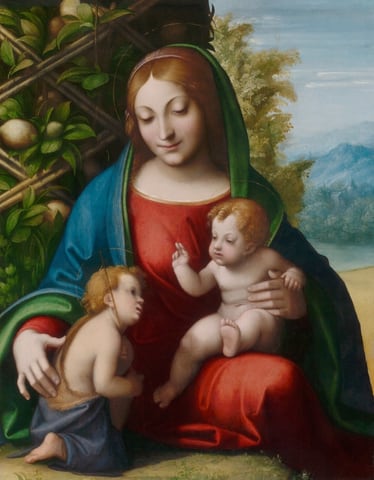
  3. Vividly colored painting of Virgin Mary with baby Jesus and baby John the Baptist.
    Virgin and Child with the Young Saint John the BaptistAntonio da Correggio, c. 1515Courtesy of the Art Institute of Chicago

Third room, north wall
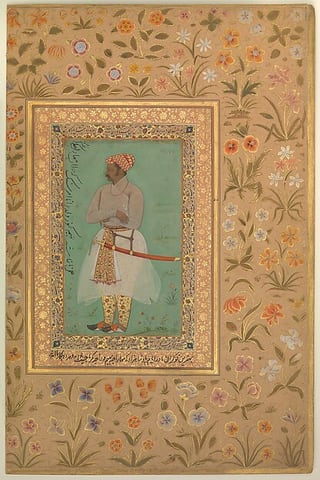
  1. "Portrait of Maharaja Bhim Kanwar", Folio from the Shah Jahan Album, by Nanha, verso: ca. 1615–29; recto: ca. 1540
    "Portrait of Maharaja Bhim Kanwar", Folio from the Shah Jahan AlbumNanha, verso: ca. 1615–29; recto: ca. 1540Courtesy of The Metropolitan Museum of Art
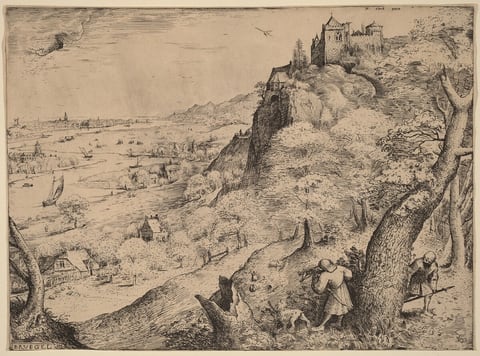
  2. The image shows a landscape with a city in the distance, a castle on a cliff, fields, forests, and two figures with a dog hunting. There are sailboats on water and houses on farmland. The style is detailed with etching lines in sepia tones.
    The Rabbit HuntersPieter Bruegel, 1560Courtesy National Gallery of Art, Washington