Floor plan

Time and placeThe 15th century

The 15th century

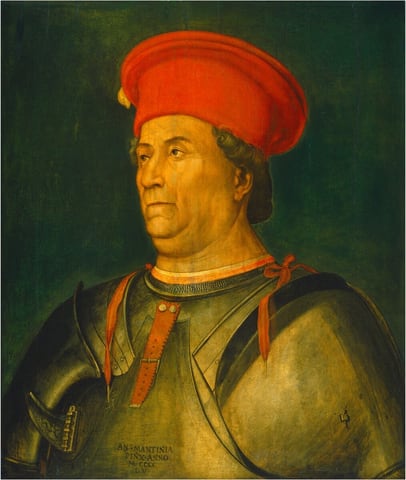
This painting shows an upper-body portrait of a man in a three-quarter view, turned to the left. He has a prominent double chin, a slightly furrowed brow, thin lips, and a serious expression. He has pale yellow skin and short, dark hair, and he wears a large, red hat. He is clad in silver armor with red straps on his shoulder and chest. The background is a simple, dark green color.
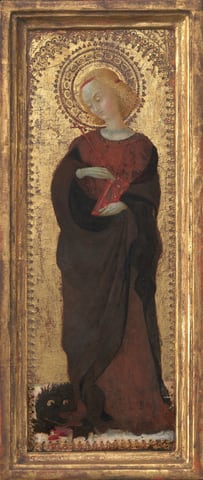
This painting shows a person standing, their body turned to us, with their head looking downward to the left. The person has pale skin, round, rosy cheeks, and wavy yellow hair surrounded by a golden halo with intricate patterns. They are wearing a dark robe over a dark red dress or tunic and holding a long, thin red cross in one hand, while the other hand holds a closed red book. At their feet lies a black dog-like animal with wide yellow eyes. The scene is set against a golden textured background within a gilded border.
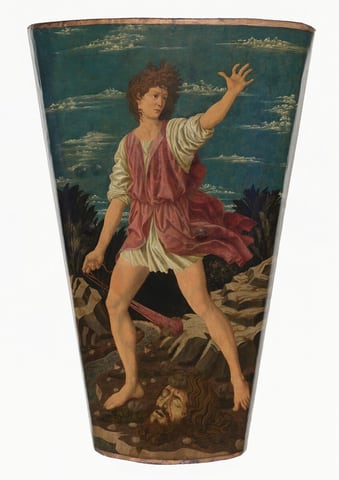
This shield-shaped painting shows a young man with pale, peachy skin and curling brown hair standing astride the severed head of a man with dark hair and tanned skin. The painting is wider at the top and tapers like a pint glass to a narrower base. The young man, David, holds the end of long red slingshot with his right hand. The slingshot is weighted by a rock and swings behind his body. His sleeveless rust-red garment is cinched at his waist over a long white shirt. Both garments skim David’s thighs and his legs and feet are bare. Long, curling brown hair frames the ashen and bloodied upturned face of the head at David’s feet. A palm-sized stone is embedded in that forehead. The landscape background is made up of gray boulders, a meandering river, and low palm-like trees. Frothy white clouds sweep across an azure-blue sky.
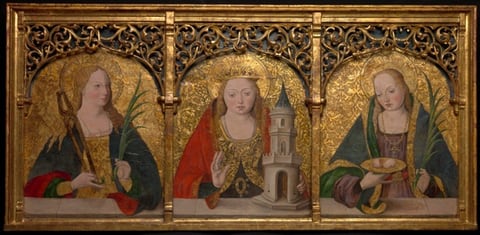
A work made of tempera on panel.
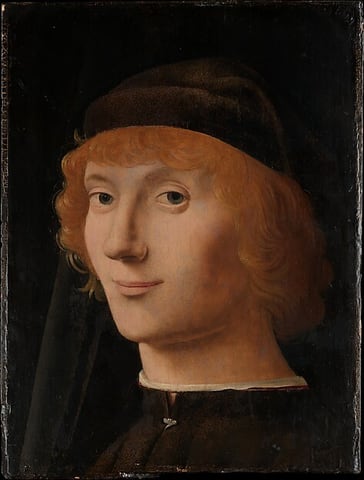
Portrait of a Young Man, by Antonello da Messina (Antonello di Giovanni d'Antonio), ca. 1470
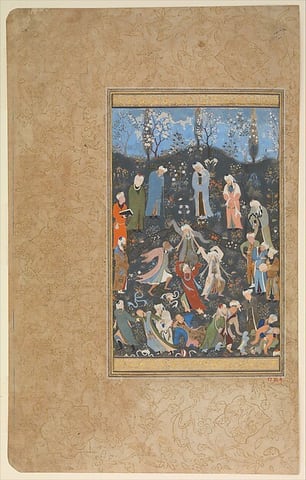
"Dancing Dervishes", Folio from a Divan of Hafiz, by Hafiz, ca. 1480
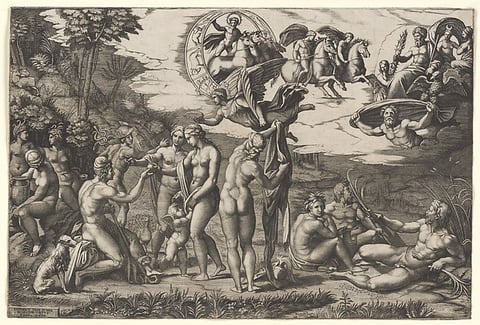
The Judgment of Paris: he is sitting at left with Venus, Juno and Pallas Athena, a winged victory above. In the upper section the Sun in his chariot preceeded by Castor and Pollux on horseback, at lower right two river gods and a naiad above whom Jupiter, an eagle, Ganymede, Diana and another goddess, by Marcantonio Raimondi, ca. 1510–20

The works in this room are listed below.

Works in this room

Works made in the 15th century, anywhere in the world.

First room, north wall

  1. This painting shows an upper-body portrait of a man in a three-quarter view, turned to the left. He has a prominent double chin, a slightly furrowed brow, thin lips, and a serious expression. He has pale yellow skin and short, dark hair, and he wears a large, red hat. He is clad in silver armor with red straps on his shoulder and chest. The background is a simple, dark green color.
    Francesco SforzaUnrecorded Italian maker, probably c. 1480/1500Courtesy National Gallery of Art, Washington
  2. This painting shows a person standing, their body turned to us, with their head looking downward to the left. The person has pale skin, round, rosy cheeks, and wavy yellow hair surrounded by a golden halo with intricate patterns. They are wearing a dark robe over a dark red dress or tunic and holding a long, thin red cross in one hand, while the other hand holds a closed red book. At their feet lies a black dog-like animal with wide yellow eyes. The scene is set against a golden textured background within a gilded border.
    Saint MargaretSassetta, c. 1435Courtesy National Gallery of Art, Washington
  3. This shield-shaped painting shows a young man with pale, peachy skin and curling brown hair standing astride the severed head of a man with dark hair and tanned skin. The painting is wider at the top and tapers like a pint glass to a narrower base. The young man, David, holds the end of long red slingshot with his right hand. The slingshot is weighted by a rock and swings behind his body. His sleeveless rust-red garment is cinched at his waist over a long white shirt. Both garments skim David’s thighs and his legs and feet are bare. Long, curling brown hair frames the ashen and bloodied upturned face of the head at David’s feet. A palm-sized stone is embedded in that forehead. The landscape background is made up of gray boulders, a meandering river, and low palm-like trees. Frothy white clouds sweep across an azure-blue sky.
    David with the Head of GoliathAndrea del Castagno, c. 1450/1455Courtesy National Gallery of Art, Washington

First room, south wall

  1. A work made of tempera on panel.
    Saints Apollonia, Barbara, and AgathaMaster Alejo (Alejo Andía?), 1490–1500Courtesy of the Art Institute of Chicago
  2. Portrait of a Young Man, by Antonello da Messina (Antonello di Giovanni d'Antonio), ca. 1470
    Portrait of a Young ManAntonello da Messina (Antonello di Giovanni d'Antonio), ca. 1470Courtesy of The Metropolitan Museum of Art
  3. "Dancing Dervishes", Folio from a Divan of Hafiz, by Hafiz, ca. 1480
    "Dancing Dervishes", Folio from a Divan of HafizHafiz, ca. 1480Courtesy of The Metropolitan Museum of Art
  4. The Judgment of Paris: he is sitting at left with Venus, Juno and Pallas Athena, a winged victory above. In the upper section the Sun in his chariot preceeded by Castor and Pollux on horseback, at lower right two river gods and a naiad above whom Jupiter, an eagle, Ganymede, Diana and another goddess, by Marcantonio Raimondi, ca. 1510–20
    The Judgment of Paris: he is sitting at left with Venus, Juno and Pallas Athena, a winged victory above. In the upper section the Sun in his chariot preceeded by Castor and Pollux on horseback, at lower right two river gods and a naiad above whom Jupiter, an eagle, Ganymede, Diana and another goddessMarcantonio Raimondi, ca. 1510–20Courtesy of The Metropolitan Museum of Art

Second room, south wall
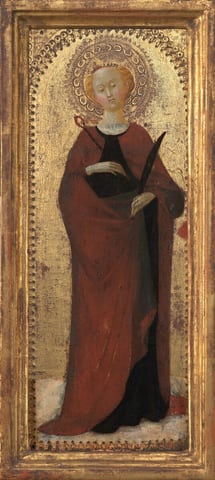
  1. This painting shows a person standing, their head slightly tilted to the left. They have a pale complexion, and short, wavy blonde hair adorned with a thin red crown. They have rosy, pink cheeks, arched eyebrows, a straight nose, and small lips set in a neutral expression. The individual is wearing a long red robe over a black tunic or dress and is holding a long black quill-like object in one hand, and what looks like a thin staff with a red loop at the end in the other. A detailed golden halo surrounds their head, and the background features an ornate gold pattern which is slightly worn and peeling in some places. The painting is bordered by a golden frame.
    Saint ApolloniaSassetta, c. 1435Courtesy National Gallery of Art, Washington
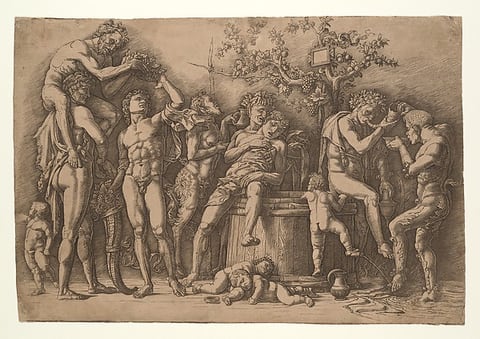
  2. Bacchanal with a Wine Vat, by Andrea Mantegna, Before 1475
    Bacchanal with a Wine VatAndrea Mantegna, Before 1475Courtesy of The Metropolitan Museum of Art
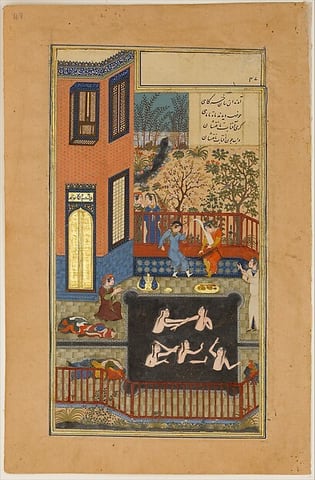
  3. "The Eavesdropper", Folio 47r from a Haft Paikar (Seven Portraits) of the Khamsa (Quintet) of Nizami of Ganja, by Maulana Azhar, ca. 1430
    "The Eavesdropper", Folio 47r from a Haft Paikar (Seven Portraits) of the Khamsa (Quintet) of Nizami of GanjaMaulana Azhar, ca. 1430Courtesy of The Metropolitan Museum of Art
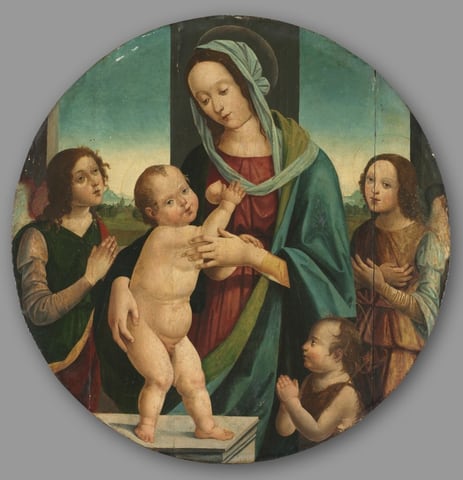
  4. Virgin and Child with John the Baptist and Angels, by Pietro del Donzello, c. 1500
    Virgin and Child with John the Baptist and AngelsPietro del Donzello, c. 1500Courtesy of the Cleveland Museum of Art

Second room, north wall
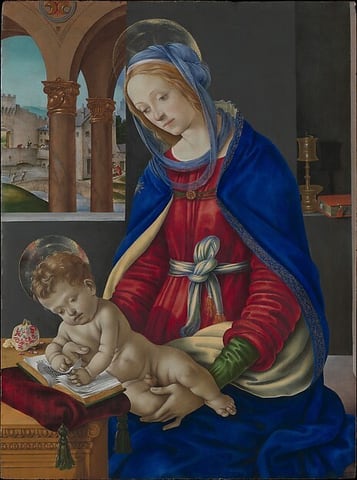
  1. Madonna and Child, by Filippino Lippi, ca. 1483–84
    Madonna and ChildFilippino Lippi, ca. 1483–84Courtesy of The Metropolitan Museum of Art
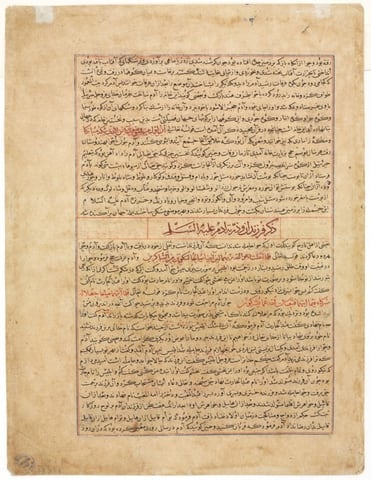
  2. Text Page, Persian Prose (recto) from a Manuscript of the Majma' al-Tavarikh (A Compendium of Histories) by Hafiz-i Abru:, c. 1425
    Text Page, Persian Prose (recto) from a Manuscript of the Majma' al-Tavarikh (A Compendium of Histories) by Hafiz-i Abru:Unrecorded Persian maker, c. 1425Courtesy of the Cleveland Museum of Art
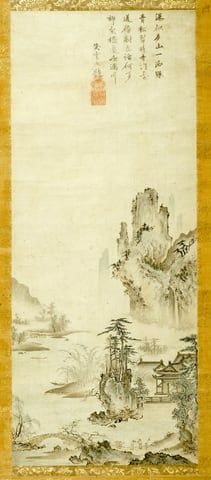
  3. A work made of ink and colors on paper, hanging scroll.
    LandscapeOguri Sotan, 15th centuryCourtesy of the Art Institute of Chicago

Third room, north wall
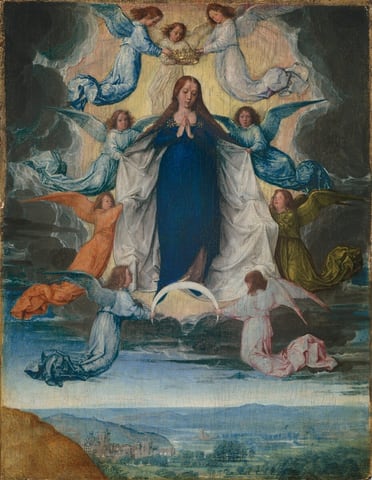
  1. A woman wearing a long, royal-blue dress is surrounded by nine winged angels as she floats on a thin, bright white, downward-pointing crescent moon above a deep landscape with a town tucked into rolling hills in this vertical painting. The woman, Mary, and all the angels have pale, peachy skin and long, brown hair. Mary and the angels float against a pale yellow and pale peach field of light enclosed within a mass of steel-gray clouds. She presses her fingertips together in front of her chest and gazes down and to our right, her dark eyes almost closed. She has a delicate, straight nose, and her small mouth is closed. Her brown hair parts in the middle and flows down over her shoulders. The angels wear flowing gowns in sky or topaz blue, olive green, tangerine orange, white, or light pink, each with matching wings. Three angels place a gold crown on Mary's head. Four others hold up the edges of a silvery white cape, which is fastened across her shoulders with brooches of white pearls surrounding ruby-red stones. The final two angels hold up the downward-facing points of the crescent moon beneath her. In the landscape below, groupings of trees are dotted among the rolling hills, with a village in the distance to our left. The blue, hazy horizon comes about a sixth of the way up the composition. A brown boulder sits in the bottom left corner, closer to us. The paint is visibly cracked throughout.
    The Assumption of the VirginMichel Sittow, c. 1500Courtesy National Gallery of Art, Washington
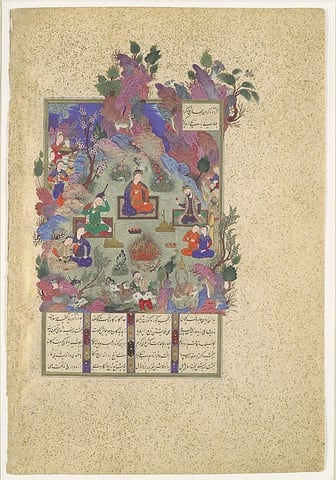
  2. "The Feast of Sada", Folio 22v from the Shahnama (Book of Kings) of Shah Tahmasp, by Abu'l Qasim Firdausi, ca. 1525
    "The Feast of Sada", Folio 22v from the Shahnama (Book of Kings) of Shah TahmaspAbu'l Qasim Firdausi, ca. 1525Courtesy of The Metropolitan Museum of Art