Floor plan

Time and placeThe 15th century

The 15th century

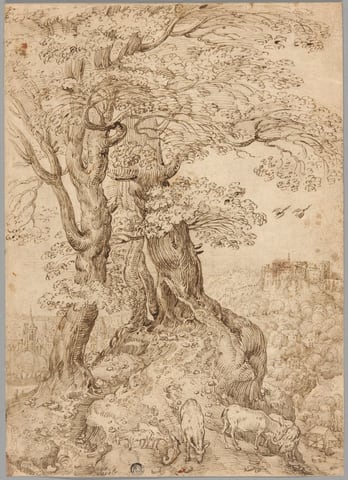
A work made of pen and brown ink on cream laid paper.
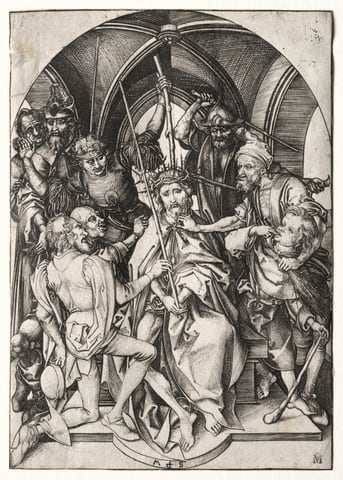
Christ Crowned with Thorns, by Martin Schongauer, 1470–82
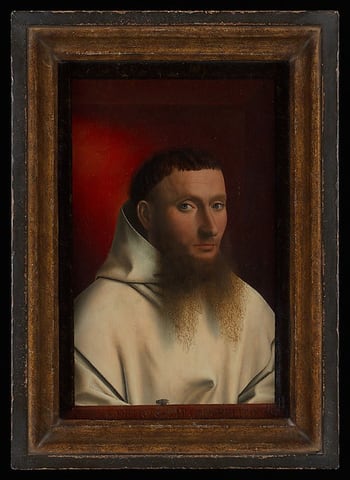
Portrait of a Carthusian, by Petrus Christus, 1446
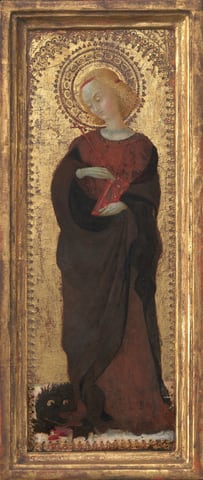
This painting shows a person standing, their body turned to us, with their head looking downward to the left. The person has pale skin, round, rosy cheeks, and wavy yellow hair surrounded by a golden halo with intricate patterns. They are wearing a dark robe over a dark red dress or tunic and holding a long, thin red cross in one hand, while the other hand holds a closed red book. At their feet lies a black dog-like animal with wide yellow eyes. The scene is set against a golden textured background within a gilded border.
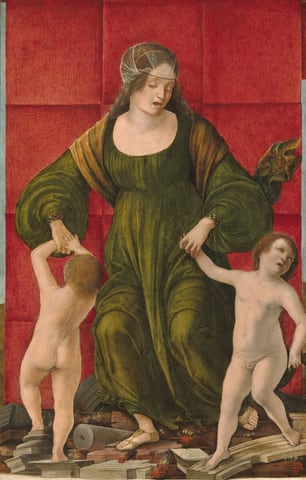
A woman holds the hands of two nude children in front of a crimson-red cloth in this vertical painting. All three have pale skin and brown hair. The woman wears a forest-green dress with voluminous sleeves and a gauzy white headdress that wraps around her hair and is fastened with a band across her forehead. She stands crouching with one foot extended slightly forward in a sandal, surrounded by broken chunks of masonry and bits of burning logs. Her body faces us but she turns her head to the right. Her mouth is wide open, and her eyes cut back to our left. The woman clutches the children’s hands in both of her own. The child to our left turns away from us and reaches one hand up to touch the back of the woman’s hand. The child on the right twists away from the woman, eyes squinted up and to the right and mouth open. Behind them, fold lines create a grid across the red cloth. Slivers of grass and blue sky line each side of the composition.
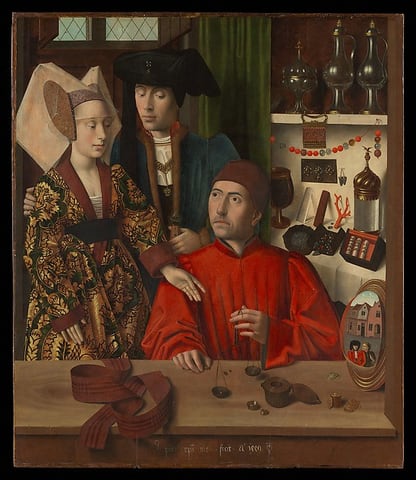
A Goldsmith in his Shop, by Petrus Christus, 1449
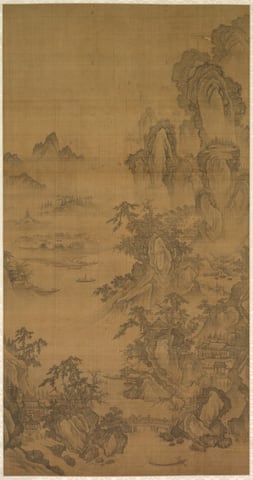
Mountain Market, Clear with Rising Mist, early 1500s
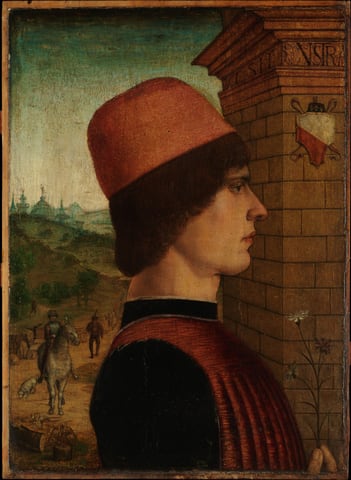
Portrait of a Man, possibly Matteo di Sebastiano di Bernardino Gozzadini, by Maestro delle Storie del Pane, 1494(?)

The works in this room are listed below.

Works in this room

Works made in the 15th century, anywhere in the world.

First room, north wall

  1. A work made of pen and brown ink on cream laid paper.
    Wooded Landscape with Donkeys and Goats, and Castle on Hill in DistancePaul Bril, n.d.Courtesy of the Art Institute of Chicago
  2. Christ Crowned with Thorns, by Martin Schongauer, 1470–82
    Christ Crowned with ThornsMartin Schongauer, 1470–82Courtesy of the Cleveland Museum of Art
  3. Portrait of a Carthusian, by Petrus Christus, 1446
    Portrait of a CarthusianPetrus Christus, 1446Courtesy of The Metropolitan Museum of Art
  4. This painting shows a person standing, their body turned to us, with their head looking downward to the left. The person has pale skin, round, rosy cheeks, and wavy yellow hair surrounded by a golden halo with intricate patterns. They are wearing a dark robe over a dark red dress or tunic and holding a long, thin red cross in one hand, while the other hand holds a closed red book. At their feet lies a black dog-like animal with wide yellow eyes. The scene is set against a golden textured background within a gilded border.
    Saint MargaretSassetta, c. 1435Courtesy National Gallery of Art, Washington

First room, south wall

  1. A woman holds the hands of two nude children in front of a crimson-red cloth in this vertical painting. All three have pale skin and brown hair. The woman wears a forest-green dress with voluminous sleeves and a gauzy white headdress that wraps around her hair and is fastened with a band across her forehead. She stands crouching with one foot extended slightly forward in a sandal, surrounded by broken chunks of masonry and bits of burning logs. Her body faces us but she turns her head to the right. Her mouth is wide open, and her eyes cut back to our left. The woman clutches the children’s hands in both of her own. The child to our left turns away from us and reaches one hand up to touch the back of the woman’s hand. The child on the right twists away from the woman, eyes squinted up and to the right and mouth open. Behind them, fold lines create a grid across the red cloth. Slivers of grass and blue sky line each side of the composition.
    The Wife of Hasdrubal and Her ChildrenErcole de' Roberti, c. 1490/1493Courtesy National Gallery of Art, Washington
  2. A Goldsmith in his Shop, by Petrus Christus, 1449
    A Goldsmith in his ShopPetrus Christus, 1449Courtesy of The Metropolitan Museum of Art
  3. Mountain Market, Clear with Rising Mist, early 1500s
    Mountain Market, Clear with Rising MistUnrecorded Korean maker, early 1500sCourtesy of the Cleveland Museum of Art
  4. Portrait of a Man, possibly Matteo di Sebastiano di Bernardino Gozzadini, by Maestro delle Storie del Pane, 1494(?)
    Portrait of a Man, possibly Matteo di Sebastiano di Bernardino GozzadiniMaestro delle Storie del Pane, 1494(?)Courtesy of The Metropolitan Museum of Art

Second room, south wall
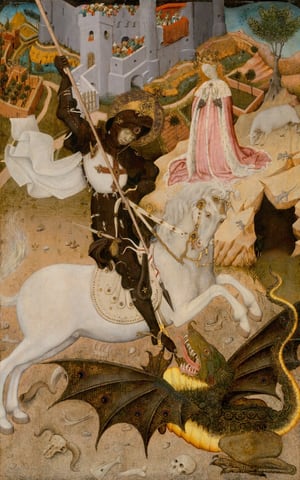
  1. St. George on white horse, piercing green, gold dragon
    Saint George and the DragonBernat Martorell, 1434–35Courtesy of the Art Institute of Chicago
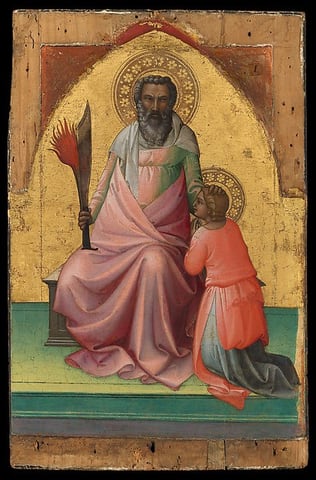
  2. Abraham, by Lorenzo Monaco, ca. 1408–10
    AbrahamLorenzo Monaco, ca. 1408–10Courtesy of The Metropolitan Museum of Art
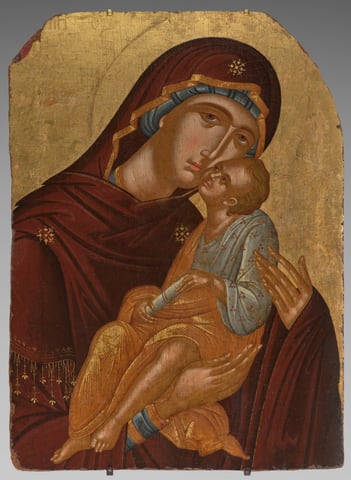
  3. Icon of the Mother of God and Infant Christ (Virgin Eleousa), by Angelos Akotantos, c. 1425–50
    Icon of the Mother of God and Infant Christ (Virgin Eleousa)Angelos Akotantos, c. 1425–50Courtesy of the Cleveland Museum of Art

Second room, north wall
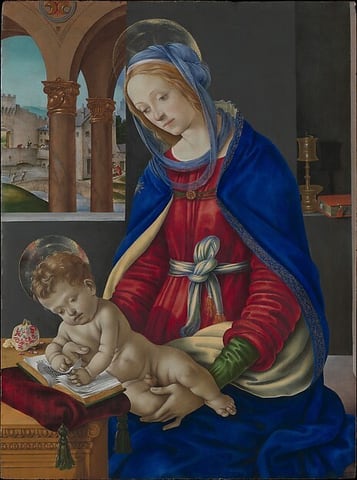
  1. Madonna and Child, by Filippino Lippi, ca. 1483–84
    Madonna and ChildFilippino Lippi, ca. 1483–84Courtesy of The Metropolitan Museum of Art
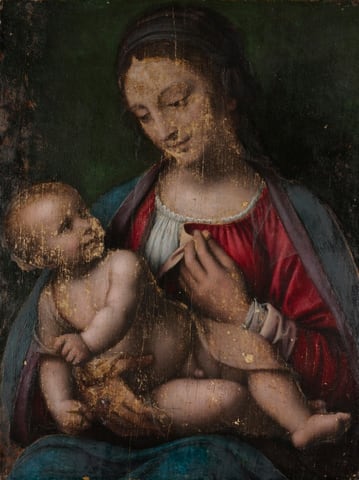
  2. Virgin and Child, by Bernardino Luini, 1500s
    Virgin and ChildBernardino Luini, 1500sCourtesy of the Cleveland Museum of Art
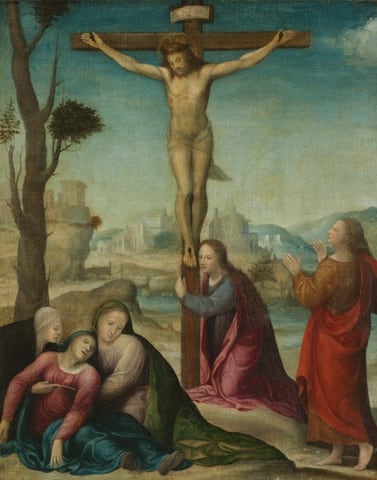
  3. The Crucifixion, by Sodoma, 1500s
    The CrucifixionSodoma, 1500sCourtesy of the Cleveland Museum of Art

Third room, north wall
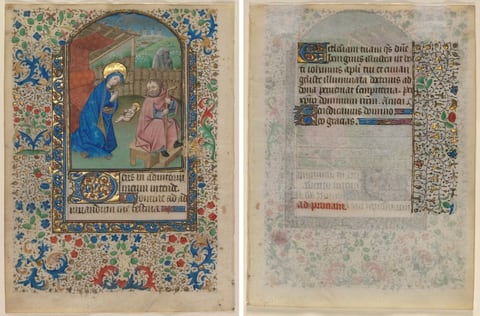
  1. Leaf from a Book of Hours: The Nativity (recto) and Text (verso), c. 1430
    Leaf from a Book of Hours: The Nativity (recto) and Text (verso)Unrecorded French maker, c. 1430Courtesy of the Cleveland Museum of Art
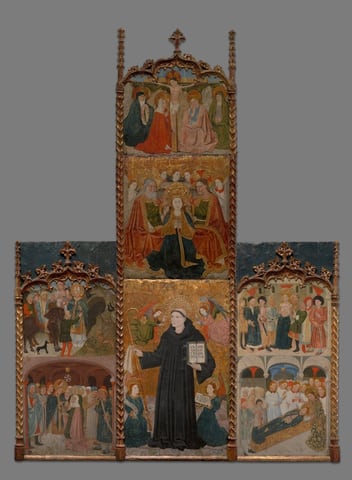
  2. A work made of tempera on panel.
    Retable of Saints Athanasius, Blaise, and AgathaMaster of Riglos, c. 1440–c. 1445Courtesy of the Art Institute of Chicago