Floor plan

Time and placeThe 15th century

The 15th century

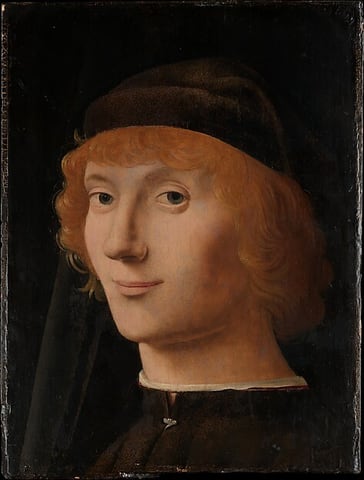
Portrait of a Young Man, by Antonello da Messina (Antonello di Giovanni d'Antonio), ca. 1470
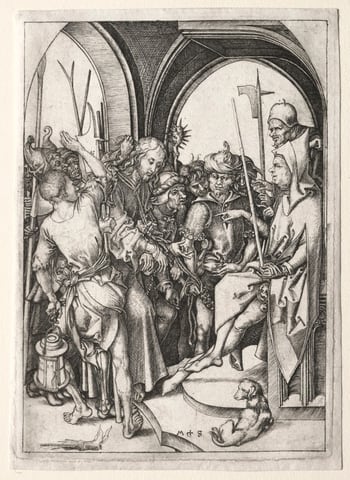
The Passion: Christ Before Annas, by Martin Schongauer, c. 1480
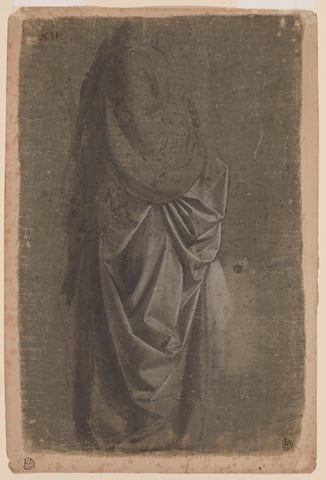
A work made of brush and opaque watercolor, on linen prepared with a gray ground, mounted to cream laid paper.
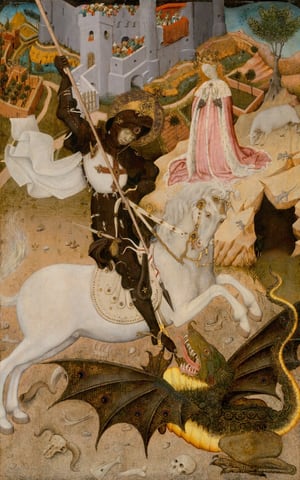
St. George on white horse, piercing green, gold dragon
A work made of tempera on panel, transferred to canvas.
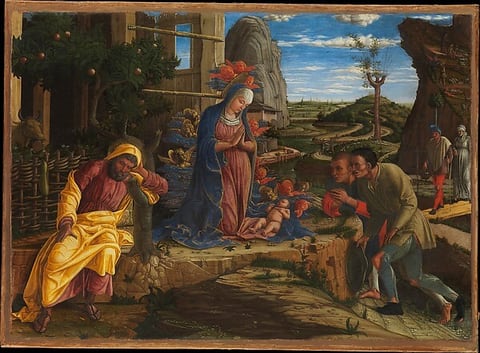
The Adoration of the Shepherds, by Andrea Mantegna, shortly after 1450
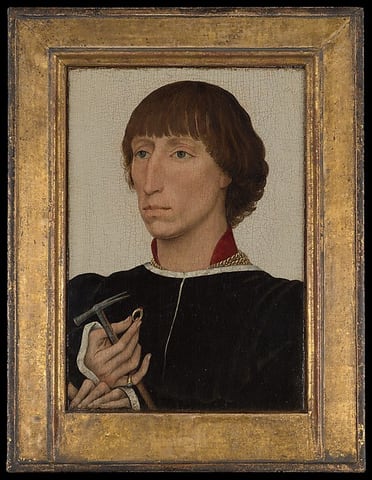
Francesco d'Este (born ca. 1429, died after 1486), by Rogier van der Weyden, ca. 1460
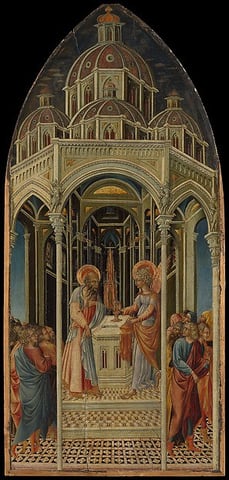
The Annunciation to Zacharias; (verso) The Angel of the Annunciation, by Giovanni di Paolo, ca. 1455–60

The works in this room are listed below.

Works in this room

Works made in the 15th century, anywhere in the world.

First room, north wall

  1. Portrait of a Young Man, by Antonello da Messina (Antonello di Giovanni d'Antonio), ca. 1470
    Portrait of a Young ManAntonello da Messina (Antonello di Giovanni d'Antonio), ca. 1470Courtesy of The Metropolitan Museum of Art
  2. The Passion: Christ Before Annas, by Martin Schongauer, c. 1480
    The Passion: Christ Before AnnasMartin Schongauer, c. 1480Courtesy of the Cleveland Museum of Art
  3. A work made of brush and opaque watercolor, on linen prepared with a gray ground, mounted to cream laid paper.
    Drapery Study of a Standing Figure Facing Right, in ProfileAndrea del Verrocchio, late 1460s–early 1470sCourtesy of the Art Institute of Chicago
  4. St. George on white horse, piercing green, gold dragon
    Saint George and the DragonBernat Martorell, 1434–35Courtesy of the Art Institute of Chicago

First room, south wall

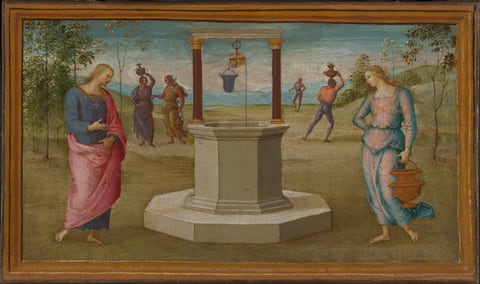
  1. A work made of tempera on panel, transferred to canvas.
    Christ and the Woman of SamariaPerugino, 1500–05Courtesy of the Art Institute of Chicago
  2. The Adoration of the Shepherds, by Andrea Mantegna, shortly after 1450
    The Adoration of the ShepherdsAndrea Mantegna, shortly after 1450Courtesy of The Metropolitan Museum of Art
  3. Francesco d'Este (born ca. 1429, died after 1486), by Rogier van der Weyden, ca. 1460
    Francesco d'Este (born ca. 1429, died after 1486)Rogier van der Weyden, ca. 1460Courtesy of The Metropolitan Museum of Art
  4. The Annunciation to Zacharias; (verso) The Angel of the Annunciation, by Giovanni di Paolo, ca. 1455–60
    The Annunciation to Zacharias; (verso) The Angel of the AnnunciationGiovanni di Paolo, ca. 1455–60Courtesy of The Metropolitan Museum of Art

Second room, south wall

  1. A work made of handscroll; ink and color on paper.
    Pillars of the CountryYao Shou, Ming dynasty (1368–1644), 1494Courtesy of the Art Institute of Chicago
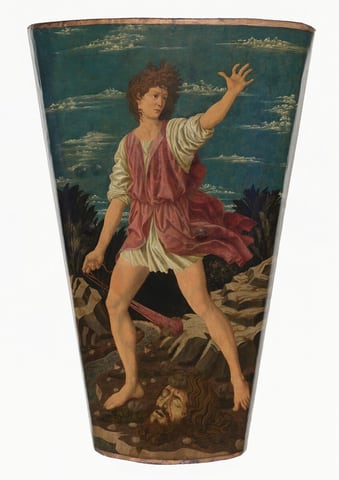
  2. This shield-shaped painting shows a young man with pale, peachy skin and curling brown hair standing astride the severed head of a man with dark hair and tanned skin. The painting is wider at the top and tapers like a pint glass to a narrower base. The young man, David, holds the end of long red slingshot with his right hand. The slingshot is weighted by a rock and swings behind his body. His sleeveless rust-red garment is cinched at his waist over a long white shirt. Both garments skim David’s thighs and his legs and feet are bare. Long, curling brown hair frames the ashen and bloodied upturned face of the head at David’s feet. A palm-sized stone is embedded in that forehead. The landscape background is made up of gray boulders, a meandering river, and low palm-like trees. Frothy white clouds sweep across an azure-blue sky.
    David with the Head of GoliathAndrea del Castagno, c. 1450/1455Courtesy National Gallery of Art, Washington
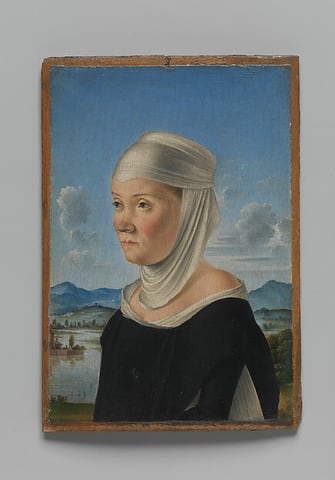
  3. Portrait of a Woman, Possibly a Nun of San Secondo; (verso) Scene in Grisaille, by Jacometto (Jacometto Veneziano), ca. 1485–95
    Portrait of a Woman, Possibly a Nun of San Secondo; (verso) Scene in GrisailleJacometto (Jacometto Veneziano), ca. 1485–95Courtesy of The Metropolitan Museum of Art

Second room, north wall
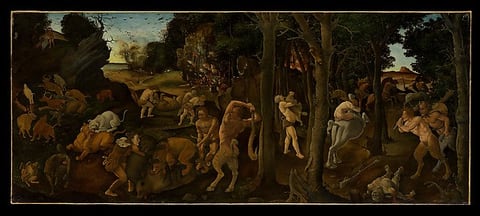
  1. A Hunting Scene, by Piero di Cosimo (Piero di Lorenzo di Piero d'Antonio), ca. 1494–1500
    A Hunting ScenePiero di Cosimo (Piero di Lorenzo di Piero d'Antonio), ca. 1494–1500Courtesy of The Metropolitan Museum of Art
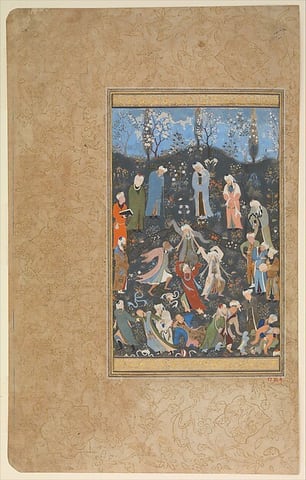
  2. "Dancing Dervishes", Folio from a Divan of Hafiz, by Hafiz, ca. 1480
    "Dancing Dervishes", Folio from a Divan of HafizHafiz, ca. 1480Courtesy of The Metropolitan Museum of Art
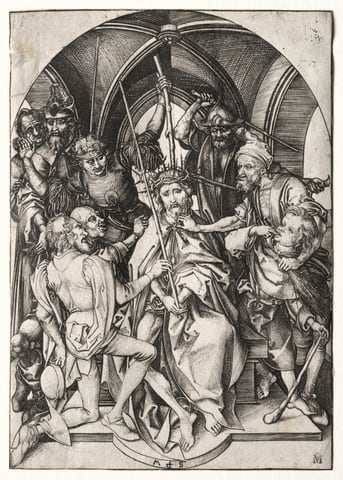
  3. Christ Crowned with Thorns, by Martin Schongauer, 1470–82
    Christ Crowned with ThornsMartin Schongauer, 1470–82Courtesy of the Cleveland Museum of Art

Third room, north wall
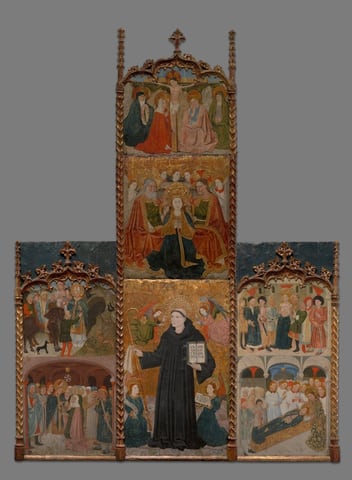
  1. A work made of tempera on panel.
    Retable of Saints Athanasius, Blaise, and AgathaMaster of Riglos, c. 1440–c. 1445Courtesy of the Art Institute of Chicago
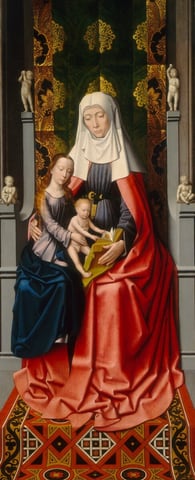
  2. Two women and a baby, all with pale skin, sit together on a gray, stone throne with patterned fabric hanging behind them and a patterned rug below in this narrow, vertical painting. The woman sitting on the throne, Saint Anne, is the largest. A second woman, Mary, is smaller in scale, and she sits on Saint Anne’s lap. Mary, in turn, holds a nude baby boy on her lap. Both women have light brown eyes under faint, arched brows, smooth skin, long straight noses, and their shell-pink lips are closed. Saint Anne sits with her body facing us and she looks down with her head slightly tilted to our left. Her white head covering drapes over her shoulders and hangs down from her chin to cover her neck. She wears a marine-blue dress cinched at her waist with a black and gold belt, and a crimson-red robe that falls to and puddles around her feet. Her right arm, on our left, wraps around and holds Mary’s hip, and she supports a book with gold-edged pages with her other hand. Mary sits on Saint Anne’s right thigh, to our left, and leans toward the baby, who sits on her left knee, to our right. Her long, wavy, brown hair falls over her shoulders, and she wears a cobalt-blue robe over a lilac-purple dress. The baby has short, curly blond hair and reaches to turn the pages of the book. He has rounded cheeks and a pudgy torso. The stone throne is ornamented on the arms and at the top corners with ivory-white, nude children that are presumably also carved out of stone. The cloth hanging behind Saint Anne is decorated with glimmering gold, ornamental leaf designs against a pine-green background. The rug beneath her feet is a geometric pattern of red, tan, black, and white.
    The Saint Anne Altarpiece: Saint Anne with the Virgin and Child [middle panel]Gerard David, c. 1500/1520Courtesy National Gallery of Art, Washington