Floor plan

Time and placeThe 15th century

The 15th century

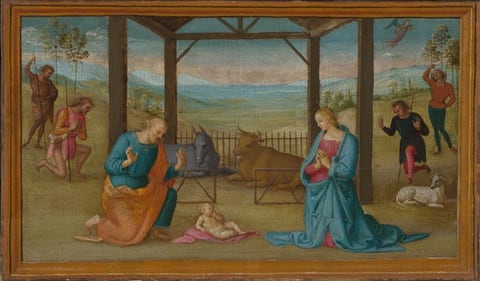
A work made of tempera on panel, transferred to canvas.
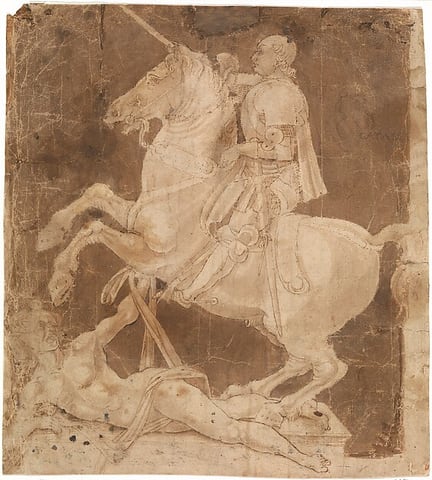
Study for the Equestrian Monument to Francesco Sforza, by Antonio Pollaiuolo, early to mid 1480s
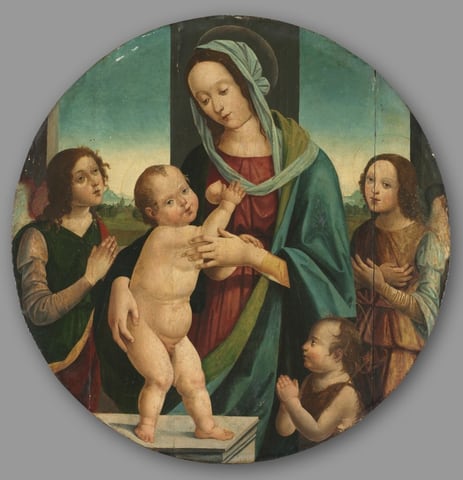
Virgin and Child with John the Baptist and Angels, by Pietro del Donzello, c. 1500
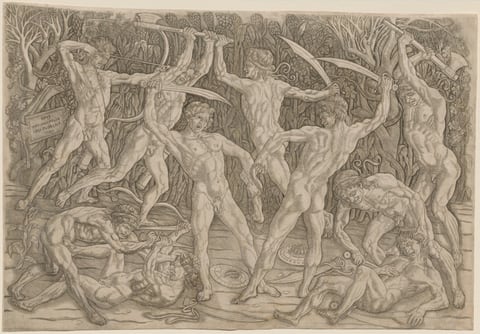
Battle of the Nudes, by Antonio Pollaiuolo, 1470s–80s
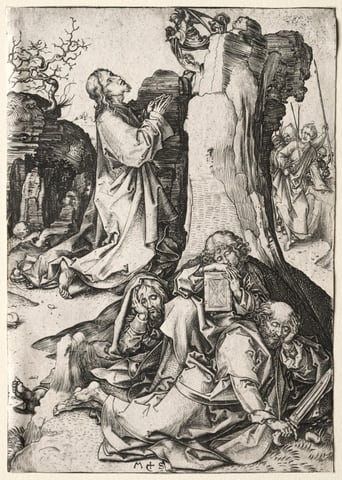
The Passion: The Agony in the Garden, by Martin Schongauer, c. 1480
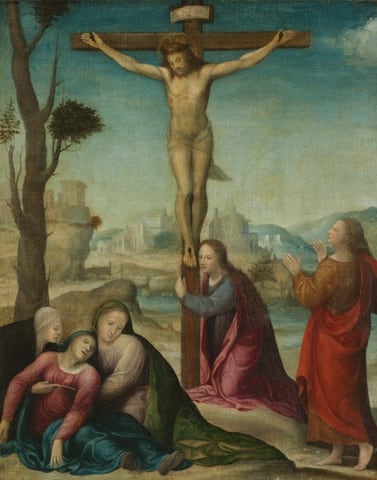
The Crucifixion, by Sodoma, 1500s
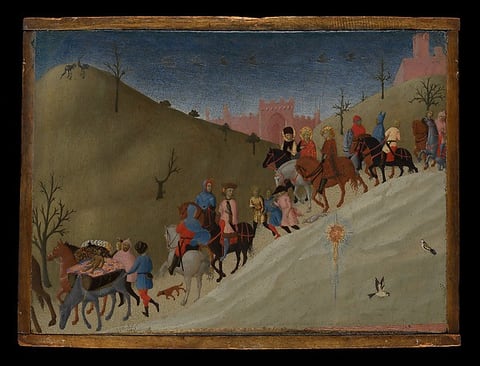
The Journey of the Magi, by Sassetta, ca. 1433–35

The works in this room are listed below.

Works in this room

Works made in the 15th century, anywhere in the world.

First room, north wall

  1. A work made of tempera on panel, transferred to canvas.
    The NativityPerugino, 1500–05Courtesy of the Art Institute of Chicago
  2. Study for the Equestrian Monument to Francesco Sforza, by Antonio Pollaiuolo, early to mid 1480s
    Study for the Equestrian Monument to Francesco SforzaAntonio Pollaiuolo, early to mid 1480sCourtesy of The Metropolitan Museum of Art
  3. Virgin and Child with John the Baptist and Angels, by Pietro del Donzello, c. 1500
    Virgin and Child with John the Baptist and AngelsPietro del Donzello, c. 1500Courtesy of the Cleveland Museum of Art

First room, south wall

  1. Battle of the Nudes, by Antonio Pollaiuolo, 1470s–80s
    Battle of the NudesAntonio Pollaiuolo, 1470s–80sCourtesy of the Cleveland Museum of Art
  2. The Passion: The Agony in the Garden, by Martin Schongauer, c. 1480
    The Passion: The Agony in the GardenMartin Schongauer, c. 1480Courtesy of the Cleveland Museum of Art
  3. The Crucifixion, by Sodoma, 1500s
    The CrucifixionSodoma, 1500sCourtesy of the Cleveland Museum of Art
  4. The Journey of the Magi, by Sassetta, ca. 1433–35
    The Journey of the MagiSassetta, ca. 1433–35Courtesy of The Metropolitan Museum of Art

Second room, south wall
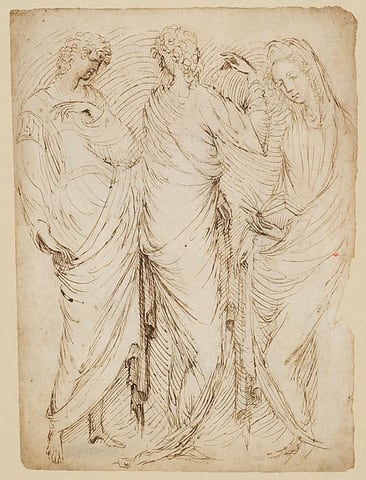
  1. Three Standing Figures (recto); Seated Woman and a Male Hermit in Half-length (verso), by Stefano da Verona (Stefano di Giovanni d'Arbosio di Francia), 1435–38
    Three Standing Figures (recto); Seated Woman and a Male Hermit in Half-length (verso)Stefano da Verona (Stefano di Giovanni d'Arbosio di Francia), 1435–38Courtesy of The Metropolitan Museum of Art
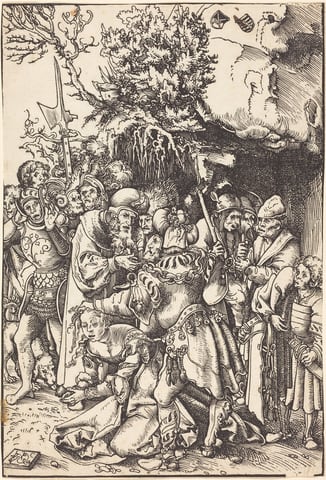
  2. This is a drawing of a group of medieval figures and a tree. The image depicts a dense gathering of figures, all wearing elaborate period costumes, including helmets, robes, and armor. Their expressions vary. At the top, a leafy tree dominates the background alongside swirling clouds. The foreground hints at an interaction among the individuals, possibly a scene of discourse or judgment. Several personal items and tools are on the ground. The attention to detail and the use of line to create intricate patterns and textures are notable features of this work. This is in the style of Albrecht Dürer.
    The Martyrdom of Saint BarbaraLucas Cranach the ElderCourtesy National Gallery of Art, Washington
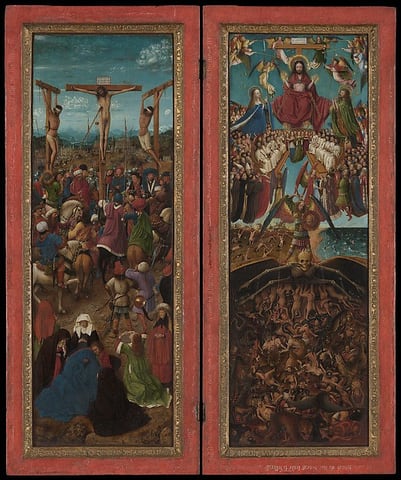
  3. The Crucifixion; The Last Judgment, by Jan van Eyck, ca. 1436–38
    The Crucifixion; The Last JudgmentJan van Eyck, ca. 1436–38Courtesy of The Metropolitan Museum of Art
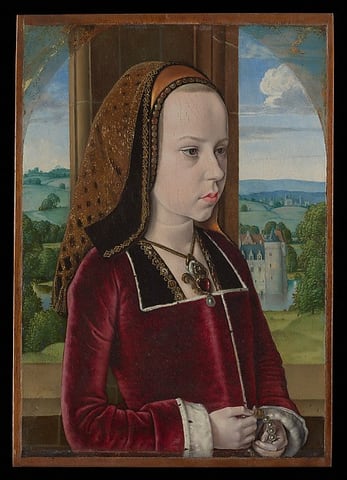
  4. Margaret of Austria, by Jean Hey (called Master of Moulins), ca. 1490
    Margaret of AustriaJean Hey (called Master of Moulins), ca. 1490Courtesy of The Metropolitan Museum of Art

Second room, north wall
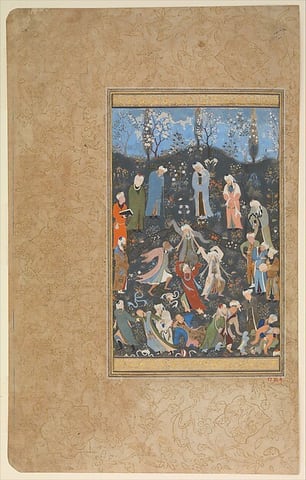
  1. "Dancing Dervishes", Folio from a Divan of Hafiz, by Hafiz, ca. 1480
    "Dancing Dervishes", Folio from a Divan of HafizHafiz, ca. 1480Courtesy of The Metropolitan Museum of Art
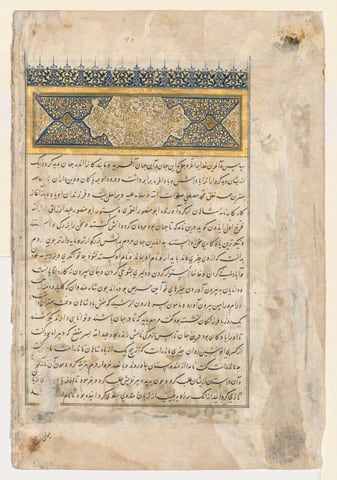
  2. Preface (verso) from a double-page frontispiece of a Shahnama of Firdausi (940-1019 or 1025), c. 1444
    Preface (verso) from a double-page frontispiece of a Shahnama of Firdausi (940-1019 or 1025)Unrecorded Persian maker, c. 1444Courtesy of the Cleveland Museum of Art
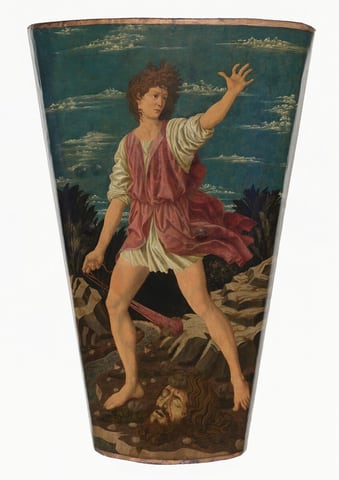
  3. This shield-shaped painting shows a young man with pale, peachy skin and curling brown hair standing astride the severed head of a man with dark hair and tanned skin. The painting is wider at the top and tapers like a pint glass to a narrower base. The young man, David, holds the end of long red slingshot with his right hand. The slingshot is weighted by a rock and swings behind his body. His sleeveless rust-red garment is cinched at his waist over a long white shirt. Both garments skim David’s thighs and his legs and feet are bare. Long, curling brown hair frames the ashen and bloodied upturned face of the head at David’s feet. A palm-sized stone is embedded in that forehead. The landscape background is made up of gray boulders, a meandering river, and low palm-like trees. Frothy white clouds sweep across an azure-blue sky.
    David with the Head of GoliathAndrea del Castagno, c. 1450/1455Courtesy National Gallery of Art, Washington

Third room, north wall
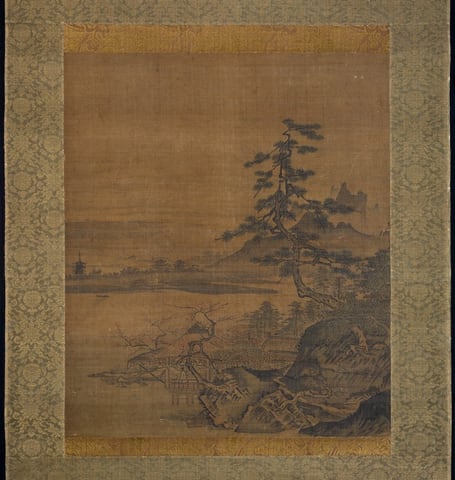
  1. A work made of album leaf mounted as a hanging scroll; ink and light colors on silk.
    Spring View from a Thatched Pavilion on the LakeshoreSchool of Sesshu, late 15th centuryCourtesy of the Art Institute of Chicago
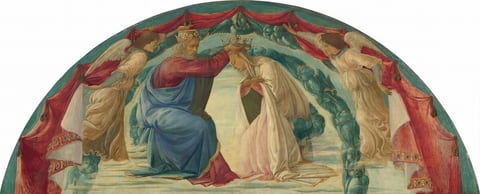
  2. In a wide, arched panel, a bearded man wearing a crown places another crown on the head of a woman. To our right, the woman bows her head with her eyes nearly closed and crosses her wrists over her chest. A white cloak covers her head, drapes over her shoulders, and pools in deep folds around her feet. The cloak is lined with pine green, and she wears a shell-pink dress. To our left, the man has shoulder-length, curly gray hair and a beard. His robe is dark rose pink, and the cloak is azure blue lined with pine green. Two winged angels have brown hair, short, white wings, and wear voluminous white robes. They stand to either side of the man and woman and hold up a swag of raspberry-red cloth hung with gold tassels. All the people have pale, peachy skin. Winged baby heads encircled with gold rays create an arch behind the man and woman, who sit on clouds. The background is pale blue sky.
    The Coronation of the VirginFilippino Lippi, c. 1475Courtesy National Gallery of Art, Washington