Floor plan

Time and place15th-century Italy

15th-century Italy

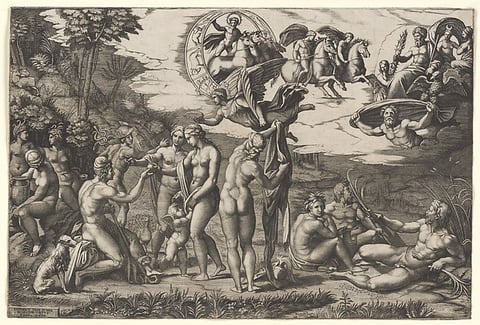
The Judgment of Paris: he is sitting at left with Venus, Juno and Pallas Athena, a winged victory above. In the upper section the Sun in his chariot preceeded by Castor and Pollux on horseback, at lower right two river gods and a naiad above whom Jupiter, an eagle, Ganymede, Diana and another goddess, by Marcantonio Raimondi, ca. 1510–20
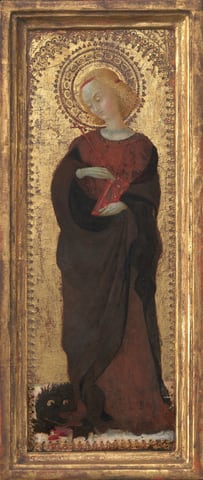
This painting shows a person standing, their body turned to us, with their head looking downward to the left. The person has pale skin, round, rosy cheeks, and wavy yellow hair surrounded by a golden halo with intricate patterns. They are wearing a dark robe over a dark red dress or tunic and holding a long, thin red cross in one hand, while the other hand holds a closed red book. At their feet lies a black dog-like animal with wide yellow eyes. The scene is set against a golden textured background within a gilded border.
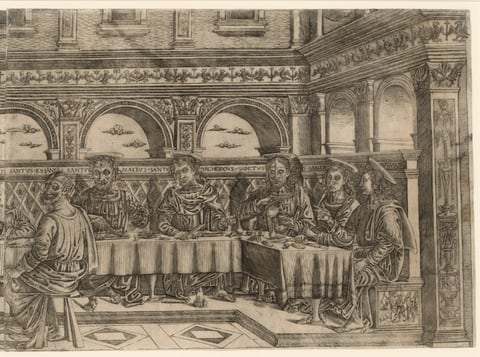
The Last Supper, by Lucantonio degli Uberti, c. 1500
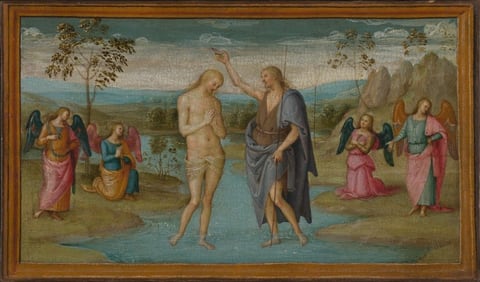
A work made of tempera on panel, transferred to canvas.
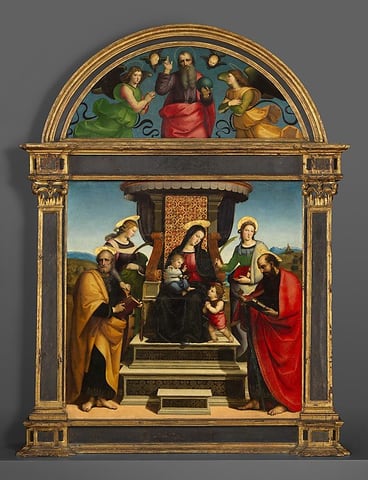
Madonna and Child Enthroned with Saints, by Raphael, ca. 1504
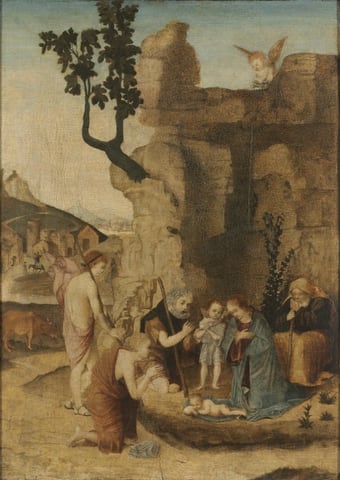
Adoration of the Shepherds, c. 1500
A work made of tempera on panel, transferred to canvas.

The works in this room are listed below.

Works in this room

Works made in Italy in the 15th century.

Section 1, north wall

  1. The Judgment of Paris: he is sitting at left with Venus, Juno and Pallas Athena, a winged victory above. In the upper section the Sun in his chariot preceeded by Castor and Pollux on horseback, at lower right two river gods and a naiad above whom Jupiter, an eagle, Ganymede, Diana and another goddess, by Marcantonio Raimondi, ca. 1510–20
    The Judgment of Paris: he is sitting at left with Venus, Juno and Pallas Athena, a winged victory above. In the upper section the Sun in his chariot preceeded by Castor and Pollux on horseback, at lower right two river gods and a naiad above whom Jupiter, an eagle, Ganymede, Diana and another goddessMarcantonio Raimondi, ca. 1510–20Courtesy of The Metropolitan Museum of Art
  2. This painting shows a person standing, their body turned to us, with their head looking downward to the left. The person has pale skin, round, rosy cheeks, and wavy yellow hair surrounded by a golden halo with intricate patterns. They are wearing a dark robe over a dark red dress or tunic and holding a long, thin red cross in one hand, while the other hand holds a closed red book. At their feet lies a black dog-like animal with wide yellow eyes. The scene is set against a golden textured background within a gilded border.
    Saint MargaretSassetta, c. 1435Courtesy National Gallery of Art, Washington
  3. The Last Supper, by Lucantonio degli Uberti, c. 1500
    The Last SupperLucantonio degli Uberti, c. 1500Courtesy of the Cleveland Museum of Art
  4. A work made of tempera on panel, transferred to canvas.
    The Baptism of ChristPerugino, 1500–05Courtesy of the Art Institute of Chicago

Section 1, south wall

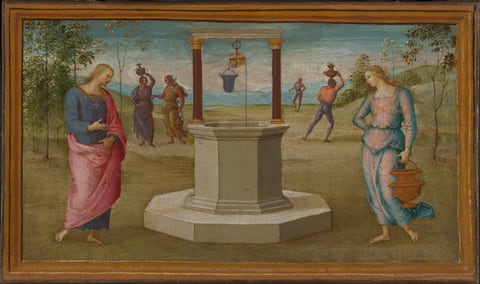
  1. A work made of tempera on panel, transferred to canvas.
    Christ and the Woman of SamariaPerugino, 1500–05Courtesy of the Art Institute of Chicago
  2. Madonna and Child Enthroned with Saints, by Raphael, ca. 1504
    Madonna and Child Enthroned with SaintsRaphael, ca. 1504Courtesy of The Metropolitan Museum of Art
  3. Adoration of the Shepherds, c. 1500
    Adoration of the ShepherdsUnrecorded Italian maker, c. 1500Courtesy of the Cleveland Museum of Art
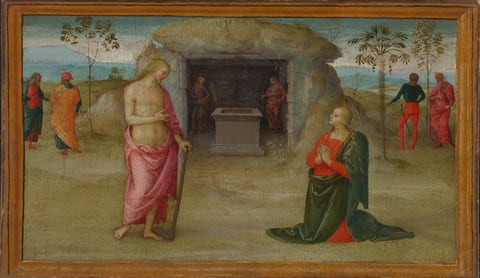
  4. A work made of tempera on panel, transferred to canvas.
    Noli Me TangerePerugino, 1500–05Courtesy of the Art Institute of Chicago

Section 2, south wall
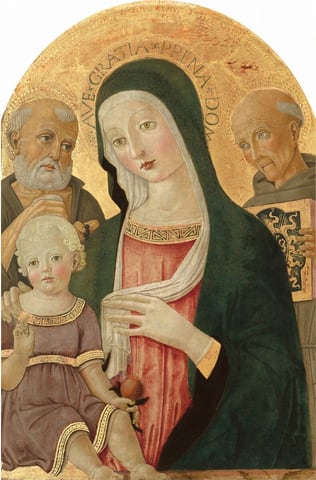
  1. Madonna and Child with Saint Jerome and Saint Bernardino of Siena, by Benvenuto di Giovanni, c. 1480/1485
    Madonna and Child with Saint Jerome and Saint Bernardino of SienaBenvenuto di Giovanni, c. 1480/1485Courtesy National Gallery of Art, Washington
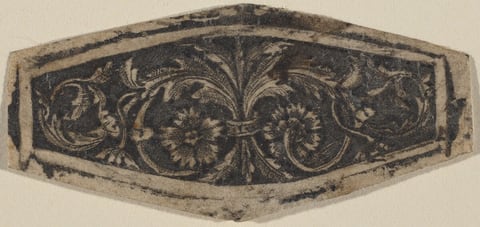
  2. This is a drawing of an ornamental floral design. The image shows a central floral motif resembling a flower with radiating petals, surrounded by swirling leaf patterns. The background is dark, contrasting with the lighter line work of the floral design. The drawing's borders are uneven and have an antique appearance.
    Ornament in Hexagonal ShapeUnrecorded Italian maker, c. 1480/1510Courtesy National Gallery of Art, Washington
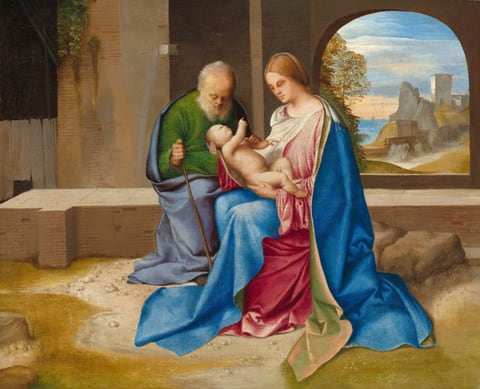
  3. An old man and a young woman holding an infant are seated together in the center of this almost square painting. All three people have pale, peachy skin. To our left, the man sits on a low, tan brick wall with his head bowed to look at the baby on the woman’s lap. A periwinkle-blue cloak is wrapped around the kelly-green robe that covers his shoulders, back, and legs. One hand grips a short staff planted on the ground. His receding white hair and beard are thin and scraggly with tufts sticking out over his ears. The woman sits next to and slightly in front of him, to our right, on a low rock, her body angled toward the man. A long, cobalt-blue cloak is draped around her shoulders and covers her knees over her rose-pink gown. Her honey-brown hair is parted in the middle and gathered at the back of her head. Her brown eyes look down at the infant, who is blond with brown eyes. A long white shawl is tucked into the neckline of her dress, drapes over her shoulders, and wraps under the baby as she cradles his body with one hand under his backside and the other behind his head. The baby lies on his back with his head turned toward the woman, and he points to her with one outstretched arm. The dirt ground is scattered with pebbles that make a loose ring around the trio, with moss-green growth to either side. A brown brick wall fills the upper half of the composition behind the people and extends off the top edge. A rounded arch pierces the back wall to our right of the woman. On the other side of the opening, trees with copper-brown leaves grow up along the left and the landscape beyond opens onto rocky hills with a white, square tower. In the deep distance, the silhouette of a town is painted in robin’s egg-blue against a pale peach horizon line. Thin, white clouds skim across the blue sky above.
    The Holy FamilyGiorgione, probably c. 1500Courtesy National Gallery of Art, Washington
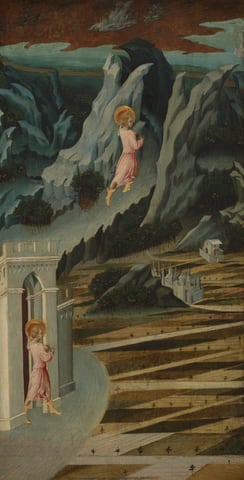
  4. A work made of tempera on panel.
    Saint John the Baptist Entering the WildernessGiovanni di Paolo, 1455–60Courtesy of the Art Institute of Chicago

Section 2, north wall
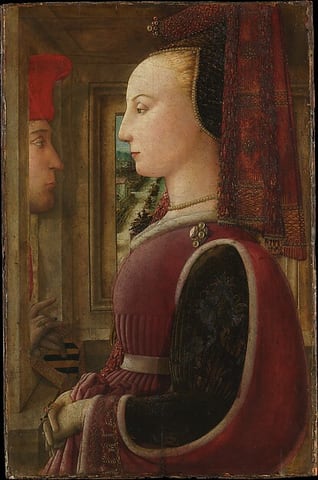
  1. Portrait of a Woman with a Man at a Casement, by Fra Filippo Lippi, ca. 1440
    Portrait of a Woman with a Man at a CasementFra Filippo Lippi, ca. 1440Courtesy of The Metropolitan Museum of Art
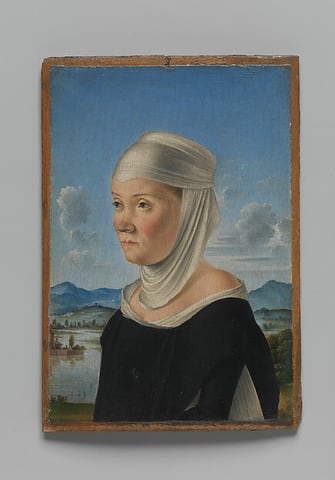
  2. Portrait of a Woman, Possibly a Nun of San Secondo; (verso) Scene in Grisaille, by Jacometto (Jacometto Veneziano), ca. 1485–95
    Portrait of a Woman, Possibly a Nun of San Secondo; (verso) Scene in GrisailleJacometto (Jacometto Veneziano), ca. 1485–95Courtesy of The Metropolitan Museum of Art
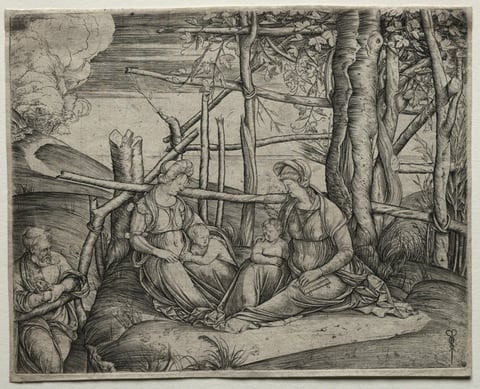
  3. The Holy Family with Saint Elizabeth, by Jacopo de' Barbari, c. 1503
    The Holy Family with Saint ElizabethJacopo de' Barbari, c. 1503Courtesy of the Cleveland Museum of Art
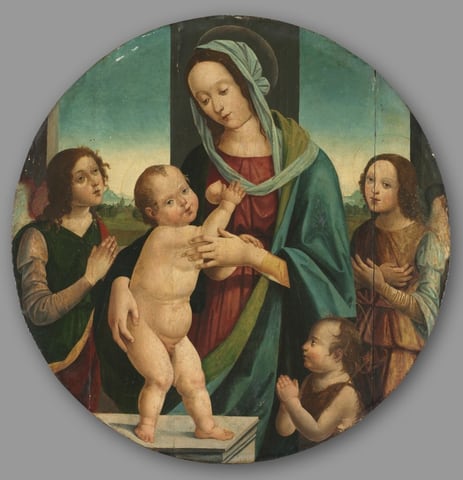
  4. Virgin and Child with John the Baptist and Angels, by Pietro del Donzello, c. 1500
    Virgin and Child with John the Baptist and AngelsPietro del Donzello, c. 1500Courtesy of the Cleveland Museum of Art