Floor plan

Artist galleriesThomas Girtin's contemporaries
Thomas Girtin's contemporaries
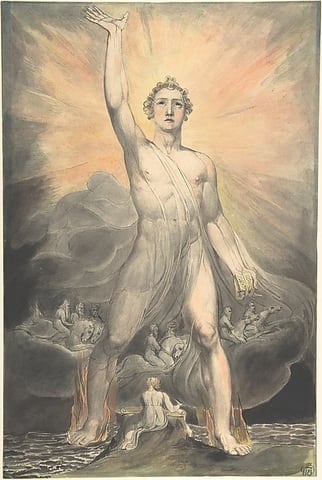
Angel of the Revelation (Book of Revelation, chapter 10), by William Blake, ca. 1803–5
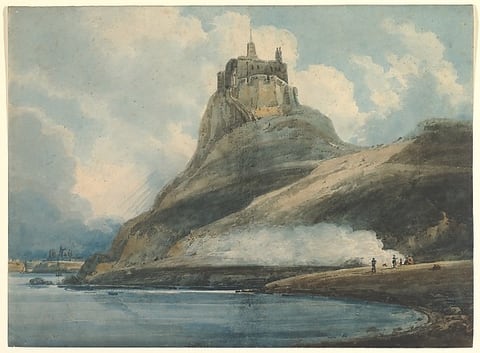
Lindisfarne Castle, Holy Island, Northumberland, by Thomas Girtin, 1796–97
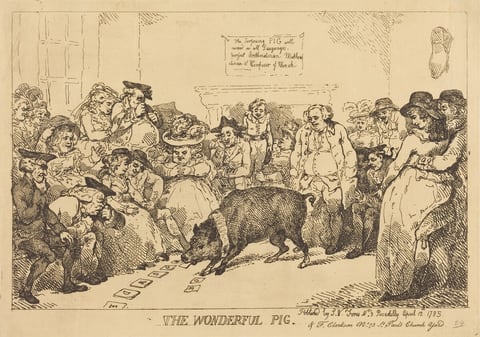
This is a drawing showing a pig performing a trick for an audience. It depicts a group of people watching the pig interacting with cards on the floor. The detailed image shows the varied facial expressions of the audience members. There is text at the top of the image suggesting the pig has a unique ability, possibly related to languages. The drawing captures a moment of entertainment in a satirical style, with lines and cross-hatching used to emphasize the humor.
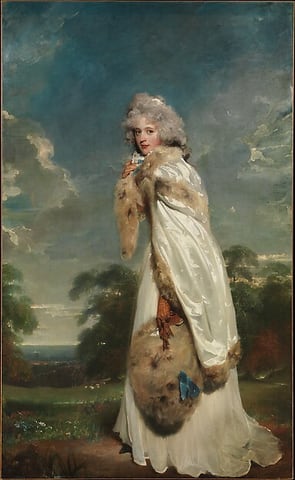
Elizabeth Farren (born about 1759, died 1829), Later Countess of Derby, by Thomas Lawrence, 1790
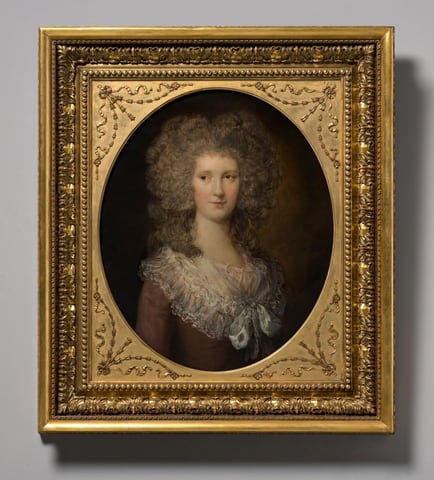
Portrait of Mary Anne Jolliffe, by Gainsborough Dupont, after 1788
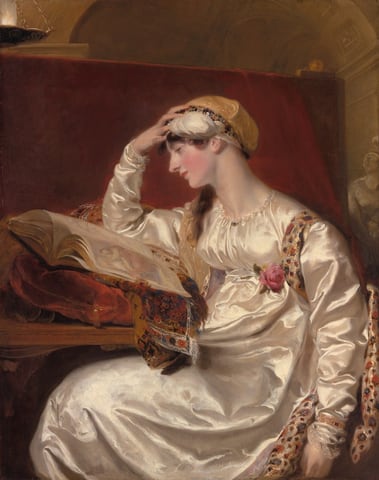
A light-skinned woman in a long, shiny white dress sits at a desk reading a book. The book is propped on a large red pillow. Her head is propped in her hand.

The works in this room are listed below.

Works in this room

A few works by Thomas Girtin, then their contemporaries: makers of the same nationality born within 25 years of them, then works from the same century and place.

First room, north wall

  1. Angel of the Revelation (Book of Revelation, chapter 10), by William Blake, ca. 1803–5
    Angel of the Revelation (Book of Revelation, chapter 10)William Blake, ca. 1803–5Courtesy of The Metropolitan Museum of Art
  2. Lindisfarne Castle, Holy Island, Northumberland, by Thomas Girtin, 1796–97
    Lindisfarne Castle, Holy Island, NorthumberlandThomas Girtin, 1796–97Courtesy of The Metropolitan Museum of Art
  3. This is a drawing showing a pig performing a trick for an audience. It depicts a group of people watching the pig interacting with cards on the floor. The detailed image shows the varied facial expressions of the audience members. There is text at the top of the image suggesting the pig has a unique ability, possibly related to languages. The drawing captures a moment of entertainment in a satirical style, with lines and cross-hatching used to emphasize the humor.
    The Wonderful PigThomas Rowlandson, 1785Courtesy National Gallery of Art, Washington

First room, south wall

  1. Elizabeth Farren (born about 1759, died 1829), Later Countess of Derby, by Thomas Lawrence, 1790
    Elizabeth Farren (born about 1759, died 1829), Later Countess of DerbyThomas Lawrence, 1790Courtesy of The Metropolitan Museum of Art
  2. Portrait of Mary Anne Jolliffe, by Gainsborough Dupont, after 1788
    Portrait of Mary Anne JolliffeGainsborough Dupont, after 1788Courtesy of the Cleveland Museum of Art
  3. A light-skinned woman in a long, shiny white dress sits at a desk reading a book. The book is propped on a large red pillow. Her head is propped in her hand.
    Isabella WolffThomas Lawrence, 1803–15Courtesy of the Art Institute of Chicago

Second room, south wall
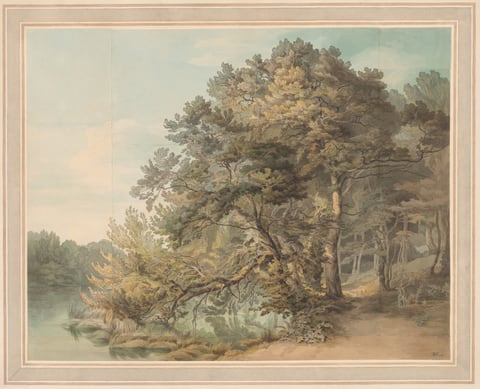
  1. The image shows a forest by a serene, tree-lined body of water. The horizon is high with tall trees extending close to it, creating a sense of depth. The brushstrokes and watercolor application are delicate, capturing textures of leaves and water gently. The color palette includes muted greens, soft browns, and hints of blue and cream. Closest to us is a dense cluster of trees on the right, curving over the water. Across the water, other tree clusters and shrubs recede into the misty background towards the left.
    Peamore, DevonJohn White Abbott, 1799Courtesy National Gallery of Art, Washington
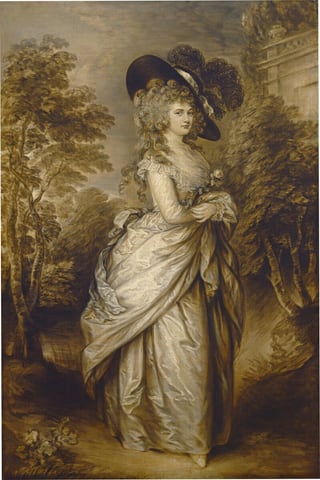
  2. This painting is a full-length portrait of a woman with her body facing the right and her head turned toward us. She has light skin, curly gray hair, arched eyebrows, and a small mouth in a neutral expression. She wears an elegant light-colored dress with a large bow on the back and a large, dark, feathered hat, and she has a flower tucked in her arms, which also gather up some of her skirts. The background shows tall trees, with the edge of a wall visible in the upper-right corner. The color scheme of the painting is mostly olive-green, and everything has a green tint.
    Georgiana, Duchess of DevonshireGainsborough Dupont, c. 1787/1796Courtesy National Gallery of Art, Washington